
![[personal profile]](https://www.dreamwidth.org/img/silk/identity/user.png)


return to Due South: season 0 episode 1 "Pilot"
Okay, here we go! The project, it turns out, is annotated transcripts, and I'm going to do them spoiler-free, though I guess the medium being what it is we can have spoilers in the comments. But I think it's an interesting exercise to approach a thing you're totally familiar with as though it were brand-new. (I was three years old when The Empire Strikes Back was released, which means I've lived my entire life already knowing that Darth Vader was Luke Skywalker's father, and I've always been envious of people who got to feel that surprise and wonder if it was true. I know: It shows.)
DUE SOUTH - Pilot
air date: April 26, 1994
Paul Gross
David Marciano
Wendel Meldrum
Chuck Shamata
Joseph Ziegler
Page Fletcher
Ken Pogue
Kaye Ballard
and Gordon Pinsent as Fraser Sr.
(plus Frankie the dog)
Scene 1
Mountains. The ground is covered with snow, but the sky is clear. We're above the tree line. A grey-haired man is tromping around looking for something. He scrapes some snow and ice away from something and sees the glassy eye of a dead animal staring up at him. He tromps around looking for more clues. Somewhere, someone chambers a round in a long gun. The man looks around the landscape but can't see anyone.
GREY-HAIRED MAN: You're going to shoot a Mountie? They'll hunt you to the ends of the earth.
The gun fires; the man falls to the ground and slides a bit.
So what have we learned? Well, we're in Canada. The man who has been killed was a Mountie, and he believes his fellows will avenge him.
Scene 2
Mountains. A dogsled team is rushing through a raging snowstorm. We can't see the driver. Caption: Two thousand miles to the Northwest. Cut to a wood-paneled police station. A half-dozen RCMP officers are hanging around doing various in-office tasks. There are filing cabinets, computers, a bulletin board: some progress toward a fund raiser (coloring up the thermometer), a couple of pictures, maybe a duty roster, what looks like an "employee of the month" plaque, and a bumper sticker that says "MY CANADA INCLUDES QUEBEC."
RCMP OFFICER 1: You tell him the snowmobiles are frozen dead —
RCMP OFFICER 2: Uh-huh.
RCMP OFFICER 1: — he says "I'll take a dogsled."
RCMP OFFICER 2: [laughing] A dogsled? This guy living in this century?
RCMP OFFICER 3: I heard he was going over the pass.
RCMP OFFICER 2: Don't be ridiculous. Nobody makes it over the pass.
RCMP OFFICER 4: Fraser went over the pass.
RCMP OFFICER 5: Oh, you've got to be kidding.
Back to the dogsled. We still can't see the driver's face, but we can now assume it's their colleague Fraser. Back to the station.
RCMP OFFICER 2: Fifty below out there. I froze coming in from my car.
RCMP OFFICER 3: The guy is certifiable.
RCMP OFFICER 2: Who'd he go after, anyway?
RCMP OFFICER 1: You wouldn't believe me.
RCMP OFFICER 2: Who?
Back to the dogsled. We still can't see anyone's face, but now we can see there is also a passenger. The driver kicks a big knife out of the passenger's hand while the sled continues to run. Back to the station.
RCMP OFFICER 2: Somebody's got to tell the chief.
RCMP OFFICER 3: That's the sergeant's job.
RCMP OFFICER 2: Then tell the sergeant.
The sergeant and RCMP Officers 4 and 5 are struggling with replacing the bottle in the drinking water dispenser.
SERGEANT: When — when I lift this, you, you jam your hand down there fast. Ready? And —
RCMP OFFICER 2: Sergeant?
SERGEANT: Yeah?
The door bangs open and in comes (we assume) Fraser, bundled up, badly windblown, carrying a man on his shoulder. The sergeant and everybody are so surprised they let go of the bottom of the drinking water bottle and the water starts glugging to the floor. Fraser nods hello to everyone and chucks the guy he's carrying into the holding cell.
FRASER, PROBABLY: The last time he'll fish over the limit.
Everyone is looking at him with can you believe this guy? vibes. Cut to the big boss's office.
STATION CHIEF: And you felt it necessary to go out there and get him now, in the middle of one of the worst storms we've had this year?
FRASER, PROBABLY: Yes, sir.
CHIEF: Fraser, you just tracked a man three hundred kilometers because he caught too many fish.
FRASER: He exceeded the limit by quite a bit, sir.
CHIEF: How much could a man fish over the limit that would justify you recklessly endangering your life and the reputation of this police force?
FRASER: [checks his notes] Four and a half tons, sir.
CHIEF: Of fish?
FRASER: Yes, sir. He was dynamiting the rivers. Scooping the salmon from the surface with a backhoe. So I destroyed the plastic explosives, the nitroglycerin, the fragmentary mines, and I then donated the three and a half truckloads of fish to a local Inuit village. The tribal elder said he would call you with his thanks as soon as their local phone lines were restored.
RCMP Officer #1 comes into the office with a printout.
RCMP OFFICER #1: Sir, there's a tribal elder on the phone for you, and this just came in over the wire.
CHIEF: [looks at the telegram and then hands it to Fraser] It's your father.
What we've learned: This is a small, slightly old-fashioned office environment in a very cold place, and Fraser's co-workers think he's a weirdo because they don't appreciate dry understatement. (They also don't appreciate those eyelashes, but we do. I urge you to watch Fraser rather than either of the others when the telegram arrives. The makeup team on this show did some nice work, I'm just saying.)
Anyway, also, where are we? Two thousand miles to the Northwest of the already snowy place in the first scene. So where was that? For a start, fair enough: Canada's really big. But I'm looking at a map here, and starting from the absolute boundary between the north coast of Alaska and the north coast of the Yukon, two thousand miles southeast takes you—well, look for yourself.
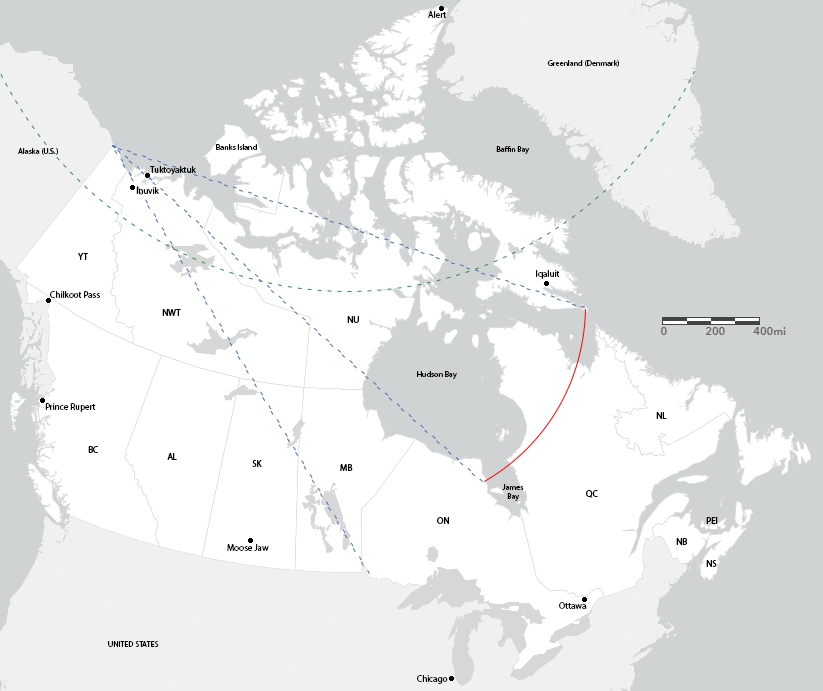
Those blue dotted lines are two thousand miles long by this map's scale. The one that lands in southern Ontario is the nearest to south your southeast trajectory can take you before you use up Canada. Somewhere along the red curve is more likely for the first scene—northeastern Ontario, that northwest quarter of Quebec, or the tiny islet off the eastern end of Baffin Island (the big one with Iqaluit on it), which is in Nunavut but in 1994 was still Northwest Territories. Anywhere west of that and if you go two thousand miles northwest you land in the Arctic Ocean. There's a bit of wiggle room where you could have the grey-hair get shot in northern Quebec or the north point of Newfoundland if Fraser and his dogsled and his coworkers' drinking water were on Banks Island up there north of Tuktoyaktuk. But if they were on the mainland, it seems to me the shooting took place somewhere along the red curve. (The green line is the Arctic Circle, more or less, so you can see that the southern bit of Baffin Island is indeed south of the northernmost point where the Yukon meets Alaska and we haven't in fact gone two thousand miles to the plain west. That parallel and the locations of the cities and towns and passes are as close as I could get them; I made this map in PhotoShop, not ArcGIS [which I don't have], so thanks for being cool. :-) )[update May 2024! I have been playing with the free online version of ArcGIS, and I am now in a position to add the following map:
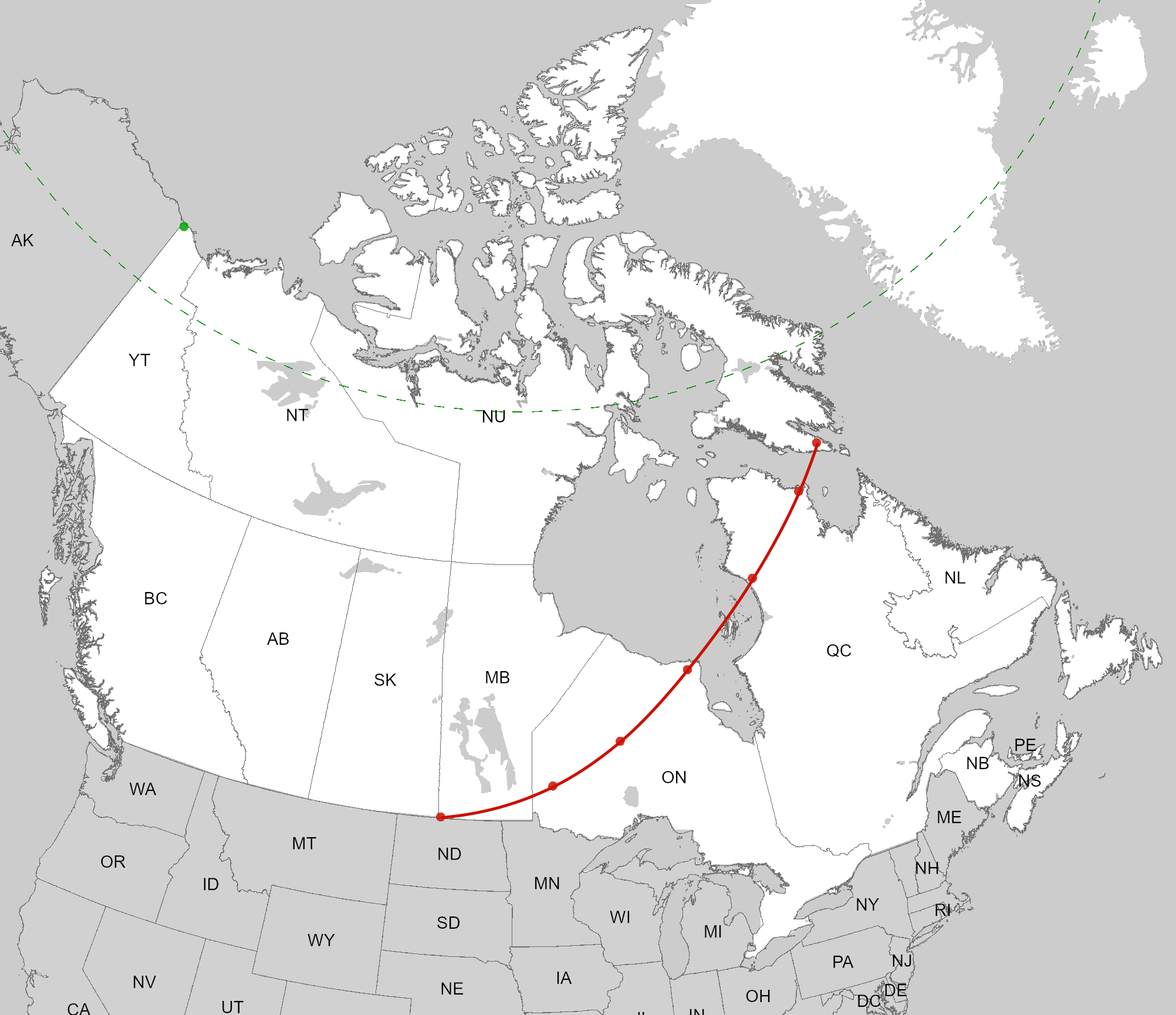
The green dotted line is very definitely the Arctic Circle. The green point is of course as far northwest as you can go in Canada, and the red points are a more accurate 2000-ish miles away from there (and the red curve connects them). It's a conic projection, see, so points the same distance away won't be on a strictly even arc on a flat image.]
Scene 3
Fraser and his dog are on a plane flying over a dam.
PILOT 1: Time was, you could look out that window and see nothing but geese, thousands of them. That river down there? Beavers used to cover it like hairy little ants. Government kinda put them out of business.
FRASER: Yeah. Everything's changing.
Scene 4
Fraser is identifying his father's body; his father was the grey-haired fellow who was killed in the first scene. An old man, also in Mountie uniform, is with him.
OLD MAN: Still don't know what the hell he was doing there. Ten below zero, middle of nowhere.
FRASER: His log book?
OLD MAN: Closed his last case over a week ago. Should have been catching up on paperwork. But you know your dad. He'd rather freeze his rump off than hug a desk. [hands him an evidence bag] Thirty-aught-six standard hunting ammo. First week of the season; suddenly every damned idiot wants to kill something. Near as we can tell, he must have caught a stray bullet. Useless death. Son, every officer in this post spent the last three days combing that gulch. If there was evidence of foul play we would've found it. When was the last time you talked?
FRASER: Christmas.
OLD MAN: Well, I guess the more you know someone the less needs to be said.
What we've learned: We're back in the "southeast," wherever that is. The old man does some expository heavy lifting about what Fraser's dad was like.
But what time of year is it? Ten below zero in the first week of the hunting season? First week of what season? .30-06 is a serious bullet; Fraser's dad wasn't accidentally shot by someone going after ducks and geese. Cursory research suggests the big game seasons in Canada are as follows:
- Black bear: autumn and sometimes spring in the west; autumn only in Ontario
- Grizzly bear: a few weeks in May or June, west only
- Deer: August to late November depending on the province
- Moose: mid-September to mid-October
- Bison: February and March in the north
- Polar bear: late winter or early spring, in the far north, but only in Indigenous communities with occasional non-Indigenous guests
- Seal: November to May in Atlantic Canada
So it's possible we're far enough north, even though we're two thousand miles southeast of wherever Fraser was stationed, to be hunting bison, and it could be February; but it's more likely that it's August or September, which could still be 10 below (centigrade) if we're at the north end of the red arc in the map up there, not that far from Iqaluit, where Uncle Wiki tells me the mean temperatures in August and September are around or slightly below freezing. Especially if the old man was speaking with any hyperbole at all. Also, it's been light out this whole time, even two thousand miles to the northwest, so it's less likely to be February than August. Anyway, concluding it's August makes it a bigger deal when the older guy asks Fraser when was the last time he spoke to his father and Fraser thinks about it for a moment before answering "Christmas."
We still don't know a lot about Fraser, but he is kind of deceptively stoic. Looks at his father's body for a long time; nice teeth-clenching jaw-twitching performance here.
Scene 5
Fraser and his dog are checking out the spot where his father was shot. It is overcast and a little snowy. He finds a passel of dead caribou.
INDIGENOUS DUDE: This is mine. You want meat, Mountie? Go to the supermarket.
FRASER: You kill them?
INDIGENOUS DUDE: Nope.
FRASER: See any hunters come through here?
INDIGENOUS DUDE: Yep.
FRASER: They kill them?
INDIGENOUS DUDE: Nah.
FRASER: Then who?
INDIGENOUS DUDE: Nobody. They just drank too much.
Later, it is clear and sunny, and Fraser is doing tracking things—looking at broken branches of subarctic fir (because we're above the tree line, dangit) and shaking soot over footprints—which is probably how he's able to have the conversation he has in the next scene.
Scene 6
In an airplane hangar. The pilot is on a mobile phone.
PILOT 2: Betty, honey, you've got milk. I brought home a gallon yesterday. Yeah, look in the fridge. [to Fraser] I never should have bought the damn thing. Now it's bring milk, bring butter. I'm up at ten thousand feet and she wants me to stop at a Seven-Eleven. Ah, a week ago you say.
FRASER: It would have been a party of six.
PILOT 2: I brought some nuns up on a retreat. Does that help?
FRASER: Not unless they were carrying firearms.
PILOT 2: You're sure they were Americans, eh?
FRASER: They were all wearing new boots, they were driving a Jeep Wrangler, and they carried big guns.
PILOT 2: Americans it is. Now here you go. A bunch of dentists from Chicago came up for the weekend, killed their limit, and went home early.
FRASER: Do you have a passenger list?
PILOT 2: Uh . . . yeah. I'll need it back.
FRASER: Thank you.
PILOT 2: No problem.
BETTY (ON THE PHONE): [She has been talking this whole time.] Are you still listening, honey?
PILOT 2: Yeah.
BETTY: Okay, foot powder, I'll need foot powder.
PILOT 2: Foot powder?!?
BETTY: Yeah.
Scene 7
In the coroner's office. Fraser hauls a caribou in on his shoulder and slings it down on the examining table.
CORONER: Pet, was it?
FRASER: You think you could tell me what killed it?
CORONER: Toss it in the freezer. It'll be a few days.
What we've learned: Bless him, Fraser has a very different haircut in the outdoor scenes than he had in the interior shots fifteen seconds earlier. Also the audio on a lot of his lines is different from the audio on everyone else's in the exterior scenes in this episode, like he did some overdubbing much later and someone Did Not Match the Levels. Also also, he's pretty strong; an adult bull caribou averages 350 to 400 lbs, so it's not completely out of line that he'd be able to heft the thing on his shoulder as he does, but that's not unimpressive.
Scene 8
At Fraser's father's funeral. Bagpipes are playing "Amazing Grace." The congregation is full of red-uniformed Mounties with black armbands and people in dark business suits. An older lady is sitting weepily next to the old man who told Fraser about the hunting accident; presumably she's Mrs. Old Man. They are in the second pew; Fraser is sitting by himself in the front.
It's an almost but not entirely white crowd. The Mounties have differing varieties of decorations; different numbers of stars on their left sleeves, different numbers of medals on their chests. The fellow giving the eulogy is dressed slightly differently; he has braided epaulettes and no brown leather belt over his chest.
EULOGIST: Twenty-two years ago I came to the Northwest Territories as a corporal. Even then the name Bob Fraser was spoken with awe among the ranks of the new recruits. It was said he could track a ghost across sheer ice and that a young officer would have to move fast and drive hard just to catch his shadow. Many have followed the spirit and traditions of the Royal Canadian Mounted Police, but few have embodied it. The name of Sergeant Robert Fraser will always be among them.
So we are in the NWT rather than northern Quebec or Ontario. Itty bitty islet off Baffin it is, then, I guess. Fraser appears to be alone as his father's chief mourner; his mother nor any siblings are not present.
Bob Fraser, for that was his name, was a Mountie long enough that he was already a legend 22 years ago.
Scene 9
At a bar following the ceremony. The old man (who has four chevrons on his cuff—no idea what rank that makes him, because I thought you maxed out at three—and also a wedding ring, so the weepy lady was indeed probably his wife) has a shot glass; Fraser has a ceramic mug.
BARTENDER: To your father. And may he not give the angels a moment's peace.
OLD MAN (FOUR CHEVRONS): Your dad and I spent too many nights in places like this.
FRASER: What did they say?
FOUR CHEVRONS: I gave them your list of names. They'll sign it off and check them out.
FRASER: With respect, sir, the Chicago PD is not going to make this a high priority case. [Four Chevrons offers him a(nother) drink] No, thank you.
FOUR CHEVRONS: Didn't fall too far from the tree, eh?
FRASER: I understand that there's an opening at the Chicago consulate.
FOUR CHEVRONS: And you're going to — what? Go charging across the border frisking sportsmen at random? Ben, man to man, if this really was a murder, I'd like to find whoever did it and show 'em the view from the end of a rope. But I can't do that, and neither can you. There were a hundred hunters out in the woods that day, most of them God knows where. You found six. They will check them out. Let them do their job.
FRASER: I realize I wouldn't be allowed to work the case, sir, but if I'm in the same city, I can at least check on their progress.
FOUR CHEVRONS: Tell me, Constable. How many years have you been on the force now?
FRASER: Thirteen.
FOUR CHEVRONS: And what was the biggest city you ever worked in?
FRASER: Moose Jaw.
FOUR CHEVRONS: Yeah, and you were transferred out after five weeks because you couldn't adapt to such an urban lifestyle. You're like your father. Out there in no man's land, there isn't a better cop in the world. But in Chicago they'd eat you alive in minutes. Sorry.
FRASER: I understand. But you also understand that nothing is going to stop me from finding my father's killer and bringing him to justice. [He hands over his shield.]
What we've learned: More exposition from Four Chevrons, who makes it sound like normal conversation, so well done that actor.
Constable Ben Fraser is not younger than 31, assuming you can't join up until you're 18. Bob was a Mountie for well more than 22 years, which will therefore have been since Ben was a little kid. (As a matter of interest, the population of Moose Jaw, Saskatchewan, in 1994 was approximately 33,000.) Props note: The badge Fraser gives to Four Chevrons looks like he got it out of a cereal box.
Scene 10
The eulogist looks sadly at Fraser's shield.
EULOGIST: Give him the transfer.
FOUR CHEVRONS: Oh, come on, Charlie. You think they're going to let him do anything? I have no jurisdiction.
EULOGIST (CHARLIE): Chicago PD is going to treat this like any other request. The only way they're going to catch this guy is if he's picked up for a broken tail light and blurts out a spontaneous confession. This was Bob Fraser. Give him the transfer.
Scene 11
And we're off to Chicago! Fraser is in uniform looking like a park ranger, toting duffel bags and a bed roll, taking the stairs rather than the packed escalator at the airport. Music cue: "From a Million Miles" by Single Gun Theory:
Pray for me, pray for me, yeah
Tormented by the futility of life
I can see the stars from a million miles
Are you out there somewhere
Transposed?
At the bottom of the escalator:
NUN: Help feed the hungry. Food for the hungry. [Fraser puts a strip of dried meat in the coffee can where she's expecting cash] What is it?
FRASER: Pemmican. Now, if you're still hungry when you finish it, drink water. It expands in your stomach.
There was an indentation from where she lay
Her tiny stature is sleek, now she's far away
Only the thoughts of her remain,
Despairing, desperate, full of self-blame.
Later, Fraser is walking next to a moving walkway on which a scammy airport guy is walking the wrong way to keep talking to him.
FRASER: So they won't operate on your little girl unless you pay them in advance?
SCAMMY AIRPORT GUY: Man, without seeing the cash, they won't even give you an aspirin.
FRASER: You promise to pay me back within the week?
SCAMMY AIRPORT GUY: As God is my witness.
FRASER: Well, I'm afraid all I can give you is a hundred.
SCAMMY AIRPORT GUY: You're going to give a perfect stranger a hundred dollars? You're kidding.
FRASER: Son, I never kid about a child's life.
Under the water I saw her lying there,
Creamy skin, lots of flowing golden hair
It was alive, that I know;
I saw her gesture to me with the ebb and the flow
Later, Fraser is at a taxi stand.
FRASER: Oh, you take it, ma'am. Hi — oh — please.
Tormented by the futility of life
I can see the stars from a million miles
Are you out there somewhere
Transposed?
Tormented by the futility of life
I can see the stars from a million miles
Are you out there somewhere?
He gives up his place in every single cab to other passengers until the very last one appears to be his, and when he turns to pick up his bags someone sneaks in and steals it from him.
The corpse was dredged from the sea that night.
Hair matted around its body tight
It was no comfort to identify
The pallid flesh, the life deprived.
The sea is writhing now
It's like a bed of rising passion
When something is that intense,
You can never tell what will happen next.Tormented by the futility of life
I can see the stars from a million miles
Are you out there somewhere?Pray for me, pray for me
So he walks from O'Hare to a police station on the west side.
What we've learned: Fraser is very sincere, possibly too polite for his own good, and pretty naive—not immune to being taken advantage of. He carries his cash in his hat. (Additional note: I'm certainly no expert, but the pemmican Fraser offers that young woman sure looks like jerky to me.)
Scene 12
This police station is nothing like the wood-paneled place all the way up at the north end of Canada.
DESK SERGEANT: Look, here's Nanook of the North.
FRASER: Constable Fraser, Royal Canadian Mounted Police.
DESK SERGEANT: No kidding. You got a dog?
FRASER: He's in quarantine.
DESK SERGEANT: Shame. You like pigeons?
FRASER: I don't have much experience with them.
ANOTHER OFFICER: Sarge, you want to move it along?
DESK SERGEANT: Shut up, Deets. It's not that they're dirty. It's just that I'm starting to question their loyalty.
FRASER: I'm looking for an officer assigned to this case number.
DESK SERGEANT: Oh, yeah. You're going to like this fella. Drop your stuff over there with Gruber. Through those doors, down the hall, third holding cell on the right.
FRASER: His name?
DESK SERGEANT: You can't miss him. Just look for Armani.
Scene 13
In a holding cell.
WELL-DRESSED DUDE 1: Can you read that? Does the label not say Armani? Of course it's original merchandise. A friend of mine just sorta found a truckload sitting on the side of the road.
WELL-DRESSED DUDE 2: Isn't this kind of a strange place to do business?
WELL-DRESSED DUDE 1: Hey, at least in here you know who you're dealing with, right?
FRASER: Excuse me. I'm looking for a Detective Armani?
All but one of the people in the cell are mad to learn that the last person in the cell is a detective. They close in on him.
WELL-DRESSED DUDE 1 (ARMANI): Come on. You mean me? Guard!
Scene 14
In the squad room.
ARMANI: Okay, who let the Mountie into the holding cell?
Everyone raises their hands without looking up from what they were doing.
FRASER: I'm sorry, I believe it was an unfortunate confusion due to an unfamiliar idiomatic trade name —
ARMANI: What the confusion was, was down here you don't bust in on some guy when he's about to take down the biggest operator in the garment district for buying stolen merchandise.
FRASER: Oh, so you were attempting to sell him a truckload of illegally obtained men's clothing?
ARMANI: That's right.
FRASER: Isn't that entrapment?
ARMANI: What do you want from me?
FRASER: I was told that you were in charge of this case.
ARMANI: Ah yes, the dead Mountie thing, like I couldn't have guessed. Look, I've got your list of names in my basket here. The moment I get a chance I'm going to go to the computer, pick up the phone, and call you with the information so you can go get your Boy Scout points. Now, is there anything else?
FRASER: Yes. The dead Mountie was my father, and I would appreciate it if you would check the names while there's still a chance of catching the man who killed him. Oh, and by the way, he's not in the garment business.
ARMANI: What?
FRASER: Your man in the cell. He had a hole in his shoe. I'm not familiar with your city, but I'd assume a big garment buyer wouldn't be caught dead with a hole in his shoe, so — like you — he is pretending to be someone he's not.
What we've learned: For a start, the people of Chicago are not bundled up against any type of cold, so it's not February, end of query. I mean we don't know how much time has passed between Fraser asking for the transfer and getting it, but probably not whole months, right? It doesn't look like people are sweltering in a midwest heat wave, so maybe it's like September by now rather than August, but Christmas was more like eight months ago than eight weeks ago.
Anyway. Detective Armani is a little slick, maybe even a little slimy, a particular kind of fake polite, and (just as Charlie, Four Chevrons, and Fraser himself predicted) not that invested in solving the Bob Fraser case, but he is appropriately chastened when Fraser turns out to be the dead Mountie's son. Fraser is a little impatient but continues to be unfailingly polite, which happens to be the correct most devastating way to make Armani feel like shit in this conversation; he's also quite a detective himself.
Scene 15
At the Canadian consulate.
INSPECTOR MOFFAT: So you want to be a Deputy Liaison Officer, eh?
FRASER: It was my understanding I already had the position, sir.
MOFFAT: No, you're the Acting Deputy Liaison Officer. You're on probation. No, I've read your reports. Nobody's questioning your ability as a police officer, but this — this is big city USA, and a consulate office is an entirely different kettle of . . .
FRASER: Fish?
MOFFAT: Fish. Uh . . . do you even know what we do here?
FRASER: As Chief Liaison Officer, you work closely with the local police and the various arms of the American criminal justice system and the intelligence community on matters of mutual interest.
MOFFAT: Basically, yes. However, the FBI and CIA types are very picky who they cozy up to. You've got to earn their respect. You've got to gain their trust — and at the same time show them you're not anybody's lap dog.
FRASER: Lap dog, sir?
MOFFAT: These are Americans, Fraser. If they think they can walk all over you, they will. It's a delicate balance. You've got to be just as shrewd and cunning and ruthless as they are. And then being Canadians, we have to be polite.
FRASER: Polite, sir?
MOFFAT: What's the one thing you hear Americans say about Canadians over and over again? "They're such nice, polite people." So we use that against them.
FRASER: I'm not exactly clear as to how we do that, sir.
MOFFAT: We let them underestimate us. You'd be surprised the number of people who underestimate me, Fraser.
FRASER: I don't think so, sir.
MOFFAT: How many times I've been at some diplomatic cocktail party when people start to say something and then stop, realizing I'm within hearing distance, and then say "Oh, it's just the Canadian." It always works, though it never quite loses its sting. So, it's a big job with a lot of ground to cover. You think you're up to it?
FRASER: I'll do my best, sir. [He clears his throat] As to my duties?
MOFFAT: Oh, Leann will give you a full briefing. [presses a button on his desk] She takes care of all that stuff. Have you met Constable Brighton? My right arm. She's the best assistant a man could have. [Brighton appears.]
BRIGHTON: Yes, sir.
MOFFAT: You'll, uh, give, um . . .
FRASER: Fraser.
MOFFAT: Fraser here a full briefing on all the, you know, the . . .
BRIGHTON: Yes, sir.
Brighton and Fraser leave Moffat's office.
MOFFAT: I'll just, uh, um, take the — um — uh — can — well, uh, can — well, I'll just — uh . . . lunch.
What we've learned: We now know what the liaison officer does, so thanks for the expository job interview, Fraser's bumbling boss. Moffat and Brighton are both in civilian dress, although they are both RCMP officers the same as Fraser. Fraser himself continues to be so polite people can't tell he's digging at them.
Scene 16
BRIGHTON: This is your office.
FRASER: It's very nice.
BRIGHTON: This is your desk. This is your phone. This is your rolodex. This is your tape dispenser. And this is your stapler.
FRASER: Thank you.
BRIGHTON: Oh, there's more. This is your pencil sharpener. This is your appointment calendar. This is your combination pencil cup. These are your pencils. And this is your plant.
FRASER: You know, I can do this.
BRIGHTON: Are you sure you don't want some help with your computer?
FRASER: No, I don't want to —
BRIGHTON: Well then, I'll be out at my desk.
FRASER: Well I — I appreciate the, uh —
Brighton slams the door. Then she almost immediately comes back in.
BRIGHTON: I want to apologize. That was uncalled for.
FRASER: Well, I was a little curious, I —
BRIGHTON: You see, this was supposed to be my job. I put in four years behind that desk out there, getting coffee, running errands, organizing every minute detail of his life. I paid my dues. I'm a cop, Fraser. Picking up dry cleaning just doesn't come naturally.
FRASER: I didn't —
BRIGHTON: And then the job opens up and I'm finally going to get to do something other than show my legs and it's, "Well, we're sorry, we don't think you're quite ready for the job. No, we need someone with kayaking experience."
FRASER: I don't recall that being —
BRIGHTON: No, they didn't say that, Fraser. They didn't have to. They hired you, didn't they? Can I be frank? I have nothing against you personally. I'm sure that you're a very nice person, and you're very good at wrestling fur-bearing animals. But I'm going to do everything in my power to have you fired, because this is my job. I don't mean to sound like a bitch.
FRASER: Oh, no, no, not at all.
BRIGHTON: I'm not usually like this.
FRASER: No, I can see that. [He clears his throat] Perhaps you can tell me, I'm a little bit unclear as to what my — uh, your — the job actually entails.
BRIGHTON: Well, that's the one good thing about this menial job of mine. I hold the duty roster. Which means that your job is pretty much whatever I tell you it is.
FRASER: Where do I start?
What we've learned: Brighton is big mad that she did underling scut work for four years and then didn't get the promotion she'd been in line for, and frankly: FAIR ENOUGH. Like I don't know if we're supposed to hate her because we're supposed to love Fraser, and it's true that he didn't mean to step on her, but look what happened: A good-looking white dude wanted a job for Reasons, and two or three other white dudes made sure he got it, and none of these white dudes even stopped to wonder if there were any other candidates (such as women or people of color or people who were already there practically doing the job already) who should be considered for that job. Fraser doesn't feel like he deserves Brighton's ire, and maybe he doesn't, but he also doesn't say anything like "Oh wow, I had no idea, let's talk to Moffat, because I don't need this job, I just need to be in Chicago while they're working on finding who shot my father, so for heaven's sake you take the office and I'll take the desk and the schedule and the dry cleaning and whatever else you were saying." Not a word of it. That my-your-the thing is one tiny moment of sensitivity, but it's not much, is it. Granted he's been on the force for 13 years and she may have been for as little as four years, so it's possible he outranks her, but this is a man who GAVE AWAY EVERY SINGLE TAXI HE SHOULD LEGITIMATELY HAVE BEEN THE ONE TO BOARD, and it doesn't even occur to him to step aside rather than take a job he knows perfectly well he doesn't deserve and literally only got because of the literal Old Boys Network, I'm going to go ahead and say it, I AM DISAPPOINTED IN CONSTABLE BEN FRASER TWENTY-FIVE MINUTES INTO THE PILOT EPISODE. CONSTABLE LEANN BRIGHTON WAS ROBBED. Ahem.
Scene 17
Fraser is in front of the consulate in his red uniform standing guard like a Beefeater at Buckingham Palace. Some kids are staring at him, blowing raspberries, trying to make him blink. Fraser stands like a statue through all of what follows.
OLDER LADY: Come along, boys. Excuse us.
ARMANI: [walks up and right past him into the consulate] Hey, what's up? [pause] It's you! I didn't recognize you standing there like that. Okay: I acted like a jerk. I didn't realize it was your father; I should have checked into it earlier. I'm sorry. Anyway, you know, you were right about the goombah in the cell. Now I dig around and I find out that this guy is Internal Affairs, trying to nail my butt for illegal entrapment. Can you believe that? This guy's trying to entrap me into entrapping him. Cops. [sigh] In any case, I figured I owed you one, so, uh, here it is: Thanks. [He offers his hand to shake. Fraser does not react.] Come on, I'm apologizing here. What else do you want from me? You're kidding, right? This is your job? This is, like, your real job? [talking to passers-by] Do you believe it? This is his job. They actually pay people to do this in Canada. [back to Fraser] Sorry. Anyway, I checked through that list of names for you and I came up with something that might be something, so we should talk. Putting me on, right? Okay, you just let me know when you get off and I'll come back. You got a break coming up soon or something? I'm talking to a corpse here. [A random couple wants to take his picture with Fraser.] Oh. [pose]
Scene 18
In the lobby at an office building.
ARMANI: So I called the American Dental Association and everyone on your list comes up as members, only one of them, this Dr. Lawrence Medley, isn't current with his dues. So I call the last number they have on the guy, and the nurse says he can't come to the phone seeing that he's been dead for twelve years. This makes me curious.
FRASER: [blocks him from getting onto the elevator ahead of others] It only takes an extra second to be courteous. After you, ma'am. Oh, after you, sir. [Fraser keeps letting other people onto the elevator.]
ARMANI: Are we gonna get on, or what?
They are climbing the stairs.
ARMANI: My bet is there ain't a lot of high-speed chases in Canada, huh?
In a dental office.
DENTIST: I'd actually never met him. He called and said he'd heard about our annual hunting trip and he asked if he could come along. Harry Prentiss, periodontist, he usually comes with, but this year he had that accident, so, uh . . . let me take a look here. Ah! There he is. Yeah, Larry Medley. He's the one in the corner. And I believe that's the only one I got of him. Yep. For some reason he was never around when we were taking pictures. Not much of a hunter, though. He didn't shoot a thing. I came home with that big fella right there. [There is a well-taxidermied beaver on a branch in his office.]
What we've learned: When he's not trying to entrap garment buyers, Armani dresses loud. But he isn't so bad; he straight-up acknowledges when he was wrong, and he turns around and goes to bat for Fraser without further grumbling. Fraser continues to be polite to an inconvenient fault (with the elevator this time just as he was with the taxis at the airport). Once is an accident, twice is a coincidence, but if he gets to the third time this is going to be a pattern, and I'm going to start thinking you know what, buddy, it's nice to be courteous and thoughtful of other people, but it's also okay to want things for yourself and even (gasp) to have them. Eight months without even speaking to your father, but apparently not estranged. Dude.
Scene 19
Coming back to the police station.
FRASER: So, how do you know him?
ARMANI: I don't. I never said I did. I just have this feeling that I'd seen him before.
FRASER: You recognized his face?
ARMANI: Not so much his face as his nose.
FRASER: His nose?
ARMANI: Yeah, it's like I have this ability. Everyone's nose is distinctive. No two people have exactly the same nose. I just have this thing where I never forget a nose. Call it a gift. You know how to type?
FRASER: A hundred words a minute. Why?
At a computer in the squad room.
ARMANI: June, eighty-six, I'm walking a beat, I get a call on this domestic violence case. Very, very messy. The guy has his wife's arm in the car door and he's slammin' it and slammin' it. Now, when I see the guy in the photo, I flash on this guy's nose. That's the puppy, Frankie Drake. What do you think?
FRASER: It's exactly the same nose.
ARMANI: What did I tell you. Now, it stuck in my mind because Homicide has been trying to nail him for a mob hit.
FRASER: He's a hired killer?
ARMANI: Well, I don't think he hunts for relaxation, Fraser. Now, someone wanted your dad out of the way enough to import a professional. You have any idea why?
FRASER: No. Do you have an address?
ARMANI: Yeah, but it's not worth the cab fare to check. He'd have been long gone by now.
FRASER: But you have an idea.
ARMANI: One lead, okay? I'm going to follow up one lead, and that's it, because I don't have time to make a career of this case, and getting my name in some Yukon Gazette ain't gonna do bupkis for my career, you understand?
FRASER: I understand.
ARMANI: Good. Now mush, yee-ha, or whatever you Canadians say.
Scene 20
Outside on the street.
FRASER: Where are we going?
ARMANI: There's this place I know where a lot of heavyweights hang out. Kind of people who can reach out and touch somebody like Frank. Now I been working it for months, you know, hangin' out, fitting in. They think I'm complete scum, and down here, your reputation is everything. Where the hell did I leave my car?
FRASER: Thirty-two degrees south.
ARMANI: Right. Uh, what's your first name anyway? I mean, I can't keep calling you Fraser.
FRASER: Benton.
ARMANI: So what's your first name?
FRASER: Benton.
ARMANI: Do you have a first name?
FRASER: Can we make a stop on the way?
ARMANI: Sure.
In the car at the Customs Service. Armani is polishing a smudge off the dashboard of his black Mercedes Benz. Fraser's dog jumps up into the car and onto his lap.
ARMANI: Whoa, whoa, whoa, what are you doing, what are you doing? He's on me!
FRASER: Diefenbaker.
ARMANI: He's on me!
FRASER: Dief —
ARMANI: He's getting intimate with me! Did you see him? He was getting intimate with me!
FRASER: I'm sorry, he's usually much better behaved. He's just excited to be out of that quarantine cage.
ARMANI: You want to tell him to get off me?
FRASER: Diefenbaker.
ARMANI: Oh, yeah, he's very well trained.
FRASER: Well, he is, actually. He's just deaf.
ARMANI: Deaf?
FRASER: And he's facing the wrong way, so you just tell him yourself.
ARMANI: I'm not real good with dogs.
FRASER: Actually, he's more of a wolf.
ARMANI: Wolf?!
FRASER: Just try to enunciate.
ARMANI: GET! OFF! ME!
Diefenbaker, for that is his name, hops off Armani and into the back seat of the car.
FRASER: Sorry.
ARMANI: There is a deaf wolf in my back seat.
FRASER: Yes. Two years ago he jumped off an ice floe into Prince Rupert Sound and pulled me out, and his eardrums burst from the cold.
ARMANI: Really? I didn't know wolves saved lives.
FRASER: Well, he doesn't always. I mean, he'll save you if he sees you.
ARMANI: Oh, great.
What we've learned: Armani pronounces Fraser's name with a zh rather than a z.
Isn't 32°S a direction rather than a location? I don't see how that's enough information to find Armani's car.
Prince Rupert is on the west coast of British Columbia, just south of the Alaskan panhandle. That's all I get when I Google "Prince Rupert Sound;" is Fraser referring to Chatham Sound, which is right there off the port of Prince Rupert, or to some other (possibly fictitious) body of water? Anyway, John Diefenbaker was prime minister of Canada from 1957–1963.
Scene 21
Armani and Fraser (and Diefenbaker) are parking in a scuzzy neighborhood.
ARMANI: Now, you won't find this on most of your tourist maps. And I wouldn't go walking around here by yourself.
FRASER: Really?
ARMANI: Trust me on this, willya? That's the joint. Just tell him to stay here and not eat anything with an emblem on it, all right?
FRASER: [to Diefenbaker] Stay. Here.
ARMANI: He reads lips?
FRASER: I've never been sure. If so, he's self-taught. Evening. [to some tough guys hanging around] Excuse me. My friend here tells me that this isn't a very good neighborhood. So, I wonder if you would mind watching the car for us.
HOOD: Absolutely.
FRASER: Thank you. [to Armani] I just asked them to watch the car.
ARMANI: I think they were already watching it. [Fraser is about to walk into the bar.] Whoa, whoa, whoa, whoa, Red. You can't just go marching in there. I have a history with these people. They think that I'm one of them. You understand?
FRASER: Ah. So you want me to blend into the crowd. [Armani gives him a Look] Ah. [He removes his hat.]
ARMANI: You have a hat line embedded in your forehead.
FRASER: Well, perhaps if we identified ourselves and then questioned them directly, they'd cooperate.
ARMANI: And what would make them do that?
FRASER: Their basic respect for the law.
ARMANI: I think we're going to do this my way. Now, why don't you just stand here and pretend that you're a fire hydrant or something?
FRASER: And if you get into trouble?
ARMANI: I'll do a moose call.
FRASER: [to Diefenbaker, who is on the sidewalk with some fabric in his mouth] Did I not tell you to stay in the car? Let's go. [speaking more clearly so Diefenbaker can see him] Let's. Go. [They go around toward the back entrance to the bar.]
What we've learned: Is the fabric in Diefenbaker's mouth supposed to be the shirt we previously saw being worn by the guy who agreed to watch the car for them?
Scene 22
In the bar.
ARMANI: Hey, Chuck, how's it going? You still single? Heh heh heh. Life's a bitch, huh? Listen, do me a favor. I'm looking for a friend of mine.
CHUCK: You're in the wrong neighborhood, Vecchio. You got no friends here.
ARMANI (VECCHIO): Ah, come on, Chuck. I got nothin' but friends. Everybody likes me. I do business with everybody. Hey, how you doin', man? And I'd like to do a little business with Frankie Drake. You seen him around?
CHUCK: You know, Vecchio, the strangest thing. Every time I introduce you to someone, the cops appear.
VECCHIO: I had some unreliable people working for me, Chuck. It happens. What can I say?
CHUCK: I don't know. Use your imagination.
Vecchio—for that is his name—is next to a guy at the bar who suddenly turns and gets in his face while another guy comes up behind him.
GUY AT THE BAR: Hey, what the hell is going on? [reaches into Vecchio's jacket and pulls out his gun]
CHUCK: You've been made, man.
VECCHIO: Aw, come on, just because I carry a gun, does that make me a cop? [The second bar guy breaks a bottle and threatens him with it.] Okay. Okay, so maybe I offended some of you guys, but, uh, I know. I know. Let me make it up to you. I'll give five hundred dollars to anyone who knows what a moose sounds like.
The door bursts open.
FRASER: Excuse me. May I have your attention, please? [record scratch as someone cuts the music] Thank you. Anyone carrying illegal weapons, if you would place them on the bar. You are under arrest. [Practically everyone in the place pulls a presumably illegal gun. Someone throws a knife, which embeds itself in the doorjamb inches from Fraser's head.] You realize I'm going to have to confiscate that.
ARMED BAR PATRON 1: Hey, Dudley Do-Right, you got no jurisdiction here.
FRASER: Now, that is true, son. However, this gentleman does. Ray, would you be so good as to show them your ID? And now if you would all just step back, Detective Vecchio and I will collect your weapons.
ARMED BAR PATRON 2: Would it be asking too much to show us your gun?
FRASER: No, not at all. I carry a standard thirty-eight-caliber Smith and Wesson service revolver. But without a local license, I am not permitted to use it. And that is why it's empty. [Guy is about to brain Fraser with a bottle, but Diefenbaker growls at him and he drops the bottle into Fraser's hand.] Thank you. [collecting weapons] Thank you. Thank you, you're a good citizen.
VECCHIO: Okay, weapons on the bar. You heard the man. You, you, Uzis on the bar. Don't even think about it, Scarface.
FRASER: Thank you. Thank you. Thank you, I'll be back for those.
VECCHIO: [to someone who is leaving] Yo! Batman!
The person leaving is Frankie Drake, and he racks a shotgun and everyone dives for cover. Big gun fight.
VECCHIO: [hiding behind the bar] Who carries an unloaded gun? Would I carry an unloaded gun? Would anyone I know carry an unloaded gun? What do they shoot people with in Canada, serviettes? [He pops up again but Drake is getting away. Vecchio hands Fraser his empty service revolver back.] The word bullets mean anything to you?
Vecchio and Fraser run out of the bar in time to see Drake drive off on a motorcycle.
FRASER: I think we're on the right track.
What we've learned: The disarming-the-crowd stuff was a bit silly, wasn't it, but the show played it absolutely straight.
Detective Armani's name is Ray Vecchio. How does Fraser know that? It's not totally out there to assume they introduced themselves properly at some point when we weren't looking, but up to now the show's been pretty careful about exposition, so having Fraser call him "Ray" without showing us when he learned that is a bit of a blip. Fraser continues to be naive and trusting—asking the guys to keep an eye on Ray's car because he's heard it's not a great neighborhood; assuming the people in the bar will cooperate with Ray's investigation because they have basic respect for the law, even though the whole reason they're there is that they suspect one of the patrons was hired to kill his father, which ipso facto demonstrates a lack of basic respect for the law, doesn't it. But weirdly everything falls into place for him.
Dudley Do-Right is a Mountie who appeared in a segment on Rocky and Bullwinkle in the early 60s.
Scene 23
Frankie Drake hauls a guy out of a phone booth and makes a call.
DRAKE: Francis Drake. Yeah, like the explorer. Never heard that one before. Guess who? Well, I thought you said there weren't going to be any complications. Yeah, yeah, a big one. And it's wearing a hat. No no, no no, I'll take care of him myself, but, ah, I'm afraid there'll be an additional charge. Oh, yes, sir. My pleasure.
Scene 24
In Vecchio's captain's office.
CAPTAIN WALSH: One solid oak bar; sixteen tables; twelve chairs; one etched mirror, six by nine; one antique pool table; two doors; thirty-two bottles of liquor; and a Pabst Blue Ribbon neon clock. Does this seem like a fairly accurate list of the damages, Detective Vecchio?
VECCHIO: I don't believe the pool table was an antique, sir.
WALSH: Oh. Well. We'll never know, will we. Because all that's left is this bag of felt.
VECCHIO: I sought refuge behind the item in question when the suspect pointed a shotgun in my direction and fired repeatedly, sir.
WALSH: Ah, the suspect. I'm glad we finally got around to that, because I would hate to think that we're responsible for all this damage without a very good reason. You say you identified him by his nose?
VECCHIO: Yes, sir.
WALSH: You didn't say something about his nose, causing him to fire repeatedly into the bar?
VECCHIO: Ah, no, sir.
WALSH: You just felt that his nose was so offensive that you decided to pursue and arrest him?
VECCHIO: Captain, the suspect is a known felon and, you see, I had this hunch that —
WALSH: You had a hunch? Ha-ha! A hunch! And you coupled your hunch with your positive identification of his nose. And this was the basis of your investigation. An investigation which resulted in injury to seven people. Three with gunshot wounds, two with broken limbs, one hospitalized with a concussion, and one who claims to have been bitten by a wolf.
VECCHIO: The wolf was just trying to help, sir.
WALSH: They usually are.
FRASER: If I could say something, sir?
WALSH: Well, of course you can, young man. I'm not sure exactly how a Mountie fits into this case, but I like to keep an open mind.
FRASER: It was at my urging Detective Vecchio went to the bar.
WALSH: Ah, so it wasn't just a hunch about a nose. You went there at the urging of a Mountie. Detective, how many open unsolved crimes are on your desk right now?
VECCHIO: Forty-one.
WALSH: And how about you, Constable Fraser? How many open unsolved cases are you working on right now?
FRASER: One, sir.
WALSH: One. Then as intrigued as I am by this case, let me suggest that you go back to your desk and you pick up any one of those open forty-one files and you put your nose into it. And you keep it there until you have an epiphany.
VECCHIO: Yes, sir.
WALSH: Yes.
Fraser and Vecchio go out into the bullpen.
FRASER: I'll write up a report. I'm sure he'll see this was all my responsibility.
VECCHIO: Yeah, thanks. [Going through message slips on his desk] You leave this number for a Doctor somebody?
FRASER: He called?
VECCHIO: So it says.
FRASER: May I? [Dials from Vecchio's desk phone]
CORONER: Coroner's office.
FRASER: It's Constable Fraser.
CORONER: Oh, yeah, I was just about to put this in the mail to you. I, uh, I did that autopsy on that caribou you dropped off. It drowned.
FRASER: I'm sorry?
CORONER: Drowned. Lungs were full of water. That do anything for you?
FRASER: It drank too much.
CORONER: Yeah, that's another way of looking at it. I'll, uh, I'll mail you the report.
FRASER: Thank you. [Hangs up phone, speaks to Vecchio.] How much do I owe you?
VECCHIO: Explanation.
FRASER: A hundred yards from where my father died, I found the carcasses of several dozen caribou. Coroner says they drowned.
VECCHIO: And I thought they were such great swimmers.
FRASER: They didn't have to be. They drowned on dry land. [Gives Vecchio some cash out of his hat.] For the call. I appreciate you putting yourself out for me.
What we've learned: Captain Walsh has a lava lamp on his desk and one of those tippy liquid frame things on top of the air conditioner in his window. Guy needs to be able to look at things to calm himself down. Nice pair of reaction shots between Fraser and Vecchio when they hear about each other's respective unsolved case loads.
Scene 25
Music cue: "Superman's Song" by the Crash Test Dummies:
Tarzan wasn't a ladies' man.
He'd just come along and scoop ‘em up under his arm like that,
Quick as a cat in the jungle.
Clark Kent, now there was a real gent.
He would not be caught sitting around in no junglescape,
Dumb as an ape doing nothing.
Superman never made any money
Saving the world from Solomon Grundy,
And sometimes I despair the world will never see another man like him.
Fraser is at his desk in his office, having addressed apparently hundreds of invitations. He holds out the stamp for Diefenbaker to lick, stamps the last one, puts it on the stack, and stretches his neck. It's late. It's dark. This is not police work, and he is not solving his father's murder. He turns off his lamp. Constable Brighton is lurking outside Fraser's office door and then leaves him alone.
A little later, they are both leaving the building. She locks up and he hails her a cab.
FRASER: Taxi!
BRIGHTON: You know, we even heard about your father down here. He was quite the man.
FRASER: Yes, he was a great man. [They both smile slightly; she gets in the car. He leans in the front passenger window and gives the driver some cash.] Walk her to her door.
DRIVER: This is Canadian.
FRASER: So is she.
What we've learned: Okay, here I need to say that the first time I ever watched this pilot, I happened to have looked away right before this point and then I was utterly gobsmacked when "Superman's Song" started to play. (I'd know that cello solo anywhere.) So it's hard for me to be objective about the next couple of minutes, because I've loved that song since the early 90s, and comparing Benton Fraser to Clark Kent is never not going to get me right in the feels. But I'll try.
The business with putting Brighton in a cab could have been completely ridiculous, but it wasn't. It's clear to me just when she's lurking outside the office door that she's is feeling guilty about giving Fraser this envelope-licking drudge work, and that's an impressive bit of performance, isn't it?, if I can get that without her saying a word? Then before she gets in the car, "Your father was quite the man" is plainly a sort of apology, and the sad smile is an acceptance of it, and tipping the cabbie to walk her all the way to her door isn't silly, it's showing us that Fraser is not capable of not being a decent guy. (And then he does a little flip-twirl of his hat before he puts it back on, which, again, should have been ridiculous, but he's brought us along to a place where it works. It's been 40 minutes since "That's the last time he'll fish over the limit," and here we are.)
If you weren't in love with Benton Fraser (and I mean that in a TV-consumer way: Okay, I've known the whole time that this guy is the lead character, he's our hero, and now I'm there, I'm with you, I'm On His Side) before now, this scene should have done it. Look at the way he looks at Diefenbaker while Diefenbaker is licking the stamp. Listen to his voice when he tells the cabbie Constable Brighton is Canadian. And then play Brad Roberts singing "Sometimes I despair the world will never see another man like him" under it, and tell me you're not all in. If you're not in love with Benton Fraser after this scene you're probably not going to be a fan of this show, is all I'm saying.
The lyrics we don't hear are:
Hey, Bob, Supe had a straight job.
Even though he could have smashed through any bank in the United States.
He had the strength, but he would not.
Folks said his family were all dead.
Planet crumbled, but Superman, he forced himself to carry on,
Forget Krypton, and keep going.
Superman never made any money
Saving the world from Solomon Grundy,
And sometimes I despair the world will never see another man like him.
Tarzan was king of the jungle and lord over all the apes,
But he could hardly string together four words: "I Tarzan, you Jane."
Sometimes when Supe was stopping crimes,
I'll bet that he was tempted to just quit and turn his back on man,
Join Tarzan in the forest.
Scene 26
But he stayed in the city,
Kept on changing clothes in dirty old phone booths till his work was through,
Nothing to do but go on home.
BOB FRASER (VO): Ten January, nineteen-sixty-nine. I tracked MacLea up to Chilkoot Pass. I found him at the top, half a mile from the border. His ankle was broken, his ammunition spent. He just sat staring at the horizon. I took his rifle without a struggle. All he said was "Don't tell my son," and then he jumped. The man was falling to his death and all he cared about was how his son would remember him. I buried him there this morning. I'll tell Gerrard he got away from me.
Superman never made any money
Saving the world from Solomon Grundy,
And sometimes I despair the world will never see another man like him.
Sometimes I despair the world will never see another man like him.
BOB FRASER (VO): The last time I saw Ben, he was barely tall enough to reach my belt. When I said good-bye he shook my hand. Never a tear or a complaint. Seven years old and he's already a stronger man than I'll ever be. Someday I'll tell him.
What we've learned: Okay well. Ben was seven the last time Bob saw him, which was some time before 10jan69, so assuming that was some time in 1968, he'll have been born in 1961. How tall was Bob Fraser if a seven-year-old child isn't tall enough to reach his belt? My son is not quite five and a half and the top of his head is approximately level with my bra band. Anyway that makes Ben 32 or 33 now (that is, in 1994), which adds up with the ≥31 we worked out before. We get the sense that the long periods of separation (last seen him at Christmas, remember) had been a feature of this father-son relationship for Ben's whole life. Bob thinks of that as strength, and he thinks of himself as weaker, implying that he himself felt sorrow at leaving his son behind. He admires the criminal he tracked for thinking of his son rather than himself; he preserves the guy's reputation (and may damage his own) by lying to Gerrard about catching him.
Fraser is in a pink formica diner reading this; Vecchio shows up.
VECCHIO: You know, I started thinking when you left.
FRASER: You solved all forty-one cases?
VECCHIO: Yeah, well, I got restless, I made a few calls. The truth? I checked every snitch I ever knew. No one's talking, no one knows Drake, no one wants to know me. What's this?
FRASER: It's my father's journal. I was just reading.
VECCHIO: Looking for something you missed?
FRASER: Yeah.
VECCHIO: Nineteen-sixty-nine? Going back a ways. Find anything?
FRASER: I don't know.
VECCHIO: Look. I know how you must feel. I mean if it was my old man? Well, if it was my old man, I'd be the last person he'd want on the case. He pretty much thought that I screwed up everything I ever touched. You know, he's been dead for five years now, and I still feel like I'm trying to prove myself to him? Your father want you to be a cop?
FRASER: I don't know. All these years and I can't remember him asking me to do anything for him. Not one thing. This is the only time he's ever needed my help.
VECCHIO: You got any other family?
FRASER: No.
VECCHIO: Well, I'm gonna show you why you are a lucky man. Come on.
What we've learned: Vecchio is clawing back his reputation in every scene, of course. Having promised to follow up exactly one lead, he's now doing everything he can to help Fraser solve the case, and here he reveals that he also knows what it is to be a son who has lost his father. (Also, Fraser has no other family, so if he had any other siblings, they and his mother are gone now.)
Scene 27
An awful lot of people are around a family dinner table.
NICE OLDER LADY: Maria, you are not getting an annulment.
MARIA: Ma, how can you say that? The man is an animal.
NICE OLDER LADY (MARIA'S MOTHER): [to Fraser] You're among friends, use your fingers.
MARIA: Ma. Ma. He's a beast.
MARIA'S MOTHER: A man who buys his wife a leopard print house coat is no beast.
MARIA: For an anniversary present? Five years we've been together, all he can come up with is a used house coat.
MARIA'S HUSBAND: It was not used. The guy just happened to sell lingerie out of the trunk.
VECCHIO: You make any sense out of the dead caribous?
FRASER: Uh, no. Um.
MARIA'S MOTHER: Francesca, you stay out of this.
FRANCESCA: Ma!
MARIA: Thank you!
FRASER: Is it always like this?
VECCHIO: It's okay, they only attack the ones they love.
MARIA'S HUSBAND: — polenta, Ma —
MARIA: Don't you call her Ma. And get your own polenta. You ate it all.
MARIA'S HUSBAND: She's still my mother-in-law, and I'll call her what I like, you understand?
MARIA'S MOTHER (MARIA AND FRANCESCA'S MOTHER): All right, stop the arguing, I'll get the polenta.
FRANCESCA: No, Ma. Don't touch the polenta. He can get his own.
MARIA: He is my husband, I will tell her not to get the polenta.
FRANCESCA: Well maybe you should tell him not to get the polenta —
FRASER: [clears his throat] Perhaps I could get the polenta.
MARIA'S HUSBAND: Would you bring the pan, please?
MARIA AND FRANCESCA'S MOTHER: He's very nice . . . so polite.
VECCHIO: He's Canadian, Ma.
What we've learned: Aha, she is also Ray's mother, so Maria and Francesca are his sisters, and I said we were coming at this thing as if we knew nothing, didn't I?
MARIA AND FRANCESCA'S MOTHER (MRS. VECCHIO): Oh, I thought he was sick or something.
FRANCESCA: Is he married? [The whole table falls silent.] What?
FRASER: Ray. Polenta?
VECCHIO: Uh, sorta like a yellow pemmican.
FRANCESCA: At least my husband never yelled at the dinner table.
MARIA'S HUSBAND: Maybe because he wasn't around long enough to have a full meal.
FRANCESCA: Oh, Madonna mia . . .
VECCHIO: He broke her arm.
MARIA: He did?
MARIA'S HUSBAND: Where you going?
FRASER: I found the polenta.
VECCHIO: We gotta go.
FRASER: I'll get my hat.
MRS. VECCHIO: Who broke whose arm?
VECCHIO: Drake. He broke his wife's arm.
FRANCESCA: Of course he did, he's a man isn't he?
MARIA: Oh, all men are evil just because you can't keep one?
FRANCESCA: Oh, sure . . .
VECCHIO: Now if we find the ex-wife, we find Drake. This is a woman who'd love to see him behind bars.
FRASER: Thanks for dinner, ma'am.
MRS. VECCHIO: You hardly ate anything. Wait, I'll wrap it up.
FRANCESCA: It was very nice to meet you. Maybe next time you can bring your girlfriend.
FRASER: Oh, I'm afraid I, I don't —
FRANCESCA: Oh, really?
MRS. VECCHIO: Raimondo.
VECCHIO: Maaa!
MRS. VECCHIO: Hey. [He comes back and kisses her cheek.] Grazie. [to a small child at the table] Eh, como si bella, si bella, si bella, mwah!
What we've learned: In addition to Ray's mother, two sisters, and brother-in-law, there are at least four children and two other senior citizens at the table. One or two of the kids could be Maria's, but at least two and maybe three of them look older than that (assuming she and her husband didn't have kids before they were married, which, given that her mother crosses herself when everyone starts really arguing, seems like a safe bet).
I believe Francesca is performatively praying to Mary when she speaks Italian here, and Mrs. Vecchio is gushing over how beautiful she finds the child (which reinforces the suggestion that it is her grandchild).
I never thought of polenta (Italian corn fritters, right?) as sort of like a yellow pemmican, but if you classify foods as similar based on being heaps of mush, then sure, I guess? Why not consider matzo balls and plum pudding part of this group as well. 😃
Scene 28
The Benz pulls up in another cruddy neighborhood.
FRASER: Looks dark.
VECCHIO: Eh, driver's license says she still lives here. Now, watch what you say to her. You don't want to spook her. And take your lead from me, you gotta know how to play these people. [Fraser pokes at something on the sidewalk, picks it up and sniffs it.] What are you doing? Put that down, you don't know where that's been. [Fraser touches whatever it is to his tongue.] Oh, no, that is disgusting! Put that down! Don't do that! God! That is disgusting.
FRASER: I'm sorry.
VECCHIO: Can't I take you anywhere?
They go up and knock on Mrs. Drake's door.
VECCHIO: Mrs. Drake, police, may we come in? [goes in] Thank you.
MRS. DRAKE: Do you have a warrant? Hey, my kid is sleeping.
VECCHIO: We're looking for your husband, Mrs. Drake.
MRS. DRAKE: Well, we're divorced, he doesn't live here. Now get out of my house.
VECCHIO: But you know where he is.
MRS. DRAKE: Yeah, we exchange love letters. I don't see him, I don't speak to him, now get out of my house.
VECCHIO: Come on, you don't want us taking you in, waking up the kid, right? Now has he seen his father?
MRS. DRAKE: Get out. Get out of my house.
FRASER: Ma'am, we're sorry to disturb you. We won't keep you any longer. Let's go.
VECCHIO: What?
FRASER: Ray.
VECCHIO: Great. You know maybe we shoulda had tea on your chesterfield instead.
FRASER: I'm sorry, ma'am. [does a Columbo] Oh, Mrs. Drake. When your husband was here this afternoon, did he threaten you?
MRS. DRAKE: [rattled] I haven't seen him, okay?
FRASER: We can protect you.
MRS. DRAKE: [writes down an address] He's in Chinatown. Here. Don't think you can just arrest him, you kill the son of a bitch.
On the way back to the car.
VECCHIO: Okay. Okay. It was the mud, right? You knew it came off his shoe because when you sniffed it, it smelled like — mud. I mean, what else does mud smell like?
FRASER: Perhaps something that was on the floor of the bar.
VECCHIO: Wood? No, no, no, beer. And maybe peanut shells. And when you tasted it, which by the way I can't believe you put that in your mouth, you tasted the salt from the peanut shells and knew that he had been here, right?
FRASER: Wrong. [They get in the car.] I guessed. I had a hunch.
VECCHIO: No, no, no, no. You don't have hunches. I have hunches.
FRASER: I had one of your hunches, Ray. Felt good.
VECCHIO: And what was it with the mud? You put mud in your mouth.
FRASER: Ray, she was looking out the window. I simply made her believe I found something.
VECCHIO: You made her believe that you were a mud eater. I can't believe I'm sitting in the same car with you.
FRASER: Where's this address?
VECCHIO: Why? What are you gonna do? Tell him to surrender or you're gonna eat something off the curb? [They drive off.]
Meanwhile, back in the apartment.
DRAKE: Very convincing. Now let's put you [He picks up his son.] and your mama to bed, huh?
What we've learned: Fraser is not above making people believe things that are not true. Probably he'd say the line is between simply allowing people to draw their own incorrect conclusions and actually encouraging them to commit crimes so you can arrest them. Much more trivially, he's wearing a brown leather blazer that looks great. Also, "I had one of your hunches, Ray. Felt good" is maybe the first time we see Fraser loosen up at all; and when Ray says "What, are you going to tell him to surrender or you'll eat something off the curb?" Fraser makes a "hm, there's an idea" face that is very funny.
Scene 29
Chinatown.
VECCHIO: One-two-seven-hundred Franklin, one officer on the scene, and tell them not to shoot the guy in the hat.
DISPATCHER: Backup's on the way.
VECCHIO: So where you from?
FRASER: Is this a good time to be discussing this?
VECCHIO: Come on. We're two friends out for a walk. Where you from?
FRASER: Well, I grew up with my grandparents in Inuvik.
VECCHIO: Really? Is that downtown Inuvik or more the outskirts?
FRASER: More the outskirts. Then when I was eight we moved to Alert, and afterwards, Tuktoyaktuk.
VECCHIO: Ah, let me guess. Your grandparents were, what, nomadic glacier farmers?
FRASER: Librarians. Do we have a warrant?
VECCHIO: Practically.
Fraser kicks down the door, and Vecchio goes in with his gun drawn. They search the place. It's empty, and Fraser happens to step over a wire without tripping it.
VECCHIO: Here's a man who doesn't know how to spend his money.
FRASER: You know, Ray — [On his way back he does trip the wire.]
VECCHIO: Fraser! [Leaps at Fraser and pushes him out the window as the mine explodes.]
Fraser flies out the window and lands on a produce stand. Vecchio does not come out the window.
What we've learned: Fraser's stunt man does a beautiful swan dive.
Also, is Fraser becoming less and less concerned with police procedure, or is it just me? From "Isn't that entrapment?" to licking mud so he can mislead Drake's ex-wife to kicking in a door rather than waiting until they actually get an actual warrant in half an hour of television. (I assume that "Practically" means a warrant is coming, because Vecchio called in for backup and it's not that he's doing this all on his own without the boss types knowing about it.)
Also also, Alert is a weather station. It is the northernmost continually inhabited place in the world. I do not believe that civilian librarians would move there with their eight-year-old grandson, even for a six-month tour of duty. So either there's another place called Alert, Fraser is pulling Ray's leg, or his grandparents had some very unorthodox ideas about proper environments in which to raise children.
Scene 30
Vecchio is in a hospital bed. Brace on his neck, oxygen cannula up his nose, couple of electrodes stuck to his chest, bag of fluids, some cuts. Fraser is pacing. He is a bit covered with soot; his collar is unbuttoned, and he is not wearing a tie.
VECCHIO: [waking up] I, ah. I think this was a big mistake.
FRASER: Yeah.
VECCHIO: I screwed up. I'm sorry.
FRASER: Don't.
VECCHIO: Yeah.
Fraser goes out to the hospital waiting room. Mrs. Vecchio, Maria, Maria's husband, Francesca, and the two unnamed senior citizens are clustered together holding hands and worrying. Four Chevrons, dressed in a business suit rather than a uniform, comes up to Fraser.
FOUR CHEVRONS: Ben. You were supposed to work through the police. You'd no right to be in that apartment working this case. You'll have to come back with me. There'll be a fitness board hearing. I did what I could.
FRASER: I know.
FOUR CHEVRONS: I'll get the car.
BRIGHTON: I'm sorry.
FRASER: [makes some well-what-can-you-do faces and shrugs, but then remembers] Diefenbaker.
BRIGHTON: Oh, ah, I'll get him through quarantine. I'll have him back up north before you are.
FRASER: Thank you. [He picks up his duffel bag, because apparently Brighton has already packed out all his stuff, and looks like he's going to say something else, but he doesn't.]
What we've learned: After the lurking-outside-his-office and feeling-bad-that-she-gave-him-crappy-tasks and then the putting-her-in-the-taxi and now this, I feel like an effort has been made to show us some chemistry between Fraser and Brighton. An added Doylist detail is that Wendel Meldrum (1954–2021), the actress playing Brighton, has third billing in this thing, behind only Paul Gross and David Marciano as Fraser and Vecchio (and Gordon Pinsent with his and-as credit at the end), so it seems possible that they were teeing up some romantic tension here. And I don't not see it, but I can't tell if it's really there or if I see it because Paul Gross could generate chemistry with a ham sandwich.
Scene 31
Fraser meets Four Chevrons in the hospital parking lot, stows his bag in the back seat, gets in the car. Ominously, someone else gets out of another car somewhere else in the parking lot at the same time and starts stalking toward them. We recognize Drake's boots and long coat.
FOUR CHEVRONS: You know what I was just thinking about? The first time I met your father. We were standing out for inspection and he had one boot on. The sergeant looks down at his feet, and he says —
Fraser sees Drake outside the passenger window just in time to kick the door at him as he fires his shotgun. The window is blown out, but Drake falls to the ground and Fraser is not hurt. Drake rolls over and gets to his feet, racking his gun again. Fraser leaps out of the car and kicks the gun out of Drake's hand. They punch and scuffle a bit more; Drake gets Fraser's gun out of his holster, aims it point blank at his forehead, pulls the trigger—nothing happens, of course, because it was Chekov's Empty Gun. Fraser gives him a hi-there eyebrow and throws him over the hood of the car. Drake runs off.
FRASER: [to Four Chevrons] You okay?
Drake carjacks a van.
DRAKE: Come on, come on, come on, move!
Fraser chases the van and manages to get on top of it as it careens around the parking ramps. He drives a ten-inch knife through the roof of the thing to pull himself along the top of the van and get to Drake. At some point during the chase, Four Chevrons starts his car and drives down the ramps also. Drake crashes the van and Fraser rolls off the top, but he leaps back up and hauls Drake out of the van as Four Chevrons drives up.
FRASER: I am making a citizen's arrest.
FOUR CHEVRONS: I'll take over.
FRASER: I got him!
FOUR CHEVRONS: No, I got him. [He shoots Drake dead. Fraser is appalled.] He reached for his knife.
FRASER: There was no knife.
FOUR CHEVRONS: [He bends down, pulls a knife out of Drake's pocket, and shows it to Fraser with shaking hands.] The man killed your father. He was reaching for his knife. We both saw it. [Local police are arriving; Four Chevrons holds up his badge.] RCMP!
What we've learned: I'd say between the dive out the window in Chinatown and this car chase, Fraser's stunt man earned his money.
Fraser is horrified that Four Chevrons shot a man he'd already subdued. It is a good facial expression of what the FUCK is the matter with you and moving immediately on to reassessing everything he'd ever thought about this man.
Scene 32
Fraser and Diefenbaker tromp around the gulch where Bob was shot. They end up overlooking a lake or reservoir or some such thing with a dam on the other side, which we recognize from scene 3. The Indigenous dude who told Fraser to go to the supermarket for meat comes up.
INDIGENOUS DUDE: This used to be a feeding ground for thousands of caribou. They lived off the land, and so did we. Till the water came. They said it wouldn't change anything, but now some nights, the rivers run backward. Land becomes an ocean and the caribou die. And in the morning, the ocean is gone. All back here neat and tidy.
FRASER: Why haven't you told someone?
INDIGENOUS DUDE: Told your father. He didn't do anything. Neither will you. [He stalks off.]
Fraser and Diefenbaker tromp back out through the snow to the road. Four Chevrons is there with a police car.
FRASER: He knew what they were doing at the dam.
FOUR CHEVRONS: Most people around here did. They earn their livings off it. People want homes. Jobs. You know how much money this dam brought into this community? How many people would be hurt if they shut it down? Progress has its price.
FRASER: And what was yours? They paid you to keep quiet about it. He was going to turn you in. That's what I'm going to do.
FOUR CHEVRONS: I wasn't the only one they paid.
He hands Fraser a bank book, which Fraser opens. Territorial Trust, account number 03-500-6464, a chequing savings account in the name of Robert J. Fraser. Fraser turns the page and sees six deposits, each for $5,000, made every two months: May 15, 1992; July 15, 1992; September 15, 1992; November 15, 1992; January 15, 1993; March 15, 1993. Fraser is heartbroken to read this.
FOUR CHEVRONS: Gave his whole life to the people up here. And all he ended up with was that shack of his. He wanted to buy a little piece of land up there someplace. Do you blame him? Can you see your dad stuck in some government retirement home? Not likely. It wasn't easy to convince him to take the money, but he finally did.
FRASER: This is just a piece of paper. [He throws the bank book away.]
FOUR CHEVRONS: Didn't start off as such a big thing. They built the damn thing wrong. Can't hold that much water. So you twist a valve here, press a button there, you let out a little. Only it turned out to be more than a little. And they had to keep doing it. I think when he saw what they were doing to the land he just couldn't live with it. He wanted out. They wanted me to do it. But I couldn't. I made the call.
FRASER: [He pulls his gun, which is not empty here in Canada, and holds it to Four Chevrons's forehead. His hand is shaking.] He was your friend, you son of a bitch.
FOUR CHEVRONS: Yes, he was. Your father was a great man. A hell of a lot better man than me. And now he's only got one thing left. His reputation. Arrest me and you take away the only thing he lived for. It's your call. [Fraser puts down his gun.] Check the bank. It's all there. I'm sorry.
Four Chevrons gets in the car and drives off. Fraser picks up the bank book where he threw it into the road. He may be crying a little, but we can't see his eyes behind the brim of his hat.
What we've learned: It was also Chekov's Government Hydroelectric Project! Ugh, the evidence shows that Bob Fraser was on the take, and Ben Fraser can't stand it.
Scene 33
Fraser goes back to his father's cabin. He stokes the fire in the stove and looks through a chest of things his father kept: medals, photographs, a crayon drawing of a red-clad Mountie on a horse captioned "DAD." He looks at the bank book some more and tucks it into the 1969 journal.
What we've learned: One, Bob Fraser had a sentimental streak; two, Paul Gross looks terrific (if that's the sort of thing you like) in a frayed cable-knit sweater by firelight.
Scene 34
In a town building where someone is making a presentation about the accursed dam.
POLITICIAN: The enormous prosperity which phase one of our operation has brought to this region will be more than doubled by phase two. A facility which will not only boom the economy of this unique community but which will, when completed, provide vital hydroelectric power for the people and industries of most of the eastern seaboard. Ladies and gentlemen, with great pride, I give you phase two.
Applause. The politician and Four Chevrons are walking back to an office.
POLITICIAN: Well?
FOUR CHEVRONS: He won't cause any trouble.
POLITICIAN: Good, because I hate to see a perfectly good career go to waste.
FOUR CHEVRONS: Yours or mine?
They reach the office; there is a dead caribou on the politician's desk. It feels very Godfather up in here all of a sudden.
POLITICIAN: This time do it right.
What we've learned: Luca Brazza sleeps with the fishes.
Scene 35
Fraser is in the cabin loading a rifle when he hears Diefenbaker barking. He moves carefully to the door and opens it with the rifle drawn. Ray Vecchio is there, looking ridiculous in a fur hat, sunglasses, neck brace, and day-glo outdoor gear with his arm in a sling.
VECCHIO: You ever think about getting a phone? We use them quite a bit in the States now. Maybe you've seen the commercials for them.
FRASER: Ray.
VECCHIO: Go ahead, shoot. Be a hell of a lot easier than getting out of this snowsuit.
FRASER: Are you supposed to be out of the hospital?
VECCHIO: Figured out who did it. I was lying there and I just kept going over it and over it in my head. Drake didn't have a phone in his apartment. How did he do business? So I check out the pay phone at the bar we busted up. One call to Canada. Number in this area code. You know who he called?
FRASER: Gerrard.
VECCHIO: Exactly. You knew?
FRASER: Yes.
VECCHIO: You couldn't have called and told me this?
FRASER: I'm sorry.
VECCHIO: Dropped me a postcard saying "Hi, I solved the case"?
FRASER: My mistake.
VECCHIO: "Don't bother crawling out of your deathbed and flying up to the armpit of the frozen north. I figured out who did it"?
FRASER: Can I help you get out of that?
VECCHIO: Just point me to the john.
FRASER: Well, uh . . .
Later, Vecchio is putting a sock back on his foot. He has a splint on his wrist in addition to everything else.
VECCHIO: So we got some fishing rods, a rifle last used by Chuck Connors, and a bag of rice. So what's your plan.
FRASER: We wait for them to come.
VECCHIO: Yeah, and?
FRASER: Then we arrest them.
VECCHIO: You see, that's such a simple plan that the American mind automatically tends to discount it, so let me run it back to you. We wait here. Gerrard and God knows who else comes sometime. When? We're not sure. And then, when we least expect it, they shoot us dead with automatic weapons. Any part I left out?
FRASER: Yes. I need Gerrard alive to testify, so we can't kill him.
VECCHIO: Oh, I don't think we're in any danger of doing that.
FRASER: When I graduated from the Academy, my father gave me one piece of advice. He said always — no, he said never — well, actually, he gave me two pieces of advice. I've forgotten the other one. But the important one is, never chase a man over a cliff.
VECCHIO: That's suppose to mean something in Canadian, isn't it?
FRASER: If you're going to take on a man, you'd better know more than he does. Our strength is I know this area better than anyone. Their weakness is they think they have an advantage.
VECCHIO: Let me see that bag. Being an American, I also know where my strength lies, and that's in being as heavily armed as possible at all times. [dumps contents; guns, ammo, grenades, explosives] It's all completely legal, I swear to you.
FRASER: Time to feed the troops. [He beckons to Diefenbaker, who is under the bed.] Let's go. [Diefenbaker whines and doesn't move.] I don't have time to argue.
Diefenbaker goes with Fraser. Fraser untethers a whole dog team, all of whom run into the barn or garage or whatever that is. He's setting out bowls of kibble when he realizes Diefenbaker isn't with them.
FRASER: Diefenbaker? [He finds Diefenbaker whimpering and looking out a gap in the door.] What are you doing? Come on.
Fraser opens the barn door to go back to the cabin, and a bad guy in white camo pulls a shotgun at him. Fraser slams the barn door back in the guy's face just in time, hits the dirt, and rolls under his jeep. The gunshot may have winged him. In the cabin, Vecchio hears the gunfire. Back in the garage, the bad guy is shooting up the jeep knowing Fraser is hiding under it. Back in the cabin, Vecchio realizes there are bad guys shooting at the cabin as well, and he hits the deck. Garage bad guy keeps shooting the jeep; he hits the gas cap and fuel starts leaking to the floor. Cabin bad guys are just strafing the place. Garage bad guy is bending down about to shoot Fraser, but Diefenbaker snarls and jumps him. Fraser scoots out from under the other end of the jeep—he has indeed been shot in his right arm—and looks over at the cabin, where four more bad guys are still firing. In the cabin, Vecchio has crawled over to where he dumped out his stash on the coffee table. In the garage, Fraser starts harnessing up the dogs. In the cabin, the guys feel like they've done enough shooting from outside, so they kick the door open and start shooting up the inside. A trap door is open where Vecchio got out, and now he's crawling through the snow. One of the cabin bad guys trips a wire Vecchio had set up with Chekov's Fishing Line on the way to the trap door; someone yells "Grenade!" and the cabin blows up. Vecchio gets to his feet. Before another white-camo bad guy can get to him, Fraser clubs the bad guy with a tree branch.
VECCHIO: You okay?
FRASER: They're here.
VECCHIO: Yeah, they knocked.
The bad guy gets up and comes up behind them; Fraser and Vecchio punch him in the face at the same time.
FRASER: This way. We're taking the sled.
VECCHIO: With dogs? [Someone is still shooting at them.] Go, go, go! [Vecchio gets in the sled; Fraser gets on the back and picks up the reins.] Mush! Mush! Yee-ha! Mush! Go!
FRASER: Okay, guys.
The dogs start running. Gerrard, for that is Four Chevrons's name, comes out of a copse of trees all tracker-hunter-like, not at all camouflaged like the white-clad bad guys in moon boots, and looks to see where Fraser and Vecchio are going. They are on the sled, being chased by four guys with snowmobiles.
FRASER: Haw.
VECCHIO: Haw? What is haw?
FRASER: Left.
More chasing.
FRASER: Use that. [points Vecchio to a handle on a line]
VECCHIO: How?
Sled goes over on a sharp curve, but they don't fall off and soon the sled is righted. One of the snowmobile guys rolls over and is out of the chase.
FRASER: Hang on.
VECCHIO: Watch the arm. Ow.
The sled goes around a bit of snowmelt. Two of the snowmobiles follow, but one of them goes in the water and is out of the chase.
FRASER: Hill.
VECCHIO: Whoa!
FRASER: Hang on.
More chasing, more shooting. The snowmobiles are catching air. It's all very snow. Much white. So chase.
FRASER: Look, when we get past that bend, jump off.
VECCHIO: Like hell!
FRASER: They'll follow me.
VECCHIO: Yeah, because I'll be dead from falling off the sled.
FRASER: Just get this guy off my tail. I can take the other one.
VECCHIO: All right. [He jumps off the sled, rolls, scrambles for cover, and checks his gun.] Ah, jeez. Jeez. I've gotta have some more. [checking his pockets for ammunition] Ugh.
FRASER: [still on the sled] Gee!
Vecchio pops up to see where his snowmobile bad guy is and immediately ducks as the snowmobile flies over his head. Then exactly the same thing happens a second time. He throws a stick at the second snowmobile bad guy and knocks him off his snowmobile and out of the chase.
VECCHIO: Cool.
The last snowmobile guy has almost got Fraser. Fraser haws the dogs a couple more times and then jumps off the sled and ducks behind it for cover as the snowmobile jumps over him—and goes straight over a cliff, at the bottom of which it bursts into flames.
FRASER: Obviously, your father never gave you that piece of advice.
What we've learned: At this point they can hang a hat right on every trope they care to and we won't mind, is that it?
Having made sure the last snowmobile guy is done for, Fraser goes back to the sled. He sees that Diefenbaker has been shot. As he's checking on him, he hears a long gun being racked. He looks around and can't see anyone anywhere.
FRASER: It's over, Gerrard. You can't cover this one up. You shoot me, and they'll hunt you to the ends of the earth.
A gun goes off, but Fraser is not shot. Gerrard falls from his hiding place and slides down the snow. Fraser goes to check on him, and the Indigenous dude from scenes 5 and 32 snowshoes up.
INDIGENOUS DUDE: Sorry. I thought he was a caribou. So many hunting accidents around here. [And he showshoes off.]
Fraser is back with Diefenbaker.
FRASER: You hold on, Diefenbaker. We'll get you fixed up. Open your eyes. Look at me when I'm talking to you. I said, hold on. You never listen. [He picks Diefenbaker up.]
VECCHIO: [Rights the sled, moves to Gerrard.] Help me put him on the sled.
FRASER: No. [Puts Diefenbaker on the sled instead.] We'll come back for him later. [Vecchio gets on the sled behind Diefenbaker.] Okay, guys.
VECCHIO: [as the sled drives away] You know we just took out seven guys? One more and you qualify for American citizenship.
What we've learned: Out here in the snow, Fraser is an action hero. Vecchio's not too bad in the outdoors himself. The dog who plays Diefenbaker is extremely professional. (I mean that sincerely. Look at that good boy lying there on his mark, whimpering on cue, and then moving his hind feet up to make it easier for the man to pick him up.)
Chuck Connors (1921–1992), by the way, was the lead in The Rifleman from 1958 to 1963.
Scene 36
Outside a courthouse. Maybe we're in Ottawa?
REPORTER: In a stunning setback for the defense, Gerrard pleaded guilty today and agreed to testify against his co-defendant. While attempting to distance itself from the murder trial, the new government was quick to deny any wrongdoing at its East Bay Power Plant, maintaining that ten thousand caribou drowned in the forest as a result of a series of freak natural occurrences. Phase two of the project, scheduled to begin construction this year, will flood a wilderness area the size of Germany. Shelley Perry, Channel 6 news.
Gerrard is led away in handcuffs. Charlie the Eulogist comes to talk to Fraser, who, as before, is the only Mountie in the scene who's in uniform.
CHARLIE: You didn't make a lot of friends today. There's no record of your father making any withdrawals. None of the deposits were made in person. People will believe what they want to believe. I know what I do.
FRASER: I appreciate that, sir.
CHARLIE: I talked to the super at your last job. He suggested transferring you further north.
FRASER: Well, that would put me in Russia, sir.
CHARLIE: Seems the only people that do want you are in Chicago. If I were you, I'd make do until things calm down.
FRASER: How long will that be?
CHARLIE: You turned in one of your own. It's not right, but . . .
FRASER: Thanks for trying, sir.
CHARLIE: [walks away but does a Columbo himself] Everyone says he was the last of a breed. It's not true. You are.
What we've learned: The only people who want Fraser are in Chicago because in Canada they're mad that he turned in one of their own? When he turned in one of their own for having murdered another one of their own? For having murdered Bob Fraser, whose name was being spoken with awe by new recruits as long as 22 years ago? Does Sad-Eyed Charlie mean to imply that people are taking Gerrard's side in all of this? Because that is some bullshit.
I'm so mad about that that it's hard to focus on what else we may have learned about where these various scenes are taking place. A bus goes by behind Fraser, but bells are ringing like it's a train or tram car. If I knew more about Ottawa's public transit I'd be in a better position to say for sure whether we're in Ottawa right now, but people are in shirtsleeves, so it's warmer than wherever they were when it was -10 in the first week of hunting season just a couple of weeks ago.
The dam is called the East Bay Power Plant. I assume the bay in question is the Hudson Bay, but there's not a wilderness area the size of Germany on Baffin Island, so maybe we've been in northern Quebec this whole time after all?
Of course there's nowhere in Canada from which you can go north and end up in Russia (unless you go so far north that you pass the pole and go south again).
Maybe, maybe, there's also something in how mad people are that the dam project might (I suppose) get shut down because of Fraser, and take all the jobs and economy and blah with it. That's also bullshit, but at least it makes a little more sense than people being mad at Fraser for blowing the whistle on Gerrard. Jesus Christ. Even if there is a thin blue line, I can't get behind a well, what can you do reaction in this case. If Gerrard had killed a civilian and Fraser had lit him up for it, I could see their fellow officers being mad at Fraser for that. That would also be wrong! But it would square with what I understand about police loyalties, especially on television. But Gerrard himself is a cop killer, so everyone who's mad at Fraser for turning in Gerrard can fuck off.
Scene 37
Back in the cabin. Fraser is nailing boards over the shot-out windows. He picks up his duffel and bedroll again.
FRASER: [to Diefenbaker] I'm not carrying you. I'm not. [Diefenbaker whines.] Oh, all right. [He picks him up.] Just don't get comfortable.
Scene 38
Plane touches down. Fraser is walking in from O'Hare again.
Scene 39
Outside the Canadian consulate. Fraser is doing the mannequin thing again.
VECCHIO: Listen, I just want to know if you can really smell what's in mud, 'cause I've been following this guy — are you listening to me? I can't believe it. I get my ass blown off for you and you won't even nod? Okay, how about winking? Winking is against the law?
SCAMMY AIRPORT GUY: Ah, when he gets off work, could you give him this? This is the hundred he lent me.
What we've learned: That is, what do we now know about Fraser. He's unorthodox in his policing methods but wholeheartedly committed to doing the right thing. He's almost offensively polite. He's historically much more comfortable in the middle of nowhere than in a city. (He's also very easy on the eyes, if—as I said—you like that sort of thing.) He's sort of sweetly naive in his tendency to trust that people other than himself also want to do what's right, and a lot of people in his life disappoint him (or worse) on that matter. When it should work out for him, it doesn't; the people who taught him to be this way turn out not to want him when he is this way. But on the other hand, when it shouldn't work out for him, it does; he gets a whole bar full of people to disarm just by asking nicely, and the scammy airport guy does return his hundred bucks. Go figure.
Cumulative confirmed body count: 2
Red uniform: At the funeral, on guard duty, on investigation when coming directly from guard dutyAccurate map of all locations mentioned in this episode:
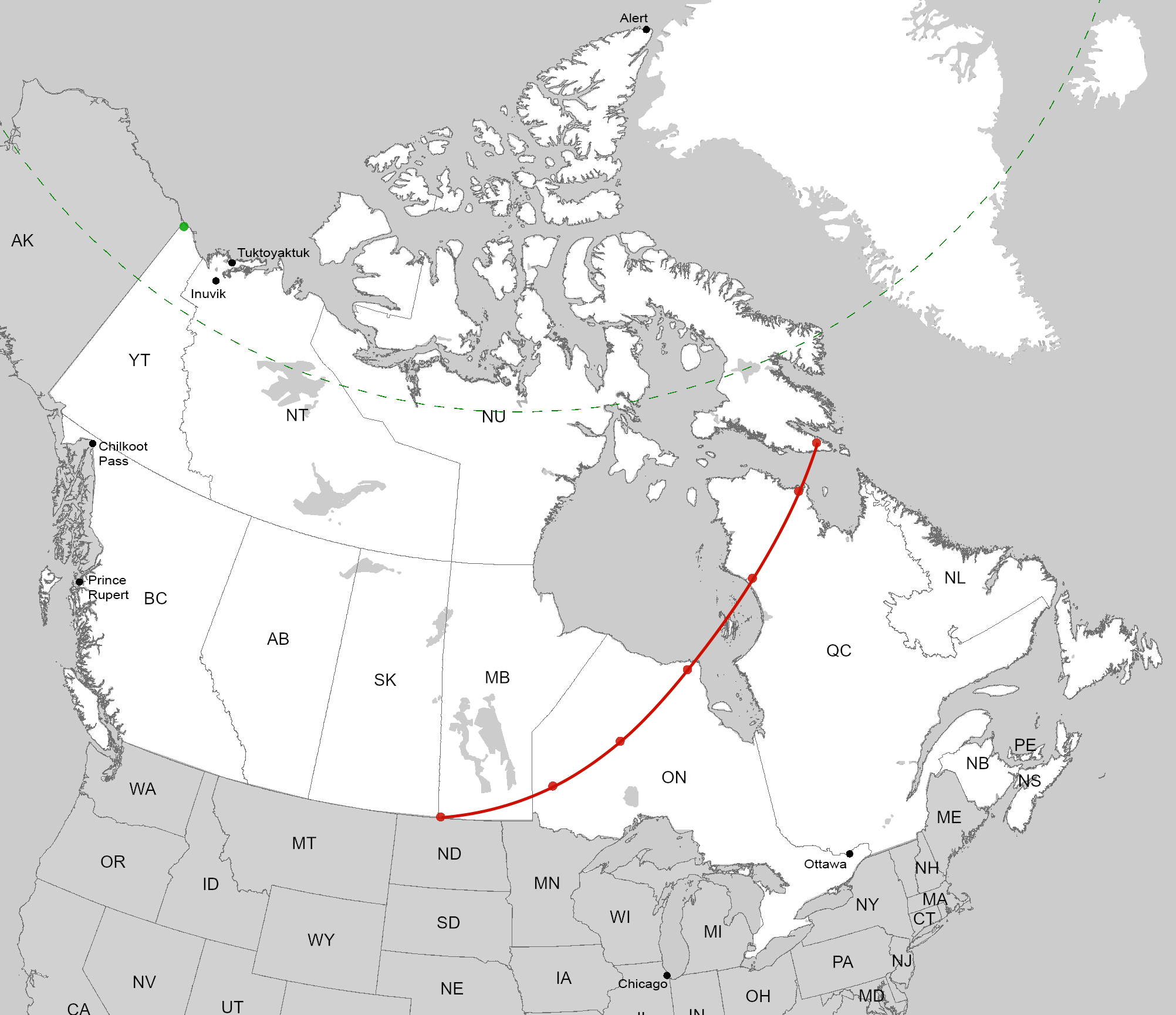
This is obviously the longest one of these, because of all the work a pilot episode has to do (and because it was a two-hour movie rather than just a single episode pilot). Tune in next time for the annotated transcript of season 1 episode 1 "Free Willie," which aired an unusual five months after the pilot.
no subject
no subject