fox: my left eye.  "ceci n'est pas une fox." (Default)

I don't, like, take notes when I read the occasional murder mystery, but all the same, I'd like the record to show that on page 85, I began to wonder if it will become relevant that spoiler? )

and in my experience KJC is sufficiently deliberate that I feel like that's more likely than not to be A Thing.

[eta: p. 168: I think I know who did it. (I'm almost certainly wrong.)]

[eta2: In fact I couldn't have been more wrong! But I dug it the most anyway. Oddly nostalgic, though obvs my own Oxford experience involved neither undergraduates nor murders.]

fox: my left eye.  "ceci n'est pas une fox." (Default)

Pilot - 24apr1994 (a Sunday)


Season 1 (Thursdays except where noted)

  1. Free Willie - 22sep1994
  2. Diefenbaker's Day Off - 29sep1994
  3. Manhunt - 06oct1994
  4. They Eat Horses, Don't They? - 13oct1994
  5. Pizzas and Promises - 20oct1994
  6. Chinatown - 27oct1994
  7. Chicago Holiday part 1 - 10nov1994
  8. Chicago Holiday part 2 - 17nov1994
  9. A Cop, a Mountie, and a Baby - 01dec1994
  10. The Gift of the Wheelman - 15dec1994
  11. You Must Remember This - 05jan1995
  12. A Hawk and a Handsaw - 19jan1995
  13. An Eye for an Eye - 02feb1995
  14. The Man Who Knew Too Little - 09feb1995
  15. The Wild Bunch - 16feb1995
  16. The Blue Line - 08mar1995 (Wednesday)
  17. The Deal - 30mar1995
  18. An Invitation to Romance - 06apr1995
  19. Heaven and Earth - 24apr1995 (Monday)
  20. Victoria's Secret part 1 - 11may1995
  21. Victoria's Secret part 2 - 11may1995
  22. Letting Go - 01jun1995


Season 2 (Thursdays except where noted)

  1. North - 09nov1995
  2. Vault - 07dec1995
  3. Witness - 14dec1995
  4. Bird in the Hand - 21dec1995
  5. The Promise - 11jan1996
  6. Mask - 19jan1996 (Friday)
  7. Juliet is Bleeding - 01feb1996
  8. One Good Man - 08feb1996
  9. The Edge - 15feb1996
  10. Starman - 22feb1996
  11. We Are the Eggmen - 29feb1996
  12. Some Like It Red - 28mar1996
  13. White Men Can't Jump to Conclusions - 04apr1996
  14. All the Queen's Horses - 11apr1996
  15. Body Language - 25apr1996
  16. The Duel - 02may1996
  17. Red, White, or Blue - 23may1996
  18. Flashback - 30may1996


Season 3 (Sundays)

  1. Burning Down the House - 14sep1997
  2. Eclipse - 21sep1997
  3. I Coulda Been a Defendant - 28sep1997
  4. Strange Bedfellows - 05oct1997
  5. Seeing Is Believing - 12oct1997
  6. Bounty Hunter - 19oct1997
  7. Mountie & Soul - 26oct1997
  8. Spy vs. Spy - 02nov1997
  9. Asylum - 16nov1997
  10. Perfect Strangers - 30nov1997
  11. Dead Guy Running - 04jan1998
  12. Mountie on the Bounty part 1 - 15mar1998
  13. Mountie on the Bounty part 2 - 22mar1998


Season 4 (Wednesdays in 1998, Thursdays in 1999 except where noted)

  1. Dr. Longball - 23sep1998
  2. Easy Money - 30sep1998
  3. The Ladies' Man - 21oct1998
  4. Mojo Rising - 28oct1998
  5. Dead Men Don't Throw Rice - 04nov1998
  6. Odds - 11nov1998
  7. Mountie Sings the Blues - 18nov1998
  8. Good for the Soul - 16dec1998
  9. A Likely Story - 21jan1999
  10. Say Amen - 04mar1999
  11. Hunting Season - 11mar1999
  12. Call of the Wild part 1 - 14mar1999 (Sunday)
  13. Call of the Wild part 2 - 14mar1999 (Sunday)
fox: girl with a fan.  fangirl. (fangirl)

Couple weeks ago I posted a little Red White and Royal Blue fic, and the other day I made a royal family family tree with, yes, the extra members I referred to in it, but also (obvs) those who appear in the book and the movie, and I think it can be made to comply with either canon with only a small number of slight adjustments.

Long post is long. )

fox: my left eye.  "ceci n'est pas une fox." (Default)

I bumped into my profile at AO3 this morning and it turns out yesterday was my 15th AO3-versary. I feel like I should have done a ficlet for the occasion.

fox: my left eye.  "ceci n'est pas une fox." (Default)

The name of the book, on the cover, was evidently Red, White & Royal Blue. That seems to be what Amazon is calling the film as well, in a different font, except when I went to double check I found that they can't even let the same decision stay made for this long:
screenshot of Amazon listing for RWRB two ways
So I'm going to carry on using the Oxford comma and the word "and" and we're all going to have to be okay with that.

Anyway, like I said, the movie was fine, and I think it was fine because it was cut down from the book, where I think exactly the same movie without the book holding it up might not have been as good. I'm just going to take a second here, and then hopefully be able to move on to other matters, to note that the cast of this movie are the best-looking lot to have appeared on my television in a long while, maybe ever, and I say this as a person who just spent a year and a quarter transcribing due South. Taylor Zakhar Perez as Alex, good lord. Something reminiscent of Rufus Sewell about the cheekbones, especially in profile when he does a similar crinkly-eyed smirking laugh, but/and then the dazzling smile and the big brown eyes and the eyelashes for days. The rest of them are very nice-looking as well, she conceded, hand-waving many beautiful people including Uma goddamn Thurman and Nicholas Galitzine, the other lead (the first words out of whose mouth are "When the revolution comes," which if it's accurate that the actor is literally a Russian prince—I mean, that is, descended from an exiled Russian princely family—is vaguely hilarious), but this Alex, holy shit.

I guess the rest of the post contains spoilers . . .

Things from the book that were absent from the movie )

Things that exist in the movie but did not appear in the book )

Things I liked a lot )

Things I wasn't bananas about )

I've been rambling about this all day. Better hit Post and move on with my life. OH, but first, I was going to come back to the Clintons and Obamas and West Wing of it all—because I am generally happier with the book plot and setting but with the movie leads and their being grownups etc., I think for the first time in my life I'm going to be happiest being a non-purist about canon and . . . combining them? That is, I'm going to take the movie as canon generally but revert Henry to being the youngest of his siblings, import June and Rafael and Leo and their storylines, and assume The West Wing as we know it was not a TV show in their universe because that allows me to cross them over and have Alex and June be friends with their immediate predecessors, Peter and Miranda Santos. [satisfied nod]

fox: my left eye.  "ceci n'est pas une fox." (Default)

Re Red, White, and Royal Blue, this is all coming out of a comment I made over chez [personal profile] jennaria, which I will reproduce behind a

details cut:
I read the book yesterday, and it . . . could have been a trilogy, I think? I mean a trilogy of novellas, maybe, but it had more than its share of climaxes (listen, the pun is not what I would have intended, but it's also utterly inescapable in the circumstances) and resolutions, so I can dig how for a single feature film they had to pick one and stick with it. And shift a couple-few things around, as well; I appreciated for example that they made the one hero a law student rather than a college senior, because while people certainly do find the loves of their lives in their very early 20s, I'm not sorry to have the main characters be slightly more of a grown-up. On the other hand, I regretted the diminishment or outright loss of a couple of the minor characters, some of whom were sacrificed along with their plots but others who I guess it seemed would just have cluttered up the place. Pity.

The royal family situation in both the book and the film is a stumper, where the other hero is the younger son of the daughter of the monarch - the book keeps calling him "the Prince of England," which drives me bats (there is no such title), and "the heir to the throne," which assuming his mother is the monarch's only child1 (and the succession laws are what they are in the real-life UK, that is, from 2015 onwards it's straight-up birth order and boys don't outrank girls provided everyone in the conversation was born after 28 October 2011, which no one in this conversation can have been) he's no higher than third in line and will be demoted steadily as his brother and sister-in-law, whose wedding is the precipitating event of the whole story, presumably have children. The movie has him clarify that he's the (or in fact a) spare, but still. Anyway in addition to the blue-Texas rom-com wish fulfillment, of course one detects a certain amount of And You Could All Have Been Nicer To Harry And Meghan in the Prince Henry Falls In Love With A Biracial American of it all.

1. Because if the mother has brothers, even younger ones, they and their children will succeed before her and this dude would be far down the list and likely not actually a prince in the first place. His royal parent has to have been his mother both because we needed the dead-dad backstory—which had to be a dead dad rather than a dead mum for probably a variety of reasons but one of them absolutely had to be not making this a complete Prince Harry parallel—and because the other hero's powerful important parent is his mother and the parallels between them required it. But the adjustment to How The British Royal Family Works isn't entirely clear to me. I haven't read The Heir Affair, but I was reading GFY a lot at the time the authors were working on it, and they had a lot to say about where to separate their alternate reality from our real reality to get the fictitious royal family they were writing—chiefly, I remember them saying they had to diverge some time after the Victorian era because of how influential so much of her legacy still is in the modern monarchy as we know it. (I think they went with Albert Victor Didn't Die, so they actually split from the real timeline after Edward VII.) In this book, the same level of care doesn't seem to have been taken? The monarch is Queen Mary and her daughter is Princess Catherine, both of which are perfectly cromulent names, but the book still does refer to "a great-uncle who abdicated because he was a Nazi," that is, Edward VIII, later the Duke of Windsor (not that that's why he abdicated, but it's just as well that he did, because he was), so the fictitious Queen Mary might be an Elizabeth II analogue who . . . only had one child, and that a daughter? The widowed daughter being known as Princess Catherine is fine, but her late husband would have had to have been elevated to prince himself for their children to be princes and a princess—or, I suppose, the queen could well have done a special arrangement to make them so if they were her only grandchildren. Not too fussed about that. But the film calls the widowed daughter the Duchess of Edinburgh, which incidentally is what Elizabeth was called early in her marriage when George VI was still alive—Princess Elizabeth, D of E, so this fictitious unseen character would be Princess Catherine, D of E, even after her husband the Duke of Edinburgh had died—which means our hero should have been called Prince Henry of Edinburgh and probably his elder brother Philip, second in line for the throne, should have been Prince Philip, Duke of Edinburgh, which . . . I think would have been pretty confusing for a lot of viewers. [eta: Oh! I had forgotten that at some point in the book Henry says he and his siblings generally just used Wales as a surname - so the fictitious Queen Mary seems to have created her daughter Princess of Wales, as I imagine a monarch would in These Modern Times if they didn't have a son—though George VI didn't, even though all the world knew his daughter was going to succeed him—which makes the fictitious QM's stodgy hidebound attitude even harder to reconcile, doesn't it? On top of which, if the monarch's daughter can be Princess of Wales in her own right, then presumably her own children will succeed in strict birth order rather than with any male preference, so the fact that in the book the sister (Princess Beatrice) is the middle child and Henry the youngest would make him no higher than fourth in line for the throne and really his marriage and procreative prospects ought to be of absolutely no concern. Anyway, I'd better take all this to a top-level post, but I did want to come in here and correct my own record just for a moment. Sorry to disturb again. ;-D] Interesting choices all around. At that point, making the monarch a king rather than a queen seems like it was probably timely, no? Uncle Wiki says filming wrapped in August 2022, and herself didn't pass until September, but still.
. . . this is all much too much of a ramble and shows that I need to stop and have some lunch.

So I did read the book the other day in advance of watching the movie, as is consistent with my beliefs. And I'm glad I did, because I think I might not have enjoyed the movie as much without it? Like: Obviously a film adaptation is going to have to change some things from a novel. Or, conversely, a novel is not a screenplay. In this case, the movie was frothy and pretty delightful, and I think I would have found it quite insubstantial if I hadn't known where it began. There's a metaphor in my head about sculpting by building up vs. sculpting by cutting away, and I'm not a sculptor myself but I do think a very delicate carving is probably more likely to be stronger than an identical work made accumulatively. Provided you don't accidentally carve out the, you know. Load-bearing infrastructure. So put another way, if the book hadn't existed and this had been the movie they'd made, I think I'd have thought, "Yeah, okay, two very good-looking young people fall in love and overcome 118 film minutes' worth of adversity; other than the fact that they are both dudes,1 what of it?" 1. This is not to minimize the importance of both the book and the movie as mainstream, non-niche queer media. I have the extreme privilege of generally not having lacked representation of People Like Myself (white, middle-class, abled, English-speaking) in movies and TV, and I seriously appreciate the fact that the era of "But surprise, the elected official is a ~woman~!" is almost behind us; it's not taking me a huge mental leap to empathize with my queer sibs here. But the book does exist, and it answers the "what of it?" question, and I think knowing the answers from the book makes the movie a little sturdier as well.

(In some cases. In others, obviously changes were made simply for reasons of time, the different distribution and visibility of books vs. films, or things-have-continued-to-happen-in-the-real-world-in-the-time-since-the-book-was-published reasons.)

It is true! that the book has several or even many plots, and the movie has basically one and a half, which is really all you can ask a film audience to keep track of. I’m going to come back tomorrow and try to make a list that is both short and comprehensive of things that were better in the book and things that were better in the movie.

bereft

Jul. 18th, 2023 10:06 am
fox: my left eye.  "ceci n'est pas une fox." (Default)

After spending more than a year doing due South annotated transcripts, I feel a bit at sea. Someone tell me not to spend a hundred bucks on the box set of The Sentinel and begin again.

fox: my left eye.  "ceci n'est pas une fox." (Default)

Friends! Fans! Fellows in hyperfocus! I’m pleased to let you know that my due South transcription project is finished and the whole lot are up at AO3, where I think they look better and may be easier to read than they were over here:

https://archiveofourown.org/collections/dueSouth_annotated_transcripts

One work per season, one chapter per episode, there’s formatting that won’t work if not viewed in author’s style. There’s also an index of episodes, and at some point I’m thinking of throwing together an index of characters and which episodes they appear in.

Share and enjoy!

fox: my left eye.  "ceci n'est pas une fox." (Default)

Call of the Wild part 2
air date March 14, 1999

Scene 1 )

Scene 2 )

These scenes run together quite seamlessly, in fact, but the first one is all flashback and the second one is all new. At the same time, I know this is billed as a two-parter, but I question the need for a "previously on" when "previously" was the previous hour. All there's been is a commercial break. "Several minutes ago, on due South . . ." doesn't have the same ring to it, I guess.

Credits roll.

Paul Gross
Callum Keith Rennie
Beau Starr
Camilla Scott
Tony Craig | Tom Melissis
Ramona Milano
and Gordon Pinsent as Fraser Sr.

plus Draco the dog

Dean McDermott, Anne Marie Loder, David Marciano, Bo Svenson, Kenneth Welsh, and Leslie Nielsen as Buck Frobisher

McDermott and Loder (Turnbull and Stella) are sharing billing and Marciano (Vecchio) is behind them both. I will never understand.

Scene 3 )

Scene 4 )

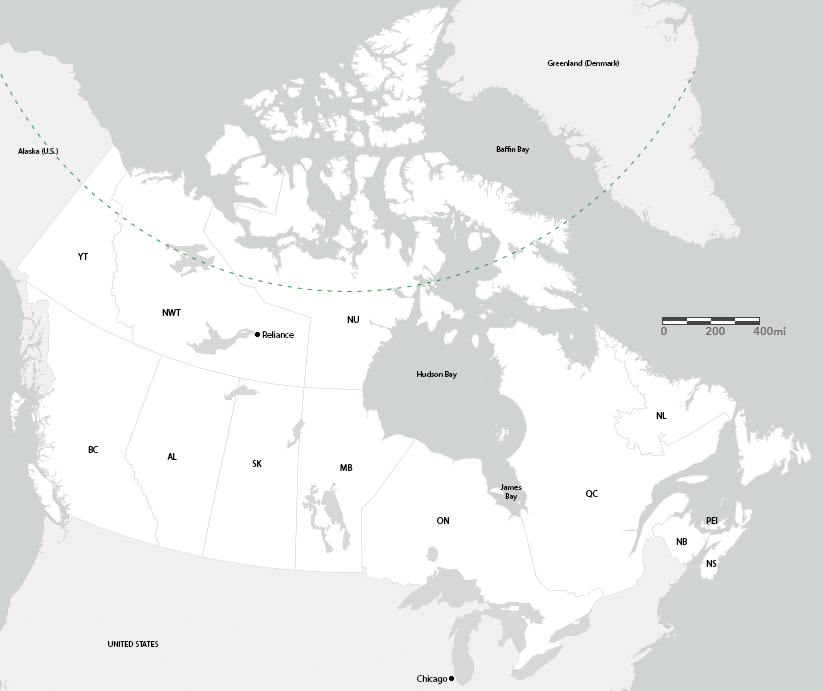
Even if you're fluent in Morse code, you can't as a human person decipher binary computer code such as is transmitted by a hissing buzzing clanging modem unless you have some sort of decoder chip implanted in your head. Maybe not even then. I like that the show is finally allowing Fraser to just handwave the impossible things he does. No more slow your own heart rate, calculate the cubic feet of air in an ostensibly airtight room, clamp down your own saliva ducts, whatever—just don't worry how I know this, it's not important.

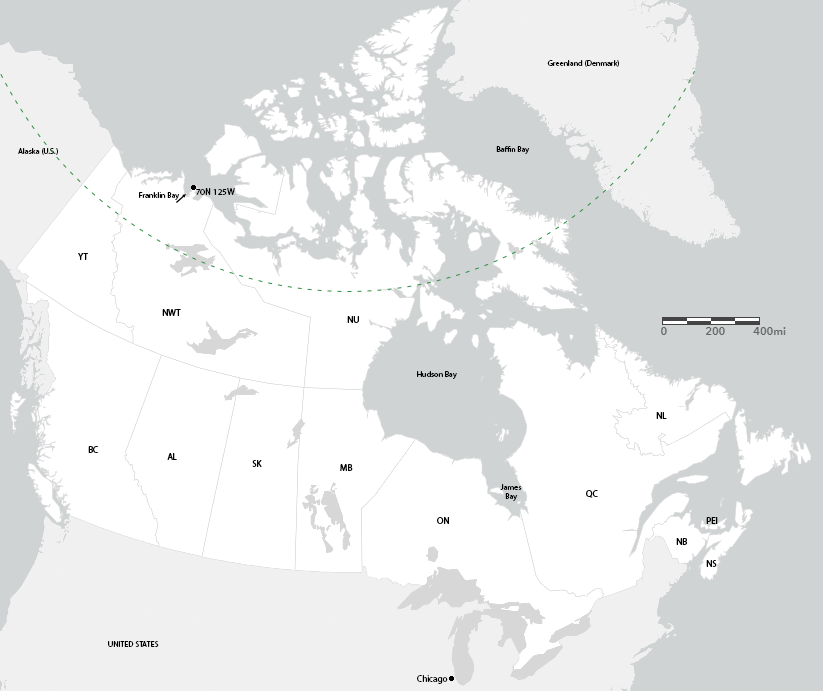
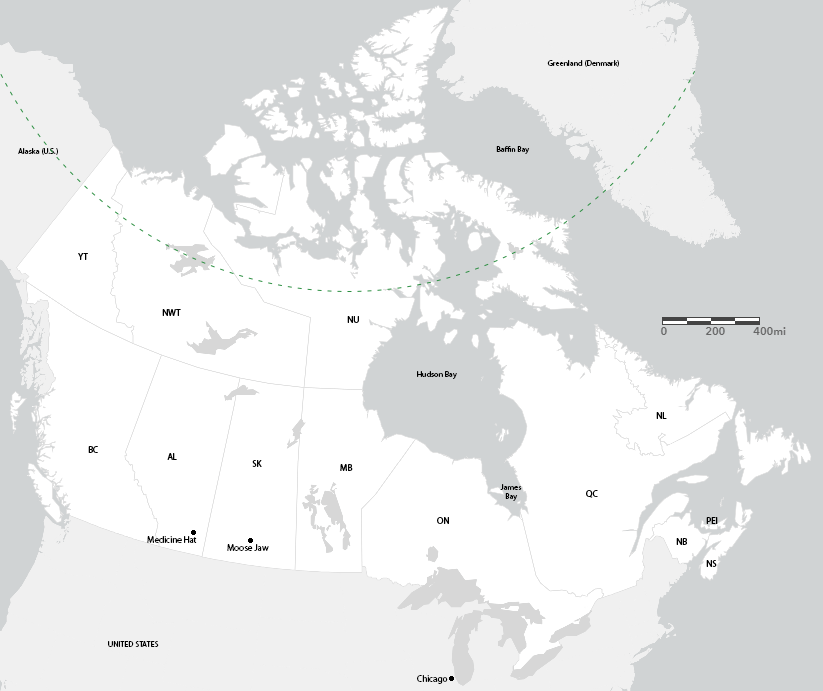
70°N 125°W is pretty dang close to Franklin Bay, depending how much of Amundsen Gulf is indeed Franklin Bay. My question is, how is that plane going to get there? It must have more than twice the range of the little plane Fraser and Vecchio crashed in in "North." Which—this looks like a bigger plane than that, and there are light aircraft whose range is over 1,000 and even potentially 2,000 miles, but even so, bro, I don't think this plane is starting from Chicago and getting to 70°N 125°W on a single tank of gas.
Canada with Franklin Bay

I can't think of a good reason for Fraser to have said "e'en" instead of "even."

Scene 5 )

I don't believe Air Canada offers full-body massages, nor is it appropriate to expect that sort of service from the cabin crew of any airline, but ha ha, sexual availability of flight attendants, what a funny funny joke that isn't at all tiresome. Meanwhile, of course Thatcher will be an Air Canada partisan, but Stan Rogers died in a fire on an Air Canada flight, I'm just saying.

How has Turnbull never flown before? When he moved to Chicago, did he do it on a bus?

Scene 6 )

Vecchio's sneering Armando persona is—well, it's not that Armando is cool, but it's good the way Vecchio can shake him off and put him back on again.

The code name is 17FOC76. Hmm.

Scene 7 )

I'm imagining a bowling ball being sucked through forty yards of garden hose, and it's not going well for the hose. I think Fraser's analogy could use a little workshopping if he's trying to emphasize the danger to the bowling ball in this situation.

Scene 8 )

For what feels like the first time all season, we can see Francesca below the shoulders and she's got a visible little tum. Impossible to say if that's a Milano who's about five months along or a Milano who's had the baby and is almost but not quite back in the shape she was before, but there you are.

Scene 9 )

Fraser shoves the crate off the plane at 9:54 on the playback and Kowalski at 9:58; he jumps out himself at 10:03. This sort of plane appears to have an average speed of 175 mph (well, a cruising speed of 150 knots, and for this purpose I'm calling that close enough), which is about .05 miles per second, so in five seconds the plane will have gone about another quarter-mile.

The snow isn't bottomless, of course—there's land under it—and even if it's soft and powdery to a depth that's safe to land in after jumping out of a plane, how will the guys get out again? Conversely, if it's got a stopping depth shallow enough that they can reach the surface, how will they not break several bones (or rupture one or more internal organs, or both) when they hit it?

I wish they'd acknowledged the fact that they've done "we'll jump" / "like hell" before, but I'm glad that "Great Scott, turtles!" apparently works on everyone.

Scene 10 )

Well, there is that. (It's not like he hasn't been back since he left, given that he had a vacation long enough for Vecchio to leave town and Kowalski to get in his place, but never mind.)

They both hit the snow at 10:10 on the playback, one after the other. So Kowalski was falling for about 12 seconds and Fraser for about seven. Accelerating at 32 feet per second per second, Kowalski has fallen about 2300 feet and Fraser only about 800, and they shouldn't land (a) at the same time nor (b) right next to each other (or, I guess, for them to land at the same time the plane can't have kept level but will have had to descend 1500 feet in eight seconds, which if Muldoon was flying and left the controls to come shoot at them I guess is not impossible?); I guess a quarter mile isn't that far, but the guys just aren't going to land side by side unless Fraser can somehow dive out of the plane in a directional way and catch up with Kowalski as he falls. Which, given that he can stay with Kowalski when they're both flying improvised fire extinguisher jetpacks, may be plausible? But come on.

Do note, though, that Kowalski is covered with snow and Fraser doesn't have a flake on him. Good to know that some things never change.

Scene 11 )

Scene 12 )

Fraser has put on mittens and a warmer coat and also, apparently, changed into the trousers that go with the brown or blue uniform rather than the jodhpurs that go with the red tunic. Also probably a sweater. Kowalski is wearing some bib snowpants and also evidently some more layers than he was wearing before they left the plane. When have they had time to do this? And wouldn't changing your clothes in the windswept outdoors be very cold indeed? Why is neither of them wearing a hat? WTF?

Scene 12 )

How does Turnbull know how to drive a dogsled? If he's originally from the far north like Fraser, won't he have had to fly on a plane before, you know, ever, and probably a small one at that?

Scene 13 )

Fraser gave Bob enough what for in "North" about the possibility of abandoning his partner; you'd think Bob (that is, Ben's subconscious) would have learned by now that it is Not Going To Happen (with the arguable addition of especially not this partner).

Scene 14 )

Stella finds Ray Vecchio charming, which is a good thing, because why would she have given a shit that Ray Kowalski was not the real Ray Vecchio? She never thought of him as Ray Vecchio in the first place. (In fact, given that she's with the state's attorney's office, shouldn't she and Ray Vecchio have met before? When she said apparently Vecchio didn't read Guy Rankin his Miranda rights, did she just hear that from someone but never in her entire career clap eyes on the guy until now? I guess even all the time he was mixing it up with her colleague Louise St. Laurent they never managed to be in the same place at the same time.)

Scene 15 )

There's nothing that high within a two-day walk (I mean, a difficult two-day backcountry hike) from Cape Parry, which is what's up at the north end of that peninsula we were talking about when Fraser said 70°N 125°W and Franklin Bay, because of course it's all river delta up there, but never mind.

Scene 16 )

I'm pretty sure that's what Kowalski said, and I think he means he just shit his pants. Which, given the spill he just almost took, fair (although we don't know what, if anything, they've been eating).

Scene 17 )

The ongoing Huey-and-Dewey-hate-each-other's-driving gag is fine, but Huey wouldn't feel that kind of whiplash if he'd wear his goddamn seatbelt.

Scene 18 )

This was almost certainly not necessary in general, still less so given my conclusions about Thatcher's history of being sexually exploited, but I'm glad Frobisher stood in her defense rather than encouraging his boorish troops.

Scene 19 )

At the beginning of this scene, the stars and the waning crescent moon (illuminated on the left because northern hemisphere) look very close. At that phase the moon doesn't appear until well after midnight, but it's strange that they'd have kept hiking through that many hours of darkness (in Whitehorse, YT, the sun sets at 8:00 p.m. in mid-March and rises again at about 8:15 a.m.). For a giggle, I asked timeanddate.com for moonrise times in the Yukon in March 1999, and as it turns out, third quarter is accurate! So that's fun. But it doesn't answer why the fellas weren't tucking in to sleep until three in the morning.

It's harrowing to hear Fraser admit to his own subconscious that he doesn't know whether Kowalski will survive. And even more so, of course, to hear Kowalski praying Our Father at this point.

Scene 20 )

I mean, yes, an incapacitated Kowalski is going to be a lot of extra work for Fraser. But it's better than a dead Kowalski!

Fraser has no ice crystals on his beard stubble (of which he has none) nor his eyebrows. If it was possible for exactly one of them to sleep with his back to the wind, he should have arranged Kowalski on that side, so presumably this is his Teflon hand-laundry good luck surfacing again instead.

Scene 21 )

Scene 22 )

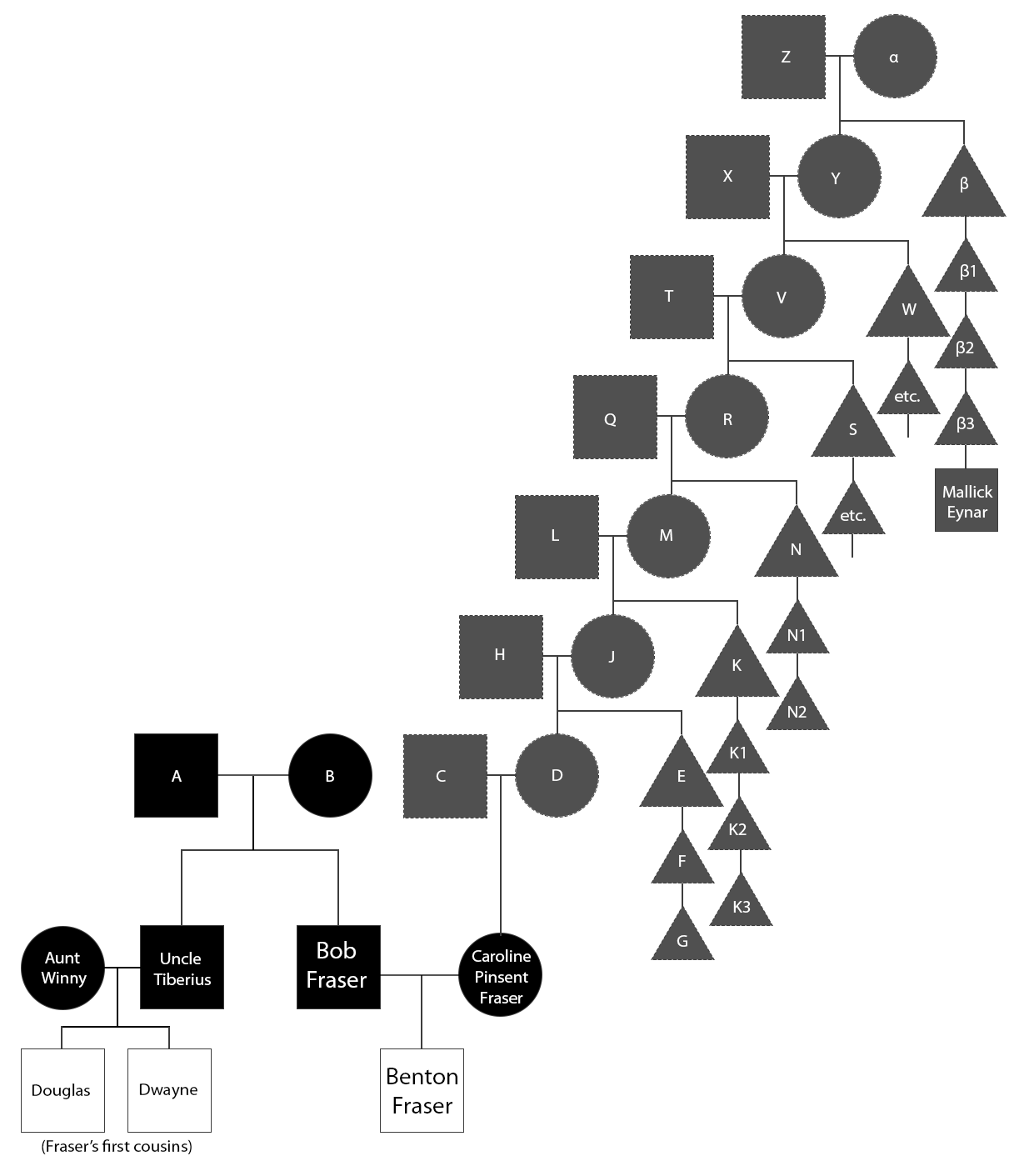
The show said Fraser and Kowalski's relationship is the same as Bob and Caroline's. They've said it twice now, along with pointing out that willingness to lay down your life for someone is true love. I don't know what else I could be meant to conclude here.

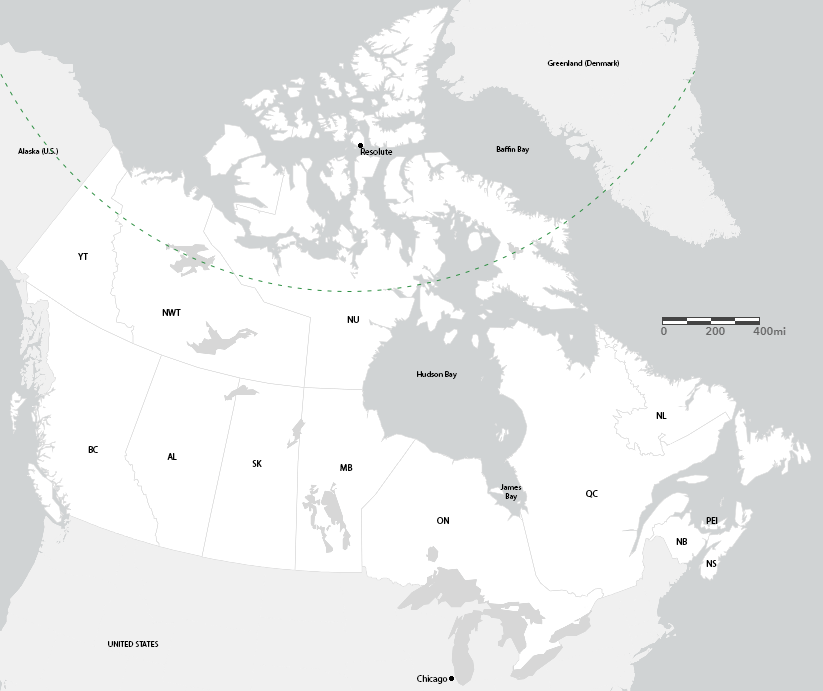
Scene 22 continues. )

Canada with Resolute
I'm sure what Kowalski means is that the pack is digging into his back in a way that's uncomfortable.

Scene 23 )

Scene 24 )

I'm just so glad Kowalski quoted White Heat (1949) rather than Titanic (1997) ("I'm the king of the world!") that I'll overlook the fact that right after James Cagney says "Made it, Ma! Top of the world!" he is engulfed in flames and dies.

What idiot would hear "mine field" and start running? I mean, running the other way, maybe. But running through a mine field is not the way to get through a mine field safely, am I right? I feel like even I know that. (I'm going to leave behind both "I just climbed my first mountain" and the fact that the fellas are jammed in that tight spot hip to hip. I feel like those things balance each other out.)

I mean, but listen, if either of them had fallen in there by himself, he'd have fallen much further and probably died, definitely been unrescuable. Only because they were together could they get stuck that relatively short way down as they did.

Scene 25 )

Scene 26 )

When Kowalski was facing death, he sang "S.O.S." by ABBA. Was that the time Marcus Ellery robbed the bank and he (at age 13) peed his pants, or another time facing death?

Where are those happy days? They seem so hard to find
I try to reach for you, but you have closed your mind
Whatever happened to our love? I wish I understood
It used to be so nice, it used to be so good

[REFRAIN] So when you're near me,
Darling, can't you hear me? S.O.S.!
The love you gave me,
Nothing else can save me. S.O.S.!
When you're gone, how can I even try to go on?
When you're gone, though I try, how can I carry on?

You seemed so far away, though you were standing near
You made me feel alive, but something died, I fear
I really tried to make it up, I wish I understood
What happened to our love? It used to be so good

(refrain)

Maybe Fraser doesn't know that one, and that's why he suggests singing "Northwest Passage" in the face of death. For the romantic atmosphere. (The romantic atmosphere.)

Anyway, I think it's delightful that Delmar asks if they want help rather than just charging ahead and assuming. It seems like a knucklehead question from a guy who repeated the fourth grade at least once, but in fact "May I help you" is much more correct than "Let me help you," so well done!

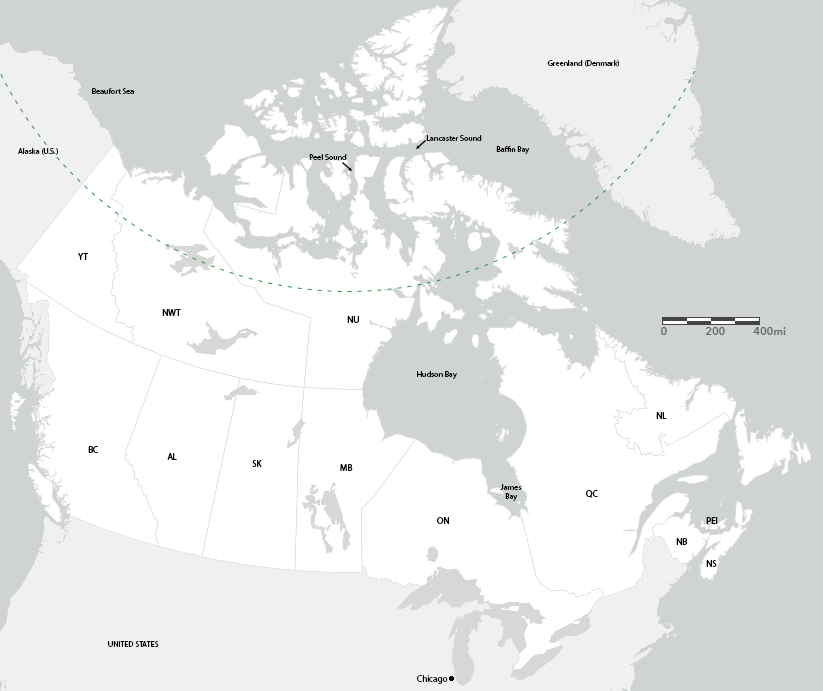
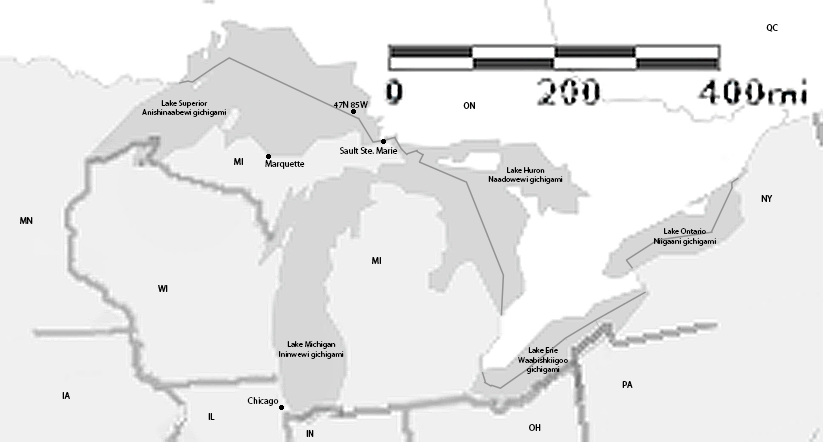
All right. Yes: In 1845, Captain Sir John Franklin did leave England in command of HMS Erebus and accompanied by HMS Terror to search for the Northwest Passage, which after late July of that year were never again seen by Europeans. (The Wikipedia article on the expedition says "In late July 1845 the whalers Prince of Wales (Captain Dannett) and Enterprise (Captain Robert Martin) encountered Terror and Erebus in Baffin Bay, where they were waiting for good conditions to cross to Lancaster Sound" and cites Richard Cyriax, Sir John Franklin's Last Arctic Expedition; a Chapter in the History of the Royal Navy (London: Methuen & Co., 1939), 66–68; I can't get Google Books to show me those pages, but I've got "The Erebus and Terror, when last seen at the end of July, 1845, were moored to an iceberg on the east side of Baffin Bay, opposite Lancaster Sound," so I'll take it. They seem not to have reached Peel Sound until the summer of 1846. But never mind: The gist of Fraser's comment is accurate, which is that the entire expedition was lost; all members were declared dead in 1854. By 1999, many had gone in search of Franklin and his lost ships, and noone (that is, no Europeans) had found more than a trace of them here and there. (Fear not: Of course we'll come back to this.)
Canada with Lancaster and Peel Sounds

Scene 27 )

I don't know any of the places Delmar mentions, so I'm not going to do the map again. It sounds like he says "Trojan Valley," of which Google is unaware in Canada; there is a Diamond Head on the side of Mt. Garibaldi 50 or so miles north of Vancouver and a Mt. Sabine at about the same latitude on the eastern end of British Columbia, but those are thousands of miles from the northern areas where we've been led to understand Fraser and Kowalski jumped out of the plane on the way to Franklin Bay. There's also no King's Creek all the way up there. In short: The whole thing is a mystery, including the Argentine soccer team reference, because I think when Delmar says "an Argentine soccer team eating themselves" he is referring to the amateur Uruguayan rugby team that (with a couple of dozen others) crashed in the Andes in Argentina in 1972, which you may remember from the film Alive (1993).

Scene 28 )

Fraser. Honestly. Not when you've just finished proposing to Kowalski, innit?

Scene 29 )

Frobisher, of course, is attempting to echo the St. Crispin's Day speech from Henry V:

This day is call'd the feast of Crispian.
He that outlives this day, and comes safe home,
Will stand a tip-toe when this day is nam'd,
And rouse him at the name of Crispian.
He that shall live this day, and see old age,
Will yearly on the vigil feast his neighbours,
And say "To-morrow is Saint Crispian."
Then will he strip his sleeve and show his scars,
And say "These wounds I had on Crispin's day."
Old men forget; yet all shall be forgot,
But he'll remember, with advantages,
What feats he did that day. Then shall our names,
Familiar in his mouth as household words—
Harry the King, Bedford and Exeter,
Warwick and Talbot, Salisbury and Gloucester—
Be in their flowing cups freshly rememb'red.
This story shall the good man teach his son;
And Crispin Crispian shall ne'er go by,
From this day to the ending of the world,
But we in it shall be rememberèd—
We few, we happy few, we band of brothers;
For he to-day that sheds his blood with me
Shall be my brother; be he ne'er so vile,
This day shall gentle his condition;
And gentlemen in England now a-bed
Shall think themselves accurs'd they were not here,
And hold their manhoods cheap whiles any speaks
That fought with us upon Saint Crispin's day.

St. Crispin's Day is October 25, which I suppose is one reason Frobisher couldn't just do the regular speech. 🙄 (This episode didn't air on March 11, which is a bummer.)

Scene 30 )

Scene 31 )

I've got a deus ex machina for Sgt. Buck Frobisher? Sign here, please. [h/t Cleolinda Jones]

I mean, last time we had a season-ending two-parter, we had Sea Mounties, right? So why not Air Mounties this time. Pity this is the series finale so we'll never get Fire Mounties, innit.

When Fraser says "a Delta-class Russian nuclear submarine" all I can hear is Leo McGarry speaking to President Bartlet in The West Wing season 3 episode 6 "Gone Quiet" (2001):

LEO: This is one of those things we've talked about that sounds worse than it is because of your inexperience with the military.
BARTLET: What is it?
LEO: Okay. The USS Portland is a Seawolf-class, or "big," nuclear submarine.
BARTLET: Yeah.
LEO: It has a crew of a hundred and thirty-seven. It is loaded down with highly classified intelligence-gathering equipment. And it is in the waters off North Korea.
BARLET: Right.
LEO: We don't have it right now.
BARTLET: What does "we don't have it" mean?
LEO: Well, as you know, with our ships, our boats, and our submarines, we keep in pretty close touch with radar, sonar, satellites, radio, encrypted messages — and we don't have the Portland now.
BARTLET: We don't have it?
LEO: We do not.
BARTLET: And they're in North Korea?
LEO: Yes. Last we heard. So we're going to set up meetings in the next few hours. Plus, if anything happens, I don't like people knowing you were running for election while the boat was out there.
BARTLET: Nah, I think I'll go ahead and cancel that trip, Leo. If only to stick around and see how this sounds worse than it really is.
LEO: I'll stick around, too.
BARTLET: I think you will.

Scene 32 )

When Vecchio said "Wish me luck" and Fraser said "You don't need it," the next major thing that happened was that Fraser found out Muldoon had killed his mother and Vecchio got shot. Kowalski can't know that, but still, this feels like a dangerous callback, doesn't it?

Scene 32 continues. )

Okay, stipulated: It's a little weird to have a guy's wife play his character's mother. Nevertheless, it's a walk-on part that who would bother auditioning for? and I can see having her come in and do it more or less as a favor to the show, don't have to spend any time getting to know each other or building any kind of rapport, put her in the cold-weather gear and get the shot in 20 minutes and move on with the considerable expense of the rest of the episode. On a practical level I get it.

And the moment she creates is lovely. (It's all her, as well; he has his back to the camera and Pinsent isn't even in the frame.) I appreciate that Caroline's focus is on Bob, whom she must have been waiting for, right?, because whatever borderland/afterlife situation she found herself in, he was somewhere else, not joining her, obviously not for the first 25 years she was there, but even since he died himself, which, not unreasonable of her to expect he'd turn up, right? But as soon as Fraser calls to her, she looks at him, and look how her face changes! Because the last time she saw him, he was only six, and now here he is, a man grown, and she thought she'd never see that but here she is: What a gift. Maybe the fact that I have a six-year-old has softened me unusually. But that smile is gorgeous.

Anyway, then she turns back to Bob, as she must, because it's time for them to go. Nothing, indeed, is permanent. Poor Fraser, losing each of his parents twice, am I right?

And/but/so okay: This Bob is evidently not Fraser's subconscious, unless what's happening here in the mine shaft is Fraser having some kind of break(through). Maybe that's why Bob is (a) visible to Muldoon, (b) able to actually shoot the gun and punch him, and (c) looking so peaky and grey and then actually disappears. Last Three Minutes Of The Series hypothesis: Since "The Gift of the Wheelman," what we see as Bob has been Fraser's subconscious; but the Bob who is visible to other people (in "Bird in the Hand" and "All the Queen's Horses") is in fact Bob Fraser's ghost. I'll have to think more about what that means with respect to "Hunting Season," but I'm down with the idea that there are two Bobs.

Scene 33 )

Last part first: You should not, repeat, should not say Stanley. How dare you.

Saddam Hussein was, at the time this episode aired, still very much in control of Iraq and the subject of considerable western sanctions and U.S. and UK missile strikes. I can't find the exact picture they've spliced Thatcher into because he was captured in 2003 and executed in 2006, so well done Ice Queen, I guess?

If Francesca "loved her babies as though they were her own," then the details of their conceptions are irrelevant, right? (Though "as though they were her own" is a shitty thing to say about an adoptive parent.) Another wasted opportunity to have had the character be pregnant at the same time as the actress, if you ask me. Which I know nobody did.

I don't have anything in particular about Turnbull's or Welsh's ever-after storylines, but let me ask this about Huey and Dewey: I don't understand how their club—a fixed address—would have played the marginal houses for any length of time, short or long. If they bought and established the One-Liner, wouldn't their place be one of the marginal houses? Also, wasn't Huey going to buy a drum machine that he could program to do the rim shot for him? What's he doing sitting behind a set?

Anyway. So Fraser and Kowalski are off to find the hand of Franklin. In 1999, of course they couldn't know—or more accurately, they certainly could have known, but nobody did, because white people had spent more than 150 years not listening to the Inuit—that the wrecks of the Erebus and the Terror would be found (by white people; the Indigenous people knew they were there) in 2014 and 2016, respectively. It's disappointing to think that Fraser, of all people, would go searching for Franklin in Nunavut and not ask the local Inuit for help, so I'll choose to believe that he did ask, and that maybe he and Kowalski were part of the greater world discovery 15 years later. Why not. Headcanon accepted.
Canada with the Northwest Passage

Cumulative body count: 44
Red uniform: Only until they jump out of the plane and land in the snow; oddly, once he's in Canada, he doesn't wear it again

Previous | Index of annotated transcripts

And that's the ball game. Thanks for reading along with me, hope you've enjoyed the commentary, stand by for the whole megillah to appear at AO3 as soon as I can finish recoding the links.

fox: my left eye.  "ceci n'est pas une fox." (Default)

Call of the Wild part 1
air date March 14, 1999

Scene 1 )

Kinnikinnick is a smoking mixture, usually bearberry, and I suppose putting something that's meant to be smoked in someone's tea could turn that tea nicely hallucinogenic. Chicago sits, as we know, on the lake they call Michigan, so of course it doesn't get its drinking water from any type of reservoir with no fish in it, but okay.

Credits roll.

Paul Gross
Callum Keith Rennie
Beau Starr
Camilla Scott
Tony Craig | Tom Melissis
Ramona Milano
and Gordon Pinsent as Fraser Sr.

(plus Draco the dog)

Dean McDermott, David Marciano, Bo Svenson, Jonathan Potts, Phil Jarrett, Jan Rubeš as Mort, and Leslie Nielsen as Buck Frobisher

THERE'S the and/as credit Nielsen has deserved this whole time. Woohoo! (Wait: David Marciano? What? (And billed behind McDermott? What?!))

Scene 2 )

As we all know, when we first met Fraser he had just arrested a guy who was dynamiting rivers and scooping salmon off the surface with a backhoe, so Mort's childhood experience sounds a tiny bit familiar, and then

💔

My researches suggest that it's possible Jan Rubeš was at Auschwitz and simply never talked about it. His English language profiles on Wikipedia nor IMDb (and their references, including his Order of Canada citation) don't include it, nor his obituaries in the Canadian newspapers; but there's a Spanish article at cines.com in which the section "Biografía" includes the paragraph "En 1942, su familia fue deportada a Auschwitz, pero Jan consiguió escapar y esconderse en los bosques de Checoslovaquia." Which is all fine and well, except that it gives a different date (September 23, 1924) and place of birth (Mladá Boleslav) from all the English sources (June 6, 1920, and Volyně, respectively). It does have broadly the same filmography, so they clearly intend to be talking about the same individual, but with those discrepancies and no sources cited, I'm not 100% confident (and I suppose even if I were sure the Spanish text was accurate, I wouldn't know if it was telling us he escaped from Auschwitz or escaped deportation when his family were sent there). The tattoo looks convincing, but they can indeed do things with makeup, can't they, so.

In any event, it's not for me to say how a survivor should most appropriately let people know what sort of camp he was talking about. If it were up to me, I might have had him read that line a little more matter-of-factly and not stop what he was doing to hold out his arm so they could see the tattoo—and then look up and be surprised at the boys' reaction. I think Fraser and Kowalski's horrified silence would have been just as believable if Mort had just mentioned the name of the place by way of clarification, rather than even edging anywhere near scolding Kowalski for having guessed wrong, and Kowalski's shame might have landed even harder; as it was, Mort's correction had just enough teeth behind it that his protests that he didn't mean to bring down the room feel just the tiniest bit disingenuous.

Thallium is indeed extremely toxic, but at this point in the scene, who cares?

Scene 3 )

Scene 4 )

I can only find a Six Mile Canyon in Nevada. In Canada, all I've got is Six Mile Hill, which is near Kamloops, BC. Mind you they don't specify that Muldoon didn't fall into the Six Mile Canyon in Nevada, but Bob Fraser wouldn't have had any jurisdiction there, would he.

So Muldoon and Bob Fraser were friends, but it turned out Muldoon was trafficking rare animals? (A lepidopterist studies butterflies. Not sure why such a person would come from Hungary to the north of Canada, but it turns out that as of 2013 there were 92 butterfly species known in the NWT, so what do I know.)

Scene 5 )

As well she might! Local girl with the local knowledge!

The pages of the date book show March 8–9 as the weekend, which means the nearest year it could be from is 1997. I'm just saying.

Scene 6 )

Scene 7 )

We've mentioned Waco before. I'm not sure how to feel about Welsh basically going "federal, schmederal" at this point.

Scene 8 )

So Bob was hunting Muldoon assiduously but took a break after Caroline died? We know he stopped going to work; apparently the time in which his beard grew and he lost weight was three weeks, and then where he went after he made Benton a bowl of oatmeal was back out in search of Muldoon.

Scene 9 )

We can't see the passenger in the back of the second car; we can barely see the silhouette. (And we can't see the lettering on the canisters, so we can't judge the rustiness of Fraser's Russian.)

Scene 10 )

This is like low tide levels of sand in this alley; that's lucky, isn't it? It's also lucky that the Hotel California embossed their employees' boot heels, rather than stamping them, and that they did so in mirror image, so that the boot print would read Hotel California backward bootheel rather than Hotel California bootheel, like the nose of an ambulance.

Scene 11 )

Sigh. There is a segment of the population for whom fart jokes are never not funny. I am not a member of that segment.

Scene 12 )

That's funny—as is "any number of clues, none of which I can remember at the moment;" like, go ahead, writers' room, just cut that Gordian Knot and Leslie Nielsen will make it sound good—but it's at least two words. (Depends if you hyphenate the first one, Dimethylaminoethoxy-cyanophosphine.) This compound appears on the U.S. Munitions Import List as an example of a toxic compound affecting the nervous system, so that's fun.

Scene 11 continues. )

Howard Stern was (apparently still is) a radio host in the shock jock milieu. I'm not sure why this show would call him out by name; what he was up to in early 1999 seems to have been losing affiliates willing to air his weekly TV show, named "The Howard Stern Radio Show," because it was too offensive even for late-night. TIL Stern also had a character called "Fartman," a superhero who attacks evil with flatulence, which I suppose Frobisher might feel was a sort of mockery of his apparently debilitating digestive upset?

Scene 13 )

So she brands the boots to discourage theft, and the result is that they are stolen more often. I feel like if your hotel is called Hotel California you might have been able to see that coming?

Scene 14 )

Bulldogging is another name for steer wrestling. I've got flashbacks to Westley fighting Fezzik and Rogue Group taking down Imperial ATAT walkers with harpoons and tow cables, and I bet you do too. This Big Toe Blake dude just keeps going, almost as if he's on whichever of the psychoactive drugs gives you superhuman strength. PCP?

Scene 15 )

Thatcher says "I appreciate that" and all I can hear is Cheers season 10 episode 20 "Smotherly Love" (1992):

WOODY: You know, Dr. Sternin-Crane, I always heard that you should tell your mother exactly how you feel.
FRASIER: Is that what you do, Woody?
WOODY: Yeah, right, like I want a whooping.
LILITH: Well, thank you very much, Woody, I appreciate that.
WOODY: You know, I have another idea.
LILTH: Thank you very much, Woody, I appreciate that.
WOODY: You didn't let me tell you the idea yet.
LILITH: Woody, in certain company, when someone says "Thank you very much, I appreciate that," it means "I don't thank you, I don't appreciate that, and I want you to shut your mouth."
WOODY: Oh. Well, thank you very much, Dr. Sternin-Crane, I appreciate that.

Tabun is indeed Dimethylaminoethoxycyanophosphine oxide, also called GA, being the first of the G-series of nerve agents because it was the Germans who synthesized them (thanks, guys). (GB is sarin gas.) Wikipedia says the lethal dose is about .01mg/kg, which if my calculations are correct means Frobisher was right that one milligram could kill a man, 100kg being a not-unreasonable mass for an adult. (I also guess that means those three Mounties in scene 10 were, alas, dead.)

I'm not sure why Francesca expects Fraser will inherit the Liaison Officer position—or, now that I think about it, why Thatcher expects Fraser would come with her if she were transferred to Toronto. Neither of those things happened when Inspector Moffat was promoted and left Chicago.

Francesca is wearing a cute little pinafore dress, so the mystery of the order of filming the episodes continues.

Scene 16 )

Francesca is right, but her point would carry a lot more weight if she hadn't been super-excited by the possibility that Fraser would be promoted and run the consulate. I get that she thinks Toronto is a sterile wasteland, but if Fraser belongs on the tundra, why is she hoping he'll stay in Chicago?

Meanwhile, Fraser is still in mufti (no complaints), and Kowalski is wearing a blue newsboy cap, which, what?

Scene 17 )

Blake is pretty cooperative now that the dust has worn off, I guess.

Scene 18 )

Please identify another reason for Kowalski to observe (in that tone, as well) that Fraser is breathing hard into the phone. I'll wait.

Scene 19 )

On the one hand: Holy shit, it's Ray Vecchio! I mean, we saw Marciano's name in the opening credits, so we were expecting to see him at some point, but here he is! Holy shit!

On the other hand: Fraser, what the fuck, bro, you know Vecchio is deep undercover with the Mob and Kowalski is here calling himself Vecchio for Vecchio's own safety; recognizing him and following him up to his room is one thing but why in, you know, THE WORLD would you call him by his name before if you knew it was safe to do so?

Do I know what I would do in a similar situation? No. Is it possible I'm having trouble shaking off all the fanfic I've read in the past 20-odd years and am not successfully coming at this thing as if I were seeing it for the first time? Maybe. I still think this is Some Bullshit with respect to our hero. He's been so careful about keeping Vecchio safe all this time; having him drop that ball now feels like the writers doing him a giant disservice.

Scene 20 )

Yyyeah. Things that are good: Kowalski pretending not to understand the question so he doesn't have to be the one to tell Ray Vecchio to his face that he, Kowalski, is Ray Vecchio. That's really smart not blowing the guy's cover by giving him time to control his reaction. I like it. Things that are less good: (a) Muldoon recognizing the name Fraser; (b) Kowalski and Vecchio taking this instant dislike to each other. Probably inevitable, but regrettable all the same, and here's Fraser not picking up on it at all, just as it didn't occur to him that it would be dangerous to call Vecchio by his name. "Yes, that was stupid and I did it" doesn't feel to me like a comprehensive awareness of the badness of the situation.

I would have sworn Vecchio had said "this is 317" or "unit 317" or something before and doing so here shows he's back in the Chicago PD persona already, but I can't actually find it anywhere. Hmm. (Oh, I just did find it: In "Chinatown" he calls in and identifies himself as unit 342.) I do know we've heard of the Iguana family before.

Scene 21 )

It makes total sense that Vecchio be Ray Vecchio "because he was Ray Vecchio to start with," that is, because he is Ray Vecchio. But why can't Kowalski be Ray Kowalski? Can we not call people by their last names around here, Welsh? Fraser? Huey? Dewey? Why make him use the name Stanley, which he wasn't using even before he went undercover as Vecchio? What the actual fuck?

Also, though, why is Kowalski so hung up on losing the Vecchio identity? Despite his assertion in scene 20, he has not actually been living Vecchio's life, such as living in his house, being with his family, etc. His own parents came in from Arizona and nobody—not Welsh and not the FBI, though apparently Internal Affairs still doesn't know he's there—said anything like "what the fuck are you doing, you're supposed to be Ray Vecchio" or anything like that. On the other hand, when he was offered a transfer and the opportunity to get his own life and his own name back, he didn't seem terribly enthusiastic about the idea. So: He's been pretty much living his own life; he doesn't seem to be too stressed about what last name he uses as long as he can use the first name Ray, which he's been using since he was a teenager; and he doesn't want to leave the 27th. Is that it? He doesn't want to leave Fraser? Make me see how what's bugging him could be something else, someone? Anyone?

Scene 22 )

Item one: THERE IS. NO. RELATIONSHIP. Francesca. Baby girl. Listen. You have been putting all those tons of feminine effort into A DELUSION. DE. LU. SION. He doesn't understand the question! It's been five years! Why, how, what, how, how can this not have got through to you by now?

Item two: The going home thing is news to him, too, can't you see?

Scene 23 )

Even if Thatcher had thought Francesca was talking through the back of her neck in scene 16, would she really be surprised to hear Fraser say that home for him is further north than Toronto? I'm going to choose to believe that these scenes should have taken place in the opposite order. Also, can't she get a decent latte in Chicago? (And I'm interested in what Fraser knows about discarding old boyfriends. 🤨)

Scene 24 )

So the thing is Kowalski has been keeping Vecchio's name warm for him while he's been gone, but everything else he's doing has been really real, right? He really is a detective, those really are his cases, that really is his desk, and Fraser really is his (let's go with) friend — so why he should have to disappear from those roles when Vecchio returns in the same way Vecchio disappeared from them when he left in the first place is not obvious to me. I mean: I can see where looking at giving things up before you're ready to would be stressful (🚨 especially for a guy whose marriage ended before he was ready for it to end; someone evaluate Ray Kowalski for PTSD and do it asap 🚨), but I don't see why he has to give any of this up at all, except the name, and he's already got his own one of those that he's been keeping in the drawer this whole time.

Scene 25 )

There's more to this Muldoon thing than we know yet, clearly. Bob wants Fraser to get Muldoon for his mother? Uh-oh . . .

Scene 26 )

💔

I mean. See above re: Kowalski's divorce, because do we think his present feeling—that if he isn't The Guy Who Hangs Around With Fraser, he doesn't know who he is—is the first time he's felt this way? I don't. Which means, taking the last part first, (b) LIKE I SAID hoo boy does this dude need a psych eval and some therapy soonest and (a) he's in love with Fraser, right? Maybe on the rebound from Stella, but in any event, fitting Fraser into the place in his life where Stella was? Right? How can the show be intending me to think anything else at this (I'm going to say it) juncture?

Scene 27 )

Damn / damn / darn is good. I don't know about Huey and Dewey's comedy club. I find whole sets of one-liners to be very difficult to sit through when the jokes are funny.

Scene 28 )

It's not for me to say for sure, but a white man using an inuksuk as a grave marker strikes me as appropriative in a way I don't love. Couldn't he have erected a heap of rocks in any other shape?

The picture of Caroline Pinsent Fraser is the head shot of Martha Burns, whom we remember as the Russian woman in "Spy vs. Spy" and also as Paul Gross's wife, so there's that.

Scene 29 )

Gentlemen, gentlemen, there are enough shooters here for everyone to arrest a couple, no need to get grabby.

Scene 30 )

So I think that's all the details in place, then. Muldoon was a family friend because he was a gifted trapper and guide, but he was also a criminal (which, by the way, means that's at least two generations of Frasers who have bad track records of trusting people they shouldn't: Gerrard, Victoria, Lady Shoes, Maggie [briefly], Muldoon); Bob wanted to arrest him for the animal trafficking; and Muldoon shot Caroline for that reason. Doesn't entirely make sense, though, does it? Did he think killing Bob's wife was going to make Bob less interested in arresting him? I suppose if Bob was there when Muldoon did it, it might have bought him some time? (I mean, in the event, it seems to have bought him three weeks, doesn't it, although when Bob shaved his beard and got his shit together he'd have gone after Muldoon with a renewed fervor.)

Ben Fraser was six when Muldoon shot Caroline. I assume if he'd been there and seen it he'd have remembered? He has memories of Muldoon but no knowledge of his connection with his mother's death, which (a) is a pretty damning indictment of every adult in his life who knew the truth, and I'm including Frobisher and the grandparents as well as Bob, and (b) kind of has to mean he was somewhere else (and I don't mean somewhere else in the house) at the time. Could have been at school, I suppose. (But I mean seriously. In a community of the size they apparently tended to live in, it would have taken 45 minutes or less for everyone who had ever met them to have said or heard "Did you hear, Holloway Muldoon shot Caroline Fraser and when Bob comes to his senses he's going to kill him." Maybe that's why the grandparents moved to Alert? Can't get further away from buzz you don't want your grandson to hear than the literal end of the earth.)

Anyway. I assume they timed this scene on purpose so that when Fraser says "your ammunition is spent," etc., he and Thatcher are rising and looking down at Muldoon from a superior position on the wheel, but when Muldoon says "she dropped like a big old sack of potatoes," Fraser is looking up at him from the absolute lowest possible position on the wheel of fortune. Since almost the first time we met Benton Fraser I've been saying how he (that is, Paul Gross) does nice reaction work. That continues to be true here. I can believe what I'm looking at right here is a grown man who is experiencing this event as if he were still six years old.
Fraser hears how his mother was killed
(Speaking of evaluating someone for PTSD, am I right?)

Scene 31 )

It's a good face, Fraser's "holy shit" face.

When Muldoon sets the bomb down and the timer shows 00:58, the time on the DVD is 40:20. Thatcher says "35 seconds" at 40:46, so I'll buy that. They have until 41:18. They disable the bomb at 41:15, and I have successfully hit the pause button at the exact right time to learn that at the moment before they cut the wires, the timer shows 00:08, not 00:03, but still, this is the closest to a legit countdown we've seen yet on this show, isn't it?

Scene 32 )

❤️❤️❤️❤️❤️❤️❤️❤️❤️❤️❤️❤️❤️❤️❤️❤️❤️❤️❤️❤️❤️❤️❤️❤️❤️❤️❤️❤️

This particular McLachlan lyric is bang on the nose, more so I think than any other needle drop we've had in the show all these years (possibly excepting "Superman's Song" in the pilot), but you know, I'm not even mad about it.

Okay okay. Legit question: Where are the rest of the Vecchios? Blah blah blah actors not available, but the man is shot and Francesca is the only family member visiting him in the goddamn ICU? Fuck it (I mean, see above re my refusal to live in a world where Sam Seaborn wasn't at Leo McGarry's funeral; this is the same sort of thing): I'm going to choose to assume they've been, and Mrs. Vecchio is overwhelmed with the stress and anxiety, so Maria and Francesca divide them up: Maria is home with Ma and Francesca is at the hospital with Ray. Maybe after dinner they'll swap.

I think Fraser and Bob are talking about two different things in their brief conversation here? I think when Fraser says "I'd have done the same as you" he means "I'd have chased the man who killed my mother to the ends of the earth and killed him with my own hands if I'd known it was him," and I think when Bob says "I hope you never get a chance to find out" he means "I hope you never have to make a decision about precisely how much of this sort of unbearable truth you have to keep from your child." Also, Pinsent did the whole scene with tears standing in his eyes. Nice work.

Scene 33 )

The title, of course, refers to The Call of the Wild, a 1903 novel about a dog who eventually hears the call and rejoins the wolves of the north. Except for the way Fraser feels nostalgic for the Yukon, I don't think this episode has anything in common with the book.

Cumulative body count: At least 44; I'm counting only people we know for sure are dead, that is, the body in the reservoir, the body in the car, and the three Mounties who were gassed, but not anyone who gets shot from there on, because if Vecchio didn't die, maybe they didn't either.
Red uniform: When he's in the station and on the final stakeout and its aftermath, but not fishing on the reservoir and not in the nighttime lurking scenes.

Previous | Index of annotated transcripts | Next

fox: my left eye.  "ceci n'est pas une fox." (Default)

Hunting Season
air date March 11, 1999

Scene 1 )

Does he mean he wants to see more of her specifically or more of people taking those two guys down a peg?

Scene 2 )

Head cheese probably is pretty durable; it's a terrine made from veal or pork face preserved in aspic, and I don't see why it wouldn't keep in an uninsulated light airplane in the far north in March, where the daily average high is not higher than 10°F (-12°C), much colder than an ordinary refrigerator. (Why on earth Jake is transporting 500 lbs. of the stuff is a separate question.)

Scene 3 )

"My constable name" is cute. I'd have preferred it if the restatement of "constable" had been slightly different; I think "My constable, uh, my constable name is Benton Fraser" would have been funnier. (I mean but I'd always prefer it if he didn't say "My name is Constable Benton Fraser," because it's not. His name is Benton Fraser, and his rank or title is Constable. "I am Constable Benton Fraser," yes; "My name is Constable Benton Fraser," no. Ah well.) I don't know why he's not on a stepladder to change that light bulb, but whatever, I guess the Canadian consulate is not subject to OSHA regulations?

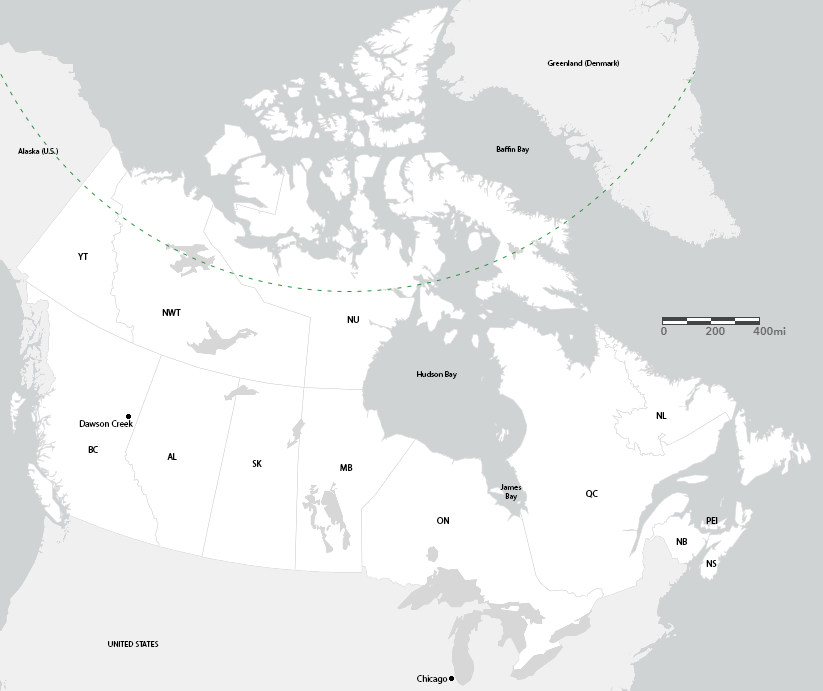
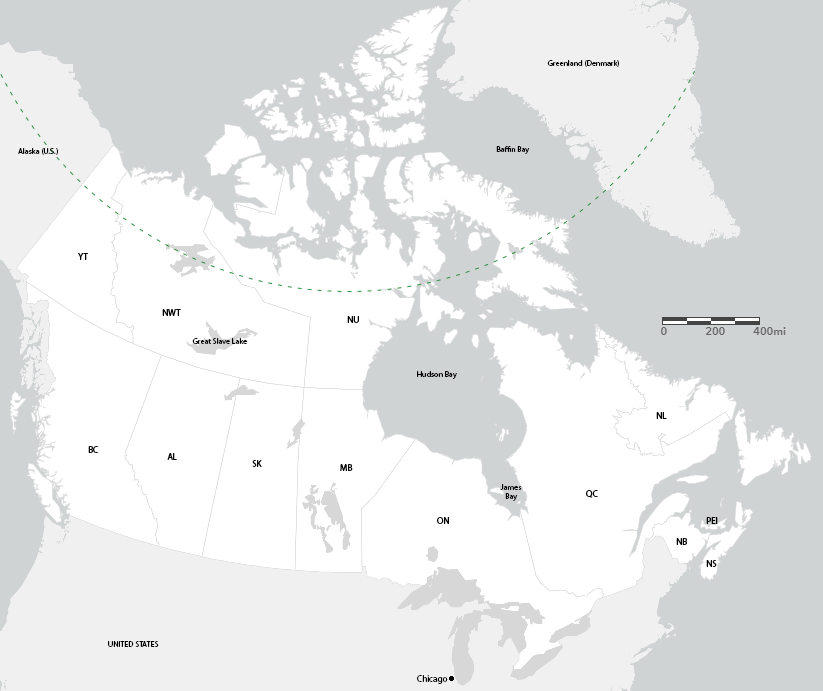
Also, you know, the name Mackenzie should indeed be familiar to a dude who grew up in Inuvik on account of Inuvik is on the delta of the mighty Mackenzie River, which rises at the western end of the Great Slave Lake and flows more than a thousand miles north to the Arctic Ocean, draining most of the Northwest Territories (almost all, now; about half when what is now Nunavut was still NWT), more than half of Alberta, and fair slices of northern Saskatchewan and BC. To say nothing of the fact that there is a town of Mackenzie a hundred-odd miles north of the northern bend of the Fraser River in British Columbia. My point is that these are not uncommon names.
Canada with Mackenzie and Fraser
(When I was looking for the course of the Mackenzie I learned that there is a community on its banks named Little Chicago, about which all the internet seems to know is that it's there. I put it on the map for you for free.)

Credits roll.

Paul Gross
Callum Keith Rennie
Beau Starr
Camilla Scott
Tony Craig | Tom Melissis
Ramona Milano
and Gordon Pinsent as Fraser Sr.

(plus Draco the dog)

Dean McDermott, Matt Heney, Vince Bruni, and Jessica Steen as Maggie

Scene 4 )

Those would be the official channels, because you're not just a Mountie, you're the deputy liaison officer. Why is the fact that Fraser has a friend in the Chicago PD presented like some sort of brainstorm?

It's odd that Maggie can vaguely hear Bob, right? The only ones other than Fraser who've ever been able to see him have been Gerrard and Frobisher, although a few minutes before Gerrard saw him Bob was able to make his voice audible to the bad guys when the situation called for it. But this doesn't seem to be something he's doing on purpose. Hmm. 🤔

(I guess Fraser probably said "Here, let me have your bag.")

Scene 5 )

It doesn't take Fraser long to go from "my friend at the Chicago Police Department might be able to help" to "back off, friend at the Chicago Police Department." But seriously, what did he think was going to happen when he put a pretty blonde woman in front of Ray Kowalski?

What's actually a little surprising is how interested in her Fraser seems to be himself, his preference having generally* run to brunettes before now (with, if you're leaning that way, just the one obvious exception. Not, of course, that hair color is the only relevant factor; Fraser, at least, isn't that shallow (though Kowalski, so far, may be), and the women he's bothered to notice and be interested in have almost all had background or interests or both that he shared. Your main control-group examples are Miss Cabot, who was all equestrian and countrified (though in a rich-girl way), but blonde, and whom he was not interested in at all; and Francesca, who is a brunette, but with whom he has very little in common except proximity to the police department, and whom he has never been especially interested in. (I feel like it's highly unlikely that he did sleep with her, but if he did, it was probably because it was easier than not?) So your outliers are Elaine, a brunette with whom he has much more in common than Francesca but whom he is also not interested in, and Katherine Burns, a blonde with whom he has nothing at all in common but for whom he leaves his post to join at the party and waltz on the patio. (I assume whatever relationship they had went nowhere.)

*I admit Mackenzie King is an edge case; she was a brunette the first time we met her and a blonde the second, but he was maybe more into her the second time than the first. And for sure she was more interested in Fraser than he was in her. But except for Victoria and Janet, about whom is that not true? Meh, leave her off this list if you want. My point holds even without her.

Anyway, it hasn't taken Fraser long to get hung up on Maggie Mackenzie, but she's from Inuvik, 1999 population just a little more than 3,000. Say a little less than a quarter of those 3,000 people are under 20 and almost 60% are over 35, that leaves maaaybe 20% between 20 and 35, which is 600 people. What are the odds Fraser meets one of the (statistically speaking) not quite 300 women in his age group of interest from his home town in Chicago? Taken that way, it's not a huge shock that he's drawn to her.

Francesca, for some reason, still thinks she has a shot at Fraser and is conflicted between solidarity with Maggie (she hasn't spoken to another woman on our screens since she asked Mama Lalla about the curse on the station, which is one of a very few times she's spoken to other women at all, only about half of which have passed the Bechdel test) and wanting to shove her at Kowalski so Fraser will be unoccupied and free to return his attention to herself, which he's not going to do.

Scene 6 )

I see now that the "correction" re: Yukon and NWT in "A Likely Story" was probably planted for the purpose of being able to call back to it here, but that doesn't make Fraser's correction accurate, and he should stop being a dick immediately.

Scene 6 continues. )

I was going to skip over the gross way Fraser and Kowalski are behaving toward Maggie and toward each other and just point out that Maggie has one star on her sleeve (she did say five years, and it appears she wasn't rounding up) and a marksmanship qualification for pistol but not rifle. But I'm also going to note that Bob, that is, Fraser's subconscious, isn't really sure what he wants, is he? Get some land, build a house, feel trapped? Innnteresting.

Scene 7 )

Polygraph is useless at determining truthfulness, but never mind.

Scene 7 continues. )

Kowalski:Maggie::Francesca:Fraser. (Oh, wait, didn't I read somewhere that they don't do analogies on the SAT anymore? How much younger than myself does a reader have to be for that notation to be meaningless? Ugh, I am feeling older every minute.) His failure to realize that his openings are being left lying on the floor is making me extremely uncomfortable.

Scene 8 )

Scene 9 )

Are these the Torrelli brothers?

Scene 10 )

I feel like any minute now the words "You betcha" are going to come out of this woman's mouth.

Scene 10 continues. )

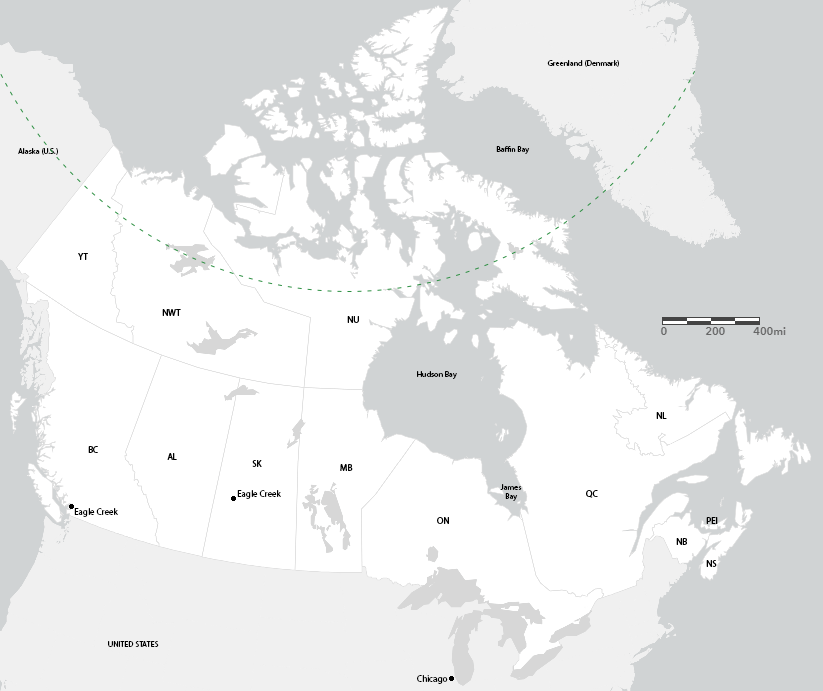
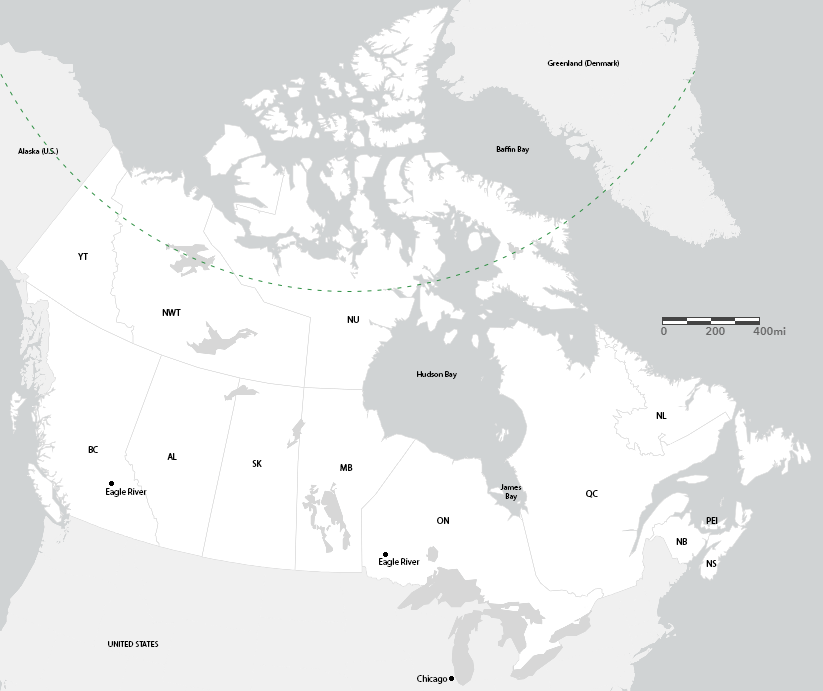
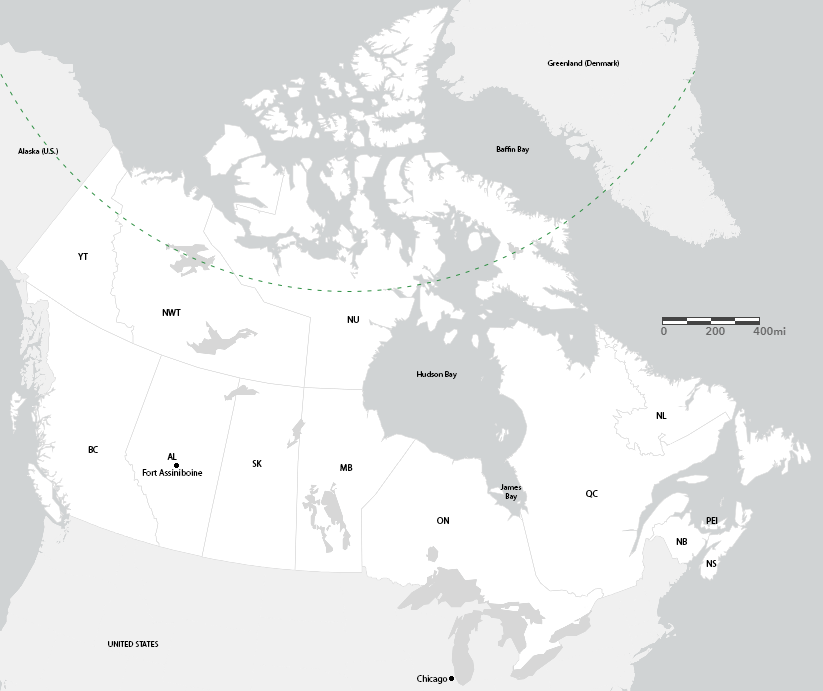
When last we heard of Joe Obodiak, he was a janitor in Eagle River. Now he was apparently a blacksmith in Eagle Creek. Although Mackenzie and Fraser are not unusual names, I feel like Obodiak kind of is, so maybe get your show bible together, writers' room? Although the name does get me a fair few hits when I google it—generally in Saskatchewan, which, as luck would have it, is also where there is a rural municipality named Eagle Creek. (There's also an Eagle Creek in BC, in the suburbs of Vancouver, but I'm not sure someone living there would need a moose hide tanned for him every year. Of course I'm also not sure how someone in Eagle Creek, SK, would be in regular communication with someone in Inuvik, but one thing the writers of this show have been consistent about is the northwestern folks moving around a lot over there, so who knows, maybe the Mackenzies came south . . . to Saskatchewan . . . for the winter?)
Canada with Eagle Creek

Scene 10 continues to continue. )

I ADORE Maggie asking if Bob has seen her mother. I loved that about her the first time I saw this episode mumbleteen years ago and I love it even more now, years after losing my own dad. That little moment between her and Bob is just gorgeous: the way she's kind of quickly processed that she's speaking to a ghost and decided to roll with it, and the first thing, the first thing she does is ask about her mother; and the kind of combination tone he puts on the word "No"—he's both delighted and confused to be talking to someone other than Ben and (but) sorry he doesn't have a different answer for her. Brilliant, brilliant. Nice work, Steen; beautiful work, Pinsent. ❤️

Scene 11 )

Scene 12 )

I was going to say something about how the pemmican always looks like jerky, but I see I've already done that. The point stands. At least they've been consistent?

Scene 13 )

Franco Zeffirelli was the director of the Romeo and Juliet you probably saw when your high school English teacher showed it on video (but the stars of which were abused in its filming), among other things. He seems to have been an antisemite and a hypocrite. Imagine our shock.

Scene 14 )

Scene 15 )

Apparently Turnbull's not the giant dope people (including Fraser and Thatcher) tend to think he is. I still can't work out the basis on which Thatcher's subordinates choose to call her "sir" vs. "ma'am."

Scene 16 )

Kowalski did his weird nasal "well, that's great" thing again. I don't care for it.

Scene 17 )

[suspenseful chord] The plot thickens.

Scene 18 )

See, the thing for him to do would have been to go stand by Maggie and take her by the arm as soon as Thatcher said boo on the phone, rather than huddle up and whisper about her and give her a chance to abscond.

Scene 19 )

Fraser is hanging his head, pretty ashamed of himself, and it's not easy to watch. Is he thinking about the time he told Kowalski he'd never made a procedural mistake? Is he thinking about the last time he believed in a woman he didn't really know, who turned out to have taken advantage of him, killed people, etc.? Because I am. It's actually pretty sympathetic of Thatcher to point out that Maggie was very convincing; like, it's not at all wrong of her and Welsh to be pretty mad right now, right?

Scene 20 )

Thatcher is not wrong on the principle: Fraser's been lucky many, many times, but his naivete was bound to catch up with him at some point, wasn't it?

Scene 21 )

SEAT BELTS, fellas. Also: Nobody's checking for parasites in that urban bush meat. Rosie might be getting protein and culling the local rat population, but who knows what kind of public health emergency she's setting herself up to be the nexus of. Tsk.

Scene 22 )

If the husband called himself Casey Mackenzie, then Mackenzie is Maggie's married name, so how is the fact that her mother and his father were friends contributing to his feeling that the name is familiar? (Except, as I said, that it's not an unusual name in the first place?)

His not-always-being-such-a-dope aside, I'm generally as happy to dunk on Turnbull as the next person; but I have to wonder two things.

  1. Fraser had the paper in his own hands; why on earth couldn't he tear the fucking article out himself in the first place rather than handing it back to Turnbull and asking him to do it?
  2. Why do they need to tear it out at all?

I have a very clear memory of watching Angels and Demons in 2009—the one in which Ewan McGregor burns his own chest with a branding iron, yes, that might have something to do with the clarity of my memory—and the biggest jump scare of all being when the female sidekick tells Tom Hanks they don't have time to copy something into their notes and tears a page out of a volume in the Vatican archives. I may have screamed out loud. My point is this: Even if they don't have a stepladder, do they not have such a thing in the Canadian consulate as a COPY MACHINE?

Scene 23 )

Everybody's deeply involved with people they don't really know that well, it seems. (Why couldn't Thatcher stop Maggie herself? Come on, lady, are you a Mountie or aren't you?)

Scene 24 )

Let's get Turnbull speaking French out of the way first, shall we? Yes yes the caption says "A street in Paris," so what he's supposed to have said is "Champs Élysées, mon ami," the Avenue des Champs Élysées being, yes, ho-hum, a street in Paris. Forsooth. It is the street in Paris, named for the Elysian Fields, the classical Greek heavenly afterlife. Normally the s at the end of "champs" would be silent, but because the next word begins with a vowel, in this name it is pronounced; but there's no "de" in the name anywhere, although Turnbull pronounced his second word very clearly as "d'Élysée," in which case he shouldn't have pronounced the s at all. Given that he also very clearly did pronounce the s, I've transcribed his utterance as "chance d'Élysée," which would mean "[the] luck (or fortune) of heaven." I'll absolutely grant that the subtitle is right there telling us that he was referring to the Champs Élysées, but if the show is going to spend all that time not re-recording dialogue until the actors by God pronounce things properly, I'm going to spend all this time reporting what they actually fucking said.

In either case, he probably doesn't mean "We'll always have Paris;" he probably means "This is not the end" or "Until we meet again" or something of that sort, and maybe he should have said "bonne courage" or "au revoir, not good-bye" or similar.

Thatcher defacing Fraser's uniform by snipping the lanyard is vaguely entertaining. Nobody really thought she was going to cut his throat when she came over to him with that giant knife and he uncovered his neck, but the idea that cutting a lanyard is the RCMP equivalent of handing in a shield is . . . no, okay, it's silly. Wouldn't it make more sense to slice the crown emblems off his epaulettes? And how would they demote Thatcher, if they needed to, who spends most of her time in business attire?

Scene 25 )

My guess is, Ellen Stern must have known what kind of dad Bob Fraser was and figured he'd make the same contribution to the upbringing of his child whether he knew about her or not. And Fraser knows this, too, which is why he reminds his subconscious father that he didn't take the time to get to know either of his children.

Scene 26 )

I have no earthly idea why that conversation had to happen in the men's room. None. Also, Francesca is back on her snacking, so one continues to be stumped about the relationship between the order in which the episodes were shot, the order in which they were aired, and the progress of Milano's pregnancy.

Scene 27 )

This feels to me like it rhymes just a bit with Return of the Jedi:

HAN: I'm sure Luke wasn't on that thing when it blew.
LEIA: He wasn't. I can feel it.
HAN: You love him, don't you.
LEIA: Well, yes.
HAN: All right. I understand. Fine. When he comes back, I won't get in the way.
LEIA: Oh — it's not like that at all. He's my brother.

Except of course that what we've got here is Han and Luke talking about the connection between Luke and Leia (and Han not yet magnanimously offering to step aside). I think it's right for Fraser to leave it vague at this point, though, because "we're brother and sister, you and I" is the kind of news he ought to deliver to Maggie first, before he tells Kowalski.

Anyway, also, we only get the one verse of the song. The rest (which McLachlan in 1994 sings the same lyrics Gordon Lightfoot sang in 1967) goes:

The smoke is rising in the shadows overhead
My glass is almost empty
I read again between the lines upon each page
The words of love you sent me
If I could know within my heart
That you were lonely too
I would be happy just to hold the hands I love
On this winter's night with you
The fire is dying now, my lamp is growing dim
The shades of night are lifting
The morning light steals across my windowpane
Where webs of snow are drifting
If I could only have you near
To breathe a sigh or two
I would be happy just to hold the hands I love
On this winter's night with you

Scene 27 continues. )

I am not a lawyer in the United States, much less in Canada, but based on my extremely amateur researches in the Criminal Code of Canada, the Torrellis' bank robbery gang may have constituted a criminal organization, and their murder of Casey Richmond-or-Mackenzie will have been caused by them for the benefit of or in association with that criminal organization (or while committing or attempting to commit an indictable offence for the benefit of or in association with the criminal organization), meaning that's first- rather than second-degree murder, for which the sentence in Canada —because who cares that we're in Chicago right now; the crime was done in Canada and they should be extradited forthwith—is indeed 25 years to life with parole in 12.5 years or 10 years, whichever is less (that is, 10 years). Maybe? I can't tell if they should be ineligible for parole until 25 years of the life sentence (if, I mean, that's what 25 to life means).

Scene 28 )

So Bob has finally admitted that he was a miserable father to Ben, and it is only at that point that Fraser is able to begin to forgive him. That sounds about right. Of course "everywhere I looked I saw your mother" is not an acceptable reason for—look, motherless children haunt their widowed fathers with memories of their (the fathers') dead wives. Family therapy was probably not available to Bob in the Northwest Territories in 1967, but the way out of that situation was through, wasn't it. Running away never solved anything; just, as I've said before, ask the Mysterious Man in Into the Woods:

They disappoint, they disappear,
They die but they don't.

. . .

They disappoint in turn, I fear,
Forgive though they won't.

. . .

Running away—let's do it.
Free from the ties that bind.
No more despair
Or burdens to bear
Out there in the yonder.
Running away—go to it.
Where did you have in mind?
Have to take care;
Unless there's a "where"
You'll only be wandering blind.
Just more questions;
Different kind.

Where are we to go?
Where are we ever to go?

Running away—we'll do it.
Why sit around resigned?
Trouble is, son,
The farther you run,
The more you feel undefined
By what you have left undone
And, more, what you've left behind.

We disappoint, we leave a mess
We die, but we don't.

Cumulative body count: 39
Red uniform: The whole episode except the period in which he's suspended.

Previous | Index of annotated transcripts | Next

fox: my left eye.  "ceci n'est pas une fox." (Default)

Say Amen
air date March 4, 1999

Scene 1 )

What do we think the movie was? The titles on the marquee are all previous episodes: "Dead Guy Running," "Good for the Soul," "Seeing is Believing" (at least two of these being titles based on film titles, viz., Dead Man Walking (1995) and Rashōmon (1950); "Good for the Soul" is not an obvious movie link-up to me but I'm more than willing to be corrected). Clues are spaceships and robots; this episode aired March 4, 1999, but who knows when it was shot? Could have been any time between sort of August 1998 and about mid-January 1999, right?, depending if they shot the whole season at once or (as seems more likely given the progress of Ramona Milano's pregnancy) on a rolling schedule with about, what, six weeks' lead time? In any case, it's too early for Star Wars (that is, The Phantom Menace), which wasn't released until May 19. Starting at March 4 and working backwards, I don't see anything obvious as a loud movie with spaceships and robots in the Wikipedia entries for 1999 or 1998 film releases until I get to Lost in Space, released April 3, 1998. On the other hand, our quartet are at the movies in the middle of the day, so who knows but maybe they're in one of those after-the-initial-release much-cheaper-ticket places catching a matinee.

But speaking of that, what is this: a double date? (And if so, who's paired with whom? Just for funsies I'm going to say Fraser/Turnbull and Kowalski/Thatcher, which of course is the one set of combinations that makes no sense whatsoever.)

Scene 1 continues. )

Scene 2 )

Credits roll.

Paul Gross
Callum Keith Rennie
Beau Starr
Camilla Scott
Tony Craig | Tom Melissis
Ramona Milano
and Gordon Pinsent as Fraser Sr.

(plus Draco the dog)

Dean McDermott, Richard Chevolleau, Elisabeth Rosen, Nola Augustson, and David Fox as Rev. Albert Barrow

Scene 3 )

Romeo and Juliet, of course, are (as Reginald Jeeves would say) characters in a play of that name by the late William Shakespeare. They meet at a masked ball and fall in love more or less instantaneously, become engaged later that night, and sneak off and marry the following day—and we all know, don't we, how well that turns out for them. (Spoilers: Her cousin kills his best friend; he kills the cousin; she feigns death, possibly by consuming the gland secretions of a bouga toad or similar, so she can escape her family from the crypt rather than from home; he doesn't get the memo and poisons himself in his despair, though not before also killing the man her father had wanted her to marry; she comes out of her catatonia and stabs herself to death with his dagger; also his mother has meanwhile died from grief; so the body count in R&J is not fewer than six and this is not, in fact, a love story to be emulated.)

Tristan and Isolde is another tragic love story, in which the young man and his uncle's young fiancée fall in love as he is escorting her to the wedding because of an ill-timed administration of a love potion—so besides being hasty, can't it be speculated whether their love is even real, you know what I'm saying? Anyway, his uncle/her husband discovers them and they're doomed and separated forever blah blah blah.

Abbott and Costello were a comedy act in the 1940s, who, like many successful professional teams, didn't always get along personally at all.

Okay, listen, I've been trying for more than a year to come at this thing as if I didn't have long-term ideas about—well, all of it, because what people put in their TV shows and what we choose to see in those shows are often not the same thing at all, right? And we all interpret things differently. Or at least many of us do. But look: Fraser deliberately misunderstands Francesca's question when she asks what he thinks, and then when he does actually answer her question—he does in fact think love at first sight can happen—he is not looking at Francesca as she heads back to her desk but at Kowalski. (Davy is also sitting at Kowalski's desk, but his back is to the camera and the shot is well focused on Kowalski, who is speaking and gesturing, and who, on the first day they met, after saying "I don't risk my life for anybody," did.) Of course even without the Kowalski of it all, Fraser fell (what he thought was) in love with Victoria in practically no time; but I'm also saying, there's simply no denying that his relationship with Kowalski is different than his relationship with Vecchio and it would be, at a minimum, inattentive of us not to notice that.

Scene 4 )

False. It originated with 19th century Methodists, at least a couple of generations earlier than (and giving rise to) Pentecostals, and continues to be used, not at all improperly, today. If this church is "unfettered" it is likely its members find themselves overtaken by their holy spirit and seem to act uncontrollably. Thatcher's use of "holy roller" is derisive in its tone but probably not incorrect.

Scene 4 continues. )

Southern accent = evangelical church, apparently. So much for Fraser's sensitivity to cultural stereotyping.

Dewey, of all people, has the most astute observation in the scene, viz., that loving someone after you know them (warts and all) is how you know the love is real.

Scene 5 )

"Hell's half-acre" is the kind of expression Fraser would use, but we've never heard him say it until he's here specifically talking about a church context. Is that weird? Is it weirder than the fact that there are a nontrivial number of places named Hell's Half Acre?

Scene 6 )

Well, Camilla Scott's got pipes, no denying that. (She sang well in "Dr. Longball," but this is another level up from that, isn't it.)

I guess the miracle is that Thatcher somehow knew the song after having only heard two or three bars of it, but to be fair, it's the kind of song that only has two or three bars and is designed to be easy to learn or even intuit. But the idea that Inspector Thatcher, of all people, even if they hadn't foreshadowed it with her scoffing attitude toward Holy Rollers, would be slain in the spirit is frankly astonishing. Is there some sort of drug being disseminated through the ventilation system in this church? And if so, why are Fraser and Davy and Kowalski not susceptible?

(The tenor soloist is listed in the credits as Dutch Robinson, whom we know from previous episodes this season. The alto (the one that isn't Camilla Scott) is Sharon Lee Williams, whom the internet tells me also has a long resume of vocal work. We'll come back to her shortly.)

Scene 7 )

Scene 8 )

The Chicago street index doesn't show a Baitland or Maitland, or Baitlin or Beytlin or anything like that. Anyone hear Kowalski more clearly?

Scene 9 )

No, dear, she's one of those other religions.

I am not qualified to judge the authenticity of this young woman's southern accent. It might really be hers, for all I know. But it doesn't sound quite the same as the accents the preacher and Pink Suit are using. The young woman is played by Elisabeth Rosen, who's from Ottawa; the mother is played by Nola Augustson, whose internet details are sparse but who seems to be English; the preacher is played by David Fox (1941–2021), who was from the regrettably named Swastika, Ontario. Are all three faking it slightly differently, or what?

Scene 9 continues. )

Francesca is back to looking kind of puffy in the face and wearing a jacket or overshirt, as though Ramona Milano hadn't had her baby yet, so I once again have no idea what order the episodes were shot in except that it apparently has no relationship to the order they were aired in. Which on the one hand I guess isn't unheard-of but I thought out-of-order-ness had mainly to do with getting all your location shots in one trip? Whereas Francesca we've barely seen outside of the squad room, much less the station? So I don't know. Anyway, if she, Francesca, were pregnant, that would make the awkwardness of the "I have to be pure" conversation feel a lot more authentic, so I'm going to keep waving that flag over here.

Scene 10 )

She didn't seem headstrong when she was talking to Francesca.

Scene 11 )

That, that sounds to me like a Vecchio line rather than a Kowalski line.

Scene 11 continues. )

Davy is a young guy, but when Fraser called him "the boy" I didn't feel gross about it, while in the preacher's accent, "that boy" doesn't sound to me like he's talking about his age. Ugh.

Meanwhile: Paul Haggis, who created due South, only got out of Scientology in 2009, but he wasn't involved with the show by this point in its career, so is it possible Dewey's idea of leaving the police force to create a moneymaking religion is those who were still involved with the show saying, 10 years earlier, Paulie, come on, man, it's a fucking cult, why can't you see that? Hmm.

Scene 12 )

Fraser is looking pensive as if he'd had a locked-up childhood himself, which—there's a lot to be said about Bob Fraser's parenting, and even more to be said about George and Martha Fraser's parenting when Bob apparently decided he couldn't or wouldn't be able to do it himself? But they didn't lock him up in a library (although I could argue that would be a better place to be locked up than a church, if you've got to be locked up anywhere) and keep him from going to school and having friends (Mark, Innussiq, June [Innussiq again]). Moved him to Alert when he was eight, about which I've got some notes, but bottom line, I don't think what's happening here is that Fraser is having any sort of epiphany about his own childhood, more's the pity.

Scene 13 )

Yeah Kowalski is probably not ideally situated to give Davy advice at this time. Got the girl, lost the girl, still carrying a torch, hard to believe him when he says it'll all be okay.

Scene 14 )

Preventative pol— Kowalski just said "to hell with his rights" about a Black man, remind me again why we love a cop show? Ugh.

Scene 15 )

I still don't like the way Eloise's father says "the boy." Surely he knows Davy's name?

Scene 16 )

The way Eloise's mother calls Davy "that boy" is, if anything, even worse than the way her father does it. Gives me the creeps.

And so yeah okay Davy's last name is Abelard, because of course it is, because his girlfriend's name is Eloise. Peter Abélard was a scholar and theologian and Héloïse d'Argenteuil his brilliant student in 12th-century France; they were secretly married (and she named their son Astrolabe, showing that famous people giving their children bonkers names is not a modern phenomenon); and then he sent her away to a convent to protect her from her furious uncle, who subsequently had him, Abélard, castrated. They continued to correspond but were never reunited. So we've completed the Doomed Lovers Trifecta introduced with Romeo and Juliet and Tristan and Isolde in scene 3. Nice work, everyone.

Scene 17 )

ASK HIM HOW HE KNOWS.

Scene 17 continues. )

I'm so proud of Fraser for finally, after five years, learning to say he'll do what he can more of the time rather than promising nothing bad will happen. He still does the latter sometimes, but there's been some progress at last—just as he's repeatedly talking ("A Likely Story" scene 1, feeling suffocated at the consulate; this very episode scene 1, his ears being more attuned to the northern forest) about how homesick he's feeling. Hmm.

Scene 18 )

That's almost what Quinn taught Fraser when he was 12, but not quite: It's more important to know where the game is going than where it's been.

Scene 19 )

There's some nice very creepy camera work on the preacher when he's insisting that Ellen get up and walk.

Scene 20 )

She's almost right about Babe Ruth. (The chocolate bar Fraser is thinking of is the Baby Ruth, but he probably knows that.) He hit 59 home runs in 1921 and 60 in 1927, but the season was only 154 games in those days—which is a little less than one home run every two and a half games, so the substance of her point stands. And it's a good one: Even if she can do miracles, can she do them on a schedule?

Scene 21 )

Scene 22 )

Ask a disgusting question, get a disgusting answer.

"Full court press" is a basketball term, but I don't think it's a special tread on a running shoe, and for all his tracking skill, I don't see how Fraser can tell from a footprint that the shoe had a high top.

Scene 23 )

I don't know, young men getting hit by cars in this show. Are the brakes of the automobiles of Chicago that sluggish?

Scene 24 )

I feel like there's a glimpse here—a glimpse—of a man who loves his daughter and is affected by her distress. He wants to keep her safe to himself and away from this boyfriend he doesn't like, but I can see a glimmer of actual paternal care coming through. Is that because the actor is that good and he's really playing it? If so, nice work, Fox (no relation). Or am I only seeing it because I want to?

I assume Another Woman From The Choir is played by Sharon Lee Williams, the alto soloist.

Scene 25 )

DIEFENBAKER IS THE BEST THERAPY WOLF.

I can't find a hard source for the "sometimes the answer is no" line. Dan Brown seems to have used it in Angels and Demons (2000). Former president Jimmy Carter seems to have said it in an NPR interview in 1996 (he is also quoted all over the internet as saying "God answers all prayers. Sometimes it's yes. Sometimes the answer is no. Sometimes it's you've got to be kidding me," which does sound like him, but there's never any specific attribution); Christopher Durang used it in Sister Mary Ignatius Explains It All For You in 1979. The earliest I can find is M*A*S*H s4e10 "Quo Vadis, Captain Chandler?", in which the titular Chandler believes, or claims to believe, that he is Jesus Christ, and the series regulars argue about whether he is or isn't trying to fake his way into a medical discharge. (The only one who seems to consider that Chandler might actually be Jesus is Radar, whose teddy bear Chandler blesses in what is actually a very moving moment; he then blesses Radar as well.) Anyway, that episode was from 1975, but it hardly seems likely that the idea—that a refusal is in fact an answer, even if it's an answer you don't like—could have been new at that time, don't you think?

I think Kowalski means he'll stay at the hospital and monitor Davy's progress, or report on it, or something like that. I like that Fraser doesn't correct him; can he be learning about this, too, at this late date? As well as not overpromising people's safety?

The fact that the PA is calling for Dr. Clooney is vaguely amusing, George Clooney having become a Big Big Star as Doug Ross on ER in 1994; his last episode as a series regular had aired just two weeks before this one on February 18, 1999. 🤔 The PA also calls for Dr. Crohn, he of the eponymous disease. (I don't have anything on Dr. Robert.)

Scene 26 )

First of all, we now know a lot more about Francesca than we did a moment ago, yowza. Secondly, who says Eloise remembers the miracle when she was five? She says they've always told her that happened, not that she remembers it herself.

Scene 27 )

It's 1999, so if Eloise was five in 1984 she's 19 or 20 now—not 17, as Kowalski said in scene 13—which means legally she's an adult and doesn't have to stay with her folks if she doesn't want to. Not that it's easy for a young person to go out on her own, but she wouldn't even have to be emancipated, is my point. So are they lying about her age like she's an elite gymnast or something? (I guess they'd be lying about her age in the opposite direction if she were an elite gymnast.)

Anyway: Did the Barrows' stories differ slightly? I don't know, it looks to me like they told the same story slightly differently, which isn't quite the same as there having been discrepancies.

Scene 28 )

Except for the Barrows' tone when they call Davy "that boy," this is the first acknowledgment that he and Eloise are of different races.

Scene 29 )

I don't know why this Fraser-on-the-altar business doesn't make me even one fraction as uncomfortable as I was when he jumped up on the stage and joined the ballet, also to escape armed pursuers. Maybe it's because this type of church service is meant to be participatory (even though the kind of testifying Fraser is doing is not what Barrow normally has in mind), while the ballet is incredibly not. I'm a little surprised that everyone in the room, choir included, immediately believes Fraser rather than the preacher they've been trusting for however long they've been coming to this church. Maybe Thatcher's been whispering in people's ears at choir practice. (Even if she hasn't, I'm glad when she got religion she didn't stop being a Mountie.)

I'm not super confident about the lyrics the choir is singing between "If you're a sinner" and "You're gonna burn;" if anyone has anything clearer, I'm happy to hear about it, but these choir numbers were purpose-written for this episode so there's not a lot of detail about them available on the internet. (Another soloist is credited, Sheree Jeacocke, in addition to Camilla Scott and Dutch Robinson and Sharon Lee Williams, on this "Not One Bit" number but not the previous one about believing in miracles, but I can't tell where she comes in. There's some descanty stuff on the "gonna burn" cadence; maybe that's her.)

Scene 30 )

The Immaculate Reception was a "miraculous" catch of a fourth-down pass with 22 seconds left to play in the 1972 AFC divisional playoff game; a defensive (Oakland Raiders) player tackled the intended receiver (which apparently didn't count as pass interference?), and the ball bounced off his helmet (so it was still a live ball, as apparently according to the rules at the time if it had simply slipped out of the receiver's hands it would have counted as incomplete according to the rules at the time even before it hit the ground?). Anyway, another player on the offensive team (Pittsburgh Steelers) caught it and ran it in for a touchdown, winning the game, blah blah blah. (I believe it is often also used to describe Doug Flutie to Gerald Phelan at the end of Boston College vs. University of Miami in 1984, but I think generally what's impressive about that event was the pass rather than the catch.)

Cumulative body count: 38
Red uniform: The whole episode

Previous | Index of annotated transcripts | Next

fox: my left eye.  "ceci n'est pas une fox." (Default)

A Likely Story
air date January 21, 1999

Scene 1 )

Fraser himself said "Territory" when Francis Bolt asked him if it was Yukon Territory or Yukon Territories, and if it was neither he could certainly have said so. As it happens, the place in question changed its name from the Yukon Territory to Yukon in 2002 and then added back "the" in 2021, and the place immediately to its east is named the Northwest Territories. So Fraser seems to be "correcting" Kowalski with incorrect information?

This isn't the first time Fraser has talked about lichen in the context of desserts, which I have to admit puzzles me a little, lichen being a symbiosis between fungus and algae—so (correct me if I'm wrong) sort of a cross between mushrooms and pond scum? Mmm. Chokecherry is apparently related to black cherry, but the fruit is poisonous until it's entirely ripe.

Scene 2 )

"Everything is going to be all right" is the right thing to say to someone who has just been shot, of course, even if it's not "you're going to be all right," which is less likely to be true. Poor Mr. Tucci.

Credits roll.

Paul Gross
Callum Keith Rennie
Beau Starr
Camilla Scott
Tony Craig | Tom Melissis
Ramona Milano
and Gordon Pinsent as Fraser Sr.

(plus Draco the dog)

Francie Swift, Helen Hughes, Paulino Nunes, Billy Otis

Scene 3 )

I feel like the Italian accents are a little clunky and stereotypical, and shouldn't Kowalski have asked Mrs. Tucci to come downtown and identify her husband's body? Or brought a picture or something? I guess we're comfortable with Fraser's acquaintance with both of them so we don't have to do the Law & Order style next-of-kin notification?

Scene 4 )

Scene 5 )

It is an oddly interesting question, isn't it.

Scene 5 continues. )

Francesca (who, by the way, has Milano's pre-pregnancy slim figure, so who knows what order these episodes were shot in or how far apart or what) is not wrong about the cultural stereotyping inherent in assuming Italians are with the Mob. It's an interesting time to bring it up, there having been a Considerable Number of cases in the past five years involving Mob issues, including her own brother undercover with that very organization, but maybe Francesca has finally had enough. I'd like it if Fraser hadn't been wearing the red uniform when he said "the air of cultural stereotyping" (how far we've come from "Yeah, look who's talking"), and I'd definitely like it if Welsh hadn't said "eye-talian."

Scene 6 )

Scene 7 )

Look, you see or hear something enough times, you remember it, whether you're trying to or not. I don't feel like that should be such a surprise to Welsh, especially having known Fraser as long as he has.

Scene 8 )

I think Kowalski's tattoo is pretty inoffensive, and I don't know if I'd be that interested in Francesca's dating advice, but I guess she's been out there longer and more recently than he has, so okay.

Scene 9 )

Scene 10 )

Aaand we're back to promising people that nothing bad will happen to them. Tsk, Fraser, you know better!

Fraser says he's going to bivouac at the Tuccis', which basically means he's going to open-air camp in the back yard; the fact that he's not going to use a tent or even a lean-to is probably why he didn't use the word "camp." I assume he's forgoing shelter so he can keep an eye on the house, because otherwise what would be the point of his staying there?

I continue to have Notes about Kowalski's bedside manner. I guess he did his best in scene 3, because what's a good way to tell someone her husband has been shot and killed? I don't know, maybe "I'm sorry to tell you that your husband has been killed" (or possibly "has died") might land a little less harshly than "I'm afraid your husband is dead"? But here, dude, you've got to make it a question, don't you? "Mrs. Tucci, did you know that your husband was ill?" is so much gentler than "Your husband was ill at the time of his murder." And you've got to be able to do it without saying "Um." (And how does Louanne get from "He didn't say anything" to "He must have known"? Wouldn't it have made more sense to put those in the opposite order? The man had advanced cancer, so he must have known, that is, his illness can't have been a secret to him, but he didn't say anything, even to his beloved wife?) And he was right the first time and shouldn't have taken the glass of wine, although the fact that he's drinking with Mrs. Tucci rather than with Louanne may make that a little less bad.

Oh! Sword of Desire was the book Francesca was reading in "Seeing is Believing", although this may be a different book by the same title.

Scene 11 )

I'm going to give Fraser a small amount of credit for having insisted that he wasn't falling for This Week's Pretty Girl back when he was the one falling for This Week's Pretty Girl rather than snarling at Kowalski about it the way Kowalski is snarling at him about it here. Because even when Fraser was falling for the girl, he knew falling for her was a Bad Idea. Perhaps Louanne Russell isn't a poker hustler, but the point is that catching feelings for any subject of a case—witness, suspect, whatever—is generally inappropriate. Didn't Kowalski learn that when he ran off to Mexico with someone he'd previously busted for passing bad checks?

Scene 12 )

It's the soundtrack that's making this young woman, Louanne Russell, seem like a femme fatale, right? She's a nice girl who has a job as a home health aide or some such thing, looking after Mrs. Tucci and reading to her and providing much-needed companionship especially now that her husband is gone, but the camera can't look at her without the saxophone doing its thing and turning the merest getting ready for bed into a striptease. Fraser is right to make Kowalski look away. But Kowalski should think hard about why he thinks Fraser might think Louanne had something to do with the murder, given that Fraser didn't actually say anything, which means Kowalski might think Louanne had something to do with the murder. Oh dear.

Scene 13 )

Like, if Fraser was going to keep an eye on Mrs. Tucci, couldn't he have stayed on the sofa in her living room and made coffee in her kitchen like a normal person? I guess a guy who's feeling stifled enough to camp in a city park may be more comfortable in a sleeping bag on the lawn, but seriously.

Scene 14 )

We have no way of assessing Huey's driving, but getting him a fake steering wheel to hold onto is pretty funny.

Scene 15 )

There's an Eagle River, BC, and an Eagle River, Ontario. Hard to say which Fraser means, though I think the former is more likely.
Canada with Eagle River

Scene 16 )

Okay so now it seems like there may be something hinky about Louanne. I haven't thought so before—the fact that she's young and pretty isn't inherently suspicious—but the fact that she's worked for enough other families where someone with money has died to know how the inheritance is going to be handled, that starts to seem like maybe Something Is Going On. Kowalski is right to wonder what's the deal with Franco Jr.; on what basis does Mrs. Tucci think the son who ran away 20 years ago is going to take care of her now? And he is wrong, wrong, wrong to put his mouth on Louanne's mouth, especially now!

Scene 17 )

Scene 18 )

Cash under the table,* so now Louanne seems even hinkier. Well done Kowalski finally remembering procedure and saying he has to check with his lieutenant about giving the money back to her. Phew.

*$1k/week was a decent wage in 1999, $25/hour for a normal full-time job; on the other hand, Louanne is apparently working or on call 24/7, which would put her hourly rate at . . . carry the one . . . $5.95, which is just barely above the federal minimum wage at that time ($5.15). (Though she also gets room and board and apparently has no expenses.)

Scene 19 )

I mean, what it generally means is that you live in a cop show, dude. But yes: If you could hear the soundtrack, you'd know that they've been trying to suggest this woman is dangerous for the past half hour (of our time; two or three days of the characters' time) and you've been determined not to see it.

I do conclude that this must not be the same Sword of Desire Francesca was reading before, because that one famously had a pool boy in it rather than a castle in Tuscany. (I mean I suppose the duke and duchess could have had a swimming pool as well. But it seems like Kowalski would have mentioned it.)

Scene 20 )

Scene 21 )

At no time does Fraser—whose borderline estranged father was shot—say, to this young man whose father was shot, anything in the neighborhood of "I'm very sorry for your loss," and I am judging him so hard for it.

Scene 22 )

Something something prodigal son something.

Scene 23 )

Francesca is visibly disappointed that the Mob angle seems to be panning out. Also, I'm not sure why Fraser doesn't go with Kowalski to check out the PI but just stands there looking like something else is bothering him.

Scene 24 )

Kowalski, thinking on his feet, when bribery doesn't work he switches to flattery immediately. Well done.

So who's trying to have whom declared legally dead, here? Calls from the Tuccis' house to this guy and the details we learned about Sammy Franks suggest that Louanne is trying to prove that Franco Jr. is no more, don't they?

Scene 25 )

The Fraser-and-Diefenbaker stuff is good, but focusing on the young members of the Tucci household: Is Louanne telling Fraser the truth? What did Frankie promise her? This stuff is interesting enough that it should have come in way earlier in the episode.

Scene 26 )

Commercial break!

Everybody is treating Frankie like he is (or his father was) Somebody, huh? Not just a guy who's back in town for his father's funeral, but like the son and heir to some sort of empire. I know they've talked about how Franco was a member of the Palermo Social Club (Palermo being the capital of Sicily and the original home of the Mafia), but they don't seem to be doing any further investigation into Franco himself, which doesn't seem particularly thorough of them?

Scene 27 )

Again with the promises! Full protection? Oy vey.

Scene 28 )

I do like Dewey for a good non sequitur. (I mean, it's shitty that cops can treat suspects this way, but being how we're here on the cops' side in a cop show, Dewey is the one with the good lines about cops being able to ask any questions they want.)

Scene 29 )

I feel like Fraser could tell Kowalski a thing or two about falling for the wrong girl? But it sounds now like Kowalski has talked himself into thinking Louanne is in on the scam and Fraser has talked himself out of it.

Scene 30 )

"If that's a crime, I'm guilty"—well, it totally is a crime, yes, but I continue to love the side characters on this show like the criminals who have professional standards. This guy! "Look, I'm a murderer for hire, but I'm not a cheat. My customers get the service they pay for." Good man.

Scene 31 )

So . . . if Fahey knew Franco Junior was dead, and how he got that way, why is it news to him that pretending to be Franco Junior could be dangerous?

Scene 32 )

This whole episode feels half-baked to me, and I feel like a lot of that is because nothing ever came of the woman on rollerskates in scene 2. She zooms past them right before Tucci is shot, she zooms back the other way right afterward, Kowalski chases her down, she kicks him in the face, and that all turns out to have been a coincidence? We never see or hear anything about that person ever again? I feel like that loose end is just flapping in the wind here and it's making the whole episode feel wrong. She could at least have turned out to be the private detective's secretary or something.

Scene 33 )

I don't see why spaghetti cooked over an open fire would be different from spaghetti cooked over any other heat source, because you'd cook it in boiling water, which isn't changed by the means you use to boil it. Serving it without sauce on a cedar plank is weird, though.

Scene 34 )

So . . . she thinks Ray Kowalski is Gandolfo? (Or, wait, Gabriella's passion was for Paolo. Is Paolo the pool boy, that is, is this the same Sword of Desire Francesca was reading in "Seeing is Believing," or is it a different one? I'm confused.)

Cumulative body count: 37
Red uniform: The whole episode, excluding when he's camping in the Tuccis' back yard but including when he's camping in the "woods," wtf

Previous | Index of annotated transcripts | Next

fox: my left eye.  "ceci n'est pas une fox." (Default)

Good for the Soul
air date December 16, 1998

Scene 1 )

Actually what happened was that Tommy made a mistake; Warfield was rude and mean, which is not a crime; Fraser interfered; and then Warfield committed a crime. So I know whose fault I think that assault was. (Being clear: Warfield's, of course, because he's the one who did it, but I don't think he'd have done it if Fraser had minded his own goddamn business, because even as an officer of the law, you can't make someone apologize for being an asshole, as being an asshole is not illegal.)

Scene 1 continues. )

Kowalski has new glasses, and they are better than the old ones. Fraser can't seem to sort out when he's able to make a citizen's arrest and when he's not.

Credits roll.

Paul Gross
Callum Keith Rennie
Beau Starr
Camilla Scott
Tony Craig | Tom Melissis
Ramona Milano
and Gordon Pinsent as Fraser Sr.

(plus Draco the dog)

Dean McDermott, Anne Marie Loder, Charles Dennis, Donald Carrier, Marc Brandon Daniel, and Alan Scarfe as Wilson Warfield

Scene 2 )

I say again: What they saw was a situation that was under control until you came and shoved your oar in, Fraser. I'm not saying Warfield was right to yell at the busboy and throw water in his face for accidentally spilling water on him, but the dude hadn't actually done a crime in public until he was provoked by our hero. (I guess throwing water in the busboy's face is technically assault. But it's not the same as hitting him, as even Fraser would admit, because he didn't move in to arrest the guy when all he'd done was throw water.)

Scene 2 continues. )

And bro, have you been paying attention for the past five years? You live in a cop show. Come on. 🙄

Scene 2 continues to continue. )

I don't want to seem like I'm pro–mob boss or pro-asshole or anything. This is an anti-asshole blog. And we do live in a society, and the kind of small-L libertarian everyone-mind-your-own-business of it all is how assholes flourish. So Fraser is right in his statements at the end of the scene, and he was arguably right to try to step in when Warfield was being an asshole in the first place. But I can't get over the feeling that he's being incredibly sanctimonious (Fraser? surely not!) about people's unwillingness to give statements about a crime that would not have occurred if he hadn't got involved. The busboy said he didn't want an apology! Warfield hit the busboy because Fraser insisted he apologize! Again: Warfield is clearly the asshole and the offender here, but Fraser is the motivator.

Scene 3 )

"Slick Willie" is a common nickname for dudes who (a) are public figures with (b) names that start with Wil- and (c) somehow manage to avoid a lot of the trouble they ought to get into.

Scene 4 )

Provoked! You provoked a crime! Isn't that entrapment? (I can't tell whether he was about to say it's the ideal opportunity to arrest Warfield or to arraign him for something that might stick.)

Scene 4 continues. )

Benton Fraser has been a cop for more than 15 years. It simply defies belief that the fact that the system is rigged and often unjust is news to him.

Scene 5 )

I'm unhappy that Welsh is the only person acknowledging that Fraser had any causal relationship to this incident.

Scene 6 )

That last bit is just adorable. Look how Fraser glances at Francesca for the merest second—blink and you'll miss it—after "whether he poses in the nude" to see if his joke is going to land but is all business when she looks at him. And she is absolutely astonished for the moment before she realizes oh my God it turns out Fraser made a joke! at work! (about nudity! to Francesca!) because he actually does have a sense of humor! ❤️

Scene 7 )

Ah! A costume party, is it? Well, it sounds like good clean fun.

Scene 8 )

I wonder what the point is of Fraser saying "use your wireless radio frequency communication devices" instead of something like "call." Is he hoping to confuse the goons enough that they'll give him what he wants? It's clear that they do understand him, and in all the time he's been living in Chicago he hasn't managed to out-lingo anyone, so . . . ?

Scene 9 )

He's picking a fight. This is just not the same as going after a guy for overfishing or running a protection racket or littering or etc.

Scene 10 )

And I don't know on what basis Fraser had been expecting Kowalski to turn up. Did Kowalski even know he was at the club?

Scene 11 )

Richie and Johnny, like the cigar smugglers in "Eclipse," remind me of the enlightened liberal cops in The Hitchhiker's Guide to the Galaxy. I guess the throughline is that you never know what someone else, even the "bad guy," is up against, which isn't the worst message ever.

Scene 12 )

"I'll do what I can" is the most honest Fraser has been to a witness yet. Back in the day, he used to promise nothing bad would happen. Glad he finally learned not to do that.

Scene 13 )

"In a manner of speaking, yes" = "no." See also "That depends on how you define cheating" (= "yes, I cheat") and "what I told you was true, from a certain point of view" (= "I lied").

Scene 14 )

Well, if that isn't right on the nose. She's been stateside too long.

Scene 14 continues. )

Scene 15 )

That children sometimes die cannot be news to Fraser. Maybe he's surprised that they haven't been reunited with their parents. But suppose their parents are still living in the material world? He shouldn't be scoffing at Bob in this manner.

Scene 15 continues. )

There are apparently several people named René Thibault, one of whom is currently LaFarge Holcim's Regional Head of North America, but more relevantly there's a Canadian artist by that name born in 1947.

I like the angel Mountie tree topper. I'm not sure what to make of Bob's advice to Fraser at this time. I guess this is Fraser realizing that forcing Tommy and the other guy to do "their duty" is maybe an overreach but not yet ready to decide to drop it himself, which is a shame.

Scene 16 )

What does a natural baritone look like, do you suppose? 🤨 ("Santa Drives a Pickup" is a real song by Paul Gross and David Keeley. I'm so sorry.)

Scene 17 )

Well, he didn't try to talk the guy into coming back to the consulate, so maybe Fraser is beginning to learn something.

Scene 18 )

Mike Ditka is still kicking it as the iconic former head coach of the Chicago Bears. By 1998 he was with the New Orleans Saints and stinking up the joint, but I assume he will always be a Chicago institution.

Scene 19 )

In 1955, Bob Fraser will have been about 18 years old. Is that old enough to head a detachment? I mean, if it was just him and Dilbert Foxworth and he was the first of the two of them to join the force, then he was the senior member of the detachment and thus the leader, I guess.
Canada with Reliance

Scene 20 )

The difference between a ball peen and a claw hammer is not even as relevant to this conversation as the difference between an African and a European swallow is to the bridge keeper in Monty Python and the Holy Grail. I can't decide if demonstrating his knowledge of various types of hammers is supposed to make it clear to Warfield that Fraser totally understood the comment "you've got brass ones" and replied as if they were talking about his coat buttons entirely on purpose. (Keep them polished, indeed. What was I saying about what you can get away with on cable?)

Scene 21 )

Scene 22 )

Fraser is making a nuisance of himself, I see. Doesn't he have responsibilities at the consulate, though?

Scene 23 )

I mean, Marty the Gun does have the most reasonable idea anyone in the whole episode has had yet, Fraser included, which is ~blink~. But the whole point is going to be who can out-stubborn the other, so blinking is losing, isn't it. Sigh.

Scene 24 )

Loitering?

Scene 24 continues. )

And Kowalski is right! About the harassment thing at least. Which I guess means also about the selfish thing. I understand that Fraser understands the system and changing the system is part of what he's trying to do here. But this is not the same as fighting City Hall, which he literally did in "One Good Man," because this? began as and still is none of his business.

Scene 25 )

So this whole episode has a little bit been trying to be an echo of "The Deal," hasn't it. Mob boss, Fraser trying to protect someone the Mob boss doesn't like, Mob boss's guys beat the shit out of Fraser while incongruously beautiful music plays on the soundtrack. Only in "The Deal," the Mob boss was threatening the guy before Fraser ever got involved. I say again: All the unpleasantness in this episode has come about because Fraser wanted Warfield to apologize for throwing water in Tommy's face (and, I suppose, for not accepting Tommy's apology for having spilled the water in the first place). Stipulated: Warfield is a son of a bitch. This episode is still not showing Fraser to be as noble and heroic as "The Deal" did. And maybe it kind of knows that? a little bit? in the way he tries to get away from the gang who are going to beat him up? Because in "The Deal," once he realized his way was blocked, he faced Charlie and took it; the only fighting back he did was to knock the gun out of his hand before he could shoot him. Here, he runs up onto the top of the car in a move that's not at all clear to me how it's supposed to help—though I'll grant he does keep trying to get up rather than just lie there once he's down. I don't know, it feels to me like the show is going for a callback and not quite getting there because they haven't realized what the point of the earlier episode actually was—in much the same way that, in H.M.S. Pinafore, Buttercup sings the captain a whole verse of platitudes about how things are not always as they appear to be, and then he sings her back a whole verse of random-ass aphorisms, because he's missed the point.

BUTTERCUP:
Things are seldom what they seem.
Skim milk masquerades as cream.
Highlows pass as patent leathers;
Jackdaws strut in peacock feathers.

CAPTAIN:
Very true, so they do.

BUTTERCUP:
Black sheep dwell in every fold.
All that glitters is not gold.
Storks turn out to be but logs;
Bulls are but inflated frogs.

CAPTAIN:
So they be, frequently.

BUTTERCUP:
Drops the wind and stops the mill.
Turbot is ambitious brill.
Gild the farthing if you will,
Yet it is a farthing still.

CAPTAIN:
Yes, I know. That is so.

[. . .]

CAPTAIN:
Though I'm anything but clever,
I could talk like that forever:
Once a cat was killed by care.
Only brave deserve the fair.

BUTTERCUP:
Very true, so they do.

CAPTAIN:
Wink is often good as nod.
Spoils the child who spares the rod.
Thirsty lambs run foxy dangers;
Dogs are found in many mangers.

BUTTERCUP:
Frequently, I agree.

CAPTAIN:
Paw of cat the chestnut snatches.
Worn-out garments show new patches.
Only count the chick that hatches;
Men are grown-up catchy-catchies.

Anyway, "It Came Upon the Midnight Clear" is a well-known Christmas carol, and what Dutch Robinson (whom we've seen, in "Dead Men Don't Throw Rice," as Detective Dutch; this recording was made just for this episode, evidently) is singing is the usual melody used in the United States. In the UK they generally sing the same text to a different tune, which is true of a fair few Christmas carols, actually, but this is a rare case in which I think the U.S. one is better. (The British "Away in a Manger" and "O Little Town of Bethlehem" are both far superior to the U.S. versions. Likewise the Harold Darke "In the Bleak Midwinter," which I associate with Britain in a way I don't the Gustav Holst setting of that text, though I'm not as positive about the U.S./UK divide between those.) Wikipedia says the UK tune is more common in "Commonwealth countries," of which Canada is one, but I guess as we're in Chicago, Fraser gets to hear the U.S. melody while he's getting the shit kicked out of him. Whatever, Dutch does a nice job, and it's nice to hear the second verse, which we don't always, because "the cloven sky" is such a terrifying image when you think about it, but it's a shame we didn't get to hear the third verse, which would actually have been on point:

But with the woes of sin and strife
The world has suffered long;
Beneath the angel-strain have rolled
Two thousand years of wrong;
And man, at war with man, hears not
The love-song which they bring; —
Oh hush the noise, ye men of strife,
And hear the angels sing!

Scene 26 )

It doesn't seem to me that Fraser is in a position to decide whether to go to the hospital or not. Wouldn't go? Kowalski is fairly carrying him down the hall here at the station; put him in the car and drive him to the goddamn hospital. Or failing that, take him home. What are they both doing here?!

Scene 27 )

And Francesca doing all this first aid is certainly a callback to Elaine doing all the first aid in "The Deal," but while that scene made me despair for Elaine, this one actually gives me the feeling that Francesca is moving on a little bit. I mean, she says take your shirt off, I could feel around a little, but she says it with a kind of tone that feels to me like she knows she's never going to get anywhere with Fraser and has come to accept it and is even ready to joke around a little bit about how big of a torch she used to carry for the guy. Good for you, Francesca.

Scene 28 )

He has not been right about this thing all along. That's a terrible lesson for him to be taking from this!

Scene 29 )

Scene 30 )

Peanuts, 27 November 1953

Scene 31 )

Scene 32 )

I call shenanigans: In scene 18, Fraser had not yet traded for Welsh, and yet there is simply no way what he was carving in that scene was an elk. I can allow grizzly bear rather than polar bear, but elk, no way. (I mean I also call shenanigans on how quickly Fraser is carving whatever he's carving right now, but.)

Scene 33 )

It's fun that Dewey got Kowalski the last ray gun but one (because we know Kowalski got the last one). It's very sweet that Kowalski donates it to Turnbull. Aww.

The framed photo Fraser is looking at is a black and white shot of a little kid and at least one adult, presumably Fraser and Bob; the kid is well tall enough to reach his father's belt, so he's apparently older than seven, which means if what's kind of obscured by shadow there on the left side of the frame is another adult, it can't be Caroline, who died when Ben was only six, so maybe it's his grandmother? Or maybe there's no one else in the picture at all. Hard to say. And it's a very small frame, certainly not bigger than 4"x6", possibly smaller, which, sure, a 60s-vintage photograph is going to lose a lot of resolution if you enlarge it too much, but look, scene 15 of this very episode had Bob and his friends making paintings to brighten the Christmases of lost children with no families—why was Fraser's supernaturally delivered extra Christmas gift not a painting of his family, for FUCK'S SAKE?

And "Christmas is about forgiveness" is a nice message, but if that's the point Fraser is trying to make, why the hell did he just spend 45 television minutes and however many days of his own life, including getting the shit comprehensively kicked out of him, to make sure Warfield faced justice? Is that forgiveness? Gah!

Cumulative body count: 36
Red uniform: The whole episode, sometimes without the tunic

Previous | Index of annotated transcripts | Next

fox: my left eye.  "ceci n'est pas une fox." (Default)

Mountie Sings the Blues
air date November 18, 1998

Scene 1 )

I didn't care for Thatcher's extreme short hair in e.g. "Seeing is Believing," but as it's been growing on her I suppose it's been growing on me. That is, by e.g. "Perfect Strangers" when it wasn't brand-new just-shorn any more, it kind of had an anticipating-Rachel-Maddow vibe, and it looked good for the 30 seconds she was on the screen in "Dead Men Don't Throw Rice," and now she's rocking a definite Hillary Clinton helmet (including the blonde highlights) and making it work. At this point I no longer miss the bubble flip she was wearing back in season 2.

Scene 2 )

Turnbull, by the way, has pistol qualifications on his sleeves, which I don't remember noticing if he had before, but I've looked into it and can report that he had no decorations of any kind in "Bird in the Hand;" he was wearing the blue overcoat so we couldn't see his tunic sleeves in "All the Queen's Horses;" he had the pistol qualification but no stars in "Burning Down the House;" and he had, as noted at the time, one star (and also the pistol qual) starting from "Bounty Hunter."

In what percentage of movies and shows and plays would the fact that Fraser and Earl Jeffers take such an instant dislike to each other be a matter of particular interest? We'll never get the Fraser/Jeffers ship off the ground at this point, but in a Hallmark movie, the two of them would be together by the end of the first hour, wouldn't they? (Is this because Paul Gross and David Keeley, who plays Jeffers, are best buds—that is, am I seeing chemistry between the actors rather than the characters? Something they didn't bother to play down, the way they must have done with respect to Fraser and Miss Cabot as played by Teri Polo, who like Paul Gross is basically a walking chemistry generator, or Fraser and That Russian Spy as played by Martha Burns, to whom Paul Gross is in fact married?)

I feel like there's a lot of room between 200 seats and 50,000 seats. Last fall my husband and I learned that a performer we really like was going to be in town playing a very small theater (a couple hundred seats) for maybe two or three nights. It was sold out long before we even heard about it. Next thing we knew the same act was coming back like less than six months later—and had sold out two nights in an 1800-seat venue also almost before we knew it. I understand Tracy's desire to perform in an intimate space where she can make a connection with her audience, but there's a reason the really big acts play the giant arenas, and it's because when that many people want tickets to a thing it's not always great for it to be too exclusive. It sounds like scalpers are maybe the least of her problems. If she wants to play a 200-seat club, is she prepared to do the same show 100 nights in a row so all her paying customers can have a crack at her? Could she maybe compromise on something with a number of seats in the low to mid four figures, where people would count as having been in the same room with her and not have to see the whole show on a JumboTron but a riot or crush could be avoided?

Scene 3 )

So I assume tonight's show is cancelled?

Credits roll.

Paul Gross
Callum Keith Rennie
Beau Starr
Camilla Scott
Tony Craig | Tom Melissis
Ramona Milano
and Gordon Pinsent as Fraser Sr.

(plus Draco the dog)

Dean McDermott, Michael Hogan, Ronnie Hawkins, Shawn Doyle, David Keeley, Dan Lett, and Michelle Wright as Tracy Jenkins

Scene 4 )

I feel like Tracy's asking the wounded officer's name is a much more graceful character note—look how nice she is, she cares about people, she's a celebrity but not an asshole about it (which is not a position the show has taken about celebrities in the past)—than the "music is about getting closer to the people" thing in scene 2.

Scene 5 )

Huey and Dewey are not being a lot less annoying here than I assume they would be if Francesca claimed she were a fan of Tracy Jenkins's music, viz., "Oh, yeah? Name three of her albums." Note, however, that when her house was burning down Francesca didn't notice at first because she had Linda Ronstadt on the tape deck, so, you know, she's going to want to be careful how hard she throws those stones.

Scene 6 )

At last, a woman is coming to stay at the consulate on Fraser's invitation and it makes some goddamn sense. I was hoping that would happen sooner or later.

Scene 7 )

Further evidence that Tracy is awfully nice. I guess a guest character has to have some character traits, and sure, being just a genuinely nice person could be one of them. It makes a nice change. 😃 It adds weight to the why-would-someone-want-to-hurt-her angle, sort of the obverse of the Murder, She Wrote way you can tell who the murder victim is going to be inside the first five minutes. (Likewise, in MSW, Dwight here would be an instant suspect according to local law enforcement, but we the viewers would know he couldn't possibly have done it.)

Incidentally, Tracy Jenkins is Canada's sweetheart, so how come she's based in Nashville? Don't they record country music anywhere else?

Kitty Wells did sing "It Wasn't God Who Made Honky Tonk Angels" in 1952, so Dewey wins this round.

Scene 8 )

The saskatoon berry is the western serviceberry, which is apparently not unlike the blueberry and not, as I thought, poisonous; that must be something else. They're eaten fresh or dried; used to make jam, wine, and cider; and, fun fact, often added to pemmican.

Scene 9 )

[sigh] Monica Lewinsky was a White House intern whose abbreviated dalliance with Bill Clinton was made national news when Linda Tripp taped their phone calls—hers and Monica's—and sold the recordings to Newsweek, eventually leading to Clinton's impeachment for perjury. (Having an affair with an intern isn't itself a crime.) She was, as she has described herself, Patient Zero of the 24-hour news cycle. I'm not going to link to her Wikipedia page, though I'm sure you can find it if you're interested; I do recommend the You're Wrong About episode about that whole chapter in U.S. history. Anyway, that was all current events in 1998 and 1999, so Kowalski's reference pins this episode firmly in its time.

Scene 10 )

Scene 11 )

That's pretty quick for Fraser to fess up to having been wrong, huh? Good for him. (And Kowalski enjoys every syllable of it; good for him too.)

Scene 12 )

Kowalski does something very strange with his voice and his upper lip when he says "Oh, well! Very, very sorry." It's a strange kind of nasal overtone—strange because it's not as if his voice isn't quite nasal to start with. Puzzling.

Scene 13 )

Scene 14 )

She's so nice! But even the nicest people in the world have their limits, and apparently 21.5 verses of Turnbull's song might be too much for her.

Scene 15 )

I'm finalizing this transcript in the final week of rehearsals for a concert in which my chorus is joining up with another group, the members of which who are sitting near me are . . . hmm, much less precise with their pitch than I try to be with mine. I feel Tracy's pain in this scene.

Scene 16 )

I feel like it's important to sort out this kind of philosophical differences before you begin an artistic collaboration.

Scene 17 )

Poor Arlene. (Though here's Tracy being genuinely nice again.) But listen: Her assignment is apparently to sing one note (C5, if you're interested), and she's blowing it. Five hundred dollars an hour? In 1998? I'm not cute and blonde, but I'd sing that note for $500/hour here in 2023. Sign me up. No, that's actually probably what they're paying for the studio space, not what they're paying Arlene herself. But here's the question: Why are they recording in Chicago? If Tracy's in town to do a couple of shows, great, but is this a time to be laying down a single?

I'm actually very impressed with the actress playing Arlene, because singing that badly on purpose—she's missing the right note and landing in the space between C and B flat—is not actually that easy and she's doing a nice job and being a sport about it.)

At $500/hour, five minutes is indeed $41.66⅔, so probably actually $41.67.

Scene 18 )

Scene 19 )

Okay. My whole life, I don't know what the hell this means. Release the vocal, sure, a higher key can be easier to sing in, not just because the notes are easier to reach and you might avoid the area of the singer's range where the voice breaks but also because it can just feel different. The different feeling is also true of many instruments; playing in a key with two flats (that is, B flat major or G minor) is easier on the piano, for example, than playing in a key with three sharps (A major or F sharp minor). I don't play guitar, so I couldn't tell you how easy it is to transpose just by capoing up and playing the same chords. You'd think it would be no big deal, right?, but you'd also think a singer with good relative pitch can sing in whatever key you put her in, but like I said, the different keys do feel different coming out of your mouth, so who knows. But ease the tempo? The tempo? What the fuck. Plus, Arlene was singing off pitch, but not out of time; the tempo didn't even need "easing." (Different tempos are easier and harder to sing in, but I do not believe the key affects the tempo at all. Fight me.)

Also, though, I have a little keyboard here, and I'm here to tell you that in scenes 15 and 17, Tracy Jenkins and Arlene and the band were recording the song in C. The refrain "Nobody's girl — she walks this world alone" went E-D-C-C, A-G-E-D-C-E. Fraser first picks it out on the piano in G flat—the refrain goes Bb-Ab-Gb-Gb, Eb-Db-Bb-Ab-Gb-Bb—that is, a diminished fifth above where they were playing. He then moves up to pick it out in C, but in the octave above where Tracy was singing it before—a diminished fifth above his all-the-black-keys experiment. THERE HAVE BEEN NO MINOR THIRDS IN THIS CONVERSATION. Will somebody just play this damn thing in E flat and put me out of my misery?

Scene 20 )

Tracy's been so nice to everyone this whole time. And not just to their faces, right, because she talked about getting closer to the people and asked about Officer McCafferty, so it's not just a kind of phoniness where she's nice when you can hear her but mean behind your back. And she did tell George there was no need to be mean even when Arlene had already stomped away. So when she brings the snark—didn't know which bar to call to find Dwight, Arlene must have some talent but singing isn't it—it's even more surprising? But there's no real bite in her voice when she says it. Maybe snarking doesn't come naturally to her.

Scene 21 )

Sure, at $500/hour, let's just try an experiment. No sense in, say, ending the session, going somewhere to rehearse in the new key, and then coming back and recording it once you've determined whether it works.

Scene 22 )

Elvis Presley died in 1977, of course, so Jeffers is yanking Kowalski's chain here. But why did he leave the Memphis Police Department? This show has trained us to believe that with few exceptions (Laurie Zaylor), the ways to leave a police department are to die (Bob Fraser, Louis Gardino, Jake Botrelle) or to be crooked and get your ass arrested for it (Gerrard, maybe Kevin Spender if we're considering him a cop, Sgt. Kilrea, Sam Franklin). Who retires?

Scene 23 )

TOTALLY ADORABLE.

In other news, Milano's face is looking quite a bit less puffy than it did in "Dead Men Don't Throw Rice," but the camera is keeping that TV cart right between itself and her, and when it can't, it's filming her entirely from the shoulders up, so we can assume we're still doing the must-hide-the-actress's-pregnancy thing. BUT then what's with Turnbull specifying that he's inviting Francesca for a nonalcoholic, caffeine-free, sugarless beverage? I'm now beginning to reassess my impression; maybe the show is giving us a Francesca who is trying to hide her own pregnancy (and mostly succeeding, if Turnbull is the only one—with the possible addition of the desk sergeant—who can tell).

Scene 24 )

This time they are in fact playing the song in E flat, thank God, even though that was none of the keys Fraser plunked it in on the piano in scene 19; the refrain is now G-F-Eb-Eb, C-Bb-G-F-Eb-G. Fraser is singing the melody on the backup part, which is different than Arlene was singing; one wonders if Arlene might have been okay if she'd been asked to sing a straight Eb5. Maybe C5 was in her break? I'm just saying, two variables (the key and the actual backup line) have been changed here, so it's hard to say which one was the one that made the difference. . . . Exactly two variables, by the way, because although we're doing this a minor third up from where we were before, the tempo is exactly the same.

It will shock none of you to learn that when Michelle Wright (who plays Tracy Jenkins, of course) originally released the song in 1996, she sang it in E flat, the key they're playing it in now. (And the backup vocal wasn't Arlene's one-note thing.) Which means she was singing it in the "wrong" key in scenes 15 and 17, which must have felt weird but isn't impossible for a, you know. Professional musician. What's totally weird is how in scene 21, when Fraser is plunking (still in C) and she comes in and sings along, she does a convincing pretense of reaching for unfamiliar intervals . . . in the key she was just singing in a moment ago herself. [hands]

Whatever. We're in E flat now, and please let's stay there.

Scene 25 )

I LOVE THEM YOUR HONOR

See, Francesca was right not to marry the German dude who looks like Fraser. Obviously she should be with Turnbull and Fraser was just not quite the right Mountie for her. I think the use of Willie Nelson is very nice here, although Turnbull doesn't actually have anything to apologize to Francesca for—it should be "Maybe I didn't love you, etc.; you were always on his mind," or "Maybe he didn't love you, etc., you were always on my mind."

Okay okay. The poem she quotes is T.S. Eliot's "The Hollow Men," which begins "We are the hollow men / We are the hollow men / We are the stuffed men" and ends, famously, with "This is the way the world ends / Not with a bang but with a whimper." I am not convinced that she knows any of the rest of it, but the fact that she comes up with the first line shows that maybe she has retained a shred of something from her 10th grade English class? Look, she's trying to connect with Turnbull, I'm going to give her full marks for effort.

The song Turnbull refers to is "Old Rivers" by (I am not making this up) Academy Award winner Walter Brennan, in which the narrator remembers an old man (old Rivers) he knew as a child. Rivers had a mule named Midnight, who would pull his plow, and he dreamed about going to heaven where the crops would grow tall without anyone having to work hard for it. The lunch Turnbull has whipped up in his buddy's kitchen is, as near as I can work out, grilled tagliatelle with tomato and basil from Fieramosca, which is (among other things) the name of a restaurant in Toronto.

Scene 26 )

Aww, has Fraser always been on Kowalski's mind? ❤️

Scene 27 )

I guess finding Diefenbaker shut in whatever room that was confirms to Fraser that someone put him in there so he wouldn't make noise about Tracy's leaving? Bit tacky of her to run off alone when she knows perfectly well that someone's gunning for her.

Scene 28 )

Ew.

Scene 28 continues. )

(Hey, another mule.)

Well, now we know why he left the Memphis PD to work personal security. Bit surprising George wouldn't have done a background check for someone in that position, but maybe he changed his name? Which I guess is a thing people do in this universe and somehow that fools everyone for long enough.

Scene 29 )

I like this young woman applying "which is, ugh, typical" to the guy dying before he could pay his check just as offhandedly as she applies it to her co-worker leaving her to work the floor alone (presumably again).

Scene 30 )

"What I'm told is a form of modern dance," he says, as if he didn't himself solve a case involving an exotic dancer just, like, two years ago. (Maybe he forgets that episode as easily as, for some reason, I do.)

Scene 31 )

I don't see why the tape isn't more informative than that when we could clearly see the guy taping the bachelor party—with Jeffers behind it—right before Jeffers was killed.

Scene 32 )

So where did she go? When did she get back? Is that just not actually a plot point anymore? Is George's affection for her maybe not 100% avuncular?

Scene 33 )

Oh nooo, it's another dark-haired country girl come along to break Fraser's heart. Be strong, Fraser!

I am, however, delighted to tell you that Flin Flon, Manitoba, is a real place.
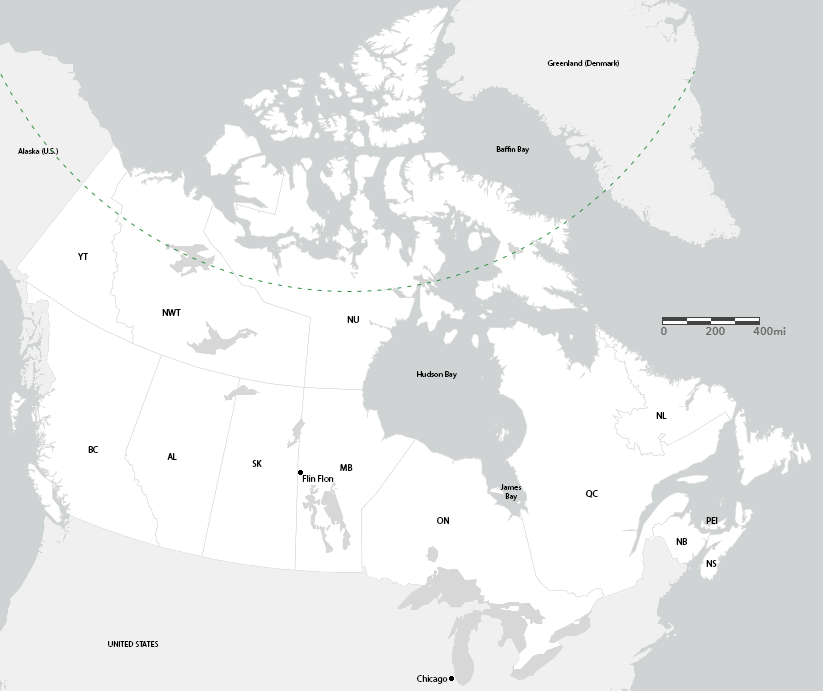
Canada with Flin Flon
(But I'd prefer if Tracy had said "stepped on a stage" or "set foot on a stage," because "step foot" has been driving me bananas since—well, at least 1998, probably before. I know it's prescriptivist. I try to do better. It's good to have areas in which one can improve.)

Scene 34 )

Is this the first time in the history of television that an unnamed uniformed police officer has just quietly got on with doing his actual job?

Scene 35 )

"Innocent" is probably a bit generous, but I suppose Fraser means only with respect to the particular crime they're talking about here.

Scene 36 )

The fixation with his mother does in fact start to nudge Dunn from ordinary creep into Norman Bates–adjacent territory.

Scene 37 )

Megafan turns out not to be completely without value? Film at 11.

Scene 38 )

Scene 39 )

Huey and Dewey's song is bound to be crap, but all the lyrics are in fact the lyrics to "Two Houses" by Paul Gross and David Keeley:

Don't call me for supper if you don't mean to feed me
Don't tell me you love me with that gun in your hand
'Cause I fall down dumbfounded
In the face of your beauty
Yeah, one look from you and I am a fool
In the palm of your hand

There's a house we call love built next door to hate
And both of them got lawns and a white picket gate
Their taxes don't differ and their water's the same
But in one you get comfort and the other house shame

Hey, do you mind if I speak
You know I'd like to be frank
Your cooking is wretched and this coffee is rank
But I look 'cross this table
Into the clutch of your eyes
And I'm kind of thrilled that we have been cursed
To live side by side

Sigh. (I don't know the Gross-Keeley song, so I don't know if Huey and Dewey are making up a crappier tune to it or just singing it badly. I can't get past the fact that "Their taxes don't differ and their water's the same" scans perfectly to "On top of Old Smokey, all covered with snow"—or possibly, in the circumstances, "On top of spaghetti, all covered with cheese.")

Scene 40 )

Scene 41 )

Do we conclude from this that it was George who killed Jeffers? I'm not sure the dots are all connected there. Why would he? I mean, if he's in love with Tracy, why would he shoot her, either, come to that. Was it him on the rooftop in scene 3? Why would he need a fan club photo—was he trying to throw suspicion on a fan? Wasn't he in on the decoy plan? Did he "miss" and only hit Officer McCafferty in the shoulder on purpose? He thinks she's going to change her management and abandon him (because he only books her into giant arenas and she wants someone handling her appearances who gives a shit about what she wants, i.e., playing smaller venues), so his idea is to scare her away from a smaller venue with the idea that a crazed fan could Get Too Close. Okay. So she wasn't in any real danger in scene 3 (or wouldn't have been even if it had been her) and wasn't really in any danger just now, either—except then he grabbed her and pressed the gun to her neck. What's that about? And, circling back to the beginning, why kill Jeffers? Because he was embarrassing her by getting trophies for Dunn? Because he wanted her to depend on him utterly? Was he going to kill Dwight next? Muddy Johnson? The rest of the band?

Scene 42 )

Look, it's not that I don't think Paul Gross is one of those performers who's irritatingly capable at whatever it is they try to do. (Except dancing, possibly. And, as I've said, crying.) I just think he's a better actor than he is a singer. His singing is perfectly competent—I'm not even mad about how far he opened his mouth on the sustained "girl," which I usually am when people sing on TV and in movies (I mean, exhibit A: the man himself singing "Ride Forever"), so well done, really singing—but he manages to look, while he's singing, like he's just so happy and flattered to be up there, and while the audience are applauding, like he's a little bit overwhelmed by the praise, which I absolutely believe is true of Fraser but do not for one minute believe is true of Paul Gross himself, who I'm sure is a very nice guy but who I expect usually assumes, like most successful actors, that he deserves to be in whatever spotlight he finds himself in at any given time. Put another way: I find the singing to be fine and the acting to be very convincing indeed. 😄

Dewey, of course, is referring to the comedy acts Laurel and Hardy, Abbott and Costello, and Milton Berle (not Milt and Berle; what a dingus). Francesca is still on about her hat issue.

Scene 43 )

I can't find that exact portrait of the Queen in a cursory few minutes of googling, and I don't care enough to track it all the way down, but I'd say it's from some time in the 1980s; her hair is still dark, so it's too early for the Golden Jubilee and probably even pre-1992, but her face is a little older than it appears in the Silver Jubilee portraits. She's wearing a blue dress; a dark cape or robe; a couple of orders on her left shoulder (but the ribbons look like the wrong colors to be the Royal Family Orders of George V and George VI, so I'm stumped); a necklace, earrings, and bracelet that are probably rubies because she tended to wear red jewelry for Canada; and a tiara that I can't see clearly enough to identify.

If Fraser is annoyed at the Queen for keeping him at his desk instead of going off on tour with Tracy Jenkins, it's probably just as well that he not go off on tour with Tracy Jenkins, isn't it? If she's going to reconcile with her husband, none of them needs Fraser hanging around catching feelings for yet another dark-haired woman who's going to do him wrong. (At least this one didn't lead him on in any type of way, for a change.)

The title can only be a reference to "Lady Sings the Blues," the autobiographical 1956 Billie "Lady Day" Holiday album, or the 1956 autobiography or the 1972 film by the same name starring Diana Ross. Except for Turnbull's suggestion that country music is the white man's blues, there is nothing in this episode that has a thing to do with the blues or Billie Holiday in any way.

Cumulative body count: 36
Red uniform: The whole episode, but not always with the tunic

Previous | Index of annotated transcripts | Next

fox: my left eye.  "ceci n'est pas une fox." (Default)

Odds
air date November 11, 1998

Scene 1 )

Is it just me, or does "It's been a bad month, it's been a bad night, well, a bad year" not actually make sense? He should have said "It's been a bad night" and then escalated from there.

In poker, a half moon is a semicircular table. So the woman, sitting on the straight edge, is the dealer; this is her game.

Scene 2 )

And "scarpa" means "shoe." She should be named Donna Scarpa, why not.

Scene 2 continues. )

I can make out almost none of the lyrics to the song—it seems to begin with "Sounds beneath the window" and I can hear "the ancient of the old" because I've been told (by the end credits) that's the title, but not much else. Can't find it online anywhere. Anyone got any help?

As-Nas as the ancestor of poker: very possibly. "I poke you" en français: it seems less likely.

Fraser is looking at Denny Scarpa with the same kind of expression of finding this woman compelling and not really understanding why that he had when he met Janet Morse, so this is sure to go well.

It's not surprising that Dewey thinks he could beat an expert in her own area of expertise just because that expert is a woman. This is a world in which one in eight men (in a nonscientific survey, though one imagines precisely none of the men in the survey were tennis players) believed they could score a point against Serena Williams. And much as in the case of the Dude Perfect Show, I would love to see Detective Thomas Dewey try to bluff Lady Shoes at her own table. For fuck's sake.

Credits roll.

Paul Gross
Callum Keith Rennie
Beau Starr
Camilla Scott
Tony Craig | Tom Melissis
Ramona Milano
and Gordon Pinsent as Fraser Sr.

(plus Draco the dog)

Stephanie Romanov, Andrew Tarbet, Paul Miller, Jack Nicholsen

(plus Dacquim the dog)

Scene 3 )

Kowalski notices it too! As if Fraser has never before fallen for a woman he didn't know.

Scene 4 )

I think Francesca becoming a cop is a terrible idea, of course, but (a) I understand her struggle to Find Herself and (b) I have to say I have not stopped loving the Welsh-Francesca father-daughter dynamic. ❤️

What kind of odd head shape would prevent a person wearing a veil? I have a deceptively large head, myself, so mass-produced hats tend not to fit me and I usually have to go with the largest size when I'm knitting myself a hat, but doesn't a chapel veil just drape over the head? I'm confused by Francesca's hat situation.

She is also, since we're talking about the shape of Francesca's body, not at all puffy or wearing a top layer or hidden behind her desk or a file folder or a vase or otherwise visibly dealing with the fact that the actress is pregnant at this time. This episode aired just a week after the previous episode, but who knows what order they were shot in, which I suppose is another reason not to give the character the same pregnancy as the actress. 🤷

Scene 5 )

I mean, I don't think so? You can hold a coffee cup in two hands?

Scene 6 )

It's no wonder Fraser's back is giving him trouble, being how he landed (a) hard (b) [right where the bullet is still threatening his spine(https://fox.dreamwidth.org/1503518.html#cutid3). Yikes.

White and Exley, of course, are the main characters in L.A. Confidential, the latter of whom is the son of a famous detective who was murdered—where have we heard this before? Anyway, I'll take Russell Crowe and Guy Pearce over these two cats any day.

Scene 7 )

What would she have done if one of the detectives had drawn the ace of spades, I wonder?

Scene 8 )

Goood.

Scene 9 )

Scene 10 )

The predictability of this stunt is slightly hampered for me by its depending on a poncho. Why is this civilian aide (apparently a civilian bicycle aide?) wearing a poncho? Is it raining?

Scene 11 )

Those feds are a couple of fuckwits.

Scene 12 )

Scene 13 )

I don't see why she doesn't just lift the table out of the cuff? It's not as if it's bolted to the floor? So I don't know, maybe she's not that bright after all.

I do enjoy the extras going by at the end of the alley puzzled and entertained by Fraser and Kowalski lying there on their backs talking to each other. (They can't be random passers-by, can they?, because randos would stop and try to watch the scene being filmed, which wouldn't do at all.)

The license plate on the car was LGB 648. We've seen that one before.

Scene 14 )

  1. Fraser is totally falling for her. Observe that he says "I'm not" in the same tone he used in "Bird in the Hand" to say "[I don't sulk](https://fox.dreamwidth.org/1506769.html#cutid19)" when he was, in fact, sulking.
  2. I'm getting tired of his assumption that women need protecting.
  3. Before anyone argues that Kowalski should have said "card sharp" instead of "card shark," I looked into it, and both terms have been in use for more than 100 years.

Scene 15 )

I . . . kind of love Drunk Thatcher. I also enjoy Fraser standing there having no real idea what (if anything) to do—although he should probably be glad she's off her face, because Sober Thatcher doesn't like it when he houses random women in the consulate even when Fraser is the only one wearing a union suit—but Drunk Thatcher is pleasing me greatly.

Scene 16 )

"Depends on how you define cheating" means she totally cheats, doesn't it.

But mainly: That massage scene was not far shy of soft porn, holy crap. The low light, the sultry music, the moaning? The last time we saw Fraser this intimate and unguarded with anyone was when he put Victoria's fingers in his mouth, which of course means, 🚨🚨🚨

Scene 17 )

See in cable syndication you can do a lot more innuendo than you could do when you were on network television so I know they're talking about all of her rather than about any part of him but they also just went ahead and said SHARK IN HIS UNDERWEAR?!

Scene 17 continues. )

No proof that she's protecting someone, Fraser? Did we not learn underneath Lake Superior that Kowalski's instincts are worth listening to?

Scene 18 )

Scene 19 )

She couldn't claim asylum?

Scene 20 )

Fraser, Fraser, Fraser, you are someone she can use.

Scene 21 )

[flinch] Ooh, he said that. Oof. It was 1998 all right.

Scene 21 continues. )

"We are on Fourth Street" just means Kowalski is dealing out the fourth card of the hand.

Huey has played poker with Fraser before, is the thing. (We talked then about how gambling is illegal in Illinois, too, but the show seems to overlook that when it's inconvenient.) Remember, he lied to get him to fold a straight flush. Fraser's been hit on the head a couple of times since then, but why wouldn't Huey remember that?

Scene 22 )

Scene 23 )

After the neck massage in scene 17, that kiss was practically chaste. (Practically.)

Scene 24 )

🤨 It's been less than 90 seconds since he asked her who said he doesn't trust her. Turns out our boy does know how to bluff.

Scene 24 continues. )

Can he not back out because doing this scam is going to make him a man?

Scene 25 )

Scene 26 )

Although she has a Russian name, the actress was born in Las Vegas, so damned if I can see why she should suddenly in the beginning of this scene seem to have a trace of an accent.

Scene 27 )

Hmm, a man named Lawrence was killed in Bakersfield, not unlike Denny Scarpa's brother Larry? Hmm. Never mind: Has this whole episode been an excuse to get Fraser into a tuxedo? Because I'm okay with that.

Scene 28 )

Okay I think "Hey, I own that tux" / "What do you charge?" is funny.

Scene 29 )

Relax, you pinheads, it's been one hand.

Scene 30 )

He's going rogue, that's what he's doing.

Packard wouldn't have been her given name, of course; he means it was her original surname. I guess this is where they pay off the adoption records he was looking at in scene 17?

Scene 30 continues. )

The Joey-and-Denny thing feels a little underdeveloped to me. He's the trigger man, but he apparently doesn't know that she's out to get Farah for personal reasons rather than just to rob everyone at her game and keep all the money for herself (although if she's that good, either at poker or at cheating, why does she need to have Joey come in and bomb the place to get all the money)? But anyway, he's had enough and wants to get out of this line of work, and she talks him into doing one more game—only he's at the table in this one rather than disrupting it, so, okay—and then they can be together always? So basically she's using him even more than she's using Fraser, right? But why on earth can't she shoot Farah herself with that gun she was smiling about a few minutes ago? I don't really see the point of Joey at all, to be honest.

Scene 31 )

But Kowalski does owe Fraser air. He did even before they bet air on this poker game just now.

Fraser is wearing a sleeve garter on his right arm (and probably also on his left, but we can't see it from here). Can it be that he's borrowed Huey's shirt along with the rest of his tuxedo (presumably including the tie and studs and cufflinks), and the sleeves are too long? (By the way, with a black tie he should have worn a fold-down collar; that stand-up wing collar goes with white tie. Hardly anybody actually follows this rule anymore, but they should.) Or is the sleeve garter just there as part of the gambling costume? He didn't take his jacket off at the poker table, so what's the point—except looking good, which I admit it does? (The deck they're using has Canadian flags on the cards, which I think is adorable.)

Cumulative body count: 35
Red uniform: Most of the episode, though without the tunic some of the time, and finishing in black tie

Previous | Index of annotated transcripts | Next

fox: my left eye.  "ceci n'est pas une fox." (Default)

Dead Men Don't Throw Rice
air date November 4, 1998

Scene 1 )

The game they are playing is meant to be Monopoly, but it isn't. In the first place, Boston and Maine Railroad isn't a property in the U.S. or Canadian versions of the game (the U.S. railroads are Reading, Pennsylvania, B&O [Baltimore and Ohio], and Short Line; the Canadian railroads from 1982–1999 were CP [Canadian Pacific], BC [British Columbia], CN [Canadian National], and Ontario Northland). In the second place, though, look at the board. Fraser is moving a token to a property two spaces from the corner, and the railroads are always in the middle of each side. The corner he's coming up to appears to say "Start Here" rather than "Go," and there seem to be three properties in the last group before that corner rather than just two, although every edition of Monopoly ever made has a two-property group on either side of Go (the dark purples at the beginning and the dark blues at the end). But the big thing is that the spaces are yellow and red and green rather than white with color-group headers. In short, this is not a Monopoly board, so I should probably not stress about the fact that there are buildings apparently on two of the three yellow property spaces in front of Fraser as well as on the red (what would be if this were U.S. Monopoly) Luxury Tax space and on the green (ditto ditto) Chance card space? Or that Fraser is talking about buying a property that, in addition to how it can't possibly be a railroad, apparently someone already owns or it wouldn't already have buildings on it? Or that he's moving his piece and declaring his intention to buy this property before the dice have actually landed? (The bills and whatnot in the middle of the board I can overlook, because some people play by house rules calling for taxes to go in there rather than to the bank and be awarded to someone landing on Free Parking.)

Rudolf Nureyev was a great ballet dancer, arguably the best of his generation, possibly the best ever, who defected from the Soviet Union to France in 1961. I don't think he spent the rest of his life looking over his shoulder expecting to be caught and returned to Russia, so I assume Jones's Nureyev comparison ends with the pirouetting.

Scene 2 )

The replacements are mad. Kowalski is vaguely entertained, possibly even flirting with Handler, who is having none of it. But listen, he's right: If there's a special signal and you don't give it, what do you think is going to happen?

Scene 3 )

I suppose you can do a lot of things when you're desperate, but that window doesn't look big enough to me for Jones to have got out through it.

Credits roll.

Paul Gross
Callum Keith Rennie
Beau Starr
Camilla Scott
Tony Craig | Tom Melissis
Ramona Milano
and Gordon Pinsent as Fraser Sr.

(plus Draco the dog)

Dean McDermott, Barbara Eve Harris, James Kidnie, John Hemphill, Frank Crudele, and Al Waxman as Van Zandt

Remember how four years ago Al Waxman was the bad guy on "They Shoot Horses, Don't They?" and Vecchio could tell it was probably him because he looked like That Actor, that is, hey-it's-that-guy?

Scene 4 )

Scene 5 )

Wonder where the other three guys—the two who let Jones in and the one who brought Van Zandt the gun—have got to.

Scene 6 )

This is the second phone Kowalski's lost in eight months, which is a bummer, I agree. What agency is Special Investigator Handler with?

The nearby car is a tan sedan with a cream-colored hard top; its license plate is, of [course],(https://fox.dreamwidth.org/1520149.html#cutid16) RCW 139.

Scene 7 )

These guys are definitely not gravediggers, because they're upset that they can't get hold of their friend who is called Digger, but there's definitely a Shakespearean-gravedigger vibe about them, innit?

Scene 8 )

Francesca is, surprising nobody, still hung up on Fraser. But someone else is sending her flowers. Does she wish they wouldn't?

Scene 9 )

I wish Fraser weren't as surprised and impressed as (let's be honest) we are when Kowalski busts out multisyllabic words and complete sentences with no hemming and hawing in them. Dude's a capable police detective, as we've seen before.

Carnauba wax is a common ingredient in shoe polish, which I assume is why Fraser is interested to discover it in the trunk of the Crown Vic; Two-Tone Jones was that dapper.

Scene 10 )

Scene 11 )

Kowalski as Good Cop, here we go.

Scene 12 )

Okay, Francesca is making plans to go to Atlantic City with someone who doesn't speak English?

Scene 13 )

Scene 14 )

How, if at all, could Fraser ever have made it clear to Francesca that there has never (or practically never) been any "this" to work out or not work out between them? I feel like even if his question had been "What isn't going to work out between us?" rather than "It isn't?" she'd have charged ahead anyway, determined to understand things in her own way despite what's obvious to literally everyone else in her world and ours. But hey, here's Francesca working hard to convince herself, I guess, that Fraser's not the guy for her (or that she's not the woman for him) (or both). "She's going to be a mountain climber or a snowmobile repair person" is sweet. Only she seems not to be happy about the fact that she's (apparently) getting married; no wonder Fraser is stumped.

And "I'm Catholic and he's one of those other religions" is hilarious. (If she's marrying the guy who was speaking German on her phone, he's probably Lutheran, right?)

Listen, though. We saw Francesca in "Dr. Longball" and "Easy Money" but not in "The Ladies' Man," and then we did see her in "Mojo Rising," and in that episode as here she's wearing more layers than usual—an overshirt, a stylish vest—and looking a little, if I'm not mistaken, fleshier in the face. This is a woman who is built slightly enough that a gain of a couple of pounds represents a much larger percentage of her body weight than of, for example, mine; but I'm also going to conclude Milano was pregnant at the time. (IMDb concurs, a little nonspecifically.) Which isn't strictly relevant, except that Francesca is apparently engaged to be married to someone nobody has ever heard of before or even knew she was seeing (including, as recently as last week when she was taking up Vodoun to try to break Mama Lalla's curse on the precinct, Francesca herself), whose language she doesn't speak and whose religion she can't name. It would make so much more sense to me if they had used the fact that the actress was pregnant to have this engagement-out-of-nowhere come out of somewhere. If, for example, Francesca—although she's a grown woman who has been married before and can make her own decisions—might as at least a Christmas-and-Easter Catholic find that she feels like single motherhood may be a step further than she wants to take her independence. I don't know! I'm not Catholic at all. I'm just saying allowing the character to be pregnant at the same time as the actress could have motivated some of her choices and behaviors in some way that otherwise seemed to have come one hundred percent from left field.

Scene 15 )

I am not Indigenous myself, so I'd certainly defer to those who are on the subject, but my understanding is that "Eskimo" is used by some and dispreferred by (and offensive to) others, so it's not quite the same as the tomahawk chop or Chief Wahoo (or the former name of the football team here in Our Nation's Capital, to say nothing of the many other professional, college, and high school teams that are named for specific tribes but may feel it's okay if they don't specifically use slurs to do it). In any event, Fraser didn't ding Ray Vecchio for his use of "Eskimo," but we've seen him learn things while he's been living in Chicago (e.g., "Zaire" one week and "Democratic Republic of the Congo" the next), so.

Anyway, I'm pleased to report that following the 2021 season, the Cleveland baseball team changed its name from Indians to Guardians, and Chief Wahoo—who was a cartoon, but more relevantly, a caricature—is no more.

Scene 16 )

The car that drove off had the rear license plate LGB 648 and the one that arrived at the funeral home had the front license plate ZYZ 364, but I feel like we're supposed to think they're the same car? Which just seems unusually sloppy for the props department, doesn't it?

Scene 17 )

I don't see why the fact that she's getting married is a more relevant reason for Francesca not to go on this assignment than the fact that she's a civilian.

Scene 18 )

They're eating cold sandwiches, which I don't see how those would have any particular smell—good or otherwise—and the place says right on the door that it's a fish market restaurant, but whatever.

Scene 19 )

Do Francesca and Kowalski know that Fraser is at the next table? It's hard to tell if she's glaring at Fraser when she's asking Kowalski about how someone can be so smart and also so stupid. Also hard to tell if he can hear her, although previous canon would suggest that from that distance of course he can.

Every dish in this scene—Tie Domi, Teemu Selänne, Esa Tikkanen, Pavel Bure—is named after a hockey player. I don't know what to do about that. I also don't know what part of a fish you'd call a saddle. Is it a sort of double filet? Like, a butterflied whole fish? (I mean you wouldn't serve one person a whole salmon. But a saddle of meat from a mammal is the loin from both sides of the spine, so I assume a saddle of salmon involves the same, even though usually it's split into sides?) Petits lardons are little cubes of salted pork belly, so maybe this saddle of salmon was seared in the hot pork fat before roasting and the crispy browned bits thrown on it as a garnish after? I don't know what "over four" means in this context; au four would mean "roasted," which the guy already said, but maybe he meant "for four," which is a more reasonable number of people to serve with a whole salmon?

Basically I'm puzzled by the menu at this restaurant on a number of levels.

Scene 20 )

Cal Tech says the surface gravity on Pluto is 112 the surface gravity on Earth (8.333. . .%). So a thing that weighs one pound on Earth, 16 oz., weighs 1612 oz. on Pluto, that is, 1⅓ oz. Other internet sources say an object's weight on Pluto is even less, about 5.9% or 6% of its weight on Earth, which would mean a pound of nails or cheese would weigh just .95 oz. (I suppose a pound of gold would weigh one troy ounce on Pluto, because there are 12 troy ounces in a troy pound, each of which is a hair heavier than an avoirdupois, that is, a normal, ounce.) I don't know from where Fraser is getting 6.4 ounces—or why he's speaking in standard or imperial measurements at all—but that represents 40% of the pound's weight on earth, which is pretty close to its weight on Mercury or Mars, but not Pluto.

Tony Orlando started in doo-wop and hit it big with Tony Orlando and Dawn in the 1970s.

Scene 21 )

What are the odds Fraser actually needs Kowalski's help to remember his lines here in this Clever Ruse they're perpetrating on these two schmucks?

In other news, Fraser is wearing an olive green sweater under his brown leather jacket, and it's good, but not as good on him as the cream and cooler blue shades he's worn at other times. (Have there been more than two blue sweaters? I can only remember the ones in "The Wild Bunch" and "Bounty Hunter," though they've dressed him in off-white several times ("An Eye for an Eye;" "Mountie on the Bounty part 1;" "Pilot," the original and best).) I was surprised I couldn't find more examples from the post-Vecchio oeuvres until I remembered there have only been half as many episodes since Vecchio split as before and Fraser is mainly wall-to-wall red uniform anymore.

Scene 22 )

Scene 23 )

The thing is that Fraser has not, as far as I can tell, been sending Francesca any signals, mixed or otherwise. So she's really off her nut. I feel like we'd be in a whole different place if her idea that her feelings for Fraser were reciprocated had any basis in any kind of reality. Of course if Francesca were pregnant, that could explain a small number of emotional outbursts; not that pregnant women always act crazy, but while I'm neither Catholic nor Indigenous I have been pregnant and I'm here to tell you it can indeed make all the feelings you were already having feel a little closer to the surface, a little bigger. So it's not like Francesca's ideas about Fraser would make sense if she were pregnant, but her yelling in the hallway might be a little less mysterious.

I'm so interested in the fact that Fraser didn't change back into his uniform as soon as he got back to the station but waited until after they'd lied to Ira and Vince.

Scene 24 )

That's too small to be a bouga toad, but whatever, apparently what Diefenbaker was saying was "Hey, remember Jerome?"

Welsh has made an offhand and unremarked-upon reference to [The Court Jester](https://en.wikipedia.org/wiki/The_Court_Jester) (1955), in which the immortal Danny Kaye (and Glynnis Johns! and Mildred Natwick as Griselda) does "the pellet with the poison's in the vessel with the pestle, but the chalice from the palace has the brew that is true" for five minutes.

Scene 25 )

Hey, remember the Nahanni River?
Canada with Nahanni River

And he could hold it for 36 hours? He wouldn't have just peed in his sleep? . . . I guess it's not really sleep. Still, though.

Special Investigator Handler has obviously never met this desk sergeant before if she thinks she can tell her to keep what she's seen to herself and that will work. I mean to say.

Scene 26 )

It's not surprising that Kowalski is the default dogsitter, right?

Scene 27 )

Did the promos for this episode show Fraser in the casket with no explanation? Did people flip their shit? Once the episode reached this point did people go all the way off on the Sleeping Beauty of it all? (Or was it Snow White? Which is the one where the prince has to kiss the girl to wake her up? Is it both?)

Scene 28 )

Aw, Diefenbaker. (Most of this short scene is in distorted black-and-white with subtitles, Diefenbaker POV.)

Scene 29 )

I like this moody music. It has a frequent descending-chords figure that reminds me a lot of the bit of the Fellowship of the Ring soundtrack right after the Bilbo Baggins jump scare. Gives the same feeling of something mystical receding, though in this case it keeps coming back in waves.

Scene 30 )

Hard to deny Fraser is good with a door. Always has been. But let me ask this:

BROTHER?!

Yeah, right.

Scene 31 )

Those two guys picked Fraser up very easily. If he were really dead he'd probably have passed out of rigor by this point, wouldn't he? And yet he doesn't bend at the waist, which is handy for them. Also, apparently after he lay down but before he became unconscious he thoughtfully grabbed onto the outseam of his trousers so his arms wouldn't just flop down from the shoulder.

Scene 32 )

This desk sergeant has spoken to Nicky about cooking poultry before, but at that time I think it was legit and this time it's obviously what she's falling back on pretending she was talking about the whole time. She's a gossipmonger, but I think I like her.

Chelsea Clinton—I keep having to remind myself how long ago 1998 was and how much might not be obvious to today's viewers—was, indeed still is, the daughter of Bill and Hillary Rodham Clinton, the former of whom was president of the United States at the time. She'd have been about 18 and was allowed, as I remember, more or less to live her own life without being subject to constant paparazzi attention. (I mean, not none. But the thing in e.g. The West Wing where the Bartlets laid down the law about press access to their youngest daughter was definitely borne out of the Clintons' real life.)

Scene 33 )

Here we go.

Scene 34 )

Heh. Brother.

Scene 35 )

Superman can die, though, although to be fair I guess he didn't stay dead, did he.

Scene 36 )

That, I think is lovely. Once in a while Bob Fraser comes through with something awesome (or heartbreaking), and this is one of those times.

Scene 37 )

Dewey's generally an asshole, but when the chips are down, look at him trying to take care of Kowalski, who's just lost his partner. Aww. (I think the story of the moose on the side of the mountain must be the caribou story he told Charlie Pike in "Diefenbaker's Day Off," so sincerely, nice continuity job, writer's room.)

Scene 38 )

It was Robert Browning, in [The Ring and the Book](https://en.wikipedia.org/wiki/The_Ring_and_the_Book), XI.2375–2377. Kurt Browning is a world champion Canadian figure skater (the first to land a quad in competition). I can't find anything on anyone named Thibault (or Tibault or Tibo or Teebo) Browning. [eta: An anonymous commenter alerted me to the existence of the Browning T-Bolt rifle, of which I had previously been unaware. This gun was produced between 1965 and 1974 and took .22 caliber ammunition (and reintroduced in 2006 allowing .17 caliber ammunition of a type that didn't exist until 2002), so it's not the gun that killed Bob—recall that was shooting .30-06—but maybe it was what he normally carried? Hard to say. It didn't occur to me to look for it in the first instance because what he says sounds like "tee-bow," that is, he doesn't pronounce the LT, which I assume one would when discussing the T-Bolt, but it's a good connection, so thanks for the heads up, Nonny!]

Scene 39 )

The Fraser-and-Diefenbaker reunion is sweet—enough so that I almost didn't ask what the hell Kowalski is wearing? It's a sort of opposite-color colorblock situation on the front of his sweater that I think even Vecchio might not have favored? Oof.

Francesca was much braver the last time she had a gun to her head, so I conclude that the sobbing this time is more because she thinks Fraser is dead than because she's scared. (Though it's another thing that could have been partly explained by the character being pregnant.) I do like everyone's stone-faced serious expressions, though. Like, again, Dewey is a jerk but maybe he's not actually a bad guy? If you see the distinction? The grim seriousness on Turnbull's face (is probably just McDermott being a professional in case the camera happens to find him but) must be what launched the Turnbull/Francesca ship, mustn't it (if it didn't get off the ground at "and think of the color yellow")? And then Welsh makes his (tasteless, in my view) Jonestown reference. Oy.

Scene 40 )

Three 99-year sentences is 297 years; I don't know how Van Zandt is eligible (not "available," Kowalski, come on) for parole in 143 years. It looks like since 1978, eligibility for parole in Illinois has been after the minimum term of an indeterminate sentence or 20 years, whichever is less; or after 20 years of a life sentence; or after 20 years or one-third of a determinate sentence, whichever is less. (Minus credit for good behavior.) (730 ILCS 5/3-3-3) So if Van Zandt's sentences are straight-up 99 years, or even if they're some range X–99, won't he be eligible for parole in either 20 or 60 years, depending if those sentences are simultaneous or consecutive? That is, if he technically gets parole in 20 years on the first sentence, doesn't he immediately begin serving the second sentence, and when he gets parole on that one, immediately begin serving the third? Or, in the alternative, does he have to do all 99 years of the first two sentences and then become eligible for parole after 20 years of the third one, which would be 218 years? There's no math I can do with these numbers that gets me to 143 years, because even if the range of Van Zandt's sentences was 47⅔–99, so three sequential minimum terms would add up to 143, he'd have been eligible for parole after 20 years because that's less than 47⅔. If the sentences were 61½–99 and he had to do two "full" (that is, the low end of the range with no eligibility for parole) terms before being eligible for parole after 20 years of the third sentence, that would get us 143 years. Otherwise I'm stumped. People who understand parole and release eligibility in Illinois are welcome to tell me what I'm getting wrong here.

Nowthen: Francesca's German fiancé. I heard Ja komm, ich nicht rauf was Sie sagen, "Yeah, come on — I'm not getting what you're saying;" als sich Ihnen vohern sagte, ich kann keine Englisch, "As I told you beforehand, I can't [speak] any English;" Sie Chicago-Mädchen sind merkwürdige, "You Chicago girls are weird;" ich muss jetzt gehen, "I must go now." I'm not super familiar with German but I have the feeling that "keine" isn't right and that "merkwürdige" should agree with "Mädchen," but maybe it does and I'm thinking too French-or-Russian-ly about it?

But besides his four lines, I have a number of other questions about Doppel Gänger (and is Paul Gross wearing some false teeth or just kind of holding his jaw oddly in addition to the glasses and the floofy way his hair is combed?) and Francesca's relationship with him. With this kind of language barrier, how did they get to the point that she decided they were engaged? I mean obviously they were not, because the dude can't possibly have proposed or consented. Or even known Francesca was planning to marry him. (He calls her Sie, which is formal, though I don't know how close you have to be to someone in German to switch to du. Naturally there'll be a range among German speakers, but is it normal or unexceptional to be reserved enough to save the familiar pronoun for after marriage?) Like—getting all the way to the dress fitting is pretty committed to the concept, yeah? But last week, as we said, nobody had ever heard of him?

Of course she was attracted to him in the first place because of his resemblance to Fraser. (See also Greene, Rachel, and her brief relationship with Russ.) But before the first place: Where did she even meet him? I assume she was making a deliberate effort to get over her hangup on Fraser. Which is hard for her to do!, and she stumbles a couple-few times. So but okay: She decides, presumably on the advice of a therapist or at least a priest (or possibly her mother and her sister, but let's give her credit for maybe going to see a professional), to proactively get out there and try to meet someone new. She meets Doppel Gänger and is thrilled. Neither of them can understand a word the other one says, but she's cute, so they give it a shot, and we've seen before how she'll hang right in there and try to keep a conversation going whether she's getting any participation from the Guy Who Looks Like Fraser across the table or not. So who knows?, maybe at some point he said something that sounded sweet and she said "Oh my god are you asking me to marry you?" and squealed and hugged him and he . . . can't have realized that's what just happened, but sure, his inexplicable new American Schatzie is effusing in his arms, why not. I'll go ahead and assume he really did send her those flowers, even. And then I'll give her credit for realizing, when she thinks Fraser is dead and is devastated about it, that she isn't over him and therefore shouldn't marry Doppel.

But I still can't make it make sense! How does he even know she works at the police station?

I want the title to be a reference to Dead Men Don't Wear Plaid (1982), but I can't make it work. I think it's just the aphorism "dead men don't tell tales" and the tradition of throwing rice at weddings.

Cumulative body count: 35
Red uniform: The whole episode, including the formal dress version when he's in the casket

Previous | Index of annotated transcripts | Next

fox: my left eye.  "ceci n'est pas une fox." (Default)

Mojo Rising
air date October 28, 1998

Scene 1 )

Yeah I don't know about the wisdom of not even yanking the keys out of the ignition when you jump out of the car at what you think is a crime scene. How much extra time would that have taken?

Credits roll.

Paul Gross
Callum Keith Rennie
Beau Starr
Camilla Scott
Tony Craig | Tom Melissis
Ramona Milano
and Gordon Pinsent as Fraser Sr.

(plus Draco the dog)

Salome Bey, Von Coulter, Maurice Dean Wint, and Maury Chaykin as Jasper Gutman

Scene 2 )

Okay, car first, then voodoo. The '67 GTO was the second year the car was available as its own model rather than just an option package on the Tempest Lemans (the last model year of the "first generation" of GTO). Kowalski appears to be driving the hardtop rather than the sport coupe (when the door is open you can see that the windows are frameless). GTO does indeed stand for Gran Turismo Omologato, which is Italian for "comfortable yet zippy car you can buy like a normal person." (I mean, it's Italian for Homologated Grand Tourer, which is more or less what I just said.) The Pontiac GTO was the first real muscle car, so Francesca's guess (great throbbing organ, we assume) may also not be that far off. The Ram Air IV camshaft apparently makes the thing even zoomier, not that it can actually go faster but that it can accelerate more quickly. I would have assumed "double barrel" meant dual-exhaust, but apparently it has to do with the fuel intake (and means this engine is less powerful than the four-barrel?). I'm not a Car Person, so if someone else wants to explicate better I'm all ears.

Father Malone is Hal Holbrook's character in The Fog (1980), a film I have not seen but which is the subject of one of my favorite stories my uncle told about the importance of seeing movies in theaters: All the characters are running from the malevolent fog and decide to run to the old church. "No," my uncle shouts in a crowded cinema, "not the old church!" From across the room another moviegoer shouts "Why not the old church?" And as the fog rolls up the church steps, my uncle shouts back, "That's why not the old church!" (. . . I don't know, maybe you had to know him.) Anyway, Papa Shango was a heel character in entertainment wrestling in the early 1990s, dressed up to look like Baron Samedi and named after Shango, a Yoruba god who was the third Oyo king before his death (and deified posthumously). The Yoruba religion is also called Vodun (or Vodon, Vodoun, Vodou, Vudu, Voudou, Voodoo . . . Fraser can shove a maple leaf in his "well, actually") and evolved in the west, as religions do, into various related forms, such as (relevant in this conversation) Haitian Vodou. The lwa are the Vodou pantheon.

If Kowalski's parents are still alive today, there's a better than even chance they watch Fox news, isn't there. (BUT I will give Damian Kowalski props for calling his son "Raymond" rather than "Stanley." Way to use your kid's chosen name, there, Mr. K.)

Scene 3 )

Thank you. Yes.

Scene 3 continues. )

Unsurprising that Kowalski is more concerned about his car than about the "stupid federal charges," but I'm not sure how I feel about the fact that Fraser seems to be more concerned about the federal charges. Like: Did we see Jerome with a deadly weapon? No, we did not. Taking the INS guys' word for it, which hasn't previously been Fraser's style.

Scene 4 )

So Gutman here is from New Orleans, so what he says he's familiar with is probably Louisiana Voodoo, and he also refers to Obeah as well as the Haitian lwa. Given his white southern boss-man-ness, I am immediately and profoundly skeptical of his sincerity, and I think so is Fraser; look at the way he cocks his head when Gutman says "It isn't a bad thing," as if he's just barely restraining himself from pointing out that nobody had actually suggested it was.

Scene 5 )

It's apparently not unheard-of to do the ninth night of the Nine-Night period after seven nights, so the fact that Eduardo's wife only died six days ago doesn't mean this doesn't add up; but should it have been done at Eduardo's home rather than in the church, whether Kowalski thinks it looks like a church or not?

Scene 6 )

I think about "There's showmanship in any religion" a lot.

Scene 7 )

That's not Kowalski's license plate, of course, but you know we've seen it before.

Scene 8 )

The white INS agent's name is Aaron Gobrah. I am going to PUNCH SOMETHING, and not just because in my personal accent "Aaron" and "Erin" are not homophones.

Scene 9 )

  1. I know there are lots of ways of describing what can be done with coffee, right?, because "regular" means different things in different places, for example, but isn't it pretty universal that black coffee has no cream? (I think Huey has not specified whether he wants sugar in that coffee, but what else would "black" mean?!)
  2. I'm always happy to see Dewey get coffee squirted in his eyes, but
  3. I shudder to think how much rehearsal that scene must have taken and how many takes they must have done and how many times Beau Starr must have had to change his shirt (or how many times Ramona Milano must have got hit by accident).

Scene 10 )

Scene 11 )

First of all, our three leads going "Mmmm" (that is: "oooOOOOOooo") is actually very funny. Second, when Fraser stops to call to Diefenbaker to join him, he does a thing with his right hand down by his hip, which I will bet several pretend dollars is actually Paul Gross telling Draco the dog "stay." Man, these are smart and well-trained dogs on this show, and it still must have just taken for-goddamn-ever to get Diefenbaker's scenes in the can. I remember reading somewhere that Peri Gilpin, who played Roz on Frasier, had workdays that were something like 20% shorter than everyone else's because she so seldom worked with Moose the dog (who played Eddie).

Welsh talks about Mert and how proud he is of her for her good work on the cleaning staff in a way that sounds actually quite sincere and not really all that patronizing? Which I suppose is Doylishly because Beau Starr is a professional actor and he can choose whatever tone he likes, but Watsonially it makes me think she has what must be a relatively severe learning disability and got her job through some sort of placement service for people with special needs. And she's beaming because she really is doing her best. ❤️ (But what kind of name is "Mert"? Obviously they were trying to do an analogy with "Mort," but couldn't they have called her Mart, which would have been short for Martha, instead of Mert, which is . . . I have no idea?)

Scene 12 )

Scene 13 )

Is this the first time Welsh has said no to some feds and the feds have actually listened?

Scene 14 )

I don't know, it sure still seems like appropriation to me. It's not that you can't learn a religion from a book; it's that your prayers won't be answered if you don't believe. (I mean, and maybe not even then.)

Scene 15 )

Damian Kowalski! He's trying so hard to connect! Every time Ray Kowalski comes up with some bullshit like "I took it for detailing" or "I run to work for the exercise" he goes with it, like he's been to therapy and learned that his son lives a different life in a different world than he remembers and if he argues too much or maybe any more at all he's going to lose him for good. ❤️Damian❤️

Scene 16 )

Gutman is skeevy as hell.

Fraser's stuff about the soul taking things to the other world (usually "the next world") is from Plato's Republic, but the words are those of Socrates.

The bouga toad to which Fraser refers is the cane toad; there's no explanation for why it is sometimes called "bouga." Pufferfish do contain tetrodotoxin, which is named for them and their fellow species whose organs contain it. (Be careful not to eat fugu unless it's prepared by a qualified chef, kids!)

Kowalski slapping his face to wake himself up after Fraser rambles is a thing that happened, although Fraser didn't comment on it.

Scene 17 )

Scene 18 )

I like the marching band. Nice return to form.

Scene 19 )

Goodfellow said [hæŋgən], sounds like "hangmen" but with a hard G and no M. Fraser said [hɐuŋgən], first syllable sounds like "hound" but with a G (and in scene 8 Lafourrette said [hɐungən], much more clearly differentiating the n and the g). I'm not surprised that Wiktionary suggests it's more correctly pronounced [huŋgən], with the u of "food," because we're talking about Hatian Creole, a French-based language, and the root of the word is from Fon, and none of these—Fon, French, nor Creole—has that "ow" diphthong Fraser (and Lafourrette) used.

Scene 19 continues. )

The INS probably does investigate everybody, which is gross.

Scene 20 )

Fraser's disappearance would be a lot more convincingly mysterious if we hadn't been able to see the brim of his hat for a moment in the shot where Kowalski is talking to the feds and then notice him turn and go.

Scene 21 )

If the practitioner herself pronounces it "voodoo," you'd think Fraser could give his "well, actually" a rest. Sigh. But okay. So Gutman is a bokor, and apparently powerful enough that Mama Lalla can't fight him herself? I guess her point is that she, as a manbo, isn't conversant enough with the Dark Side to confront Gutman effectively.

Scene 22 )

Wikipedia suggests that pwen are a type of talisman provided by oungans for healing. I don't see why he shouldn't keep them in a govi, which is indeed a vessel, except that the govi is usually used to house the spirit of an ancestor, and keeping pwen in there sounds a little (to me, and I'm absolutely not an expert, learning this as I am from the internets) like keeping a lucky charm in the urn with your grandmother's ashes. Bit disrespectful. A tabernacle is not a pantry. On the other hand, if Gutman is a bokor, that is, a bad oungan, maybe he profanes the sacred on the regular.

My French is pretty good but I don't know Haitian Creole, so I can't work out what Gutman is supposed to be saying (or whether Chaykin is saying it well). I got something like va vi li et pas ti chon; va faire boutou, which Google Translate suggests means something like "go live [your life] and don't be a fool; go do [your] work," so maybe it's all "mind your own goddamn business." Anyone able to parse it better than that?

Scene 23 )

The Tonton Macoute were a paramilitary organization serving two generations of Duvaliers, the dictators of Haiti from 1958 to 1986. So Gutman is, as suspected, a very bad man indeed, abusing refugees and threatening to return them to the persecution they'd fled.

Scene 24 )

I think Mama Lalla and her crew are praying to Loko and Gutman to Shango, both powerful figures among the lwa. I'm impressed with the photographic differences in the two scenes; Gutman is shown praying angrily and all alone, while—though it's not, obviously, that Lisa Lafourrette is happy right now, as her daughter is still missing—the prayer and song at Mama Lalla's altar is generally joyous and definitely full of confidence. Nice lighting choices here.

Scene 25 )

I like how Jerome doesn't hurl the jar onto the floor with any type of vehemence; he just lets go of it, beneath his contempt, I got no use for this object or this guy. Nice.

Scene 26 )

Scene 27 )

"I'm in love with the Mountie." "I know, son."

No?

Scene 27 continues. )

In Haitian Vodou, the gros bon ange is the part of the soul that handles basic biological functions like the ABCs of respiration and circulation. (Air goes in and out. Blood goes around and around. Change is bad.) Its complement, the ti bon ange, handles the nonphysical, like character and will. (The bons anges are "good angels," gros "big" and ti (petit) "little," respectively, or major and minor, though I don't think the ti bon ange is lesser than the gros in any way; maybe outer and inner is a more accurate gloss?) I expect Fraser is not concerned about Jerome Lafourrette's ti bon ange, but telling him to keep his gros bon ange healthy (and pronouncing it extremely Québecois, by the way, at least to my ear) is basically telling him to be safe.

Cumulative body count: 35 34
Red uniform: The whole episode

Previous | Index of annotated transcripts | Next

fox: my left eye.  "ceci n'est pas une fox." (Default)

The Ladies' Man
air date October 21, 1998

Scene 1 )

First of all, car owner guy, your car is a shitty beat-up station wagon with rust around the gas cap, so I wouldn't worry about the paint on the hood. Second of all, the main article in the newspaper in the vending machine is clearly pasted on, and not well.
front page of American Morning
The typesetting looks a little better than the replacement headline and byline in the Chicago Tribune article about the U.S. Open Billy Butler in "Mountie on the Bounty part 1"—although there's not enough space above the headline and too much space below it, and why does it only span three and three-quarters of five columns—but I am still dinging the props department pretty hard for this. Oy vey. (The picture is no doubt the actress's head shot, but I suppose it works in the context.)

Mainly, though, this is a scene about how something is bugging Kowalski to a degree we have not previously known, dissociating wildly and then, when he looks at Fraser, haunted and scared and still ready to snap if the wind blows wrong. Lucky for everyone that he responds to Fraser's voice the way he does.

Credits roll.

Paul Gross
Callum Keith Rennie
Beau Starr
Camilla Scott
Tony Craig | Tom Melissis
Ramona Milano
and Gordon Pinsent as Fraser Sr.

(plus Draco the dog)

Dixie Seatle, Bill MacDonald, Nancy Palk, and Art Hindle as Robert Bedford

Scene 2 )

I'm a little puzzled by a buffet or salad bar that has nothing on it but cheese and dried fruit. Does Fraser think Kowalski is in the state he's in because he's backed up? It's probably not important. I think the bartender was maybe supposed to be some sort of comic relief? Where he was supplying the words Kowalski was looking for in a way Fraser might once have done except that he, Fraser, has (not a moment to soon) caught a clue about when such "help" is appropriate? I don't know, I feel like maybe this scene (hell, maybe this episode) could do without the levity. I do like how concerned Fraser is about Kowalski and how gently he's taking care of him.

Attention to detail alert: I'd like it if Officer Kowalski in the flashback had been wearing a wedding ring, although I suppose we don't know how long he and Stella were married, do we.

Scene 3 )

I'm with the lawyer on this one: Not Employing Literal Medieval Torture Methods is a pretty low bar to clear. (Besides, modern prisons have torture methods of their own, so it's not 100% certain they do clear that bar.)

My dad used to sing "K-k-k-Katie" to me when I was wee. (My name's not Katie either.)

Scene 4 )

I think I like her. The way she rolls her eyes and singsongs "It's not your fault"—like, even assuming she did kill her husband and is therefore guilty and "should" be executed (a premise I don't agree with, but we're not here to talk about the death penalty today), her execution is not something that's happening to Kowalski, right, and she is one hundred percent within her rights to make him aware of that.

Scene 5 )

It really is a beautiful car.

I'd like to believe there are some anti–death penalty protesters there as well, not just the go-to-hell-and-stay-there crowd.

Scene 6 )

I'd like to thank everyone involved in writing this scene for not having the bartender say "Why would she want to kill him in public?" and Fraser say "I think he meant she'd threatened, in public, to kill him."

I'm alarmed by this Despondency cocktail. St. John's wort is an herbal remedy thought to have some antidepressant qualities, but all parts of the windflower are poisonous. And what's the cuttlefish doing in there? Maybe that's how it got the brown color, because cuttlefish is where sepia ink came from? And is the bartender hitting on Kowalski or Fraser or both? Read the room, buddy. Although speaking of reading the room, if there was ever a time for Fraser not to tell the whole truth, it was in response to the question "You ever make a mistake like that?" What, I ask you, would it have cost Fraser to cut straight to "That's not important" without saying "No" first?

Scene 7 )

What is Welsh carrying, a coffee maker? And it's not that I don't appreciate putting Dewey in the role of Chief Asshole of the precinct, because he's clearly established himself as tactless and insensitive at best, but for a guy who so obviously isn't satisfied with his job as a cop, he sure is ready to beat the in-group drum here, isn't he?

Eight years doesn't seem like that long of a time for a capital case to get all the way from arrest to final appeal, especially because if clemency from the governor is Beth Botrelle's only hope, she'll have exhausted her federal options as well. I can't find data specific to Illinois (which hasn't executed anyone since 1999 and abolished capital punishment in 2011), but here's a statistic that says in 1998 the average time between sentencing and execution was 130 months; of course averages get to be that way by some things being longer and some quite a lot shorter. Beth Botrelle's trial will have had to take place within about four months of her arrest, and given that the trial only took a week, maybe she was sentenced quickly too? But anyway, that means Kowalski was a rookie in 1990, which would make him about 29 at the time, which is old for a rookie, isn't it? Especially one who dropped out of college to go to the police academy? What was he doing in the rest of his 20s? (I mean: He was accumulating citations as early as 1988, so apparently we're being extremely generous with the word "rookie" here and are going to have to do some convolutions to make it work. When Kowalski says he was a rookie when he went to chez Botrelle eight years ago, i.e., in 1990, does he mean that was the first case he'd ever gone to by himself? Is that a reasonable use of "rookie"? Hmmmm.)

Scene 8 )

This young woman works in an archives- or librarian-adjacent job, so it's true that she and Fraser have something in common, but where the hell has she come from? And if she and Fraser are good enough buddies to be giggling together over her misfiling of Land Acquisitions with Aboriginal Spirit Walks and she's inviting him on a bark tea date right under Kowalski's nose, would it have been too much to ask Fraser to call her by name?

Burmese marionette puppetry is a real thing, and the art was of course badly damaged by colonialism; it's been revived since the late 1990s under the patronage of the ruling junta, so the geopolitics of post-colonial Burmese puppet theatre is probably a very interesting subject and I'd like it if the show didn't treat Fraser's friend as ridiculous for giving a lecture on it (though as a white woman her standing to do so could, I suppose, legitimately be questioned). Inuit throat singing is also real, and so is Dawson Creek, BC, though I'm getting exhausted by how much Fraser seems to have moved around as a kid.
Canada with Dawson Creek

It also makes me tired that the state's attorney is named Robert Bedford, especially in a moment where we're already talking about movie stars because Ronald Reagan. Sigh. However, I appreciate the attention to continuity, that Damon Cahill was running for the position but presumably wasn't elected because he was implicated in a murder-for-hire scheme. (I mean in Chicago that might not be disqualifying. But still.)

Scene 9 )

That was sloppy sneaking, Kowalski. Couldn't you have put the guy's sandwich back where you found it?

Scene 10 )

It's locked? It's a fire exit. It's got a fucking crash bar on it. That shit locks from the inside. You should always be able to get out that kind of door. How did Fraser and Kowalski lock it behind them?

Anyway, if bag 1 was replaced into bag 6, bag 2 into bag 7, and so on, then bag 26 wouldn't be replaced into bag 111, would it? Wouldn't it just be in bag 31? 1-6; 2-7, 3-8, 4-9, 5-10, 6-11; 16-21; 26-31. What am I missing? Unless by "up to 20 and then the pattern repeats itself" what Fraser means is that the contents of bag 19 are in the bag marked 24 and the contents of bag 20 are in the bag marked 25 and then the contents of bag 21 are in the bag marked 106? . . . So are there no bags marked 26–105? And how much time must someone have spent so carefully changing all these things? Jesus. Why not just do a random switcheroo?

Scene 11 )

Do the police work for the state's attorney? I really don't think they do, and I don't see where this cat gets off giving Kowalski a direct order about his lunch, never mind about what questions he's allowed to ask. On top of which, Kowalski hasn't made any statements about the situation, inflammatory or otherwise. So Bedford can probably shove it. (Also also: Everyone in this episode is going ahead and calling Kowalski Kowalski. I guess the Vecchio's-safety thing is no longer a going concern?)

Thanks for the callback to Sandor the pizza guy, Fraser. This is actually a scene about how we love Welsh a little bit more.

Scene 12 )

Scene 13 )

Welsh isn't in charge around here? With his known preference for not keeping records any longer than is necessary? What about Commander O'Neill? What ever happened to her?

Scene 14 )

Now Welsh is carrying a feather duster and a toaster. I'm dying to know what kind of back story Starr had in mind for what Welsh was up to in this episode.

Scene 15 )

Scene 16 )

In fact the real question is can Sherman demonstrate that the state shouldn't be allowed to kill Beth Botrelle.

Scene 17 )

Scene 18 )

Norma Rae

Scene 19 )

This isn't what's important about this scene, but how did Fraser get into Kowalski's building if he wasn't even sure Kowalski was there? I think we have to stop the clock and admit that by this point Fraser has a key to Kowalski's place. Did he ever get a key to Vecchio's house? 🤔

Scene 20 )

Scene 21 )

Scene 22 )

So Fraser and Kowalski were hoping to lure whomever had bugged Kowalski's apartment to Wayne and Shuster, and they were surprised when they got Huey and Dewey instead—because I guess they have immediately discarded the idea that it could have been Huey and Dewey who bugged the apartment? Or maybe they didn't discard that idea until the explanation was the tip about the drug deal. Now they know whoever placed the bug was the one who gave Huey and Dewey that bogus tip; but why didn't it occur to them that whoever was spying on them would also be after that bit of fake evidence?

Nice of Huey and Dewey to offer Fraser and Kowalski a lift back home, though. Does Fraser not want a lift in their car because he assumes it's bugged as well? Or just because it's a piece of junk?

Scene 23 )

It didn't take Huey and Dewey long to get over being annoyed that someone was playing games with them, huh? I wonder if these scenes were edited together in a different order than they were written in.

Has the rumor of Bedford's running for governor been confirmed? I guess "Let's not talk about that right now" is different from "No."

Scene 24 )

The toughness Beth showed Kowalski is not at all present here. Also, I love (love) Fraser saying (with the same kindness with which he said "thank you" to Garret the Dreamer "He knows" rather than "I know." ❤️

Scene 25 )

I guess "she's guilty anyway" is supposed to have been Bedford's reasoning for why it was a good idea to destroy the evidence that Botrelle was having an affair with his wife. Which I also don't see why a guy's wife having an affair with a cop ruins his family image—not if he's the aggrieved party who's been stepped-out on—but of course it would have disqualified him from the case, and if he wanted prosecuting Beth Botrelle to make his career, okay, he destroys evidence that would reveal his own wife's affair with the victim but not (apparently) exonerate the victim's wife. . . . But if that's the story Kowalski is telling Franklin, that they're trying to prove Bedford tampered with evidence and therefore Beth Botrelle should be acquitted on a technicality, I don't see why he's also leaning on "She didn't do it."

Scene 26 )

Okay that cash has been sitting in that storage locker for eight years. Did nobody miss it? (And what did Fraser find?)

Scene 27 )

I can only assume that what Fraser found in the storage locker was a notebook with a page torn out (that would be the piece of paper Kowalski found under Jake Botrelle's body), and he was able to see the impressions the pen had left on the page behind it? Or something like that? The last few dots have not at all been connected here.

As for the witnesses to Beth Botrelle's execution, one imagines the older man in the back might be her father-in-law. There's also a uniformed officer (wearing their hat indoors, tsk), two women, and two youngish men in suits. I'm a little surprised none of them is her lawyer.

Scene 28 )

I do like her. I'm fine with her continuing not to let Kowalski off the hook, although I'm not sure about the value for her in reviewing the night her husband died all over again. (I'm surprised she's already home, though I guess we don't know how much time is supposed to have passed since the previous scene; also frankly I'm surprised she still owns the house.) I think it's absolutely right for her not to want to hear Kowalski's apology, because she doesn't want to be in the position of having to forgive him—but ultimately I suppose she concludes that he was used as a scapegoat, too. (I mean. If he had read the note and knew what it said, couldn't Franklin have tampered with the evidence anyway and discredited him; ruined his, Kowalski's, career; and sent Beth Botrelle to her death?)

Scene 29 )

Thank God Fraser doesn't feel like he has to say anything at this point. And the camera backs humanely away to give Kowalski a moment as well.

Cumulative body count: 34
Red uniform: Almost the whole episode, but a soft sweater and flannel overshirt for the very end

Previous | Index of annotated transcripts | Next

fox: my left eye.  "ceci n'est pas une fox." (Default)

Easy Money
air date September 30, 1998

Scene 1 )

So this Goody fellow is a ball of slime, eh? And he's awfully full of himself for being someone's personal assistant. Like that young woman fetching the coffee probably outranks him by about nine levels and he must have paid her a hundred bucks to answer when he pressed the button on that garage door opener.

"The Tonto act" is funny. Give 'em the old razzle-dazzle, Quinn.

Scene 2 )

It's so interesting to me how Fraser pops up to his feet as soon as he's back up on the roof. It's the same way he hops back up after he dives for the fan that's about to land on Annie Morse-Torrance and Janet catches it instead; a hop up that connotes a great deal of "I'm good, nothing to see here" or even "That was deliberate, it was deliberate." This is not the first time a baddie has got him in a pickle; what's he so embarrassed about?

Credits roll.

Paul Gross
Callum Keith Rennie
Beau Starr
Camilla Scott
Tony Craig | Tom Melissis
Ramona Milano
and Gordon Pinsent as Fraser Sr.

(plus Draco the dog)

Dean McDermott, Philip Granger, Tyrone Benskin, Clare Coulter, Dan MacDonald, and Gordon Tootoosis as Quinn

Scene 3 )

This kid is about . . . what, 12? His voice hasn't changed, and his teeth don't exactly fit in his mouth. I guess he could be as old as about 14 before I'd expect him to have got quite a bit sturdier and stronger given the life he must lead. But I think he's on the young end of the range; if he were already bar mitzvah, Quinn probably wouldn't ding him for being out on his own.

So a 12ish Benton Fraser and he's feeling some peer pressure because Innussiq killed his own caribou last year. Sigh. My six-year-old is annoyed that one of his best friends, who's seven months younger than he is, has already lost three teeth while he, my own kid, hasn't had so much as a wiggle. The explanation that different kids grow at different rates is not really meaningful or satisfying to him. So probably asking 12yo Ben Fraser why Innussiq killed the caribou wouldn't get you far. And yet.

Scene 4 )

I'm vaguely interested that Kowalski was all up on Quinn's visit to Fraser before they went downtown.

Scene 5 )

Ha. Did I say 12? I did.

So: I've been a kid, and I know the tyranny of everyone-else-gets-to. But I'm also a parent, and I feel pretty strongly that Fraser's grandparents will have a reason for keeping him from hunting while every other boy's parents or guardians (if it is in fact true that every other boy his age is allowed to hunt) allows them to hunt. [ponder]

Scene 6 )

I don't know why Francesca thought it was a good idea for her to open her mouth at all, to be honest.

Scene 7 )

So I've ranted before about how we're up a tree over here loving a cop show where we have to consider the cops the good guys, because Kowalski is Bad And Wrong here and the guy is absolutely right not to be talking to him. But then in comes the "lawyer," that is, the partner in crime, and he too is Bad. (Does anyone for a single moment believe that if Storey tells Tim where the stuff is, Tim will in fact get him a defense lawyer of any kind? Of course not; he'll disappear with the stuff, and Storey knows it perfectly well.)

Scene 8 )

This scene is so important.

Listen to the tone in Fraser's voice when Kowalski asks why Quinn is his, Fraser's, responsibility; it's as if it literally never occurred to him that it wouldn't be, and more than that, he doesn't entirely understand the question even now. (I'm going to grit my teeth and skip lightly over his use of the word "articulate" to describe a person of color. Just this once.) Then Kowalski's monologue about his own father ends up with him talking about how much he loved . . . a car. And then the way his face changes when Fraser presses. (And the way Fraser's face changes while Kowalski is talking.) Man, people's relationships with their dads on this show. Fraser's father was absent for most of his childhood, and when he died they hadn't spoken since Christmas. (But he was probably secretly pleased his son had gone into the RCMP.) Ray Vecchio's father was a drunk and an abuser, and he may have been a low-level gangster, which may have been why he hated cops and didn't want his son to become one (although they don't seem to have cared for each other much). Welsh's father is a drunk, and he was apparently in law enforcement himself, but he's not too exercised about the fact that his younger son (I know it's an assumption, but I'm assuming that Wilson Welsh is the elder brother because Wilson was president before Harding) followed in his footsteps. And now here's Ray Kowalski, who knows perfectly well that his father feels like he squandered the opportunities his father (a) never had for himself and (b) worked hard to get for him.

So Fraser feels a responsibility to Quinn, and Kowalski feels that he has already let his father down. But listen: I just did a tangent on everyone's relationship with their fathers on this show, but in fact Fraser nor Quinn has not said more than three syllables about Bob Fraser in this episode (this is where he was killed; he was honest), which I think is not uninteresting.

I'll also bet about five pretend dollars that Diefenbaker might not have been supposed to be sniffing at the countertop and it's actually Rennie asking Draco the dog, rather than Kowalski asking Diefenbaker, if he wants a coffee. He bends down and talks to him nose to nose and it is freaking adorable whether it was in the script or (as I also suspected, remember, when the baby cried and Fraser said "Oh, very unhappy!") not.

Scene 9 )

The timing of Fraser interrupting Kowalski on "The guy's got —" was a little off. I wish Rennie had had the rest of the sentence in mind so he could have kept talking until Gross cut him off.

Scene 10 )

There's your titular easy money, then. Is Quinn going to sell the jewels to pay for lawyers and access and whatnot to save his community? Ransom them to stop the dam project?

Scene 11 )

I don't know about you, but this episode is not quite 19 minutes old and I already feel like Quinn wouldn't have been that careless.

Scene 12 )

I like "Hey, Fraseur" almost enough to forgive the fact that Kowalski pronounces "composite" so goofily (with the accent on the first syllable, ['kɑmpəzɪt], rather than on the second syllable, [kəm'pɑzɪt].

Scene 13 )

Scene 14 )

See, in this scene I don't see just a Francesca who is uncomfortable with how loudly Welsh and everybody else is yelling. I see a Francesca who (granted, she shouldn't have run her mouth in front of the cameras in scene 6, but) had the same abusive father as Ray Vecchio and is even now, as an adult, reflexively frightened when a man twice her size is angry. Put another way: Earplugs-schmearplugs, that woman needs an EAP.

Scene 15 )

Something something student becomes the master? (Although look, Benton, 12 isn't too young to learn that there's a difference between tasting something and eating it. Good lord.)

Scene 16 )

Never mind, I guess the student isn't becoming the master at all.

Scene 17 )

Where I come from, we don't say "the" I-90. I think of that as a California dialect item (or, of course, Canadian).

Scene 18 )

Scene 19 )

We've come to the heart of the matter. Quinn knows Fraser knows he has the stolen jewels and doesn't think he should keep them, even though selling them and hiring lawyers with the proceeds could save his home. When Fraser was 12, Quinn didn't think he should kill a caribou, even though it could prove that he was grown. The question of need is a sticky one, though. Benton didn't need to kill the caribou in the same way that, presumably, Innussiq and the other boys did—that is, the other boys are subsistence hunting and Benton is doing it for sport, like Quinn's clients from the city. Benton wants to kill a caribou to show he belongs; Quinn says he already does belong and that's why he shouldn't do it. . . . All that does feel different to me than (a) their other metaphorical example, where Stinky Masterson's dog needed transport to an emergency vet and (b) Quinn's situation. It sounds to me from Fraser's own description as though Stinky did need Jimmy's snowmobile, not just want it; and does Quinn have another way to save his home other than hiring lawyers to fight the dam builders? Or another way to hire lawyers other than fencing the stolen jewels? So the parallels are not 100% accurate, but nevertheless, Quinn wants to fight the corrupt, evil men and Fraser says it's not worth it if he becomes corrupt and evil himself to do it. So where Quinn helped Benton find the caribou so he could decide for himself whether to kill one, Fraser is going to help Quinn find a fence so he can decide for himself whether to go ahead with his plan. (For what, as has been pointed out from time to time, shall it profit a man if he should gain the world and lose his soul? That's clearly what the show is driving at here, though it's been pretty careful all this time to keep away from religion as much as possible.)

Scene 20 )

I'm not sure what sudden interest in Kelly he's asking her about. Other than that, I appreciate Francesca finally telling Kowalski where to shove his corrections of her malapropisms.

Scene 21 )

If he'd killed anything big before, he wouldn't probably be out here feeling the need to hunt to prove he's a grown-up, right? The "not too late to turn back" exchange is heartbreaking.

Scene 22 )

Scene 23 )

Mushrooms? In ratatouille? (Also, doesn't Fraser have keys to the consulate? Why would a locked door stop him?)

Scene 24 )

This just in: Turnbull is not, in fact, completely useless.

Scene 25 )

For our younger readers: Toys R Us was a chain of giant toy stores that for a while in the 1980s and 90s were everywhere. They went bankrupt and closed in 2021.

Scene 26 )

Scene 27 )

Fire hazard much?

Scene 27 continues. )

Scene 28 )

There's a pause in "Forget the _ script" that sure sounds like the actor playing Kelly did an expletive and rather than shoot the scene again or even do ADR they just deleted it in post. An interesting choice. Anyway, it sounds like they might be talking about an actual movie?, and I don't know which one. Not like there's not a wide selection of heist-and-hostage films to choose from.

Scene 29 )

So Kowalski the giant Steve McQueen fan on a motorcycle flying through the air—the movie was probably The Great Escape (1963)?

Scene 30 )

Let's get the Kowalskis out of the way first: I love the way Kowalski and his mom look at each other. I'd like it better if she accepted his chosen name, but if it doesn't bother him that she calls him Stanley, the rest of us can probably get over it. (And at that time it was definitely much more common, wasn't it, for people to tie name changes to life-stage changes as well, so people who had always known them by the old name were often excused for continuing to use it. Today, I feel like your kid—at any age—says "I'm going to use this other name now," you call them by the other name. You at least make the effort. But again, Mrs. K calls her son Stanley and he doesn't say "Mom, for the hundredth time, it's Ray," so I'll just be over here adoring how their eyes both crinkle when they put their foreheads together.) And! How Damian Kowalski (fun side note: we've seen this actor before as Murph, the Whiskey King of the Windy City) towed that GTO all the way to Chicago; that is a father and a son who are both worried they've irremediably disappointed each other, is what that is, so how lucky for both of them (and especially for her, honestly) that all it took was a 2,000-mile road trip to bring them back together. (It wouldn't have been that long, but apparently they came in on I-90, so I conclude they were doing a grand tour and just stopped by when they were in the vague vicinity of Chicago, rather than coming to Chicago specifically, because in fact I-90 only runs in Illinois for about 100 miles between Gary, Indiana, and the state line on the way up to Madison, Wisconsin. You would not use I-90 at any point on the drive from anywhere in Arizona to Chicago.)

But how fortuitous that the Kowalskis happened to be coming by or through Chicago within 24 hours of Fraser and Ray Kowalski having that conversation about how they'd moved to Arizona. Did . . . did Fraser contact them and ask them to come see Ray? Because he absolutely should not have done that. I'm going to choose to assume he did not.

Nowthen. Benton Fraser shooting that caribou. The kid gives a pretty good performance in this scene, nicely showing the initial "I did it!" and the ultimate "What have I done?" The foley guy supplies good dying caribou; I don't know what noises a caribou makes when it has just been shot, but I believe that the one Benton shot is going to take a long time to die. And then what's he going to do? Take the antlers as a trophy? Does he even know how to field dress game? How's he going to get the carcass home? Do his grandparents have the storage space for that much meat? Will he be able to make use of the hide? Or has he, as Quinn suggested, killed an animal not because he needed it but because he wanted to, for himself, which is sacrilege? I can't not think about Sports Night s1e3 "The Hungry and the Hunted," in which Jeremy gets his first producing credit but ends up in the emergency room after he passes out on a hunting trip:

JEREMY: We shot a deer! In the woods near Lake Mattituck on the second day. There was a special vest they had me wear so that they could distinguish me from things they wanted to shoot, and I was pretty grateful for that. Almost the whole day had gone by, and we hadn't gotten anything. Eddie was getting frustrated, Bob Shoemaker was getting embarrassed. My camera guy needed to reload, so I told everyone to take a ten-minute break. There was a stream nearby, and I walked over with this care package Natalie made me. Sat down. When I looked up, I saw three of them: small, bigger, biggest. Recognizable to any species on the face of the planet as a child, a mother, and a father. Now, the trick in shooting deer is that you've got to get them out in the open, and it's tough with deer, 'cause these are clever, cagey animals with an intuitive sense of danger. You know what you have to do to get a deer out into the open? You hold out a Twinkie. That animal clopped up to me like we were at a party. She seemed to be pretty interested in the Twinkie, so I gave it to her. Looking back, she'd have been better off if I'd given her the damn vest. And Bob kind of screamed at me and whispered, "Move away!" The camera had been reloaded, and it looked like the day wasn't going to be a washout after all. So I backed away, a couple of steps at a time, and I closed my eyes when I heard the shot. Look, I know these are animals, and they don't play bridge and go to the prom, but you can't tell me the little one didn't know who his mother was! That's got to mean something! And later, at the hospital, Bob Shoemaker was telling me about the nobility and tradition of hunting, and how it related to the Native American Indians, and I nodded, and I said that was interesting, while I was thinking about what a load of crap it was! Hunting was part of Indian culture. It was food, and it was clothes, and it was shelter. They sang and danced and offered prayers to the gods for a successful hunt so that they could survive just one more unimaginably brutal winter. The things they had to kill held the highest place of respect for them, and to kill for fun was a sin. And they knew the gods wouldn't be so generous next time. What we did wasn't food, and it wasn't shelter, and it sure wasn't sports. It was just mean.

That episode aired October 6, 1998, one little week after this one. What an interesting week on TV dramedies for hunting stories, am I right? The absolute guilt and shame Joshua Malina puts into the silent beat right after "You hold out a Twinkie." is what we're meant to understand Fraser has been living with since he was 12 and shot that caribou not because he knew he needed to for his own survival but because he felt he needed to for his own reputation. Shooting the caribou would prove he was a grown-up, he thought, and here's the thing: It did, but not in the way he had expected it would.

And of course the best performance of all—in that last scene and in fact in the whole episode—is Gordon Tootoosis as Quinn, who presses his knuckles to his lips when Benton sights the caribou and drops his hand when Benton shoots and is so sad and disappointed that he led this boy to where he could make his own decision and then the boy made the wrong decision—and then, while the caribou is groaning and dying, looks at Benton to be sure he's going to be okay.

Cumulative body count: 34 (and one caribou)
Red uniform: The whole episode, but not (of course) the flashbacks

Previous | Index of annotated transcripts | Next

fox: my left eye.  "ceci n'est pas une fox." (Default)

Dr. Longball
air date September 23, 1998

Scene 1 )

Yeah okay blah blah Welsh wants Fraser to give him a lift back to 1958, or failing that to Willison, which is presumably in Wisconsin because of all the dairy references, minor league baseball, crime does in fact exist even in the heartland, the announcer does some nice expository work, I guess we're going on another field trip. But WAIT JUST A SECOND, Huey called Welsh "massa," and nobody in the squad room blinked or was in any way surprised? Just me? Huey is about a millimeter shy of openly observing that the 27th precinct is run like a plantation and that is somehow not the subject of this episode? Doesn't even warrant a tiny bit of scrutiny? Nothing? I'm the only one talking about this? Holy shit.

Credits roll.

Paul Gross
Callum Keith Rennie
Beau Starr
Camilla Scott
Tony Craig | Tom Melissis
Ramona Milano
and Gordon Pinsent as Fraser Sr.

(plus Draco the dog)

Dean McDermott, Max Gail Jr., Wanda Cannon, Richard Fitzpatrick, and Bruce Weitz as Huck

Scene 2 )

Sigh. So look, the nature of crime in the big city is different from the nature of crime out in the sticks, sure. Probably so is the staffing. A sheriff's department is a lot fewer people responsible for a lot more ground than a local police department; they may have more officers per capita, but those capitas are spread out over a huge area, so my guess is they're a lot more reactive than preventive, crime-wise. (Police departments and sheriffs' departments don't always see one another as colleagues, for some reason.) Also, this is 1998, which means out in Nowheresville there's probably a nontrivial amount of recreational meth use and the odds are pretty good Welsh's brother has seen 14-year-olds killed by hypos. I choose to live in a city myself, but I don't have a lot of use for Welsh's urban chauvinism.

I also don't have a lot of use for Fraser's "keep trying" advice, because as we all know, sometimes the best thing you can do with a relationship is let it be over, and if Welsh doesn't speak to his brother he probably has a reason and "but faaamily" UGH, though we do get it from lead characters who are sole survivors, don't we. Fraser here; Josh Lyman (who doesn't quite qualify, because his mother is still living) in The West Wing s4e11 "Holy Night" when he brings Toby Ziegler's estranged father to the White House and says "Because you don't know what I know! . . . That I would give anything to have a living father who's a felon or a sister with a past." It's well meant but he shouldn't have done it, because people's complicated relationships are their own business. In the present instance, though, I can forgive it because Welsh did ask Fraser for his advice.

So Fraser is on this trip because Welsh has busted his right foot in some manner and can't drive the car himself. Which means Fraser is driving, and this is going entirely uncommented-upon, which is bigger news than it is being treated as. And "the pros from Dover" is a M*A*S*H reference. In the book, Pierce used to run a con where he claimed to be a golf pro from Dover to cadge invitations to play for free; later in the book and also in the movie, he and Trapper are called from Korea to Tokyo to do surgery on a congressman's son, and he hollers about being the "pros from Dover" (which they really are in this instance, not a con) but not having access to recent pictures of the injury. (It never turned up in the TV series.) The fact that the character is, like the Willison baseball team, called Hawkeye (. . . does that mean we're in Iowa instead of in Wisconsin?) may mean something is happening here or just that someone in the writers' room had M*A*S*H on the brain.

Scene 3 )

It doesn't really make sense to me that Sheriff Welsh has such a different accent than Lieutenant Welsh, but what can you do. Right now the thing is playing out like Willison, Wisconsin, is not unlike Cabot Cove, Maine, a charming little place with a sudden surge of crime. If this were Murder, She Wrote I'd be putting my money on Huck Bogart (given Bruce Weitz's and/as credit) to get a letter opener between the shoulderblades, given his lack of sympathy for the injured Hector.

Scene 4 )

I guess I don't see why moving things from a van to a car is inherently suspicious and why Fraser and Welsh had to come along and bust it all up. I mean once they began to bust it became clear they'd come upon something totally hinky; but all this just off the fact that Fraser heard an engine? While he was out on a . . . road?

Scene 5 )

The fact that Harding Welsh has a brother named Wilson just makes me so tired all over again.

I like that Ramona Milano is the sheriff's deputy. Big fan of alternate-reality episodes where the cast gets to do something different for a change. (See, e.g., Torchwood s2e5 "Adam," Bones s4e26 "The End in the Beginning," any of about a dozen episodes of Star Trek: The Next Generation.) I also like that Sheriff Welsh is pointing out to Lt. Welsh that in fact law enforcement is not dissimilar in different jurisdictions.

If Fraser has brought back the stadium payroll, which I guess was still in the back of the van, what all did Rusty and his friends put in the trunk of the car before it drove off?

Scene 6 )

As we might have suspected, the Welsh brothers' backstory is deeper than Lt. Welsh initially suggested. And given the heat with which Harding Welsh insists he never needed his father's approval, it seems like he's actually the odd one out, not Wilson Welsh, right? Like in scene 2 it sounded as if both brothers went to the police academy and then Wilson deviated from what had always been the plan to go off and be a sheriff in a rural (or exurban at the most) county. But now it feels like both brothers went to the police academy and then Harding Welsh decided to stay in the city. Like they grew up in the country and Harding moved to the city and is kind of being a jerk about it, to be honest. Because there's no zealot like a convert.

Scene 7 )

It's probably just as well that Bogart not drink that coffee, unless the mascot brought him decaf. I'm not sure what we're supposed to think of this guy, but it's hard to see anything except a wildly abusive boss. (The names he mentions are fictitious, and no minor league manager has ever won 3,000 games.)

I do like that for whatever issues Welsh has with his brother, he doesn't want anyone else saying anything bad about him. (Oh and I guess we're in Illinois after all.)

Scene 8 )

Scene 9 )

I'm thinking a lot about Bull Durham (1988) right now. Can't imagine why.

Scene 10 )

Why does Wilson Welsh keep the mug book at his home instead of in his office?

ADR alert: "I let him go a long time ago" is not quite what Welsh said, but I can't make out what he did say before it was dubbed over in post.

I also have some questions about the travel time between Mexico (a big place, but let's assume the club couples place where he was on vacation was in, like, Cancún) and the side of the road in Willison, Wisconsin Illinois, to which Kowalski appears to have hitchhiked—after stopping off in Chicago to pick up his bat and his glove. When did Fraser even call him? And how? It cannot possibly be the same day Fraser and Welsh arrived in Willison any longer; where are they staying? Or is the whole town of Willison in some sort of temporal vortex (which might explain how Francesca and Turnbull have presences there) where the county sheriff reports to the town mayor for some reason instead of to, you know, the voters who elected him? (The sheriff being responsible for law enforcement in the town doesn't bother me, because the town is probably too small to have its own police department. But the mayor isn't the sheriff's boss, and short of losing a regularly scheduled or a recall election, I don't see how Wilson Welsh loses his job.)

Scene 11 )

I'm handwaving Fraser's reverse psychology and handwaving Acapulco instead of Cancún and focusing on "they're only looking for someone who can hit .380." In the first place, the highest major league career batting average of all time is .366 (Ty Cobb). The best season average in the modern era was Ted Williams's .406 in 1941; since then only four players have had seasons at or above .380 (one of which was Williams himself in 1957). It just doesn't happen that often. Batting averages tend to be a little higher in the minor leagues, because pitching tends to be a little weaker, but even then it's not frequent. It's a preposterous bar to set for Kowalski to achieve. And in the second place, I don't see how Fraser wouldn't know this, having apparently read everything he could get his hands on as a child, having almost total recall of everything he's ever read or heard, and being familiar enough with baseball (or softball) to recognize that Thatcher's ERA of 1.3 over 30 games was very good. So . . . is he hoping Kowalski will think he doesn't know .380 is a lot to ask?

Scene 12 )

It looks like Cossantino is feeling a little threatened by the arrival of Leary. Way to show team spirit, kid.

Rennie is still wearing underwear; the waistband is visible for a second when he goes to drop Kowalski's boxer briefs, but we are absolutely meant to understand that Kowalski is standing there naked when Toni Lake comes in and can't get away. I don't know what the union rules are for nudity on television or if/how they differ from broadcast rules. I mean for sure frontal male nudity is right out. Probably so is frontal female nudity below the belt, and now that I think about it I guess prime time broadcast TV doesn't show breasts either (cable TV is a whole other situation, of course). But women are topless on television all the time; the audience never sees a nip slip, but your actresses are bare to the waist and that's a thing that happens. Either she's got her back to the camera or there's a strategically placed item of set dressing or props or clothing that covers it up. And when people take their pants off it's the same; the camera and some number of objects work together to make us "believe" (not that we really believe) that a person is naked when they are wearing something as brief as possible so it looks more or less as though the obstruction is obstructing only what it needs to and not whatever underthings they're wearing so they're not displaying to the whole crew. There are occasional exceptions. John Barrowman bared it all in Doctor Who (2005) s1e7 "The Long Game," and seemingly the whole cast of NYPD Blue got their asses out at one time or another (and the show went to court to fight the fines they incurred for indecency, and won). But generally, in e.g. Friends and How I Met Your Mother as here, a person who is supposed to be naked from the waist down is visibly nothing of the sort, which is as it should be, if you ask me.

Scene 13 )

I'm pretty sure Fraser just called either Olivia or the mayor a whore. Neither of them seems to be offended by this.

Scene 13 continues. )

I don't know why the mayor thinks this is an incisive guess given that Fraser is wearing the red Mountie uniform. "Let me guess, you're from Canada." Where else could he be from? Disneyland, I suppose.

Scene 13 continues to continue. )

Olivia is flirting with Fraser in a way we haven't seen in a wee while; this is kind of a return to the early days of the show where every woman he met just salivated over him. Janet Morse was a little more decorous than that, and otherwise the only women he's interacted with are Francesca and Thatcher—who do embarrass themselves a bit, but at least he already knows them, so it's somehow not the same as complete strangers flinging themselves at his feet—and the only other women he's met for the first time are Sergeant Thorne, whatshername the Russian spy, and Stella Kowalski, none of whom could have been less interested in him. He seems fractionally less uncomfortable with Olivia's attention than he used to be with other random women's, either because she's being a little subtler about it than the Tammy Markles of the world or because it's been almost five years and he's growing accustomed.

I still think Wisconsin would have made more sense if they're going to keep talking about cheese.
Canada with Medicine Hat and Moose Jaw

Scene 14 )

Kowalski is wearing Babe Ruth's number, and I will not be told that was a coincidence.

Scene 15 )

As you know, if the Barenaked Ladies had a million dollars, they'd buy you a K-car, a nice reliant automobile.

My feeling is there's probably room for both the police and the sheriff's department, and a little interagency cooperation (rather than competition) wouldn't be out of line, but what do I know?

Scene 16 )

All the lockers have guys' names taped on them, too. I'd like Kowalski to have been able to come up with a better excuse than playing dumb again.

Scene 17 )

Impressively, they can both be right and both be wrong, both (all) at the same time.

Scene 18 )

"Did you grow up in a public service announcement?" is good.

I don't think Wilson Welsh is necessarily bad at his job, but he does seem to lack conviction, which is probably what happens when you elect your law enforcement leaders, so there's your trouble.

Scene 19 )

If Wilson Welsh didn't have a fax machine, how did they get the Chicago mug books in the first place? Did someone courier them over? And if so, why can't they just send that person back with a copy?

Scene 20 )

I'm not sure it's true that lawn mowers are worse polluters than cars, but I sort of enjoy that Huey and Dewey have unrelated conversations at work the same way the rest of us do.

Scene 21 )

Okay so Wilson Welsh has been having an affair with Olivia—as apparently has Kelley Olsen, and if that's what she meant by "contract negotiations," possibly also the mayor. I'm not sure I see how he gets from there to she has a motive for sabotaging the team. (I mean, the fact that the robbers were carrying around the number to the phone in the hallway outside her office doesn't look good for her. But we're not clear yet on what her motive is supposed to be.)

Scene 22 )

This show and its daddy issues, I tell you what.

Thank god Willison Huey and Willison Dewey didn't do any more of "Who's on First" than they did. Just a little nod in that direction and then spare us the whole megillah, thanks so much. This is sort of the point at which I start to wonder if Welsh maybe hit his head trying to shelter from a tornado and in fact this whole episode is a dream.

Scene 23 )

Force majeure is a clause that would get Olivia out of a contract obligation based on an unforeseen circumstance other than an act of God. But if she wants to sell the team and the stadium, I don't see why she'd be sabotaging the team—wouldn't she want it to be worth as much as possible? I mean, if she's having trouble finding a buyer who'll pay what the team is worth, she could simply lower her asking price without arranging to have the payroll stolen, setting players up to be injured, etc. The scheme is entirely opaque to me here.

"A bucket of warm spit" is famously what John Nance Garner, who was FDR's first vice president, once named as the worth of the office of the Vice President of the United States, apart from spit was not the bodily fluid he spoke of at the time.

Scene 24 )

You shouldn't expect to hear the end of this! Your boy just caught a line drive to his face for the 27th out! That is wicked impressive!

Also, one of the robbers was Hector's nephew, which means Hector getting whacked on the head really sucked, huh?

Scene 25 )

This is sort of the first time that it's really clear to me that Wilson Welsh does in fact know exactly what he's doing and is just taking a longer, gentler route to get there than Harding Welsh wants to take. Sheriff Welsh knows perfectly well that Hector isn't a scrupulously honest bookkeeper and is annoyed when Lt. Welsh busts in to argue with him. He does a "see?" face when Fraser points out that Hector had no motive for the other acts of vandalism. He's been doing things his way, is all, not fumbling and bumbling, and it's all down to the slower pace of life out there, which is what Welsh started out talking to Fraser about to sell him on the idea of coming out to Willison in the first place.

Scene 26 )

So was there a man in town Olivia wasn't sleeping with? Not that she shouldn't get it wherever she wants, of course, although the trope of the oversexed widow is well tiresome.

Scene 27 )

Camilla Scott sings circles around Paul Gross, and that's all I have to say about that.

Also, this whole scene puts paid to the suggestion that Fraser didn't know .380 was an impossibly high batting average to suggest Kowalski should aim for. A pull hitter is the opposite of an opposite-field hitter, that is, a right-handed pull hitter (such as Kowalski) normally hits to left field, because he's batting from the left side of the plate; he pulls the ball toward his own field. I have no idea on what basis Fraser has identified Kowalski as a pull hitter, but that's what that means, anyway.

The idea that Diefenbaker is judging his first pitch as high and outside is hilarious to me. (And the queue to make pitching-and-catching jokes about Fraser and Kowalski forms to the right.)

Scene 28 )

Toward the end of Chariots of Fire (1981), when (real-life historical event spoiler) Harold Abrahams wins the 100m at the 1924 Olympics in Paris, there's a scene where his coach is hanging around in his hotel or training room or some such place because, as a professional, he wasn't permitted in the stadium. (This was back when the Olympics had standards and stuck to them.) So the only way the coach knows his athlete has won the gold medal is when, through the window, he sees the flag being raised and hears the band playing "God Save the King." And the coach, played by the inimitable Sir Ian Holm, punches through his straw boater in his glee and says "Harold!" and then sits down on the edge of his bed, weeping, and whispers "My son!" Which I mention because I feel like that's what this scene is going for with Huck Bogart. Kowalski hit a walk-off grand slam, which is awesome, and with that hit he got Bogart to 3,000 career wins, and now he doesn't have to strive for that anymore, and the relief is so stupendous that all he wants to do is be somewhere by himself and sit down.

Scene 29 )

So with respect to the crime wave in Willison . . . did they all do it? Hector was behind the payroll robbery; Woody was behind the pitching machine, the poisoned concessions, and the collapsing bleachers; and the mayor was behind the department store burglary and the arson at the factory (or the lumber mill and the warehouse, whatever)? But in fact Huck Bogart's only crime was being a bad boss, and Olivia's was . . . nothing at all? I was right about her not wanting to sabotage a team and a stadium she's trying to sell, and she can shag whomever she pleases? Actually no complaints about her at all? That's pretty refreshing, to be honest.

I am SO GLAD that Welsh didn't thank Fraser for pointing out that he only has one father, etc. This was what I was on about in scene 2; at that time, Welsh asked Fraser for his advice, but here he did not, and while there's a chance Fraser is right that Welsh would be sorry if his father died before he even attempted to reconcile, that is 100% his own, that is, Welsh's, decision to make. I'll go so far as to say there may not be anything Fraser can bring up that Welsh hasn't thought of in the past 25 years; in fact, it's just that Welsh Senior has been living wherever it is he's living for the past 25 years, but Welsh himself has been estranged from his father since, if my math is correct, before Fraser was born. So Fraser can and should, although he won't because he's the main character of the show and therefore probably can't understand that he's not the main character of other people's lives . . .

. . . shove it.

Cumulative body count: 34
Red uniform: The whole episode

Previous | Index of annotated transcripts | Next

fox: my left eye.  "ceci n'est pas une fox." (Default)

Mountie on the Bounty part 2
air date March 22, 1998

Scene 1 )

Credits roll.

Paul Gross
Callum Keith Rennie
Beau Starr
Camilla Scott
Tony Craig | Tom Melissis
Ramona Milano
and Gordon Pinsent as Fraser Sr.

(plus Draco the dog)

Dean McDermott, Douglas Campbell, Janet Wright, August Schellenberg, and Jan Rubeš as Mort

Scene 2 )

It's so interesting to me how Turnbull saying "If we find the robbers, we'll find Constable Fraser" was so stupid but Welsh saying Huey and Dewey had better find their friends before they find the stolen treasure is exactly right.

Scene 3 )

In this instance, I am with Fraser; I think it's Kowalski who is arguing. (Although fair enough, this would not be a time in my life in which I would be interested in a "bright side.")

Scene 4 )

My favorite part of this scene is that when Francesca, Thatcher, Turnbull, and Welsh crowd around the phone, Diefenbaker crowds the closest. Good dog.

Scene 5 )

Scene 6 )

Okay so if Turnbull has a learning disability, how much of his quirkiness makes more sense? (I mean, maybe none. Maybe he's got a learning disability and is a goofball.)

Scene 7 )

Scene 8 )

Scene 9 )

Scene 10 )

Dewey answers "high school" quickly enough that either he's got that excuse in his pocket for every time a sex worker recognizes him or it's actually true. He's also got his plans all thought through for what he'd do if he weren't a cop. Vaaaguely interesting.

Scene 11 )

Fraser pronounces "Gödel" as if it were spelled "Godel," and he was Austrian (and then German after the Anschluß, but); and his Incompleteness Theorem doesn't say that everything he says is untrue but that a formal mathematical system sufficiently powerful and complete to represent everything that is true will also be able to represent self-contradictions, such as "This statement is false," and if it can’t represent that sort of thing in the same form as true statements, it is incomplete. But this isn't really the time for Fraser and Kowalski to get into metamathematics, surely. (Kowalski is indeed yelling at him, and I find it quite sweet that in this one instance, Fraser is calling him on it.)

In case you're interested in timing it yourself, Fraser went under at 7:52 on the DVD and Kowalski at 7:56, and they breached at 9:46, for a total of 110 or 114 seconds. I can hold my breath (in or out) for about 30 seconds before I begin to get Quite Uncomfortable, and/but that's without (a) swimming while I'm doing it or (b) the adrenaline of knowing I have to keep going or I won't be able to breathe ever again. Fraser and Kowalski are both much more athletic and fit than I am, but I'm a trained singer, so my breath control is not, you know. Something I haven't thought about before now. Basically, I'm calling shenanigans on the two minutes underwater and trying for as long as possible to avoid talking about what happened at 8:50, the three seconds of "buddy breathing," which, okay, is that what we're going to call it? Really? I mean, I suppose whatever gets you through your day, Kowalski, because fair enough, I concede it was 1998 but at this point the plausible deniability is itself gasping and near death, isn't it. I mean to say. Well done thanking the guy for literally saving your life rather than preferring to die with your compulsory heteronormativity intact, dude, but I do appreciate how for viewers who were persuaded by the "buddy breathing" explanation and relaxing into their "no homo" comfort zones, the scene literally ends with literal sparks literally flying.

On which note, I think I'd have liked it if they'd been able to make it an even more explicit reference to The Empire Strikes Back:

LEIA: Let go of me.
HAN: Shh. [He is holding onto her where she fell into him when the Millennium Falcon shook; he is listening to the noises in the cave outside.]
LEIA: Let go, please.
HAN: Don't get excited.
LEIA: Captain, being held by you isn't quite enough to get me excited.
HAN: [setting her back on her feet] Sorry, sweetheart. [inspired grin as he leaves the cockpit] Ain't got time for anything else.

Scene 12 )

It is charming that what Dewey would buy if money were no object would be real estate, and what Huey would buy would be . . . a fancy toy. Okay, not a toy, it's a professional tool for a studio musician or one-man band. It's probably still not even in the same order of magnitude as buying a comedy club, right? I mean what we're learning here is that Dewey? is miserable as a cop, and Huey just thinks he knows what would help him really get the most out of his free time.

Scene 13 )

I have no idea if a fire extinguisher that size (and it does look pretty big, not your little under-the-kitchen-sink job) has enough oomph to lift a grown man high enough in the air that he'd be able to see a golden eagle, nor what the odds are that the pair of them would go (a) straight up rather than off at (b) wildly different angles, but never mind. The real issue is, I feel like what needs to happen here is rather than magically get out of the fire extinguisher harnesses he'd rigged up and drop them to the bottom of the lake, Fraser needs to lash Kowalski to something buoyant (did they really not pass a single flotation device in their travels through the sinking ship?!) or, at least, lay him on his back so he can breathe air; pass whatever harness material he was using (a fire hose, I guess) under Kowalski's arms; and tow him as he does the swimming his own goddamn self rather than swimming ahead and assuming that the guy he "taught" to swim three minutes ago will be able to follow.

We've heard about Clyde River before.
Canada with Clyde River
Of course we don't know why Fraser was under a drilling platform in a fjord near there, and Kowalski won't let him tell us.

Scene 14 )

. . . I don't know, Francesca, Thatcher is an actual sworn law enforcement officer and you're an employee of the Chicago Police Department, but that doesn't mean that together you are a Chicago police officer, you know what I mean?

Scene 15 )

I like how in the background while Francesca is going all nonsensical on the guy, Thatcher is looking at Welsh like "???" and he's just letting it happen, so eventually Thatcher just goes with it.

Scene 16 )

Scene 17 )

Oh, Huey. (Also, why is Huey wearing glasses all of a sudden?)

Scene 18 )

We've talked about PCBs before. I don't know if Fraser would be able to taste them in crude oil—strike that, I don't know if a normal person would be able to taste them in crude oil—but here we are.

Scene 19 )

No, Turnbull, ordinals would be fourth, seventh, eighth, fifth. What you have is four little cardinal numbers.

Sometimes I think it would be cool to have a job where you could just yell "Somebody $DO-A-THING" and everyone around would jump to it.

Anyway, Thatcher with the knowledge! 47° latitude 85° longitude is actually in eastern Kazakhstan, near the border with China, but in the circumstances it's not unreasonable for everyone to understand without specifying that they're talking about 47° latitude –85° longitude, which is indeed in Lake Superior, and on the Canadian side at that:
47N -85W
And everyone in the room, not to say everyone in the lake, is lucky that she knows that off the top of her head.

Scene 20 )

Scene 21 )

I didn't see any X marking the spot on Butler's chest map or anything, but whatever, our secondary heroes are solving the case, which is what's important.

Scene 22 )

Thank you, Constable Exposition.

Scene 22 continues. )

Henderson and Thompson are common enough names, so it may not be relevant that one of the HMS Bounty mutineers was named Thompson and one of the Pitcairn Islands, where the mutineers eventually settled, is named Henderson Island.

So Fraser and Kowalski have stolen the crew members' clothes like Han and Luke stealing armor from TK-421 and the other stormtrooper who came to search the Millennium Falcon, but Han and Luke had smuggling compartments they could hide people and things in. It's fair enough for Fraser and Kowalski to have left Henderson and Thompson looking post-coitally passed out as they did, but (a) how did they get their clothes changed so fast and (b) what did they do with their own clothes? Kowalski was just wearing jeans and a quilted flannel jacket of some kind (which he took off when Fraser was teaching him to swim but got back again, apparently), but what's happened to Fraser's red tunic, jodhpurs, and boots he spent all that time wearing in and will have to replace himself if he loses them? (I was going to ask (c) why did they need Henderson and Thompson's underwear?, and then I realized who's to say Henderson and Thompson were even wearing underwear, and now I'm upset.)

Scene 23 )

I'm sure Thatcher wouldn't call a sergeant, whom she outranks, "sir," if it weren't for the muscle memory of being yelled at. One is interested in this incident to which the sergeant refers, because Thatcher looks pretty uncomfortable at the mention of it.

Scene 24 )

Yes, thank you, Bob, what Fraser actually means is "I love you, too, Ray," and he should say it

Scene 25 )

I think I like Sgt. Thorne. If the Frasers and Frobishers and (before they went rogue) Gerrards of the RCMP are going to be all backwoods tracking experts, why not have a dedicated sailing master as well? I mean she's a little mixed up with her British naval history, the Spanish Armada having been defeated in 1588, 170 years before Lord Nelson was even born (who, as we know, contributed to the defeat of the French, but also, okay, fair enough, the Spanish).

Scene 26 )

I'm not terribly interested in why Bob and Buck fell out, but it's vaguely interesting that they'd have been in a position where they had to work together to save each other's lives if it had been that long since they'd even spoken to each other. Here's the Nahanni River:
Canada with Nahanni River

Anyway, it's not that Fraser is wrong to say there's no particular reason to go the way Kowalski wants to go, but I think the weakness in his argument is, he doesn't actually have a reason not to. So why not go with one of Ray's hunches? It's worked for him before.

Scene 27 )

I can't tell if this Bounty is the Bounty, the replica of HMS Bounty that was built for Mutiny on the Bounty (1962) and appeared in half a dozen movies before she sank in Hurricane Sandy in 2012, or just some other ship with "Bounty" painted on her hull. (The credits shout out both Canadian Mariner and Seaway Queen, both of which played the roles of freighters in this episode; there's not a syllable said about what ship played the role of the Bounty.)

Scene 28 )

I don't believe we have ever heard Fraser use language as strong as "oh my God" before. . . . Okay, no, he called Gerrard a son of a bitch right to his face, so it's not that his mouth has always been squeaky clean. But seriously, was anyone else as surprised as I just was to hear him say "oh, my God" rather than "great Scott"?

Scene 29 )

So Fraser apparently knew that there was a tall ship Bounty on Lake Superior? Because otherwise, even if what he was surprised by was that this non-freighter what-sort-of-vessel-have-we-found-on-the-radar object was in the water with them, how could he have guessed what name to call her by when they came to the surface?

Scene 30 )

I think I'd like it if when Thomas said "Talk like a puppet? What does that mean?" Francesca had said "I'm asking the questions here, [nonsensical epithet]." Ah well. Bygones. (A Hercules is a transport aircraft that can use unprepared runways for takeoff and landing, so it would be a good plane to load with something you were trying to steal and then fly somewhere nobody could find you.)

We're about 75 minutes into a 90-minute two-parter, so it makes sense that this is where the summing-up is about to begin. But knowing now that this was where we were going with the Mackenzie storyline, holy shit, yes, it was right to make something up rather than use the Edmund Fitzgerald.

Scene 31 )

First of all, "Thank you for that expository information"?, Fraser, you can shove that up your — secondly, I'm with Kowalski, why is it always up to them? But thirdly, I have so many questions about the relative positions of the various watercraft right now. The Henry Allen sank at 47°N 85°W (which is, by the way, according to Google Maps, practically on top of the wreck of the Edmund Fitzgerald). The Whaling Yankee was within about half a mile of it at the time, and either not moving (or not moving much) or coming toward the Henry Allen's last position, or else Fraser and Kowalski could have swum for it forever and never got there. So let's assume that when they came aboard, the Whaling Yankee was also at or near 47°N 85°W. That appears to be very approximately 10 miles (or, apparently, about 8.7 nautical miles) from land, a largely undeveloped area of western Ontario that is nevertheless crossed by the Trans-Canada Highway, where it's safe to assume Thatcher and everybody boarded the Bounty. Fraser and Kowalski were in that wee submersible heading . . . some direction or other, just away from the Whaling Yankee, though if they'd been thinking about it the smart thing would have been to face east or south, if they could find it, so they'd hit land as soon as possible. Anyway, the fanciest modern submersibles apparently max out at about 20 knots, so I don't guess that yellow thing Fraser was driving could probably manage more than, what, five knots? Maybe ten at the outside? So they'd have to have been going full speed for at least a couple of hours to get to where the Bounty, sitting at anchor, could see them. (Actually longer, because they were going for long enough to get sweaty and argue about it before they turned left and started traveling toward the Bounty in the first place.) And now it sounds like Fraser is asking Thorne to sail the Bounty to 47°N 85°W, figuring the Whaling Yankee will be right where they left her? Top speed for a sailing ship of that size is apparently about 14 knots, so Thorne thinks they're about seven-ish nautical miles away, which lines up with my extremely scientific estimates (measuring how many widths of my thumb fit on my screen between the wreck of the Edmund Fitzgerald and the Coppermine Point Lighthouse). Even though the Whaling Yankee could probably pull 15 knots and would, if her crew had any sense, be doing so and in the opposite direction. Not that they have any suspicion the Bounty is after them—although they do know Fraser and Kowalski got away in the submersible, so they no longer think the cops are at the bottom of the lake and they're safe.

My point is basically: Huh?!

Also, how handy for Fraser that Thorne happened to have a uniform in storage on her ship, including boots, in exactly his size and specifications. 🙄

Scene 32 )

Then how was he good enough friends with Captain Smithers for the latter to teach young Benton his first knot?

Scene 32 continues. )

🤦‍♀️

Okay all right I'll stay here for a couple of minutes to say: I'm tired of Fraser and Thatcher, and I'm cranky about the soft homophobia of snickering over Turnbull and the boatswain and making them arm wrestle in a "romance" montage where everyone else gets to put their face on someone they at least like the look of. (I mean, these are not burgeoning Relationships, because as we've observed Fraser and Thatcher are Never Going To Happen and all the other "couples" have only been acquainted for about six minutes of our time or about an hour of theirs.) I can't really tell what Kowalski and the blonde Mountie are talking about; her line "Time to go" is my best guess, and other than that they're just saying place names, right? How does Fraser get from the wheel where he was talking with Bob to the outside of the railing? And are Welsh and Turnbull going to throw themselves at their respective interlocutors in full view of the whole rest of the ship's crew? It's really only Diefenbaker and the border collie who are exhibiting any kind of discretion.

Or are they? If the sun is setting even though it's noon, is this montage even really happening or is it all in someone's imagination? Of course Fraser is with Thatcher and Kowalski is with a pretty young woman who's really kind of taking charge of that kiss to get some distance from the fact that the last mouths Fraser and Kowalski had their mouths on were each other's. This is true whether the events of the montage happened or whether they didn't. But because of the weird timing of the sunset and Bob Fraser rattling on about romance, I feel like this whole brief sequence is happening in Fraser's office closet, if you see what I mean.

Scene 33 )

I'm absolutely not an expert, but I don't feel like that's how radar works? That is, your radio wave will bounce back to you and you can tell a thing's size, but that's about all you can tell? Not whether it has an engine or not?

Scene 34 )

Yes, we see what you did there, the boys are back to communicating well, etc. etc. Even though you're hitting us over the head with it, it makes me happy.

Scene 34 continues. )

Okay, "Andy Calhoon oblique-stroke Vic Hester" is funny.

But I mean, I don't know what else to tell you. "Right now, my friend, you're in the Dominion of Canada" is such an odd flex, and yet the next minute or so is so good. It's good enough that I'll forgive them for the following things:

  • As I said 47°N 85°W is already in Canadian waters, so they shouldn't have needed to wait.
  • The six men Wallace murdered in the process of all his dastardly deeds were the six guards killed in the robbery at the Federal Reserve bank, who were mentioned precisely once before and it took me forever even to remember that.
  • I'd like it if Fraser had caught the gun a little less awkwardly, but I get that there wasn't room in the shot as it was composed for him to catch it with his arm outstretched, and who knows how many takes they took and decided this was the best one.

I think this is only the second time (after "The Wild Bunch") that we've seen Fraser fire a gun, and we should have known that even in Canada he'd prefer to shoot to inconvenience rather than shoot to kill or even to wound. Bones s4 e10 "The Passenger in the Oven" has a moment where Booth has to hurry and get someone arrested before a plane lands, and he reads the Miranda warning as fast as he can and finishes "can and will be used against you in a court of law because this is the United States of America" just before the wheels touch down, which is cool in those circumstances, and Fraser swaggering out from behind those barrels and catching the gun in midair and then not shooting Wallace with it is cooler than that.

I don't know, maybe I'm still just enjoying our heroes getting their groove back. The communication! The fact that Kowalski said no and Fraser didn't override him but changed the call until he found one they could both work with! ❤️❤️❤️

The lake they call Gitche Gumee is Lake Superior, whose name is ᐊᓂᐦᔑᓈᐯ ᑭᒋᑲᒥ Anishinaabe gichigami 'Anishinaabe's great sea' in Ojibwe. Longfellow spelled it "Gitche Gumee," and then Lightfoot sang about "the big lake they call Gitche Gumee," so that's what the line is doing here, but (a) in real life the /u/ vowel is a mystery and (b) all five of the Great Lakes are gichigamiin 'great seas,' whose proper Indigenous names are

  • Anishinaabe gichigami (Superior)
  • Ininwewi gichigami Illinois' great sea (Michigan)
  • Naadowewi gichigami Iroquois' great sea (Huron, of which the northern part is Waaseyaagami wiikwed 'Shining Waters bay,' known in English as Georgian Bay)
  • Waabishkiigoo gichigami neutral great sea (Erie)
  • Niigani gichigami leading great sea (Ontario)

Also, I say again: It would have been extremely wrong to use the Edmund Fitzgerald in this episode, with or without the Gordon Lightfoot song—it would in fact have been using the crew's names and reputations for their own purposes, as Fraser points out Wallace has done to the crew of the Robert Mackenzie—and I'm glad they went the other way with that decision.

Scene 35 )

Despite the Afterschool Special nature of this final conversation—from now on, Fraser will go with his gut more often and Kowalski will think things through!—it's good that our heroes have confirmed they're going to stay put for now. Fraser may be homesick, but Ottawa wouldn't really scratch that itch for him, would it? Everything would be (a) clean and (b) in the metric system, but otherwise how would it be better than living in Chicago, where at least he knows a handful of people, some of whom like him? (Some of whom may even like him a lot, if that's how you're reading Kowalski.) And on what basis does Kowalski think he could get his own life and his own name back if he takes the transfer out of the 27th precinct to anywhere else he wants to go in the department, which was offered to him in a letter addressed to Ray Vecchio? In short, neither of them would gain anything by taking their respective transfers, and they'd lose each other, which even if all they are is each other's best friend, is a lot to lose. So the decisions to turn the transfer down is sensible on both their parts.

I note that Welsh may still have a brief future with Thorne, but Turnbull is getting exactly nowhere with the boatswain and whatever was between Kowalski and the blonde Mountie was wrapped up off-screen. I assume that Diefenbaker and the border collie, however, are going to enjoy as much of each other's company as they can before the Chicago and western Ontario contingents separate when the ship reaches—wherever it's going. In the final scene, the sun is setting off its starboard bow, meaning they're heading a little south of west, so they're sailing for what, Marquette, Michigan?
the Henry Allen and the Bounty
What has happened to Wallace and Hester and the rest of the crew of the Whaling Yankee? What has happened to the Whaling Yankee herself? Presumably the relevant Coast Guard will have arrived by then to take charge of everyone (and sorted out which Coast Guard, U.S. or Canadian, has the responsibility). But how are Fraser and Kowalski going to get back to Sault Ste. Marie and pick up the car?

Cumulative body count: 34
Red uniform: Except when he steals civvies from either Henderson or Thompson

Previous | Index of annotated transcripts | Next

fox: my left eye.  "ceci n'est pas une fox." (Default)

Mountie on the Bounty part 1
air date March 15, 1998

Scene 1 )

(Kowalski didn't stress about not being able to swim when he had to drive the car into the lake, did he? How'd he get back up to the surface then?) The conversation feels familiar because it's straight out of Butch Cassidy and the Sundance Kid (1969)—in which the two leads are a couple of antiheroes running away from the cops, but never mind.

BUTCH: Damn it! Well, the way I figure it, we can either fight or give. If we give, we go to jail.
SUNDANCE: I been there already.
BUTCH: We fight, they can stay there and starve us out. Or go for position and shoot us. Might even get a rockslide started and get us that way. What else could they do?
SUNDANCE: They could surrender to us, but I wouldn't count on that. They're going for position all right. Better get ready.
BUTCH: Kid, the next time I say let's go someplace like Bolivia, let's go someplace like Bolivia.
SUNDANCE: Next time. Ready?
BUTCH: No, we'll jump!
SUNDANCE: Like hell we will.
BUTCH: No, it'll be okay. If the water's deep enough and we don't get squished to death, they'll never follow us.
SUNDANCE: How do you know?
BUTCH: Would you make a jump like that, you didn't have to?
SUNDANCE: I have to and I'm not gonna.
BUTCH: Well, we got to. Otherwise we’re dead. They're just gonna have to go back down the same way they come. Come on.
SUNDANCE: Just one clear shot, that's all I want.
BUTCH: Come on.
SUNDANCE: Uh-uh.
BUTCH: We got to.
SUNDANCE: Stop! Get away from me.
BUTCH: Why?
SUNDANCE: I wanna fight 'em!
BUTCH: They'll kill us!
SUNDANCE: Maybe.
BUTCH: You wanna die?
SUNDANCE: Do you?
BUTCH: All right. I'll jump first.
SUNDANCE: Nope.
BUTCH: Then you jump first.
SUNDANCE: No, I said!
BUTCH: What's the matter with you?
SUNDANCE: I can't swim!
BUTCH: [laughs in his face] Why, you crazy? The fall'll probably kill you!
SUNDANCE: Oh . . . [They jump.] . . . oh shit!

Are we therefore mapping Paul Gross onto Paul Newman and Rennie onto Redford? . . . (You might very well think that, but I couldn't possibly comment.)

Scene 2 )

Okay, it's true that Fraser doesn't correct Kowalski all the time, but in Kowalski's defense, "No, I don't correct you all the time" is an example of a correction and this was definitively Not The Time, Fraser. Also, Kowalski said he was going to sock him if he didn't knock it off, and rather than knock it off, he basically taunted him into going ahead and doing it. . . . Look, violence is seldom the answer, but I'm 100% on Kowalski's side in what is really looking like a breakup.

Credits roll.

Paul Gross
Callum Keith Rennie
Beau Starr
Camilla Scott
Tony Craig | Tom Melissis
Ramona Milano
and Gordon Pinsent as Fraser Sr.

(plus Draco the dog)

Dean McDermott, Douglas Campbell, August Schellenberg, and Jan Rubeš as Mort

Scene 3 )

Rennie is playing guy-who-just-lost-his-best-friend (-at-least) to the hilt. I love Francesca and the sensible questions she's asking! Look how well she's doing at this civilian aide job!

Scene 4 )

Thatcher's not wrong that generally people shouldn't change their clothes in their offices during the day; but on the other hand, if the door was closed, knocking on it wouldn't have been monumentally out of line. All the Canadians are earning demerits today.

Scene 5 )

THE CHICAGO POLICE DEPARTMENT
[ something something ] DOCUMENT DISTRICT 27
To the attention of: DETECTIVE RAYMOND VECCHIO
August 13, 1997

NOTIFICATION OF TRANSFER

Dear Detective Vox:

This is to inform you that we have completed our review of your performance at the Division of Detective Division are to be commended for your excellent service under [one word; extremely?] difficult circumstances.

As a result of our review, we are pleased to offer you the opportunity to transfer SOMETHING SOMETHING position of your choice within the department. Should you decide to accept this [two words], we should like to schedule a meeting to discuss the more sensitive details in person.

In the meantime, please contact me at the personnel office to discuss a bit of the possible [one word].

[The signature block is not visible off the bottom of the screen.]

August 15, 1997? How long had Kowalski been Vecchio-ing by then? About five minutes? And who's been holding onto this notification of transfer for seven goddamn months?

Scene 6 )

Is . . . is Fraser being paid less than he should be because he's living in the consulate? Surely a government agency has pay bands and that sort of thing?

Scene 7 )

Even-steven, right? (I mean, the fact that even as they return to the scene of their biggest fight to square up, Fraser was unable to avoid correcting Kowalski pretty much identifies one of the issues he needs to work on in therapy, right? Why is it so important to him to be right all the time?)

Scene 8 )

10-52 is apparently the police code for "ambulance needed."

Scene 9 )

Scene 10 )

Francesca's shirt has never been more cropped. (And it is "shiver me timbers," but Francesca's etymology is not without its logic.)

I like how Kowalski has still had it up to here with Fraser, and Fraser knows it but still can't help correcting him and going off on his tangents anyway. There's a look in his eye when he says "that's a different story" whose subtext is "I'll shut up now," and I love it. It's taken almost four years, but he's learning.

I'd like it even better if he'd apologized to Kowalski or at least used the words "I was wrong," but baby steps, I guess.

Scene 11 )

I'm impressed with how violent these guys aren't getting when a couple of cops come in asking questions. Also with how mad the bartender isn't that they've emptied his place, although I guess the regulars will be back tomorrow.

Scene 12 )

It's hard to see clearly, but the number stamped on the gold bar looks like it might be 55073.

Scene 13 )

Oh my God, Albert Sumner is still at it.

Scene 13 continues. )

I don't know why "Blind Lou" is a meaningful name for Fraser (I mean, the guy is named Lou and he is blind, but aside from that), unless it's because Louis Braille was blind?

Scene 14 )

Okay, "whaling as in whaling on a guy's head" is spelled the same as "whaling as in sperm," so once again Kowalski has no business correcting Francesca; but how are you going to have a whaler in the Great Lakes? Should it have been the Wailing Yankee?

Francesca has a lot of pictures taped around the edges of her computer monitor. I recognize none of the dudes in them.

The article accompanied by the picture of Billy Butler, under the heading "Local crewman drowns at sea," is about tennis. The next headline is "Israeli women on the firing line," which happens to have been the banner on page 1 of the Chicago Tribune on July 6, 1997, though I can't get a closer look at the actual page than this on account of I'm not a subscriber and the Trib's own archive site isn't working for me today. But the tennis article didn't originally come from above that Israeli Women headline. Here it is (bold is what we see on the screen):

Come with me down a Chicago Tribune rabbit hole )

Anyway, Francesca also has a lovely floral cover on her desk lamp, which is probably a giant fire hazard, and she's taken out at the knees by the idea of Fraser leaving town, which is sad but come on, Francesca, you've been after this dude for several years at this point, it was never going to happen.

In other news, Kowalski has still had it up to here with Fraser, but who knows how angry (or otherwise emotional) librarians can get if provoked? Fraser probably has better intel on that than Kowalski does.

Scene 15 )

ADR alert: Lou visibly said "Fitzgerald" rather than "Mackenzie" when the scene was shot and dubbed over it at a later time. We'll come back to that in a minute, but it turns out it is possible to re-record dialogue after a scene is shot, which just makes me sadder about all the times they chose not to.

Meanwhile, impersonating a blind person is probably misdemeanor fraud if you do it for the purpose of soliciting donations or concessions that you wouldn't be entitled to if you didn't have that disability. Otherwise it's just a dick move but probably not grounds for arrest. However, it is absolutely not the case that blind people's pupils don't move involuntarily.

But let's hear it for Francesca doing solid research work!

Scene 16 )

Con Air (1997) is an action movie in which Nicolas Cage, serving 10 years for involuntary manslaughter, is paroled and flying home on a transport jet that is hijacked and taken over by an assortment of not-at-all-paroled incarcerated dudes. (It's not relevant to Kowalski's reference, but the chaotic-good Nic Cage character goes along with the hijacking plan just until it's safe to team up with the lawful-good U.S. Marshal played by John Cusack and save the day.)

Why is Gilbert Wallace wearing a hard hat—or, more importantly, why are Fraser and Kowalski not?

The law of averages is the belief (per Wikipedia) "that a particular outcome or event will, over certain periods of time, occur at a frequency that is similar to its probability." (Wikipedia also says this belief "usually reflects . . . a poor understanding of statistics.") It's not really a law. I'll cop to relying on it or something like it when I worked out how often the Toronto Blue Jays "should" have won the World Series in "Eclipse," but I'll give myself credit for admitting that the whole rant was based on an assumption not supported by, you know. Facts. 😊 Fraser probably means to refer to the law of large numbers, though as numbers go, 30 isn't that large, is it.

It's hard for me not to still be on Kowalski's side in this argument. Fraser's being a genuine smug know-it-all here and I'm not surprised Kowalski's sick of it. And shouting "Ray. Ray. Ray. Ray. Ray." as he walks away rather than, I don't know, following him so he doesn't get too far before reminding him the car is the other way would have been a more partnerly choice he could have made.

Vecchio hung out with Fraser for two years before Fraser had got sufficiently on his nerves that bad guys could exploit the weakening spot in their relationship; Kowalski's only been here six and a half months. Something something burns twice as hot for half as long? Something?

Scene 17 )

Canada - Sault Ste Marie

Scene 18 )

the fate of the Robert Mackenzie

Partnership is like a marriage? Like a marriage? I know I just said "twice as hot for half as long," but the show is pretty much elevating the subtext almost all the way to text at this point, isn't it. The plausible deniability is clinging for dear life to how much work the word "like" is doing. It's definitely a married-couple level of bickering Fraser and Kowalski are doing about where they left the car and the way Fraser had to have known perfectly well that Kowalski was misremembering "Henry Allen" when he said "Henry Anderson" and therefore was it actually at all important to correct him? It was not. But has Benton Fraser ever, in his life, even once let anything go?

🦗🦗🦗

Anyway, there never was a Robert Mackenzie. The SS Edmund Fitzgerald had sunk in Lake Superior with the loss of all hands in 1975, well within living memory of people who were adults when this episode was made. They'd intended to refer to the Fitzgerald as the ghost ship and to use Gordon Lightfoot's "The Wreck of the Edmund Fitzgerald" in the episode; Lightfoot's condition for releasing the song stipulated that the families of the drowned crew had to agree. Which rather than ask all 29 families for permission to fictionalize the loss of their husbands and fathers and brothers and sons—but not to dramatize it, if you see what I mean; this isn't the story of what happened to the Edmund Fitzgerald and her crew, it's suggesting that the lost ship and the lost crew (none of whose bodies were ever recovered) are still out there haunting the lake; it would be making people's drowned loved ones into a plot device—Paul Gross and series theme song and incidental music composer Jay Semko made the much more humane and sensitive choice to invent a fictitious ship for the purpose instead, whose name had the same prosody, and the Robert Mackenzie was born (and then christened and then sunk, all in one fell swoop). But apparently not until after some of the episode had already been shot, hence Blind Lou saying "Fitzgerald" in scene 15 and being dubbed; here in scene 17, we can't see the guy's mouth moving who says "Don't go looking for the Mackenzie," but I speculate may have been Gross doing the pickup himself. It is definitely Rennie as Kowalski asking why he and Fraser should risk their skinny asses chasing the Robert Mackenzie, but note that we're looking at Fraser when we hear him; and obviously Fraser's whole monologue about that ship refers to it and its invented misfortune, but the camera is pointing up at him with a foggy night sky behind him, that is, he needn't have been on the dock set or even in the same room as Rennie when he shot that speech.

(It doesn't sound like he says the ship left the pier at Thunder Bay headed for the steel mills of Detroit, but that's definitely the lyric in the song, and also, what else could he be saying? All I've got is that at about 5:30 in "The Wreck of the Edmund Fitzgerald", Lightfoot sings "Dee-troy-it," apparently because in that verse he suddenly cares about scansion; so maybe Paul Gross was nodding in that direction even though by the time he recorded this monologue he was talking about the Robert Mackenzie instead. I am confident, as a person who grew up in Cleveland, that nobody who has ever lived within a hundred miles of a Great Lake has ever pronounced the name of that city in that way.)

Sault Ste. Marie is 470 miles from Chicago via (eventually) I-75 through the mainland of Michigan or 489 miles via I-43 through Wisconsin and the Upper Peninsula. Google Maps makes it seven or eight hours of driving, though Kowalski could probably do it in more like six if he put his foot down (and granted that he'd be driving in the middle of the night). Assuming they're having this conversation before about 2:00 a.m., they should be able to get there in enough time, though maybe not, you know. Safely.

Scene 18 )

So they drove all night, probably stopping once or twice to gas up the car and get themselves some food. They've got to be exhausted as well as kind of rumpled and grody. Why does the show never acknowledge the ickiness of wearing the same clothes for days at a time? Is it because it's distracted by how suspenders outline a nicely built dude's back and shoulders, or is that just me?

Scene 19 )

Kowalski's question about everyone in Canada knowing one another is 100 percent fair. Maybe it's just that Bob Fraser knew everyone? How was he in the Mounties for 35 years or more and living in a series of who-knows-where in the far north but still had a close enough friendship with a Great Lakes shipping captain that the fellow could teach Benton Fraser some number of knots (and Benton Fraser would remember him all these years later)? I think it would have made more sense if Smithers here had been an old friend of Fraser's grandparents'.

The lightning quick knot-tying is sped up just as the typing was in "Spy vs. Spy," which makes me think we're in Kowalski's POV for a moment here. (Not for long, because naturally he wouldn't be able to see Bob Fraser.)

I'm not sure about the "Moor on the Dardanelles" reference. The Dardanelles is the strait connecting the Sea of Marmara to the Aegean Sea (and thus separating the Gallipoli peninsula from the Asian part of Turkey). It used to be called the Hellespont; is Smithers referring to Othello's (the Moor of Venice) consuming rage at what he thinks is Desdemona's betrayal? Iago suggests Othello might change his mind back and love her again, and Othello says no:

Never, Iago. Like to the Pontic sea,
Whose icy current and compulsive course
Ne'er feels retiring ebb, but keeps due on
To the Propontic and the Hellespont,
Even so my bloody thoughts, with violent pace,
Shall ne’er look back, ne’er ebb to humble love,
Till that a capable and wide revenge
Swallow them up.

Scene 20 )

I can see where sailors would be superstitious, but I guess I don't see how a crew made up of guys who pick up gigs here and there at Union Halls isn't all "strange crew."

Scene 21 )

The whole scene, except Welsh's first line, is shot from Diefenbaker's POV, which means it's in black and white, kind of distorted visually, and with subtitles because of course the dog is deaf. I'm not kidding when I say I feel like some choices are getting made because DPs are getting bored. Also, though, if Thatcher and Turnbull represent the entire non-Fraser resources of the Canadian consulate, and they're both here at the 27th precinct, then who (if anyone) is minding the store?

Nevertheless, the fact that Fraser and Kowalski didn't call and leave someone a message is shocking.

Scene 22 )

Fraser misses out the verses about Barrett assembling the crew in the first place and about the Antelope getting pitched on her side, Barrett being smashed like a bowl of eggs, and the narrator losing both of his legs (which is why he's lying rather than standing there in his 23rd year), but the crew don't seem to mind, singing along with all this enthusiasm. Of course I don't see why Kowalski can't be the one to inform the captain that the second superstitious crewman has a radio in his locker (nor why the guy shouldn't have a radio in his locker, for that matter).

I don't know who was responsible for dressing Fraser in this dingy cream-colored cable-knit sweater with the collar all frayed, or if it's the same person who dressed him in a (bulkier, but otherwise) cream-colored cable-knit sweater with a frayed collar in the pilot, but can I just say damn, wardrobe friend?!

What would Fraser and the crew of the Henry Allen have made of the TikTok sea shanty revival during the COVID-19 pandemic, I wonder? Conversely, what did Kowalski make of this singalong? Was he the only person in the room who didn't know what was happening when Fraser started singing? I'm reminded of a time when I was about 17 at a medium-sized extended family gathering. My aunt had a sound system with speakers on her large covered deck, so she always had music piped out there at dinner time as if she lived in a restaurant, and we were all having dinner minding our business—gosh, how many of us were there? Her family was six, possibly including a couple of girlfriends who might have been there with my cousins; our family was four; my other uncle and aunt would have been there; I can't remember if my grandparents were there or not; and almost certainly up to half a dozen other family members from further-out branches on the tree, for a total of at least something like 15 or 20 people, of whom I was the second-youngest (the youngest of all being my brother, three years behind me). So the chatter and laughter will, you understand, have drowned out the background music pretty comprehensively. And then all of a sudden, every single person at the table except my brother and me sang the chorus of "The Witch Doctor" by David Seville, a song of whose existence I had previously been unaware.

Try to imagine being a teenager, in a perfectly normal dinnertime conversation, and out of nowhere everyone around you is singing "♫ ooh, eeh, ooh aah aah, ting tang walla-walla bing-bang! ♫" x2 and then resuming the conversation as if this had not just happened:

  • I'd never heard the song before;
  • I couldn't hear the speakers so I didn't know it had been playing;
  • I absolutely did not understand what was happening to my parents, aunts, uncles, and cousins and for a moment was really afraid that either they were losing their minds or I was losing mine;
  • My brother somehow did know the song and could hear it playing on the speakers, so he knew they were singing along and didn't see what I was so freaked out about.

I think Kowalski handled Fraser's bursting into song pretty well, considering.

In other news, I don't know what to do about Kowalski asking if the food comes with instructions. That's the kind of thing Ray Vecchio might have said about Chinese food or, I suppose, Kowalski might reasonably say about "foreign" food of any variety, but what he's got on his plate is some sort of stew with what looks like a couple of potatoes in it, and Fraser is buttering a slice of bread. "Open mouth, put in" is not really a mystery here. Maybe Kowalski is confused by the stew not being in a bowl? He drinks instant coffee with candy in it, so it's not like he's a gourmand all of a sudden.

Scene 23 )

Look at our girl being all competent at her job! (Also, I for one appreciate the "yellow is a soothing color" callback, even if no one else does.)

Scene 24 )

Oh dear.

Scene 25 )

I don't have a ton of confidence in this captain, I have to say.

Scene 26 )

Wikipedia, of course, has information about the running bowline knot, but it does not include anything about squirrels.

Scene 27 )

Why would the Whaling Yankee have guns in the first place? These are cargo vessels, not warships.

I think the captain is supposed to be the last one off the ship after having made sure everyone else got off safely, right? So if he had someone who refused to leave the ship, he'd be okay to go without him, but in this case, shouldn't the captain be staying and helping Fraser find Kowalski? Instead of making this one half-assed attempt to get Fraser to abandon Kowalski and then buggering off himself? 🤨

Scene 28 )

I mean, I appreciate how the two of them call for each other in this sort of emergency. ❤️

Scene 29 )

I think the bucket was supposed to give Kowalski a little more of an air bubble; the water level under there should have stayed lower than the water level outside it? Because while he was cuffed to the railing he couldn't stand up, so he'd have drowned a lot sooner than Fraser. But I'm not sure it gave him an air bubble at all. I'm also not sure this was exactly the right moment for Fraser to give in and let Kowalski have his way.

The title of this episode, of course, refers to Mutiny on the Bounty, or possibly to the actual mutiny on the actual HMS Bounty, and fair enough, Hester and his buddy do intend to mutiny on the Henry Allen, but otherwise . . . "Mountie" sounds a little like "mutiny" and the story is taking place on a ship, is what they have in common.

Cumulative body count: 34
Red uniform: The whole episode except when he's in the ratty frayed sweater

Previous | Index of annotated transcripts | Next

fox: my left eye.  "ceci n'est pas une fox." (Default)

Dead Guy Running
air date January 4, 1998

Scene 1 )

And that is the first cut in the episode, friends. Almost three minutes (2:53 on my DVD playback) in one take, almost two years before The West Wing and its famous extremely long Steadicam walk-and-talks. I wouldn't want to be the guy who biffed a line at 2:45.

Canada - Great Slave Lake
There's the Great Slave Lake, miles away from where Fraser (and Innussiq, I assume) grew up. Those kids apparently travelled a lot, huh?

Kowalski calls Stanley Smith with the iconic "come on down, you're the next contestant on" from The Price Is Right, a game show in which the contestants are drawn from the audience and invited to come down to the front of the house to join the game. The show has been running for 50 years and is apparently still on. The mind boggles.

Michael Johnson is a runner whose greatest successes were in the 1990s.

Mercedes 280 SL was a sporty hardtop convertible apparently more correctly called SL 280, and it looks like it did sell for something in the $100k ballpark when it was new, although by January 1998 a 1995 model would have depreciated a fair bit, wouldn't it?

Scene 2 )

This show never used "Oh, dear" quite the way Quantum Leap used "Oh boy," but in this episode it's close.

Credits roll.

Paul Gross
Callum Keith Rennie
Beau Starr
Camilla Scott
Tony Craig | Tom Melissis
Ramona Milano
and Gordon Pinsent as Fraser Sr.

(plus Draco the dog)

Richard Chevolleau, Anne Marie Loder, Alex Carter, Michael Ricupero, Greg Kramer, and Jan Rubeš as Mort

Scene 3 )

Scene 4 )

Okay, well, that monologue made me cry. Nice work, Milano.

I am HERE for Francesca having more to do than just toss herself at Fraser, although per usual I am mad at the number of times the camera shows us Fraser instead of the Vecchio who's having the emotional moment. Five times! by my count, in this scene, although one of them is when he's speaking and one of them is his final reaction after Francesca's last line. And like. He's not mugging it up or anything. They're sensitive reactions. In this case I'll grant that there's room for the one where he shows he understands how "going out for a drink" is different from "going out for a drink" (though Francesca was ready for him to understand that a little earlier, after "I guess he thought") OR the one where he hasn't seen The Godfather, but probably not both?

(Parenthetically, Fraser's acknowledgment of "going out for a drink" makes me surer than ever that he knew exactly what Thatcher was trying not to say when he supplied "Deflect?" in "We Are the Eggmen." I know I'm the only one still banging this subtextual drum, but I'm going to keep banging it.)

So but. This neighborhood dude was halfway to raping Francesca, and Ray Vecchio whaled on him and said he was going to kill him (incidentally: when Sonny found out Carlo was beating Connie, he kicked the shit out of him in the street), and now the guy is dead, and Francesca concludes her brother did kill him. Holy crap. Like: Most of us probably don't think of Ray Vecchio as a guy who would go all the way through with killing a man? But his own sister doesn't doubt that he did? . . . Do we now have to reassess the question of nine kilos of missing heroin from "Eclipse" or are we still sure that's okay because Siracusa didn't say "What are you talking about, Ray Vecchio isn't in this lineup"?

Also, I really might have had this (rather than discovering the dead guy in the wall) be the end of the teaser.

Scene 5 )

The show said "eat the rich" again, y'all.

Scene 6 )

Speaking of "Eclipse," this is a far cry from Fraser's "with dispatch" sanctimony, isn't it? Other people have their own shit to deal with, they're flouting procedure, but Fraser wants to absolve Ray Vecchio of a crime his own sister assumes he committed, and it's manual-schmanual, am I right?

Scene 7 )

Is she sure he was booked? Fraser, you are holding a mug shot in your hand. 🤦🏻‍♀️

Scene 7 continues. )

Canada - Fort Assiniboine

Francesca worrying that Fraser might think less of her for having been assaulted is (a) heartbreaking and (b) unfortunately pretty realistic. I don't know when Fraser had the sensitivity training he must have had to be so quick to promise Francesca that he wouldn't tell anyone else about it. And then she has to biff the whole thing by assuring him that she thinks of him as a man rather than as a priest because of his apparent lack of a vow of celibacy. 🙄 When do we think this disastrous date with Guy Rankin took place? Fraser had no knowledge of Vecchio's fury about this dude coming after his sister, so it had to be either before Fraser arrived in town in 1994 or while he was on vacation this past summer, right?

Scene 8 )

The soft spot in my heart for Ray Kowalski reviewing with Fraser which pedal is which, I can't even tell you. ❤️❤️❤️

This episode aired on January 4, 1998, which 92 days earlier would have been October 4, 1997—the day before "Strange Bedfellows" aired, and by which time Ray Vecchio had been in his undercover Vegas gig for at least a couple-few weeks. ("Burning Down the House" aired September 14, but all we know is that Fraser was on vacation and Vecchio was gone when he got back, so he could have left town as late as the 13th, couldn't he.) So if Vecchio did kill and shellac Rankin, he'd have had to have someone else in on it to hide the body in the interview room. Which brings me to this question: Where was Tony? (Or, as Discord user Conundrum asks, Maria? which is a fair question.) (I assume he wasn't there when Vecchio was going all Sonny Corleone on the front porch, or he'd have helped—either helped Vecchio tear into Rankin or helped Francesca pull them apart, either way, because Tony's a doofus but he's not a bad guy.) So the monstrousness of the act is not irrelevant, but shouldn't Fraser be interested in the timing as a way of absolving Ray Vecchio?

Scene 9 )

From room temperature, cook a 14-pound turkey at 350°F for about three hours unstuffed or three and a half hours with stuffing inside. (If you spatchcock the bird, that is, remove its spine and flatten it at the breastbone, you can cut this time in half; obviously then you have to make other arrangements for the stuffing, but you were probably doing that anyway.) Make sure it reaches an internal temperature of 165°F before removing it from the oven, and let it rest for half an hour (tented with foil) before carving and serving.

Scene 10 )

I'm getting very strong "For Want of a Boot" vibes from the way Welsh is running around in this episode.

Scene 11 )

I've noted before in this space how Fraser can dish it out but he can't take it. I can't see the desk sergeant's nametag clearly.

Scene 12 )

Bob! Is! Fraser's! Conscience! Fight me.

Scene 13 )

The guy the cops are looking for is always not employed there anymore. Has Fraser never seen a single episode of Law & Order?

Scene 14 )

So Stella — I mean, obviously she knows Ray Kowalski from before and knows perfectly well he's not Ray Vecchio, but she's having to pretend just like everyone else, right? Although she also knew Ray Vecchio professionally, apparently, if she's been working in the prosecutor's office for any length of time? (She and Louise St. Laurent are colleagues, evidently.)

Scene 15 )

Not that I don't appreciate a moment of Kowalski defending Fraser's hat from interlopers as much as the next girl, but why did Fraser not take his hat with him when he went to see DiNardo?

Scene 16 )

Scene 17 )

Scene 18 )

In case it wasn't clear, we are now entering Weekend at Bernie's (1989). Please keep hands and feet inside the episode at all times. (But Kowalski's mention of Rita Hayworth is a reference to The Shawshank Redemption (1994), in which (as in the Stephen King novella on which it is based) Andy Dufresne digs a tunnel out of his prison cell by chipping at the wall with a rock hammer for 19 years, covering the hole with posters (Rita Hayworth initially, and then Marilyn Monroe and finally Raquel Welch); I will also note that he does not follow "Well, I'm changing the deal" with "pray I do not alter it any further.")

Scene 19 )

The "parking spot for Nicky at NASA" thing is a complete mystery to me.

Scene 20 )

I'm still so confused about the timing of this thing. It has to have happened while Fraser was out of town on his vacation this past summer, which means Kowalski should know all about it, right?, because he'll have assumed Vecchio's identity almost as soon as the dust cleared?

Scene 21 )

See, Dewey should have asked her about the 14lb. turkey.

Scene 22 )

♫ Someone's in trouble . . . ♫

Scene 23 )

The call they're talking about is the one Smith said he'd make at the end of scene 20, but I don't know who it is they're supposed to be calling. Is it DiNardo?

Scene 24 )

This is much too much of a necrophilia kink for Francesca to be talking about with Fraser at this time.

Mort is probably just singing "ritorna vincitor" ("return a conqueror") at the beginning of the scene because he's getting back to work, bless him. It's like people singing "Hail, the conquering hero" when someone comes back from the grocery store. We've got a good old Fraser-talking-to-Bob-and-someone-else-not-understanding moment; Bob urging Fraser to seize the moment with Francesca, because he's hung up on grandchildren (that is, Fraser is beginning to think about being alone forever?); another reference to postal violence; and then a bit of Puccini at the end ("Wait, young lady, and I'll tell you in two words . . . la da di"), from the bit where Rodolfo has just met Mimi and is about to introduce himself, but the title of the song translates as "What a cold little hand," which is frankly hilarious.

Scene 25 )

Is Stanley Smith going to turn from a life of crime and become a cop? Ugh.

Scene 26 )

Stella has a bandage on her right wrist. Did she get injured in the earlier interview with Kuzma, where she was the one who screamed?

Scene 27 )

We've just been over the Fraser Does Not Lie question. How is lying to DiNardo (in the interest of exonerating Ray Vecchio, er, I mean, finding out what happened to Guy Rankin) different from lying to Melissa (to investigate what has happened to Celine) or lying to Walter Sparks (to get him in off the ledge of a building)? (We won't consider the ready-to-run-away-with-Victoria of it all, but it's back there too.) Huh, Fraser? How?

Scene 27 )

Okay, the extremely offhand note that Stanley Smith is homeless is old-school due South poignance. Get that young man a job and an apartment, yo.

Scene 28 )

Of course "addio" just means "farewell."

Scene 29 )

Dead Man Walking (1995) was a film whose title (and the title of the book on which it was based) apparently comes from the notification that is called out when a prisoner is being transported from death row to the place of execution. Trivializing such a thing seems fairly disgusting to me, but I suppose it's not out of character for Stanley Smith, so I'll let it go and just move on.

Scene 30 )

Scene 31 )

Scene 32 )

Again with the hat thing. He can't recognize it, because Fraser didn't have it with him when he visited the building site. And if it was Fraser who called him to come in about stolen supplies (that is, if that's the lie Fraser told), then I'm no closer to understanding what call Stanley Smith wanted to make in scene 23.

Scene 33 )

Ooh, say it again. Mufasa.

Er, that is, what I mean is, (a) Fraser doesn't normally get right up in people's face like that, but he's enough bigger than DiNardo that stepping into his path and not backing down is genuinely intimidating for once, and (b) the Smooth Voice is back.

Scene 33 continues. )

This is a lot of scenes in one, but I didn't see a good place to cut, so.

Fourth cousins three times removed are barely related at all. First cousins share grandparents, second cousins share great-grandparents (that is, second cousins' parents are first cousins), and so on; and the number of times removed is a number of generations, so a first cousin once removed is your parent's first cousin (or your first cousin's child), twice removed is your grandparent's first cousin or your first cousin's grandchild, etc. So Mallick Eynar was someone whose great-great-great-grandparents (Z and α) were Fraser's great-great-great-great-great-great-grandparents.
Fraser's family tree
I made the family tree up Fraser's mother's mother's side, staying on the distaff the whole time because it was easier that way, but in the Eskimo kinship system (which is conveniently also what the English language uses) there is no difference between one's cousins on the father's side and cousins on the mother's side, nor between the children of a parent's same-sex sibling and the children of a parent's opposite-sex sibling. So I went ahead and made the gender-unspecified cousins the siblings of maternal ancestors all the way up, but they'd have the same relationships to Fraser if they were off different branches. But in communities the size of the ones Fraser lived in as a kid, I don't see how you'd even know such a person (or frankly how, if you did, that distance would be the only way in which you were related, because back that many generations, you start to run out of unique ancestors, innit).

Anyway, for a long time I thought, how could a narwhal come out of a shell small enough that a dude was holding it up to his ear? But then I realized that the narwhal and the shell were never connected, and the dude was close enough to the water that the narwhal came out of the water, not the shell, and drove the shell into his ear. (Still totally improbable, but at least it doesn't defy physics.)

I don't really see how DiNardo's having noticed the hole in the drywall is evidence of anything, so if he'd just hung in there under the frank harassment he was getting from Kowalski and Fraser, he could have left the building and not had to shoot anyone. Given that he did feel the guilt, though, I appreciate Stanley Smith coming through with the heroism! I mean it was right of Kowalski to motion him back behind cover, but in the few hours he's been here in the police station, Stanley Smith seems to have decided the cops are all right? Which, as I said, ugh, except that we're here loving a cop show and these particular cops are our heroes, so. And then he gets the gun the other guy dropped and makes sure to give it to Kowalski! That's rock solid redemption work, there, Smith, well done.

Scene 34 )

It's sunny outside when Fraser and Bob go out there, and I'd love it if they'd found a way to remove Bob's shadow in post.

That dance couldn't have been in 1972 if Caroline showed up and made Bob come home, because Ben Fraser was born in about 1961 and he was six when she died. So either Bob is misremembering when that dance-followed-by-Joe-murdering-Thibeaux-the-trapper incident took place, or Caroline showed up in some noncorporeal form to make him come home—which, as this is a noncorporeal Bob manifesting Ben Fraser's conscience, I suppose is also possible.

Cumulative body count: 33
Red uniform: The whole episode

Previous | Index of annotated transcripts | Next

fox: my left eye.  "ceci n'est pas une fox." (Default)

Perfect Strangers
air date November 30, 1997

Scene 1 )

Neither I nor [personal profile] ellen_fremedon nor my husband with his music degree can definitively identify what Fraser is listening to, and the hum-a-few-bars search engines are no help, either, so the best I can work out is that it might be Mahler's symphony no. 4? Which apparently everyone hated in Mahler's lifetime. That sounds about right for this show, anyway.

Scene 2 )

I don't know, Sonny seems like one of these guys who struggles to take responsibility for his own shit. Everything is always someone else's fault. It's nice of Kowalski to take care of him, though, and I appreciate Kowalski not letting the parole officer know Sonny's living someplace he shouldn't be allowed to.

Scene 3 )

Scene 4 )

The song lyrics we didn't hear were these:

The river dying
Despite your triumph
Upon a sinner
Reward your lying
You sit, fixated
Alone, berated
Adjust your statement
Again

The ends won't fit now
Condemn you out loud
Big talk you told
Decayed, eroded
The grim sensation
Your black creation
Your black foundation
Again

The rooftop chase, especially interrupting the work crew's lunch, was a nice callback to how it used to be.

Credits roll.

Paul Gross
Callum Keith Rennie
Beau Starr
Camilla Scott
Tony Craig | Tom Melissis
Ramona Milano
and Gordon Pinsent as Fraser Sr.

(plus Draco the dog)

Dean McDermott, Scott Hylands, Shawn Alex Thompson, Cedric Smith, Kenneth McGregor, Mackenzie Gray

Scene 5 )

I like that Kowalski figures out what "OTT" means. I don't especially care for how he and Fraser both put their grubby hands all over this evidence.

We assume Sonny is not dead, because if he were they'd have covered his face before taking him away, right? Except if he's not dead wouldn't they be in a lot more of a hurry? Hmm.

Scene 6 )

Okay, I guess Sonny didn't make it after all. Why is Kowalski doing this interview by himself?

Scene 7 )

❤️ Diefenbaker ❤️

Francesca would have known it wasn't Pamela's dog if she'd read the textbook. But at least she's paying attention in class? Or trying to?

I have no idea what's going on with Welsh's id and I'm not sure I want to.

Scene 8 )

Fraser's beating the drum about cultural protectionism again. Those are some production values, eh? To be able to film that whole thing in less than two days (and get a hard copy to Chicago in just a couple of hours)? I think I'm calling shenanigans on the timeline ("still unsolved"? they've been at it for a day and a half, bro), but I'll buy the rest of it for a dollar. Also, Fraser is right that "flight attendant" is more correct than "stewardess." It could be argued that the correct terminology isn't important in this precise moment, but it could also be argued that it's as well to develop better habits and stick to them, and I'm with the second argument, so I'm on Fraser's nit-picking side, for once.

Oh, the monks! The monks are singing a Marian prayer: "Remember, O most gracious Virgin Mary, that never was it known that anyone who fled to thy protection, implored thy help, or sought thy intercession —" — and then the tape ends. The rest of it goes — esse derelictum. Ego tali animatus confidentia, ad te, Virgo Virginum, Mater, curro, ad te venio, coram te gemens peccator assisto. Noli, Mater Verbi, verba mea despicere; sed audi propitia et exaudi. Amen. "— was left unaided. Inspired with this confidence, I fly to thee, O Virgin of virgins, my Mother; to thee do I come; before thee I stand, sinful and sorrowful. O Mother of the Word Incarnate, despise not my petitions, but in thy mercy hear and answer me. Amen."

Scene 9 )

Field trip!

Okay so the taxi stand thing is obviously a call back to the pilot, and a hilarious one. But I have a hard time being bothered by the Canadian-ness of the two guys arguing over who's not going to take the first cab that pulls up. A couple of Olympics ago, I remember the Canadian figure skaters talking about how they really wanted to do well in the team competition, because there was one guy on their team (maybe one of their men's singles skaters?) who they all just loved, and he'd been skating forever, and this was probably his last Olympics, and the team event was his best shot at a medal, and they all just really wanted to do everything they collectively could to get him one, and you guys, it was the most Canadian thing I had ever heard in my life. (I am also reminded of a time I heard about a contest to complete the phrase "as Canadian as [ ]," by analogy with "as American as apple pie" and similar, and the winning entry was ". . . possible, under the circumstances." Perfect.)

Meanwhile, I also have a hard time being bothered by the extreme stereotype of the Japanese tourists taking their picture with Fraser, because it has happened to me: When my college roommate got married, we were taking pictures by the tidal basin and a large group of Japanese tourists came along and were delighted to have come upon a wedding party in formal dress and insisted on taking pictures with us. It was bizarre and delightful.

That's all about the outdoor part of the scene, isn't it. I don't really give a shit about the indoor part. Mosaic vs. melting pot, Royal Commission brochure, whatever. Kowalski is guessing half French ("allo," which may still be how French speakers answer the telephone) and half Spanish ("que pasa"), and it defies belief that he would seriously think everyone conducts all their personal business in both languages at all times.

Scene 10 )

This may be my single favorite Ray Kowalski scene that was ever aired. (The Hawks in question are the Blackhawks, Chicago's NHL team, who have somehow not, as far as I've heard, been involved in the name-changing conversations that have sensibly taken place wrt Cleveland baseball and Washington football.)

Scene 11 )

On what basis do General Bowman and the RCMP believe the killer lives in Chicago? I mean now that the pin has turned up there that seems like a solid guess, but it sounds like they thought that before the pin was found, right?

Scene 12 )

I don't understand the roommate's affect. She says she can't believe Chantal is gone, but she doesn't seem surprised or upset at all, about any of this (except disappointment in "the usual crap" about Chantal's older boyfriend not leaving his wife for her). She's even delighted that Fraser guesses "obsessed, fixated, single-minded" correctly and that she's able to give them the key to Chantal's place in Chicago. Something is not right about this young woman.

Scene 13 )

Scene 14 )

Get online? In 1997? I'm not sure what Kowalski is asking here. I do like "I wouldn't know this guy if he jumped out of my suit." That's good.

Scene 15 )

Apparently (per IMDb, where I was looking for Mahler information and finding none) Draco the dog got on the wrong side of a panther at the zoo during the filming of this episode. Poor buddy.

What does Fraser mean about its feeling good to be back in the saddle? Hasn't he been doing police work? I guess he hasn't really been doing it in his capacity as a Mountie, so maybe that's what he's been missing.

I'm glad Fraser acknowledges that his experience of infants is limited, because I was legit about to wonder what made him such an expert. It is true that babies cry to let us know they're hungry. However, especially if you're formula feeding, you can't necessarily wait until the baby cries to feed them; the whole process of parenting an infant will be pleasanter for everyone if you keep aware (somehow; new parents are often mentally exhausted, so electronic means are not at all wrong!) of how long it's been since you fed the baby and try to anticipate the next feeding, because if you wait to begin even warming the bottle until the baby is crying, by the time you're ready to feed them they may be too upset to eat. This is sometimes represented with wisdom like "crying is a late sign of hunger," but that's a bit crap, because it stands a real risk of making parents (especially those who might have post-partum anxiety, diagnosed or not) worry that they're supposed to be able to anticipate every time the baby is about to be hungry and are doing something wrong or neglectful when they "fail" to do this or—eventually—if the baby cries at all. (Ask me how I know.) Still, as you learn when you have an infant, there's crying and then there's crying, and my point is that if you don't start getting food ready until the baby is already crying, you probably are going to be late to feed them, and feeding a baby who is crying is much more difficult. If you're breastfeeding or chestfeeding you may have the additional signal of your own discomfort when you're engorged that it might be time to feed the baby, but you can't count on that either, because you might feel it too soon or not soon enough or not at all. Timers are great and Fraser should shut the fuck up about the mother-child bond—which he should call the parent-child bond—not being improvable by technology. The technology is there not explicitly to improve anyone's bond but to free up adult brain cells so the adult can focus on the baby. Which might well improve their bond. It might not be what Thatcher's friend Nancy needs! Every family is different! But Fraser can cram it.

Scene 16 )

I can't work out who this dude reminds me of with that half-smile. Is it Viggo Mortenson? (To be clear: This is not Viggo Mortenson and doesn't look like him at all. It's specifically the moment of the stiff slight smile that is ringing a bell with me.)

I think telling an immigration officer your visit is neither business nor pleasure is likely to get you denied entry into the United States these days, but in those long-ago pre-2001 times who knows what a white dude could get away with. Anyway, assuming this general is General Bowman and he's here on the trail of the killers of his daughter, we could call that business, couldn't we? How do we imagine Fraser answered that question when he arrived in Chicago in 1994? (Family business, she concluded ominously.)

Scene 17 )

Aha, so that's where everyone knows the guy from but why they can't put their finger on exactly who he is. (The fact that they've named a smarmy white guy "Chad" is nothing short of brilliant, of course.)

Are we not using the name "Forty-Niners" because that organization wouldn't allow its name to be used? Interesting, if so, that they were able to get "Bears" and "Soldier Field" through (possibly by naming it not quite accurately; it's not "Soldier's Field" or "Soldiers' Field"). Also, wouldn't a sports anchor be likely to use a quarterback's name, even if he also used the team name? ". . . made it very difficult for San Francisco's Bobby Throwsalot to call any of his plays," I mean. So this feels weird. (The Bears didn't play the 49ers in 1997, but never mind.)

Scene 18 )

I am extremely digging the quiet competence of Kowalski's police work here. I particularly love it in the way he is interested by Percy's use of "butchering," but really, the whole scene. Nice work, Rennie. (I am also unavoidably reminded of Sports Night and would like to think of this as a jumping-off moment for crossovers, except how I don't want any of our Sports Night heroes to draw this kind of attention from the police department of any city.)

Is having robbed a liquor store 17 years ago a bad enough situation for Chad here that he had to change his name and pay blackmail to avoid it? I feel like those sportsball guys routinely have criminal records (and way more violent ones) that they get more and more opportunities to rehabilitate. Especially a white dude, I mean, why wouldn't he take this on the chin and talk about putting his past behind him and so on. But here we are. Two hundred bucks a week was decent money in those days; Sonny wasn't getting rich off shaking Percy down, but it should have kept him and his pregnant girlfriend off the street, at least. This was when rent for what we assumed was a two-bedroom apartment in Fraser's extremely crappy former building was $375/month including utilities, so if your only income was $200/week from blackmailing a sports anchor, you could maybe rent a one-bedroom apartment in a slightly nicer building and still have money for groceries and incidentals. And Sonny and Irene were going to be pulling in welfare benefits as well. He should have had the $10 to pay George if he really did bet and lose that much on pool.

Scene 19 )

This was quite a nice moment between Fraser and Thatcher, until Bob (that is, Fraser in the form of his own subconscious) had to ruin it. The conscious mind latching onto "sirloins" and managing to make a hash of that is funny, though.

Scene 20 )

Fraser is right, they don't look like clouds. I was sure Bob was painting mountains in the background. The Group of Seven were Canadian landscape painters, but apparently Bob hung around with a smaller group. Heh. (I also like Fraser's utterly uncommented-upon "Inthatcher Spector".)

Scene 21 )

This would be even more interesting to me if we could ever get a clear view of that picture, but I guess we're not meant to at this time.

Scene 22 )

Nice place. There's a hallway table in there that I like a lot. Whose phone is Fraser using?

Scene 23 )

How'd Bowman get that gun into the country? Not that you can't carry guns in the United States, because obviously you can, but on a plane?

Scene 24 )

Scene 25 )

🚨 Danger, Will Robinson Constable Fraser, 🚨 Danger 🚨

I mean, to Fraser's credit, he sees the danger here. Holy carp, is his boss asking him to stud for her? How can she be? What can she possibly mean by "wouldn't even know how to start"? How much experience does she think he has in the field? And yet what else can she be talking about? This manager-employee dynamic has always been inappropriate on one level or another, but this is a whole other thing, isn't it? (On the other hand, how can she be so oblivious to his discomfort? "Is your seat wet, too," forsooth. This is pretty much the point at which I begin to wonder if there's ever been anyone neurotypical working at this particular Canadian consulate. Maybe Ovitz.)

It's a pity, too, because the beginning of this cab ride was a very handsome apology by Thatcher for being less than managerial in scene 19, which she absolutely was, and Fraser covered for her admirably and it was nice to see her acknowledge that. But now here we are.

Oh, before they got in the cab: Francis Gary Powers was a pilot flying a spy mission when he was shot down over the Soviet Union in 1960, recovered alive, and tried and convicted of espionage. In 1962 he and a student who had been imprisoned in East Berlin were exchanged for Rudolf Abel (né William August Fisher), a Soviet spy who had been convicted in New York in 1957. Dougie Gilmour is a hockey player for whom (along with four other guys) the Leafs traded five guys to the Calgary Flames in 1992, but that trade apparently hugely benefited Toronto and hurt Calgary, so it's not clear to me how it would be embarrassing to trade for Bowman the way the Leafs traded for Gilmour. It's also not clear how it would be embarrassing to trade for Bowman the way the United States traded for Powers, nor what Thatcher thinks the Canadians might have that the Americans would want in exchange. The whole conversation is a bit of a stumper.

Scene 26 )

One assumes that baby belongs to one of the officers and is just in for a visit. Fraser is canonically not afraid of babies, so it's really the proximity of Thatcher to that baby that has sent him scurrying.

So okay, Chantal's Older Boyfriend is named Evers, and he's married to money. No wonder, as Kowalski says, he's more afraid of her than he is of the police.

Scene 27 )

I mean, in fairness, who doesn't hate it when they lose a war? Uncle Wiki says the outcome of the War of 1812 was "inconclusive," which I suppose could be seen as losing if you define losing as not winning. It's true that the United States failed to annex any part of Canada, so as far as Canada is concerned, I can see where "sent you packing" is a fair assessment of things. (The Canadians did in fact win a decisive victory at Queenston Heights, so General Bowman isn't making that up. It's just that it's a slightly odd thing to be hung up on 185 years later.)

Scene 28 )

I like how Fraser and Kowalski lean across the desk at each other to talk about this insight, and I like how Fraser instantly dismisses Kowalski's challenge. "It's an excellent epiphany." 😂 I'm not sure why Francesca is approaching the two of them to ask about what I assume is her psych homework (though I do like that she's doing the reading, which too many students never bother). Also, Francesca is (a) left-handed, which I'm not sure we've noticed before, and (b) wearing the hell out of that yellow blouse. That's two out of two White women on this show wearing yellow successfully. I myself could never. (I think I tried, when I was a kid—I seem to remember a passport photo when I was 10—but kids can get away with a lot of things adults can't, innit.)

Here's the picture in Francesca's textbook that leads to Fraser's Excellent Epiphany (which would be a great title for a fic, by the way):
rubin vase

Scene 29 )

Apparently nobody in the 27th precinct has seen Throw Momma from the Train (1987) or, better yet, its antecedent Strangers on a Train (1951), in both of which people who don't know each other well agree to trade murder victims to rid themselves of unwanted relationships while avoiding suspicion. (The 1987 film, directed by Danny DeVito, features himself telling Billy Crystal, "I kill your wife, you kill my momma. That's fair." The 1951 film, directed by Alfred Hitchcock, is of course the source of the title of this episode; it is nothing to do with the sitcom Perfect Strangers, which was a buddy comedy about a "city mouse" in Chicago and his long-lost distant "country mouse" cousin who comes to . . . live with him and . . . wait a minute . . .)

Scene 30 )

Poor guy.

Scene 31 )

I do love when a civilian aide gets to help out with genuine police work instead of just fetching and filing. (I don't know how the gang at the police station was able to hear Percy's second call, but never mind.)

Scene 32 )

So Percy seems to have known his phone was bugged this whole time, huh? Meanwhile, Evers is feeling it like a Poe character and seeing General Bowman around every corner.

Scene 33 )

This is a pretty good scene, though I don't love Fraser's as-a-Canadian stuff (the implication being, I feel, that Canadians are as a populace more law-abiding than . . . than whom? than anyone else? than Americans specifically? Only Americans do vigilantism? Feh.). I'll point out right off the mark that the graffiti on the pier behind Bowman says "EAT THE RICH!" But note how the whole time, Evers is cowering behind Fraser, while Percy—though he's a son of a bitch—is facing Bowman straight on and with his head up. The only time he lowers his chin is to look at the sight-light on his chest; other than that, after lying about never having seen Evers before in his life, he knows what he did and is ready to take his lumps for it. Interestingly complex, Percy, for a single-episode villain.

Scene 34 )

I appreciate how Fraser's voice and accent sound more like Bob's when he's talking to Bob. The detail in that bit of the performance pleases me greatly.

Scene 35 )

Oh no.

Scene 35 continues. )

This is the most uncomfortable conversation that has ever been had.

Scene 35 continues to continue. )

"Several hundred kinds of inappropriate" is the phrase both of them are reaching for at this point, I'm sure.

Scene 35 is about to come to a merciful conclusion. )

But before this scene comes to its merciful conclusion, let's twist the knife just a tiny bit more.

Look at how many emotions Gross and Scott manage to play in the second and a half in which neither of them is speaking. Fraser does a little sad sighing chuckle in which "adoption, of course, what an idiot I am" might as well be tattooed on his forehead; Thatcher looks at the flowers in his hand and her expression changes from gentle clarification to a kind of dismay that is somehow not in any way pitying; and they both do it in less than one beat. I mean, I've said before: Professionals. But man, I love watching people work who are really good at what they do. I'll put this moment on the shelf next to "Deflect?" as the tip-top Fraser-and-Thatcher subverbal performances.

Scene 35 finishes. )

Okay, I've said a relationship between Fraser and Thatcher would be a terrible idea. I've said you shouldn't catch feelings for your boss. I've said you should keep your mouth off her mouth at all times in future. He's obviously been horrified by the very prospect for the first 42¾ minutes of this 45-minute episode! So why is it SO GUTTING when it turns out at minute 44:30 that she was talking about something entirely other all along?

You'd think he'd be relieved, right? I mean, he is visibly relieved (isn't he?), but he is also mortified to have misunderstood her intentions so badly (though one isn't sure how he was supposed to hear her say "I've been thinking of having a child" and conclude what she meant was "I've been thinking of adopting a child"). On top of which, apparently by talking himself into being okay with this idea he has actually talked himself into wanting it, and he only realizes that's what he's done when it turns out he can't have it.

How much of his distress is because it's only been five or six weeks since the last time his heart was broken and how much of it is because he feels like he really isn't supposed to have feelings at all? And if it costs him that much to open up and put his heart out there, and the payoff keeps being zilch (or worse), it's not going to be long before he stops even trying, right? 😭

(I mean. I don't know what the Fraser-and-Thatcher plot is doing here at all, but it's tacked on a little more solidly than it was on "Witness"—there's at least a through-line here—so there's that. But given that it is here, I think they played this button beautifully.)

I also kind of adore the item that Bob and Caroline used to dance without music, which went by so fast it got swallowed up in the entire rest of the scene. ❤️

Cumulative body count: 32
Red uniform: The whole episode

Previous | Index of annotated transcripts | Next

Profile

fox: my left eye.  "ceci n'est pas une fox." (Default)
fox

December 2025

S M T W T F S
 12 3456
78 910111213
14151617181920
21 222324252627
28293031   

Tags

Expand Cut Tags

No cut tags