
![[personal profile]](https://www.dreamwidth.org/img/silk/identity/user.png)


return to due South: season 4 episode 3 (or season 3 episode 16) "The Ladies' Man"
The Ladies' Man
air date October 21, 1998
Scene 1
In a newspaper vending machine, the front page of American Morning, apparently a national weekly broadsheet (so, USA Today?), has a banner headline: "Beth Botrelle dies on Friday" with the subhed "Justice for a cop killer." There's a black and white picture of a smiling woman accompanying the full-width article, the text of which is not legible but which we can see is continued on an interior page. The headline below it reads "[ ] new clues in slasher case." The next machine has a tabloid, the Daily Telegram, with the same picture and the headline "Date with death." Kowalski sighs as he walks by and kicks a beverage can off the sidewalk into the snow.
KOWALSKI: Empty can, garbage can. How hard is the equation? I mean, I don't get it. How hard is that? Look at this. [He directs Fraser's attention to a heap of empty cardboard boxes. Diefenbaker sniffs at them.] Box. You put one box in the other box, then you take it to the dump, or wherever. How hard is that?
FRASER: Well, you know, I sympathize with your sentiments, Ray, so you'll have to forgive me for asking, but when did you become so interested in neatness?
KOWALSKI: This is not about neatness, Fraser. This is about the, the nut, the bone core of what keeps the city ticking. Little things. You don't chuck stuff in the street. You stop at a red light, you go at a green light. I mean, if you cannot agree on the little things, then, then, how are you gonna manage the big stuff?
FRASER: It's an interesting question, Ray. My father used to —
KOWALSKI: Look, look, look, I'm not looking for an answer here, Fraser. This is one of them whatchamacallits.
FRASER: Rhetorical questions?
KOWALSKI: Yeah. I mean, think about those countries where, where, where they cut your hands off for stealing. I mean, you think they keep stealing? No. Why? They got no hands.
FRASER: Well — are you proposing that we cut people's limbs off for littering?
SOMEONE NEARBY: Let go of the gun! [Whoever has the gun shoots it instead of letting go of it.] Ah!
FRASER: Ray.
SOMEONE NEARBY: Stop!
Fraser and Kowalski run and meet a uniformed officer in a parking lot, where he has run out of an alley.
FRASER: Are you all right?
OFFICER: Guy tried to get my gun! He's got a knife, like, a big one like you see in the movies. Ran down the alley.
FRASER: All right, cover the corner.
Fraser and Kowalski head into the alley.
KOWALSKI: When I was six, I made this mask out of a paper bag, and I lit it on fire. Almost burned down the entire house. My dad was gonna skin me alive.
FRASER: Did he?
KOWALSKI: Ah — no, but the, the threat was there. See? That's my point. No threat, no danger. No danger, anarchy. How do you want to work this?
FRASER: I think I can see an entrance to the back of the alley through the building. Dief.
Fraser and Diefenbaker go into a building. Kowalski moves along the alley, gun out in front of him. He goes past a loading dock and slinks around a dumpster. As he gets to the end of the dumpster, someone who'd been hiding behind it pops out and punches him in the face. He falls back, and the bad guy hauls him up and holds a knife to his throat; it looks like a small (I mean, 14 inches or so) scimitar. The guy also tries to grab his gun.
BAD GUY: Give me that gun.
KOWALSKI: You don't want my gun.
BAD GUY: Don't tell me what I want. I know what I want. I want what I need. I need what I need, I need your gun.
KOWALSKI: Why don't you go buy a gun?
BAD GUY: If I could afford to buy a gun, I wouldn't need to buy a gun. Do you have any idea the cost of maintaining a single-family dwelling in the greater Chicago area? No, you probably live in an apartment. Me, I want to put down roots, pay for a new roof, a little pink insulation, so give me the gun!
KOWALSKI: What are you gonna do with the gun?
BAD GUY: I'm gonna rob the Great Huron bank tomorrow just before closing.
KOWALSKI: You think that's a smart idea, telling me what you're gonna —
Kowalski elbows the guy hard and gets away from the knife, but now the guy has his gun. Kowalski lies against the hood of a car. Fraser steps out of the building he went through, a little way further down the alley.
FRASER: Excuse me. [The bad guy looks at him for a moment but immediately turns the gun back to Kowalski.] I don't think you want to do this. You really want to shoot a man? [Fraser is slowly coming closer.]
BAD GUY: Sometimes. [He is wigging pretty hard.]
FRASER: You realize it's a felony.
BAD GUY: I don't care.
KOWALSKI: He doesn't care, Fraser.
FRASER: You'll go to prison.
BAD GUY: I don't care! [He turns momentarily to Fraser, and Kowalski is instantly ready to tackle him, but the guy turns back too fast and keeps Kowalski where he is.]
KOWALSKI: He doesn't care, Fraser.
FRASER: Or you could be attacked by a wolf.
BAD GUY: In prison?
FRASER: No. [cocks his head] Right now. [nods to Diefenbaker]
Diefenbaker is on top of the dumpster. He barks, surprising the bad guy, and then jumps on him. Guy falls down and drops the gun. Kowalski retrieves his gun and hauls the guy up onto the hood of the car, holding him by the collar and pointing the gun right in his face.
KOWALSKI: Do you want this gun bullet by bullet, or do you want me to pound it into your head?
SOMEONE ELSE: Excuse me, what are you doing?
KOWALSKI: Come on, tell me!
SOMEONE ELSE: This is my car.
KOWALSKI: Come on, tell me how much you want it! Tell me!
SOMEONE ELSE: Is this guy crazy?
FRASER: [nonplused by how berserk Kowalski is going] No, he's a police officer.
KOWALSKI: How much do you want it? Tell me!
SOMEONE ELSE: Scratching up the paint.
BAD GUY: You can't kill me!
FRASER: Ray.
KOWALSKI: I can't kill you? You don't think so?
FRASER: Ray! Look at me. Look at me. [Kowalski turns his head to look at Fraser. He still has hold of the bad guy and is still training his gun on him, but his face is distraught.] You're not going to kill this man.
KOWALSKI: [quietly] Why not? That's what I do.
FRASER: It is not what you do.
KOWALSKI: You talk to me in two days. I guarantee you I've killed someone.
Kowalski lets go of the bad guy and stands up. He's on the hood of the car; the bad guy is still cowering; and Fraser, the car owner, and Diefenbaker are standing around watching him.
First of all, car owner guy, your car is a shitty beat-up station wagon with rust around the gas cap, so I wouldn't worry about the paint on the hood. Second of all, the main article in the newspaper in the vending machine is clearly pasted on, and not well.
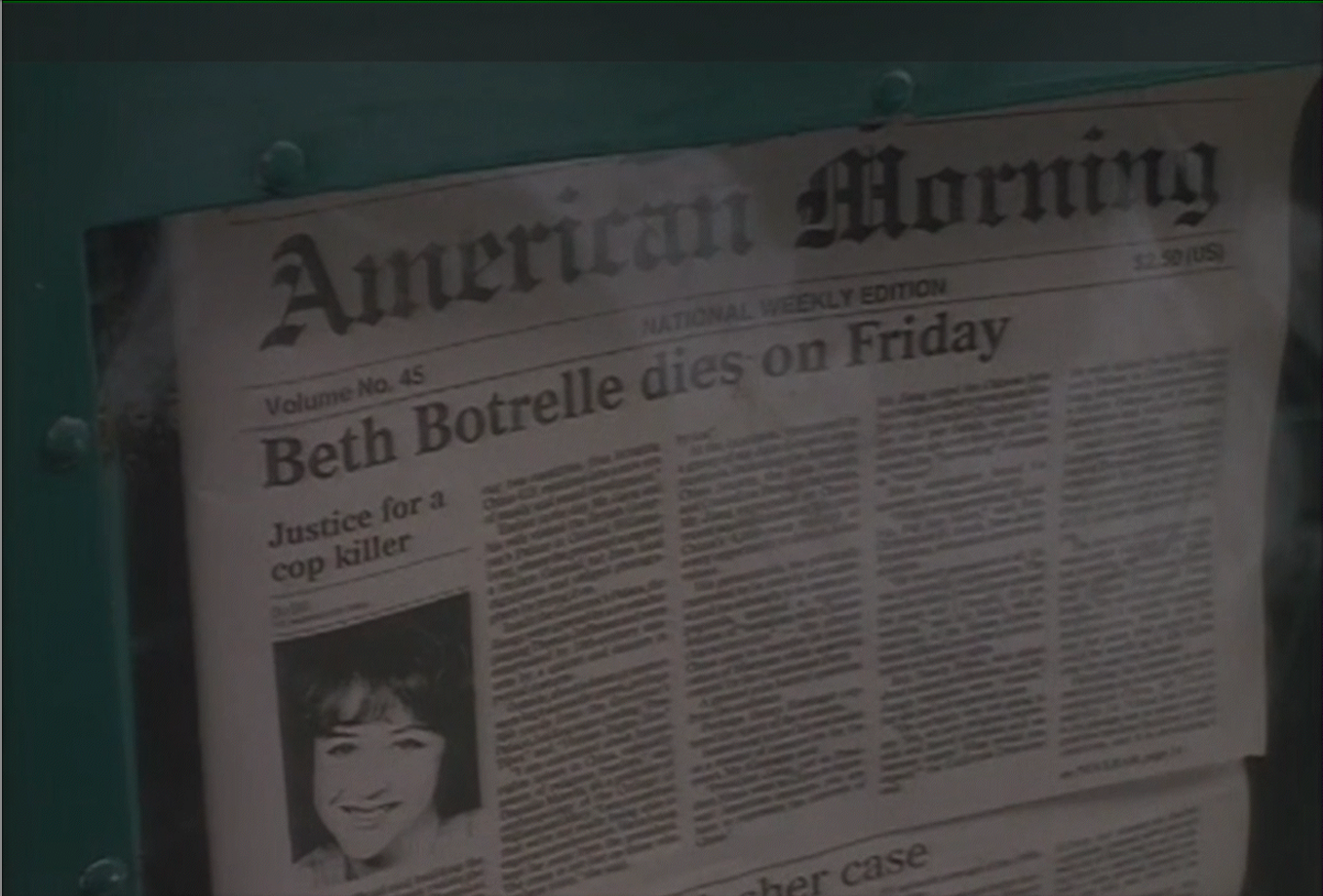
The typesetting looks a little better than the replacement headline and byline in the Chicago Tribune article aboutthe U.S. OpenBilly Butler in "Mountie on the Bounty part 1"—although there's not enough space above the headline and too much space below it, and why does it only span three and three-quarters of five columns—but I am still dinging the props department pretty hard for this. Oy vey. (The picture is no doubt the actress's head shot, but I suppose it works in the context.)Mainly, though, this is a scene about how something is bugging Kowalski to a degree we have not previously known, dissociating wildly and then, when he looks at Fraser, haunted and scared and still ready to snap if the wind blows wrong. Lucky for everyone that he responds to Fraser's voice the way he does.
Credits roll.
Paul Gross
Callum Keith Rennie
Beau Starr
Camilla Scott
Tony Craig | Tom Melissis
Ramona Milano
and Gordon Pinsent as Fraser Sr.
(plus Draco the dog)
Dixie Seatle, Bill MacDonald, Nancy Palk, and Art Hindle as Robert Bedford
Scene 2
Kowalski has his head down on the bar. Fraser brings him a plate from a buffet or salad bar.
FRASER: Ray. [He pats his back as he sits down.] There's a selection here of dates, apricots, prunes, figs, and two cheese sticks.
KOWALSKI: [lifts his head] Oh. Look at that, look at that. [His hand is shaking.] I'm just — I'm just — I'm pressed right up against some — I — I don't know what.
BARTENDER: Breakdown?
KOWALSKI: [glares at him for a second] I just — I gotta get my, um —
BARTENDER: [gently] Head.
KOWALSKI: — screwed on right, and I'm just —
FRASER: As you know, Ray, I first came to Chicago on the trail of the killers of my father —
KOWALSKI: And have remained.
FRASER: Indeed. But over the course of the long hunt for the murderers, I would often picture myself — picture the moment when I came face to face with them. And in every scenario I would concoct, I would exact revenge in like kind.
BARTENDER: Like kind? What does that mean, like kind?
FRASER: It means I would see myself killing the killers. But the impulse to murder, no matter how justified, was dulled by time and reality.
KOWALSKI: What if it's out of your hands? Then what?
FRASER: It's never out of your hands. It's your decision.
KOWALSKI: Not in this case.
BARTENDER: I don't follow.
KOWALSKI: [puts a newspaper in front of them] Beth Botrelle gets a needle stuck in her arm in two days. I was the arresting officer. I took the call.
Flashback: A bright flashlight goes by. It is held by a young Ray Kowalski, in uniform, chewing gum, his hair much shorter, his face smoothly clean-shaven.
KOWALSKI (VO): My first big case. Door was open. I was a rookie. No backup. [He steps into the living room. His shoes are shiny. He checks his hair in a mirror. As he moves on, he sees where a woman's purse is spilled on the floor.] It was dark. Quiet. Then I saw him, lying there. In the blood. [He almost trips over the body and whirls around, drawing his gun in his non-flashlight hand. Then he smells it. He takes a moment to compose himself and then steps carefully toward the body. As he crouches next to it, he puts his knee down in the blood for a second and recoils.] There was a piece of paper near the body. I picked it up. [He puts his gun down and picks up the piece of paper. It is covered in blood. He starts to try to unfold it.] Then I heard a noise. [The flashlight goes by again; the water is running.]
OFFICER KOWALSKI: [talking to himself as he advances, gun back in his hand, toward the bathroom] Okay, you're good. You're good. [He's very nervous. He pushes the bathroom door open with the gun. His flashlight illuminates the steam. He sees bloody shoe prints on the bath mat.]
KOWALSKI (VO): It was the shower. There was all this steam, and — and — there she was. [He pulls back the shower curtain. The woman is fully clothed, huddling in the back corner of the shower. She covers her face.]
End of flashback.
KOWALSKI: See, I'm the first link in a long chain. I'm the first link in a long chain that leads to somebody getting killed, okay? Let me tell you something. There's a, there's a big difference between, ah — you know, the, ah —
BARTENDER: The abstract. [Fraser looks at him and then back at Kowalski.]
KOWALSKI: — the abstract and, and, and, and, the abstract —
BARTENDER: And reality. [Fraser looks at him and then back at Kowalski again.]
KOWALSKI: Hey, do you mind? [The bartender fucks off.] Reality. You know, it's — it's — it's like this, Fraser. I mean — when it comes right down to it, the question is, could you pull the switch? Look, I had this, um, this dog once, this crazy little mutt, and um, and he got hit by this car, and, and it didn't kill him, but he's laying there on the ground, lot of pain, and he's looking at — up at me, wanting me to, you know, help him. I get — I couldn't look at him. I could not look at him. I put him in the car, and I drove him to the vet. I drove him to the vet, and I got the vet to give him the needle. [Fraser doesn't say anything.] Just — I know what I gotta do.
FRASER: What's that?
KOWALSKI: Look her in the eye. I gotta look her right in the eye.
I'm a little puzzled by a buffet or salad bar that has nothing on it but cheese and dried fruit. Does Fraser think Kowalski is in the state he's in because he's backed up? It's probably not important. I think the bartender was maybe supposed to be some sort of comic relief? Where he was supplying the words Kowalski was looking for in a way Fraser might once have done except that he, Fraser, has (not a moment to soon) caught a clue about when such "help" is appropriate? I don't know, I feel like maybe this scene (hell, maybe this episode) could do without the levity. I do like how concerned Fraser is about Kowalski and how gently he's taking care of him.
Attention to detail alert: I'd like it if Officer Kowalski in the flashback had been wearing a wedding ring, although I suppose we don't know how long he and Stella were married, do we.
Scene 3
A woman gets out of a car at the prison, where there are news crews and shouting demonstrators carrying signs that say things like "You're the scum of the earth" and "An eye for an eye" and "Vengeance will be ours." Nice.
REPORTER: Beth Botrelle's lawyer, Carolyn Sherman, is a daily visitor to the prison. Clemency from the governor is now Beth Botrelle's last and only hope.
A correctional officer admits Fraser, Kowalski, and Carolyn Sherman to the women's prison.
SHERMAN: Against my better counsel, Beth has consented to see you.
INCARCERATED WOMAN NEAR THE DOOR: Ooh, I love a man in uniform.
SHERMAN: I can't prevent this, but I can impose one condition —
INCARCERATED WOMAN AS THEY GO BY: I bet you got ways of making me talk.
SHERMAN: — anything said between you remains between you. Agreed?
FRASER: Understood, yes.
INCARCERATED WOMAN ON HER WAY BACK TO HER CELL: Oh, are you really a Mountie?
FRASER: Uh, yes, ma'am, I am.
ANOTHER INCARCERATED WOMAN: [pushes the previous woman out of the way; she falls down] Never mind her. I want to taste your Musical Ride.
FRASER: I see. Thank you. [He pats her shoulder and pushes past her to get to the woman she'd pushed down.] Excuse me, ma'am. Are you all right?
INCARCERATED WOMAN ON HER WAY BACK TO HER CELL: Oh, yes, yes. Can you really sing?
FRASER: Ah — well, I can, yes.
INCARCERATED WOMAN ON HER WAY BACK TO HER CELL: Oh, please?
FRASER: Oh. All right. ♫ K-K-K-Katie, my beautiful Katie, you're the only g-g-g-girl that I adore. ♫
INCARCERATED WOMAN IN A NEARBY CELL: Hey, sweetheart. [She grabs Kowalski's jacket and tugs him toward the bars of her cell.]
KOWALSKI: [stepping away from the cell] Uh, Fraser?
FRASER: I'm just about finished, Ray. ♫ When the m-m-m-moon shines over the cow shed, I'll be waiting by the k-k-k-kitchen door. ♫
INCARCERATED WOMAN ON HER WAY BACK TO HER CELL: Ohh.
CORRECTIONAL OFFICER: That's enough. Get back to the range.
Our heroes continue on their way. The Incarcerated Woman On Her Way Back To Her Cell calls after them.
INCARCERATED WOMAN ON HER WAY BACK TO HER CELL: Ohh. Hmm. Yeah. Um. My name's not Katie!
They reach an interview room where Beth Botrelle is waiting at a table.
SHERMAN: Beth, this is Constable Fraser of the RCMP.
BOTRELLE: Hey, the British wore coats like that during the War of Independence. Minutemen picked them off like it was a turkey shoot. No wonder you lost an empire.
SHERMAN: And this is, uh, Detective —
BOTRELLE: Yeah. I know him. Couldn't forget him.
SHERMAN: Beth, are you sure you want to do this?
BOTRELLE: Yeah, sure, I'll talk to him. Alone.
SHERMAN: Beth, I'm not sure if —
BOTRELLE: Alone, alone, alone, alone.
SHERMAN: Very well. [She and Fraser leave the room. Botrelle is looking at Kowalski with a slightly predatory gleam in her eye as he sits down. Sherman leans against the outside of the door.] I loathe this place.
FRASER: Hmm. You know, in the Middle Ages, they would often open a hole in an accused person's torso, into which they would pour molten lead as, ah, an encouragement to confession. So I suppose, if you viewed it in a favorable light, you could consider this a form of progress.
SHERMAN: Are you under the care of a qualified psychiatrist, Constable?
I'm with the lawyer on this one: Not Employing Literal Medieval Torture Methods is a pretty low bar to clear. (Besides, modern prisons have torture methods of their own, so it's not 100% certain they do clear that bar.)
My dad used to sing "K-k-k-Katie" to me when I was wee. (My name's not Katie either.)
Scene 4
Kowalski is sitting at the table across from Beth Botrelle. He's there to look her in the eye, but he can't.
BOTRELLE: So you're looking for forgiveness?
KOWALSKI: Is that what you think?
BOTRELLE: Well, people visit me for a limited number of reasons. You're not press. You're not family. If it's not a pardon you're looking for, what is it?
KOWALSKI: I'm just here because I, um —
BOTRELLE: You're just here because I'm — here. Because I'm here? Because I'm queer?
KOWALSKI: Kinda nutty, huh.
BOTRELLE: [unimpressed] Actually, I'd say I'm fairly well adjusted, considering.
KOWALSKI: You got a point.
BOTRELLE: You can rest easy, Kowalski. They took me to the death room four times. One time, the needle pricked my skin before the call came and they had to stop. I would prefer they killed me.
KOWALSKI: Because you killed him?
Flashback: Beth Botrelle is kneeling over the body. She picks up the gun; it is dripping with blood.
BOTRELLE: I loved him. [Kowalski finally looks up at her. She immediately looks away. When she speaks again it sounds rote and insincere.] It's not your fault. Any cop could have taken that call.
KOWALSKI: I know that.
BOTRELLE: [looking right back at him, speaking firmly this time] Yeah, so don't let it wear on you. [He does not look away. She gives just a little, but she is still impatient with him.] I know how hard it is. I was a cop's wife for ten years.
KOWALSKI: I know.
BOTRELLE: Yeah.
Flashback: Beth Botrelle is still kneeling over the body with the gun in her hand.
BOTRELLE (VO): So let your conscience be clear, Officer Kowalski.
Flashback ends.
BOTRELLE: I killed him.
They look at each other. He glances away briefly and looks back at her. She does a tiny Mona Lisa smile.
I think I like her. The way she rolls her eyes and singsongs "It's not your fault"—like, even assuming she did kill her husband and is therefore guilty and "should" be executed (a premise I don't agree with, but we're not here to talk about the death penalty today), her execution is not something that's happening to Kowalski, right, and she is one hundred percent within her rights to make him aware of that.
Scene 5
Kowalski and Fraser are leaving the prison. The demonstrators are still baying for blood.
FRASER: Are you all right?
KOWALSKI: [shakes him off] I, I'm good. I'm good. I'm great. [He stalks to the car, where he finally pauses. He's not good, he's not great; he's not all right.] She's lying, Fraser. She's gonna die, and she's trying to make me feel better.
FRASER: How do you know she's lying?
KOWALSKI: I know when somebody's lying, Fraser. She's lying. She did not kill her husband.
They get in the car.
It really is a beautiful car.
I'd like to believe there are some anti–death penalty protesters there as well, not just the go-to-hell-and-stay-there crowd.
Scene 6
Fraser and Kowalski are back at the same bar. Kowalski is hunched over their table. The bartender comes along with a pint glass of what looks a little bit like but cannot possibly be chocolate Yoohoo.
BARTENDER: Throw some of this down the old food tube. Boost you right up. [He pats Kowalski's shoulder as he sets it down.]
KOWALSKI: What is that?
BARTENDER: [taking the third seat at the table] It's a little concoction of my own devising. I call it Despondency. It's got windflowers, it's got a little bit of dried cuttlefish, but the main ingredient — St. John's Wort.
KOWALSKI: What, you want me to eat something that's got warts in it?
FRASER: No, I believe that's wort, W-O-R-T, Ray. It's an herb renowned for its medicinal qualities.
BARTENDER: [impressed] Gotta respect a guy who knows his roots.
KOWALSKI: Well, I'd respect you, if you were to take your Despondency and give yourself a colonic. We're talking here, okay? [The bartender leaves, hurt, and takes his pint glass with him.] Look, Fraser, it was an open-and-shut case. Number one, her fingerprints were all over the trigger. Number two, she had threatened to kill him in public. Number three, she could not account for her movements on the night in question. Whole thing was over in a week.
FRASER: What about the piece of paper? The one you said you found near the body?
KOWALSKI: A little piece of paper is not gonna change the outcome, Fraser. In forty-eight hours, she's dead.
FRASER: Indulge me. Let's just follow the paper trail.
KOWALSKI: Follow the paper trail.
Flashback: Officer Kowalski picks up the paper, which is covered in blood.
KOWALSKI (VO): Okay, I found the paper near the body.
FRASER (VO): And did you read what was on it?
KOWALSKI (VO): No. I heard the shower. I shoved it in my pocket, and I carried it with me to the bathroom. [The bloody paper is in his pocket as he advances toward the bathroom door.]
FRASER (VO): And after that?
KOWALSKI (VO): Everyone else showed up. The backup. And eventually I gave it to Detective Franklin. [More people are present in the flashback now.]
FRASER (VO): Who was he?
KOWALSKI (VO): The primary investigator. He bagged it, tagged it, and that was it.
FRANKLIN: [holding a Sharpie in his teeth like a cigar] Don't worry about it. [He opens an evidence bag open for Kowalski to put the paper in. He writes on it and shows Kowalski what he's written.] Okay?
Flashback ends.
KOWALSKI: [hanging his head] I contaminated the evidence.
FRASER: Procedure would suggest that it had been disturbed, yes.
KOWALSKI: I forgot about that. I forgot about that until right now. Whole careers are wrecked over things like that. What happens to me? I get promoted.
FRASER: Ray, you mustn't be so hard on yourself. You were young. It was your first situation. There was blood on the floor. There was a corpse. It could happen to anybody.
KOWALSKI: You ever make a mistake like that?
FRASER: No, but that's not important. What's important is that we need to know what was on that piece of paper.
KOWALSKI: A woman is sitting on death row 'cause I screwed up. [He calls over to the bartender.] You got any of that, uh, Despondency?
BARTENDER: You know I do.
KOWALSKI: Okay, bring me a jumbo. To go.
I'd like to thank everyone involved in writing this scene for not having the bartender say "Why would she want to kill him in public?" and Fraser say "I think he meant she'd threatened, in public, to kill him."
I'm alarmed by this Despondency cocktail. St. John's wort is an herbal remedy thought to have some antidepressant qualities, but all parts of the windflower are poisonous. And what's the cuttlefish doing in there? Maybe that's how it got the brown color, because cuttlefish is where sepia ink came from? And is the bartender hitting on Kowalski or Fraser or both? Read the room, buddy. Although speaking of reading the room, if there was ever a time for Fraser not to tell the whole truth, it was in response to the question "You ever make a mistake like that?" What, I ask you, would it have cost Fraser to cut straight to "That's not important" without saying "No" first?
Scene 7
Kowalski comes into the squad room. People are whistling and cheering and applauding. Dewey is writing a huge 2 on a big tear-off easel pad.
KOWALSKI: What the hell is that?
DEWEY: Two more days, and it's wham, bam, thank you, ma'am.
KOWALSKI: Take it down.
DEWEY: What's your problem?
KOWALSKI: Take it down. [Dewey doesn't get it. Kowalski is furious.] I said, take it down!
Kowalski charges at Dewey, shoves him out of the way, and tears down the sign. Dewey fights back; Huey comes in to break it up. So does Welsh.
HUEY: Knock it off!
WELSH: Hey, what's going on? What's going on? [He and Huey get Kowalski and Dewey separated. He scolds the room.] Come on, it's not the Middle Ages here. You wanna celebrate this thing, you do it in private.
TV REPORTER: And the countdown continues towards Friday's execution of convicted cop killer Beth Botrelle.
TALKING HEAD ON THE TV: No one gets any pleasure from what's going to happen here. But people should let the state get on with the business of dispensing justice. That is the will of the people.
WELSH: What is this, a paid political advertisement? Turn it off.
DEWEY: [turns it off but keeps talking back] Am I missing something here? She killed one of us. She killed a cop. And she's getting what she deserves, all right? The big sleep. End of story.
HUEY: Are you trying to become a colorful personality?
DEWEY: Screw you, Jack.
WELSH: [quietly to Fraser] Botrelle was a good cop, Constable. Kill a cop, eight years or not, people are gonna remember.
SOMEONE BEHIND KOWALSKI: Not easy, is it.
Kowalski turns around.
KOWALSKI: Inspector Sam Franklin. [Kowalski shakes his hand. Fraser hears the name and looks over.]
SOMEONE BEHIND KOWALSKI (FRANKLIN): Good to see you, Ray.
KOWALSKI: Good to see you.
FRANKLIN: Come on, walk me down the hall. [They head out.]
KOWALSKI: What the hell are you doing down here at the twenty-seventh?
FRANKLIN: I'm just passing on the new regulations for petty cash accountability. [Both smile.] I was in the area, so I thought I'd pop my head in and see how you're holding up.
KOWALSKI: Truth? Not so good.
FRANKLIN: Ray, I know it's hard. Maybe you should take a few days, get out of town till this is over.
KOWALSKI: I don't want you to think I'm off my nut. But I'm not so sure she did it, Sam.
FRANKLIN: Come on, Ray, you know she did.
KOWALSKI: No, I do not. I mean, there's —
FRANKLIN: Come on, I know what you're going through. Jake Botrelle and I worked together. He was a hell of a guy. I thought I'd be the first one to lead the cheer when his killer was taking the walk. Come on. All we can do now is feel sad.
KOWALSKI: What happened to that piece of paper?
FRANKLIN: What paper?
KOWALSKI: That, that, that, ah, piece of paper that I gave you.
FRANKLIN: It was bagged, tagged, like everything else. Listen, Ray. You and I, we did a hell of a job. That's all you gotta think about. You keep thinking about all this other stuff, it's gonna make you crazy. You gotta let it go.
KOWALSKI: Right.
FRANKLIN: Come on. Take care of yourself. You need to talk to someone? Call me.
Kowalski thinks about following him but heads back to the squad room instead.
What is Welsh carrying, a coffee maker? And it's not that I don't appreciate putting Dewey in the role of Chief Asshole of the precinct, because he's clearly established himself as tactless and insensitive at best, but for a guy who so obviously isn't satisfied with his job as a cop, he sure is ready to beat the in-group drum here, isn't he?
Eight years doesn't seem like that long of a time for a capital case to get all the way from arrest to final appeal, especially because if clemency from the governor is Beth Botrelle's only hope, she'll have exhausted her federal options as well. I can't find data specific to Illinois (which hasn't executed anyone since 1999 and abolished capital punishment in 2011), but here's a statistic that says in 1998 the average time between sentencing and execution was 130 months; of course averages get to be that way by some things being longer and some quite a lot shorter. Beth Botrelle's trial will have had to take place within about four months of her arrest, and given that the trial only took a week, maybe she was sentenced quickly too? But anyway, that means Kowalski was a rookie in 1990, which would make him about 29 at the time, which is old for a rookie, isn't it? Especially one who dropped out of college to go to the police academy? What was he doing in the rest of his 20s? (I mean: He was accumulating citations as early as 1988, so apparently we're being extremely generous with the word "rookie" here and are going to have to do some convolutions to make it work. When Kowalski says he was a rookie when he went to chez Botrelle eight years ago, i.e., in 1990, does he mean that was the first case he'd ever gone to by himself? Is that a reasonable use of "rookie"? Hmmmm.)
Scene 8
Fraser and a young woman are coming down an office hallway. Kowalski is behind them.
WOMAN: I had Land Acquisitions right next to the Aboriginal Spirit Walks. [She and Fraser both laugh.] Can you believe it?
FRASER: [laughing] No, I can't. [Kowalski pushes past them as all three come into a large outer office.]
WOMAN: Oh, you have to come to the Art Institute. I'm giving a lecture on the geopolitics of post-colonial Burmese puppet theater.
FRASER: Oh, you scamp.
WOMAN: Yeah. [They are both still laughing.] I'll just get the evidence logs. I'll be right back.
FRASER: Thank you.
WOMAN: Okay. [She goes. He is still laughing.]
KOWALSKI: Friend of yours?
FRASER: Ah, yes. I mean, well, we — we share some common interests. Inuit throat singing, for example. As a matter of fact —
KOWALSKI: Yeah, yeah. Hold on the story. There's the man. [He points to a framed photograph on the wall.]
FRASER: You know, we used to watch his, ah, movies at the cinema in Dawson Creek. Few were more surprised than we when he actually became president.
KOWALSKI: Not Reagan. The guy beside him. That's, uh, Jake Botrelle, everybody's favorite cop.
FRASER: And who's this? [The third man in the picture is shaking hands with Ronald Reagan.]
KOWALSKI: Uh, that's our fearless state's attorney, Robert Bedford. Known to his intimates as, ah, Ordinary Bob. Made it big after the Botrelle case. Keeps it up, he's gonna make governor.
WOMAN: [returns and hands them the log book] Here it is! [to Fraser] You know, we really must go for bark tea sometime.
FRASER: Oh, that is an inspired idea.
WOMAN: Oh —
KOWALSKI: Hang on, where's the evidence?
WOMAN: Oh, it's not here. After five years, they move it across town into storage. Which is stupid, but it's government. [She and Fraser chuckle.] I could call ahead and get you a time?
FRASER: I'd appreciate that. And I am looking forward to that bark tea.
WOMAN: Yes! Okay. [She and Fraser are both laughing again. She backs out of the room. Fraser starts to look through the log book, still chucking.]
KOWALSKI: Look for evidence bag twenty-six.
FRASER: Twenty-six. [He is still chuckling as he turns the pages. He realizes Kowalski is glaring at him and cans it.] One pair of sunglasses. There is no reference to a piece of paper. [He almost slams Kowalski's fingers in the book as he closes it.] Sorry.
This young woman works in an archives- or librarian-adjacent job, so it's true that she and Fraser have something in common, but where the hell has she come from? And if she and Fraser are good enough buddies to be giggling together over her misfiling of Land Acquisitions with Aboriginal Spirit Walks and she's inviting him on a bark tea date right under Kowalski's nose, would it have been too much to ask Fraser to call her by name?
Burmese marionette puppetry is a real thing, and the art was of course badly damaged by colonialism; it's been revived since the late 1990s under the patronage of the ruling junta, so the geopolitics of post-colonial Burmese puppet theatre is probably a very interesting subject and I'd like it if the show didn't treat Fraser's friend as ridiculous for giving a lecture on it (though as a white woman her standing to do so could, I suppose, legitimately be questioned). Inuit throat singing is also real, and so is Dawson Creek, BC, though I'm getting exhausted by how much Fraser seems to have moved around as a kid.
It also makes me tired that the state's attorney is named Robert Bedford, especially in a moment where we're already talking about movie stars because Ronald Reagan. Sigh. However, I appreciate the attention to continuity, that Damon Cahill was running for the position but presumably wasn't elected because he was implicated in a murder-for-hire scheme. (I mean in Chicago that might not be disqualifying. But still.)

Scene 9
A guard eating a sandwich buzzes a couple of guys out of the evidence lockup. They pass Fraser and Kowalski in the corridor.
FRASER: Hmm. Bay Rum cologne.
KOWALSKI: [stepping up to the desk] I'm Detective, ah —
GUARD: We're closed.
KOWALSKI: Well, you don't look closed.
GUARD: Well, we are closed. Very closed.
KOWALSKI: Since when does evidence lockup —
FRASER: Ah, Ray. [to the guard] Thank you kindly, sir.
They pretend to leave but duck into the women's room instead. The guard's phone rings.
GUARD: Security. Right. Right away.
He drops his sandwich and grabs a clipboard as he leaves his desk. Fraser and Kowalski come out of the women's room, Kowalski closing up his phone, that sneak. He has to move the guy's sandwich to find the buzzer to open the secured area, and he doesn't put it back. When the guard returns, he's apparently not as dumb as guys in that position are often implied on TV to be; he glares at the buzzer-locked door.
That was sloppy sneaking, Kowalski. Couldn't you have put the guy's sandwich back where you found it?
Scene 10
Fraser and Kowalski are at the top of a tall rolling warehouse ladder in the shelving units of the evidence lockup.
KOWALSKI: So what you're saying is basically nothing is in the right bag?
FRASER: Yeah, but there does seem to be a pattern. I mean, the contents of every fifth bag has been switched. One's with six, two for seven, so on up till twenty, and the pattern repeats itself. So I think the piece of paper should be in bag one hundred and eleven, marked "eyebrow pencil."
KOWALSKI: Eyebrow pencil. Eyebrow pencil. I saw that, I saw that! [He rummages in a box for bag 111 "eyebrow pencil" and finds it. Fraser hears something.] How'd you do that?
FRASER: Someone's just entered the building.
The two guys who were leaving when Fraser and Kowalski got here are running along the shelves.
FIRST GUY: Yeah, this way!
SECOND GUY: Down here.
KOWALSKI: [looking at the bag] This doesn't look like the same piece of paper.
FRASER: It's two men, heading this way, carrying weapons.
Fraser and Kowalski climb up onto the top shelf. The two guys come running along the row and move their ladder out of the way. Fraser and Kowalski jump across from shelving unit to unit. The guys try to track them but can't see to the top of the shelves. Finally our heroes jump down onto a convenient pile of empty boxes. They climb out like kids trying to get out of a ball pit and get out an emergency exit. The two guys come running right behind them.
FIRST GUY: Come on!
SECOND GUY: Ah, it's locked.
It's locked? It's a fire exit. It's got a fucking crash bar on it. That shit locks from the inside. You should always be able to get out that kind of door. How did Fraser and Kowalski lock it behind them?
Anyway, if bag 1 was replaced into bag 6, bag 2 into bag 7, and so on, then bag 26 wouldn't be replaced into bag 111, would it? Wouldn't it just be in bag 31? 1-6; 2-7, 3-8, 4-9, 5-10, 6-11; 16-21; 26-31. What am I missing? Unless by "up to 20 and then the pattern repeats itself" what Fraser means is that the contents of bag 19 are in the bag marked 24 and the contents of bag 20 are in the bag marked 25 and then the contents of bag 21 are in the bag marked 106? . . . So are there no bags marked 26–105? And how much time must someone have spent so carefully changing all these things? Jesus. Why not just do a random switcheroo?
Scene 11
Fraser is waiting outside Welsh's office, where Kowalski is hearing from State's Attorney Bedford.
TALKING HEAD ON TV (BEDFORD): Detective Kowalski, Lieutenant Welsh tells me you've more than lived up to your promise as a rookie. As a matter of fact, he tells me you're one of his finest officers, which dismays me. It dismays me because I can't have anyone from the CPD making public statements that, ah, inflame the situation. You know what I mean?
KOWALSKI: I'm not sure.
BEDFORD: Am I not getting through to you, Detective?
KOWALSKI: I'm really not sure, sir.
BEDFORD: All right. Let's cut the nail. Carolyn Sherman is one of the finest defense attorneys in the state. You have been talking to her. You have been talking to her client. You have been requesting evidence from the Botrelle case. See, in my eyes, this is not a good thing.
KOWALSKI: It's not official, sir.
BEDFORD: I hope it's not personal. You have a job to do. I expect you to do it.
KOWALSKI: I just wanna do what's right. Sir.
BEDFORD: I'm suggesting you're not. Now, this woman was sentenced, by the people, to be put to death, with cause. That's our mandate. Personally speaking, she deserves it. Now, the longer we drag this thing out, the more negative PR we attract to one of the greatest cities in America.
KOWALSKI: So we should kill her to avoid any bad press? Sir?
BEDFORD: You're a smartass, huh? [Kowalski pretends not to know what he's talking about but doesn't say anything.] I'm gonna make this very simple, Kowalski. Drop the Botrelle case. That's a direct order from the state's attorney. [Kowalski twists his finger in his ear as Bedford turns to go.] Lieutenant, it would be a good thing if you, ah, learned to control your men. [He leaves Welsh's office, where Fraser is standing right outside the door.] What do you do?
FRASER: Uh — well, sir, I first came to Chicago on the trail of the killers of my father, and —
Bedford leaves the squad room. Fraser goes into Welsh's office.
WELSH: Detective, I have never met anyone with as great a capacity to piss off people as you.
KOWALSKI: Just people I don't like, sir.
FRASER: Well, no, actually, Ray, even people you do like. I mean, if you think about Sandor, who you beat about the head —
KOWALSKI: Fraser! [Fraser shuts up.] Lieutenant, don't shut me down on this, I'm close.
WELSH: All right, look. You got sick days coming. Take a couple. Go home. What you do on your own time is your business. All right? [Kowalski and Fraser turn to go.] Oh, Detective? [They turn back.] Find something.
Fraser and Kowalski point at Welsh and leave the office.
Do the police work for the state's attorney? I really don't think they do, and I don't see where this cat gets off giving Kowalski a direct order about his lunch, never mind about what questions he's allowed to ask. On top of which, Kowalski hasn't made any statements about the situation, inflammatory or otherwise. So Bedford can probably shove it. (Also also: Everyone in this episode is going ahead and calling Kowalski Kowalski. I guess the Vecchio's-safety thing is no longer a going concern?)
Thanks for the callback to Sandor the pizza guy, Fraser. This is actually a scene about how we love Welsh a little bit more.
Scene 12
Fraser and Kowalski are on their way out of the squad room.
KOWALSKI: Now what?
FRASER: We need to find out everything we can about Jake Botrelle. If his wife didn't kill him, somebody else did. They must've had a reason.
KOWALSKI: Uh, crime scene videotapes. Were they in any of the boxes?
FRASER: I didn't see them, I'm sure we won't get a second look. But I do have another source.
KOWALSKI: Good. Oh, first things first. Let's, uh, pull the files.
Scene 13
They are back at the front of the station, where the desk sergeant is talking to them while she's helping.
DESK SERGEANT: Oh, yeah, I knew Jake. Everybody loved Jake, especially the ladies. Wanna know why?
FRASER: Why?
DESK SERGEANT: Sincerity. He had it down. [loading his arms with files] You couldn't tell that he didn't mean a single word he was saying. Or that as soon as you were out of his sight, you were out of his mind. [She gives Fraser the last of the files.] You're lucky. If anybody was in charge around here, we would've gotten rid of those a long time ago.
FRASER: Thank you kindly.
Welsh isn't in charge around here? With his known preference for not keeping records any longer than is necessary? What about Commander O'Neill? What ever happened to her?
Scene 14
Fraser and Kowalski are at Kowalski's desk examining the files.
FRASER: Detective Botrelle's Day-Timer. And there's several entries with a single reference: Mermaid. Is that standard police nomenclature?
KOWALSKI: I don't know no clature from my elbow, but uh, the mermaid? That is not, ah, standard cop talk.
FRASER: And here's a monthly payment reminder to Callaghan's. Does that mean anything to you?
KOWALSKI: Uh, sounds like a bar?
Huey and Dewey come over, displeased.
HUEY: Still investigating the victim.
FRASER: Is that not standard procedure in a homicide investigation?
DEWEY: Well, if it's an unsolved homicide, yes. But we know the murderer in this one, so what's the point?
KOWALSKI: [standing up] The point is, walk on. That's all, just walk on. Get outta here, okay? [They walk on.] Thank you. [He sits back down.]
Welsh comes over.
WELSH: Detective, how're you feeling?
KOWALSKI: I'm fine.
WELSH: No, no, you don't look too good.
KOWALSKI: No, I'm fine.
WELSH: No, no, you look sick. You should go home.
KOWALSKI: Right, I'm sick.
He nods. Welsh heads back to his office.
Now Welsh is carrying a feather duster and a toaster. I'm dying to know what kind of back story Starr had in mind for what Welsh was up to in this episode.
Scene 15
Sam Franklin answers the door when someone knocks.
FRANKLIN: Coming. [He opens the door.] Ray.
KOWALSKI: Am I, ah, interrupting anything?
FRANKLIN: You bet. Look at me. [He has a towel in his hands; he's been doing the dishes.] Come on in. I've been offered a job, you know. Chief Investigator for Phalanx Insurance. Hmph.
KOWALSKI: Never thought you were, uh, the type to retire.
They sit down. Franklin pours whiskey.
FRANKLIN: Well, uh, after the Botrelle case — well. Can't say I lost my nerve, exactly. But if it could happen to him —
Kowalski nods. After a moment he puts the evidence bag on the table. Franklin may be a little uncomfortable seeing it.
KOWALSKI: Found it. But I don't think that's the same piece of paper. What do you think?
FRANKLIN: How'd you get it?
KOWALSKI: Evidence locker.
FRANKLIN: [laughs out loud] You broke in?
KOWALSKI: You think that's the same piece of paper?
FRANKLIN: If it was in the bag.
KOWALSKI: Well, yeah, it was in the bag, but, uh —
FRANKLIN: But what? You remember something about a piece of paper eight years ago? Listen to yourself, you're losing it.
KOWALSKI: Look. I think that Bedford suppressed the evidence.
FRANKLIN: Bedford's an ambitious bastard, yes, but that's as far as it goes. You tell me something. Why would he rig a trial that he already had red-handed?
KOWALSKI: Look, I don't know. But that is not the same piece of paper that I found eight years ago, and that is not the same piece of paper you put in evidence bag number twenty-six.
FRANKLIN: Well, if you're sure about that, we better move forward now, 'cause the clock is ticking on that woman.
KOWALSKI: No. We, n— we don't have nothin' solid yet. Jake ever talk about, uh, Mermaid? Look, uh, it showed up in his notebooks a lot.
FRANKLIN: Who knows. He was called Jake the Make. Maybe it was one of his women.
KOWALSKI: He had some bad habits?
FRANKLIN: [pours again] There were rumors about him and Bedford's wife. I never believed them.
Scene 16
Fraser is in Carolyn Sherman's office.
SHERMAN: What exactly are you looking for, Constable?
FRASER: Well, I'm not exactly sure, to be perfectly honest with you. There are certain questions that we have that may be answered by the crime scene tape.
SHERMAN: And those that aren't?
FRASER: I was hoping that you'd be able to help us. For instance, why didn't the subject of Detective Botrelle's philandering arise in court?
SHERMAN: Because it didn't help our case. Every step down that road led to a witness who'd testify that they heard Beth threaten to kill him in public. At some point, you cut bait and run.
FRASER: But it might have provided another party with a motive.
SHERMAN: No physical evidence placed anyone else inside the house.
FRASER: Do you believe she's guilty?
SHERMAN: That's an irrelevant question. The only real question is do I think she should die. Constable, if you're actually onto something, be quick about it. It'll be a matter of academics in less than thirty hours.
In fact the real question is can Sherman demonstrate that the state shouldn't be allowed to kill Beth Botrelle.
Scene 17
In her cell, Beth Botrelle's anxiety is growing. She dries her eyes a couple of times.
Scene 18
Dewey is at his desk humming "Frère Jacques" and making a smaller sign with a big number 1 on it in his notebook.
DEWEY: It's all over but the crying!
He holds up the sign like Norma Rae. Everyone in the squad room applauds and cheers. Someone yells "It's about time!" Welsh comes to his office door. He doesn't like it.

Scene 19
Fraser lets himself and Diefenbaker into Kowalski's apartment. Kowalski himself is lying on the couch with a compress over his eyes.
FRASER: You there, Ray?
KOWALSKI: Mm.
FRASER: Carolyn Sherman gave me the crime scene videotape. [Diefenbaker jumps up to be with Kowalski.] I'm not sure it's going to be all that revealing. [He puts the tape in the VCR.]
KOWALSKI: [sitting up to make room for Fraser to sit next to him] And I got a piece of paper that's not the real piece of paper. I suppose you'd like a cup of that, uh, bark tea?
FRASER: Oh, yes, I'd love some, thank you.
KOWALSKI: Yeah, well, I don't have any. [The tape has started to play. It shows some papers on a desk or coffee table, with a pen nearby and a cup sitting on top of some bills.]
FRASER: Oh, well. Another time.
KOWALSKI: Okay.
Kowalski sips his own coffee as he watches the tape. Fraser notices that the newspapers on Kowalski's coffee table have a ring from where the cup was previously sitting.
FRASER: Ray, look.
KOWALSKI: What, I'm a pig?
FRASER: No, no, not that. Here. [The tape has moved on to a couch; Fraser rewinds it to show the coffee cup on the bills again. He takes the bloody paper out of the evidence bag and unfolds it.] I think we'll be able to prove that this piece of paper is not the piece of paper that you found underneath the body.
KOWALSKI: How?
FRASER: Here it is, see that? It's a partial stain. Look there. The coffee table? Three overlapping pieces of paper, three partial stains. Like this. [pointing to Kowalski's newspapers] Three overlapping pieces of paper, three partial stains.
KOWALSKI: Right, now look at the time code. That means that that piece of paper was in the kitchen an hour after the crime. This is our proof. We have the proof.
FRASER: I think we do, yes. [He runs his finger through some dust on the coffee table.] You know, Ray, you really ought to consider dusting.
KOWALSKI: I'm a slob. [But it's actually sawdust. Fraser looks up; there's a hole in the ceiling almost hidden by the smoke detector. He turns to Kowalski, flaps his hands like bug wings, and makes a buzzing sound.] Okay, so I'm a pig, I'm a slob, and I have an infestation. [Fraser shakes his head, points to the ceiling, and does the flutter-and-buzz again.] Huh? [Fraser does the buzz-flutter one more time and points to the ceiling. Kowalski finally looks up and gets it.] Oh. [They both speak ostentatiously clearly. Kowalski puts his gun in his holster.] Uh, those guys from the Trib sure thought that I was, uh, full of it.
FRASER: [putting the fake evidence back in the bag] And, uh, and you are supposed to meet them within the hour, aren't you?
KOWALSKI: Uh, yes, I am. At the, uh, at the Gladstones, behind the corner of, uh, Shuster and Wayne.
FRASER: [puts the bag with the fake evidence in the videotape case] I believe that's, uh, Wayne and Shuster, isn't it, Ray?
This isn't what's important about this scene, but how did Fraser get into Kowalski's building if he wasn't even sure Kowalski was there? I think we have to stop the clock and admit that by this point Fraser has a key to Kowalski's place. Did he ever get a key to Vecchio's house? 🤔
Scene 20
Fraser and Kowalski are on a rooftop at the corner of Wayne and Shuster. A compact car slows down.
FRASER: Here we go. Backing up. He's turning in. This is it.
They run down the steps to intercept the car. Kowalski climbs over it and Fraser comes up next to it. Kowalski pulls his gun and looks: Huey and Dewey are inside with their guns drawn. Everyone is shocked.
Scene 21
Huey and Dewey are standing outside the car with Fraser and Kowalski.
HUEY: What the hell are you guys doing here?
KOWALSKI: What are you doing here?
DEWEY: We got a tip there was a drug deal going down.
KOWALSKI: Somebody's playing games with us.
FRASER: The piece of paper.
He and Kowalski start to run.
DEWEY: You want a lift?
FRASER: [over his shoulder] Ah, not in that car, thank you kindly.
Scene 22
Fraser and Kowalski reach Kowalski's building. They pass at least one guy in the hallway; Kowalski's apartment has been ransacked.
FRASER: The paper?
KOWALSKI: [looking at the empty VHS case] Gone.
Fraser smells something.
FRASER: That man we passed in the hallway? I've smelled him before. At the evidence lockup.
The First Guy who chased them around the evidence lockup is back at work moving boxes around. He's apparently the one who wears Bay Rum.
So Fraser and Kowalski were hoping to lure whomever had bugged Kowalski's apartment to Wayne and Shuster, and they were surprised when they got Huey and Dewey instead—because I guess they have immediately discarded the idea that it could have been Huey and Dewey who bugged the apartment? Or maybe they didn't discard that idea until the explanation was the tip about the drug deal. Now they know whoever placed the bug was the one who gave Huey and Dewey that bogus tip; but why didn't it occur to them that whoever was spying on them would also be after that bit of fake evidence?
Nice of Huey and Dewey to offer Fraser and Kowalski a lift back home, though. Does Fraser not want a lift in their car because he assumes it's bugged as well? Or just because it's a piece of junk?
Scene 23
Fraser is at Francesca's desk typing like mad while Kowalski reads out of a file.
KOWALSKI: Here we go. Sergeant Eddie Polito. Twenty-year veteran, currently in charge of evidence and seized property. This is the guy?
FRASER: I think so. [They look at the record on the computer.] In nineteen-eighty-nine, nineteen-ninety, Officer Polito worked undercover with Officer Drop Robertson under the direction of Detective Jake Botrelle on Project Neptune for the State's Attorney's Office's investigation into union corruption on the waterfront. An investigation headed up by Robert Bedford. [He ponders.] Neptune. Mermaid.
KOWALSKI: Connection?
FRASER: Other than they both have maritime associations, I have no idea.
Huey and Dewey come over.
DEWEY: You guys investigating other cops now? You want a job in IA, why don't you apply to IA.
KOWALSKI: [getting right in Dewey's face] Look. This is personal. You wanna get in the middle of it? That's fine with me. You wanna be filled in? 'Cause I'll fill you in.
DEWEY: [laughs] Maybe another day, tough guy. [He biffs off.]
SOMEONE IN THE SQUAD ROOM: Hey, it's Bedford. Turn it up, turn it up!
BEDFORD: Let us pray not just for Beth Botrelle, but for America as well.
REPORTER: Is it true you'll be running for governor?
BEDFORD: I don't think this is the time to be discussing that. I will say that my faith in and love for this country has never been stronger. Thank you.
KOWALSKI: [as he and Fraser go back to his desk to get their coats] The body's not even cold and he's running for governor.
FRASER: That may have provided us with the opening we need.
KOWALSKI: How so?
FRASER: [They're on their way out of the building.] Well, now that the rumor of his seeking the governorship is confirmed, he'll be walking on eggshells until such time as Ms. Botrelle is dead. It'll make him vulnerable. Now, what if we can trap him into talking about that piece of paper on tape? That should — [Kowalski is headed upstairs.] Ray. Ray. Ray.
KOWALSKI: Oh. [He comes back down again.]
FRASER: That should give us all the evidence we need.
KOWALSKI: Well, we can't meet him, and if we try to call him, he's gonna have us off the street in no time flat.
FRASER: Well, exactly. So it'll have to be someone he could trust.
KOWALSKI: I know the guy. I'll talk to him. Where are you going?
FRASER: To find a mermaid.
KOWALSKI: Here.
He tosses Fraser his hat.
It didn't take Huey and Dewey long to get over being annoyed that someone was playing games with them, huh? I wonder if these scenes were edited together in a different order than they were written in.
Has the rumor of Bedford's running for governor been confirmed? I guess "Let's not talk about that right now" is different from "No."
Scene 24
Fraser is at the women's prison talking to Beth Botrelle. Carolyn Sherman is also present.
BOTRELLE: Mermaid?
FRASER: Mm-hm.
BOTRELLE: Mermaid. No, nothing springs to mind.
SHERMAN: Constable Fraser found the reference in your husband's journal.
FRASER: I thought perhaps it might be one of his contacts?
BOTRELLE: Well, you, you, you could ask State's Attorney Bedford. Jake was his, um, chief investigator into waterfront corruption. So he, he would know. Better than — he, he called Jake, the night that he died.
FRASER: Do you happen to know what they talked about?
BOTRELLE: No. No. He didn't talk about his business.
FRASER: I don't imagine he ever mentioned a Callaghan, or Callaghan's?
BOTRELLE: Callaghan's.
FRASER: Mm-hm.
BOTRELLE: Yeah, Jake ran up a bunch of charges on our credit card, and I thought it was a bar. We had one of our biggest fights about that.
FRASER: It wasn't a bar?
BOTRELLE: No. No, it was a storage place. It was the only time he was telling the truth. Is this of any use?
FRASER: I hope so.
BOTRELLE: Yeah, me too. I, um. I lied the other day to Officer Kowalski. I didn't kill my husband.
FRASER: He knows.
The toughness Beth showed Kowalski is not at all present here. Also, I love (love) Fraser saying (with the same kindness with which he said "thank you" to Garret the Dreamer "He knows" rather than "I know." ❤️
Scene 25
Franklin and Kowalski are in Kowalski's car.
FRANKLIN: You're asking me to save a woman who killed a cop.
KOWALSKI: She didn't do it, Sam. I know it.
FRANKLIN: Come on, Ray, what do you got?
KOWALSKI: We think Jake Botrelle was having an affair with Bedford's wife. That piece of paper that I found at the scene had something to do with it. He knew that this case would make his career, so he destroyed the piece of evidence that could disqualify him from the case and kill his family image at the same time.
FRANKLIN: No. Bob wouldn't do that.
KOWALSKI: Sam, come on. Power? Ambition? People do crazy things. Besides, she's guilty anyway, right?
FRANKLIN: So what do you want me to do?
KOWALSKI: Set up a meeting.
I guess "she's guilty anyway" is supposed to have been Bedford's reasoning for why it was a good idea to destroy the evidence that Botrelle was having an affair with his wife. Which I also don't see why a guy's wife having an affair with a cop ruins his family image—not if he's the aggrieved party who's been stepped-out on—but of course it would have disqualified him from the case, and if he wanted prosecuting Beth Botrelle to make his career, okay, he destroys evidence that would reveal his own wife's affair with the victim but not (apparently) exonerate the victim's wife. . . . But if that's the story Kowalski is telling Franklin, that they're trying to prove Bedford tampered with evidence and therefore Beth Botrelle should be acquitted on a technicality, I don't see why he's also leaning on "She didn't do it."
Scene 26
At Callaghan's, the manager leads Fraser and Huey and Dewey back through the lockers.
CALLAGHAN: Hasn't been opened in years. You sure it is okay?
HUEY: Oh, absolutely.
DEWEY: It's really strange that the warrant department ran out of forms like that, huh? It's unlike them. [They're in.]
HUEY: Botrelle's.
DEWEY: Probably his love letters.
Huey opens a briefcase; it is full of bundles of cash.
HUEY: Ooh, love that writing paper.
DEWEY: Whoa.
Fraser is more interested in a notebook. He flips through the pages.
FRASER: There.
DEWEY: What?
FRASER: I found a mermaid.
Okay that cash has been sitting in that storage locker for eight years. Did nobody miss it? (And what did Fraser find?)
Scene 27
Bedford is coming along an aisle in the evidence repository. Kowalski and Franklin are waiting behind a shelving unit.
KOWALSKI: What did you tell him?
FRANKLIN: I just said we had to talk. I hope you're right about this, Kowalski.
KOWALSKI: [checks his watch] Yeah, you, me, and, ah, Beth Botrelle.
Beth Botrelle is being escorted from her cell. The other incarcerated women are watching her go.
KOWALSKI: [turns to give Franklin a dictophone] You're up.
FRANKLIN: [But Franklin has pulled his gun. Kowalski makes a face like maybe he should have seen that coming.] Move. [He makes Kowalski step out into the aisle.]
BEDFORD: Hey, what's going on here?
FRANKLIN: Sorry, Bob. You would've made a good governor. You know, mostly you always got what you wanted. But not this time. It's my turn. [Franklin unholsters Kowalski's gun and points it at Bedford. His own gun is still pointed at Kowalski. The two thugs, Polito and the other guy, appear behind Bedford in the aisle when Bedford tries to turn and walk away.]
FIRST GUY (POLITO): That's far enough.
Beth Botrelle is being escorted into the execution room. Her knees are giving out as she walks.
BEDFORD: Sam? What the hell is going on here? I don't understand.
FRANKLIN: It's not that complicated. Why don't you give it a try?
FRASER: Why don't I take a stab at it? [Fraser steps out from around another corner.]
Beth Botrelle is on the table. A nurse wheels an IV to the head of the table; another nurse nods.
FRASER: Beth Botrelle did not kill her husband. He committed suicide. A suicide that was prompted by a telephone call from State's Attorney Bedford.
The table is tilted up so the half-dozen people somberly gathered in the viewing area can witness Beth Botrelle's execution.
FRASER: In which Jake Botrelle learned he was about to be indicted in a kickback scheme.
The doctor who is going to administer the lethal injection uncaps the needle.
FRASER: The piece of paper found under his body was a suicide note. A note that also implicated his partner in the crime, Inspector Sam Franklin.
Beth Botrelle looks at the clock. It is 11:58:35 and closing.
KOWALSKI: You really like these dramatic revelations, don't you, Fraser.
FRASER: [tugging at his collar] Not really, Ray. Actually, all that exposition makes me feel a little thirsty.
KOWALSKI: Mmm.
FRANKLIN: This scheme was gonna be my payoff. And no one's gonna take it away from me.
FRASER: Are you willing to kill all of us for it?
Beth Botrelle is trembling. Her eyes are fixed on the clock. It is 11:59:05.
FRANKLIN: I was willing to let a woman die for it. So why not kill the three of you?
FRASER: Only three? Look again.
Guns rack and cops step in from all sides. Franklin starts to go the other way, but Welsh is behind him. Business-suited lawyers and detectives come in also. Huey and Dewey are there and well convinced. Kowalski turns to face Franklin. He holds out his hands for the guns. Franklin hands them over and pats Kowalski on the cheek. Beth Botrelle is staring at the clock. It is 11:59:49. The red phone rings.
I can only assume that what Fraser found in the storage locker was a notebook with a page torn out (that would be the piece of paper Kowalski found under Jake Botrelle's body), and he was able to see the impressions the pen had left on the page behind it? Or something like that? The last few dots have not at all been connected here.
As for the witnesses to Beth Botrelle's execution, one imagines the older man in the back might be her father-in-law. There's also a uniformed officer (wearing their hat indoors, tsk), two women, and two youngish men in suits. I'm a little surprised none of them is her lawyer.
Scene 28
Beth Botrelle is at her home. She and Kowalski are walking through what happened the night her husband died.
BOTRELLE: You were frightened?
KOWALSKI: Uh, yeah. Uh — no, I wasn't, uh, frightened, and then — and then I bumped him, and then, and then I pulled my gun out, and I — and I — 'cause I didn't know. I didn't, uh —
BOTRELLE: And he was here. He was — he was lying here. [They are looking at where Jake was lying.]
KOWALSKI: Yeah. Look, we don't have to, uh —
BOTRELLE: No, please, you just, you keep going, please. [Her lower lip is trembling.]
KOWALSKI: I kneeled down, and I, uh, picked up the piece of paper — [She is nodding.] — and I, um —
BOTRELLE: And you didn't read it. You didn't read it, did you.
KOWALSKI: No. No. 'Cause I — I heard, um —
BOTRELLE: You heard the water running. [She pats his elbow. They walk down the hall toward the bathroom.] So the water drew you here.
KOWALSKI: Yeah. But the, uh, the door wasn't closed all the way. You know — [He sets the door ajar.]
BOTRELLE: So you opened it.
KOWALSKI: I pushed it open, yeah. [He pushes it open and goes in.]
BOTRELLE: And where was I?
KOWALSKI: [He points to the shower.] There.
BOTRELLE: [She does not look.] And the water was running. [She leans against the wall across from the bathroom door.]
KOWALSKI: [comes out to face her] I'm sorry.
BOTRELLE: [shakes her head] No.
KOWALSKI: I am. I'm so sorry.
BOTRELLE: [crying, finally] No. [She reaches up to pat his face.] Thank you, Officer Kowalski.
She kisses his cheek and cries on his shoulder. He puts his own face in her shoulder and hugs her.
I do like her. I'm fine with her continuing not to let Kowalski off the hook, although I'm not sure about the value for her in reviewing the night her husband died all over again. (I'm surprised she's already home, though I guess we don't know how much time is supposed to have passed since the previous scene; also frankly I'm surprised she still owns the house.) I think it's absolutely right for her not to want to hear Kowalski's apology, because she doesn't want to be in the position of having to forgive him—but ultimately I suppose she concludes that he was used as a scapegoat, too. (I mean. If he had read the note and knew what it said, couldn't Franklin have tampered with the evidence anyway and discredited him; ruined his, Kowalski's, career; and sent Beth Botrelle to her death?)
Scene 29
Fraser (in mufti at last) and Diefenbaker are waiting for Kowalski outside the house. He comes out and goes straight to the car. Fraser lets Diefenbaker in and gets in on the passenger side. Kowalski starts to cry, and then he can't stop. Fraser puts his hand on the back of Kowalski's neck as he sobs.
Thank God Fraser doesn't feel like he has to say anything at this point. And the camera backs humanely away to give Kowalski a moment as well.
Cumulative body count: 34
Red uniform: Almost the whole episode, but a soft sweater and flannel overshirt for the very end