
![[personal profile]](https://www.dreamwidth.org/img/silk/identity/user.png)


return to due South: season 3 episode 9 "Asylum"
Asylum
air date November 16, 1997
Scene 1
A car pulls up to the Canadian consulate, and the driver goes inside. Turnbull is at the reception desk, wearing his hat even though he's indoors. Thatcher is speaking to Fraser in her office. Diefenbaker is running back and forth from the office to the hallway.
THATCHER: I know it's long distance, Fraser, but I'm giving you authorization. Should anything of an urgent nature arise — and I do mean urgent, as in fire, flood, famine, act of God — these are my numbers. [She hands him a series of cards.] My cell number and pager number, my room at the spa, the front desk at the spa, the therapy rooms, the mud rooms, and, uh — [She decides against handing him the last card.] — you won't be needing this number. Clear?
FRASER: Yes, sir. [The phone rings; she goes to answer it, but he stops her and does it himself.] Canadian Consulate, acting liaison officer Constable Benton Fraser speaking.
KOWALSKI: [on his cell phone, in an alley] She gone yet?
FRASER: Ah, no, sir. Ah, Canada is a nation bordered by the United States to the south, the Atlantic and Pacific Oceans to the east and the west, and the Arctic Ocean to the north, comprising of roughly ten million square kilometers.
KOWALSKI: So the Ice Queen is still there.
FRASER: Yes, sir, it can be a cold climate.
THATCHER: Who is it?
KOWALSKI: Fraser, I'm in a hurry.
FRASER: [to Thatcher] It's a man in a hurry.
TURNBULL: [at the office door] Your limo, sir.
THATCHER: My limo. [She picks up two big suitcases and heads for the car.]
KOWALSKI: Fraser, you there?
FRASER: [calling after Thatcher] Have a safe trip, sir.
KOWALSKI: Listen, Fraser, something came up. I gotta meet a guy, so I won't be dropping by tonight. There's a —
A dude in a leather coat appears at the end of the alley. Music cue: "Boring Days" by Race.
DUDE IN A LEATHER COAT: [appearing at the end of the alley] Vecchio!
KOWALSKI: Gotta go. [He hangs up and turns to Leather Coat.] Volpe.
DUDE IN A LEATHER COAT (VOLPE): So?
KOWALSKI: So?
VOLPE: You wouldn't be wearing a wire, would you?
KOWALSKI: Me?
VOLPE: So you don't mind if I have a look?
KOWALSKI: [waggles his head, grins, holds out his arms for Volpe to pat him down] A man with style is a man who can smile. [Volpe pats up his legs.] Ooh. [He gives Volpe a little eyebrow.] Do you the same favor?
VOLPE: I'm a criminal. What would I be doing wearing a wire?
KOWALSKI: Posterity? [He quickly pats Volpe up the legs and sides, finishing with a little pat-a-pat on his head and face.]
VOLPE: Satisfied?
KOWALSKI: I'm never satisfied. What do you want?
VOLPE: What do I want? You called me.
KOWALSKI: I didn't call you. You called me.
They are both immediately suspicious. They both reach to draw their guns and look around. Someone neither of them can see starts shooting; Kowalski dives for cover, but Volpe is hit. Kowalski comes out to check on him, and the shooter appears behind him and clocks him with the butt of a gun. The shooter checks Volpe's pulse, takes his gun, plants a different one on him, and runs. A uniformed cop appears at the other end of the alley.
UNIFORM: Police! Stay where you are!
She comes carefully toward the scene and is horrified to see two guys laid out in the middle of the alley. As she's about to examine Volpe, Kowalski starts to come around.
KOWALSKI: Augh.
UNIFORM: [pulling her gun on him] Police officer! Don't move!
KOWALSKI: It's okay, I'm —
UNIFORM: I said don't move!
KOWALSKI: Take it easy, I'm a cop.
UNIFORM: I said freeze! [Her hands are shaking.]
KOWALSKI: Okay, okay, okay. Good. Good.
There is a noise at the far end of the alley. The uniform turns toward it, which gives Kowalski time to get up and start running away from her, and shoots; it turns out to be a cat that knocked over a trash can. The uniform turns back to where Kowalski is running.
UNIFORM: Stop! [She fires four rounds as he gets around the corner.] Or I'll shoot!
KOWALSKI: Good sequence! [He runs like hell. She keeps firing, but either her gun jams or she's out of bullets. He runs and runs and eventually busts into the Canadian consulate, collapsing in the front hallway, calling for help.] Fraser!
There's a fair amount to unpack in this scene, isn't there? Fraser and Kowalski apparently have plans that they don't want Thatcher to know about (before Kowalski has to cancel), and Fraser is practically lying to her face so she won't find out? Kowalski does an ooh-hey-are-we-flirting-now reaction to Volpe putting his hands somewhere interesting, which is itself not uninteresting from the guy who asked Fraser if he found him attractive and said he'd try anything sexually? Fraser is where Kowalski runs when he needs help?
Fraser should say "comprising" or "consisting of," not "comprising of," but it won't be long before I have to give up on that one, I expect. Sigh.
Kowalski's hair is not at all spiky today, and fun fact, "volpe" is Latin for "fox." (Bro!)
I can't really hear the lyrics to "Boring Days" and I can't find them online. Anyone got a source?
Credits roll.
Paul Gross
Callum Keith Rennie
Beau Starr
Camilla Scott
Tony Craig | Tom Melissis
Ramona Milano
and Gordon Pinsent as Fraser Sr.
(plus Draco the dog)
Dean McDermott, Wayne Robson, John Evans, Kurt Reis
Scene 2
Kowalski is leaning back in a visitor's chair at Thatcher's desk while Fraser tends to the cut on his forehead.
KOWALSKI: Guy's a psycho. He's been running his own little operation on the South Side for a year or so. Drugs, guns, prostitution, your basic American dream. [Fraser touches the cut with a salve-covered Q-tip.] Ow!
FRASER: Sorry.
KOWALSKI: What is that?
FRASER: It'll prevent infection. [He dabs.] You were discussing Mr. Volpe?
KOWALSKI: It smells. Ah, word is he's getting ambitious lately, so naturally I'm anxious for a face-to-face. I get there, and it's a setup.
FRASER: You think somebody hit you?
KOWALSKI: Stuff smells. I don't remember. I wake up, Volpe's dead, and I got this uniform blasting away like Yosemite Sam. Bang, bang, bang. I take off.
FRASER: And you have no idea what happened to Mr. Volpe?
KOWALSKI: This stuff really stinks. Ah, somebody shot him. Could've been anybody. Could've been me.
FRASER: I see. [He's unwrapped a bandage of some kind and starts dabbing at the salve with it.]
KOWALSKI: What is this?
FRASER: It's a concoction I made from the mucous membrane of a pregnant — it's not important. What is important, if I may recap, is that you were lured to a meeting with a gangland figure, and at this meeting, the gangland figure was murdered, an event of which you have no memory. The uniformed officer arrived, you resisted arrest, and you then fled the scene of the homicide. Do you agree these are the facts of the scenario?
KOWALSKI: Did I just say that or do I have a head injury?
FRASER: Well, Ray, I'm afraid that I have no option. [He starts digging in Thatcher's desk drawers.] By the powers that are vested in me by the government of Canada, I am placing you under arrest. You have the right to remain silent. Anything you say can be used against you in a court of law. You have the right to an attorney. If you cannot afford an attorney, one will be appointed to you without charge. Do you understand these rights?
Fraser has cuffed Kowalski's hands together.
I know Fraser said it wasn't important what pregnant creature's mucous membrane he used to make the salve, but I'm still simultaneously interested and revolted. I mean in the interest of research, I'm interested, but I'm actually fine not knowing and not thinking about it any further.
I'll give Fraser partial credit for not having been happy about having to arrest Kowalski (and Kowalski full credit for not arguing or trying to get away). What he does, though, is read Kowalski his Miranda rights, which are rights he has in the United States; Canadian arrest procedure is slightly different, and I'm surprised Fraser isn't reading Kowalski those rights instead.
Scene 3
Welsh is walking in the corridor with Huey and Dewey.
WELSH: Don't let his exterior fool you. Cahill is a real pit bull. Other guys were out playing baseball, he was breaking kneecaps on the picket line. He's tough, he's a son of a bitch, and he's running for state's attorney. If he wins, gentlemen, we do not want to be on his bad side, because he will break our chops for eternity. Let's go in, hear him out, then do our job. Got it?
They have reached his office, where Apparently Cahill is sitting in Welsh's desk chair.
CAHILL: Harding! Hey, how's your belly where the pig bit you?
WELSH: Sore, Damon, sore.
CAHILL: Huey, good to see you again. [shakes his hand]
HUEY: Thank you, sir.
CAHILL: [doesn't recognize Dewey] Didn't you have a, a, a beard or something?
DEWEY: No, sir.
CAHILL: You look different.
HUEY: You're thinking of Louis, sir. My previous partner.
CAHILL: Yeah, yeah. What, did he retire?
HUEY: Ah, no, sir, he, uh —
DEWEY: He was blown up in a car, sir. The name's Dewey. Nice to meet you. [shakes his hand] You know, you look bigger in your posters?
CAHILL: Oh, it's not the size of the army, kid, it's the fury of its onslaught. [Everyone chuckles.] We done, huh? Done with the laughs? Let's move on. [He sits back down at Welsh's desk.] The Volpe shooting. What's the status?
WELSH: We're investigating, sir.
CAHILL: [interrupts him] Was he registered as a confidential informant?
WELSH: No.
CAHILL: What was the purpose of the meeting between Volpe and Vecchio?
WELSH: I wasn't privy to that content.
CAHILL: Were you even aware that Volpe was going to take a meet with Vecchio? [Welsh doesn't answer.] So this, ah, meet was unauthorized. Tell me, is that the way you normally conduct the affairs in this station?
WELSH: What kind of question is that, Damon?
CAHILL: It's not a question, Lieutenant Welsh, it's a statement. And speaking as candidate for the office of state's attorney, I will not have members of the Chicago PD cozying up to organized crime. Speaking as an officer of the courts, I will not have members of the Chicago PD blowing them away in back alleys. Pick Vecchio up.
WELSH: Would you escort Mr. Cahill out, Dewey?
Dewey, who is a lot less smiley than when this conversation began, does. Welsh sits down at his own desk. At the squad room door, Cahill stops and turns back.
CAHILL: Oh, ah, Dewey — tell Huey I'm sorry about Louie.
Cahill heads out into the hallway with his goons behind him. A reporter catches him immediately.
REPORTER: Mr. Cahill.
CAHILL: Ah, Ms. Byron.
REPORTER (BYRON): Mr. Cahill, as a candidate for state's attorney, what's your response to today's shooting?
CAHILL: Well, Ms. Byron, as you know, I've spent the past year heading up the mayor's task force in the fight against organized crime —
So this Cahill is a smarmy sonofabitch, huh? Looks like Welsh hit it on the head. But here's what I don't get: Do the police work for the state's attorney (which is what Illinois calls the district attorney)? I don't think so. He's not the boss of them. So theoretically he can fuck off. (Also, "Is that the way you normally conduct the affairs in this station?" is absolutely a question and not at all a statement, so he can fuck off twice.)
Scene 4
Fraser and Kowalski are watching Cahill's interview on the TV in the consulate. An older lady is waving to them from the conference room doorway until she is led away by a younger woman.
CAHILL: — and the battle has only reinforced in me the deep conviction that no one is above the law. Not you, not me, nobody. Especially not the police.
KOWALSKI: [turns off the TV] The guy's campaign is dying, needs an issue, so I'm the issue.
FRASER: Well, only temporarily. As soon as we can arrange for a blowback test to prove that you haven't fired a gun recently —
KOWALSKI: Won't work. Small arms certification. I was on the range this morning. I'm covered in blowback.
FRASER: Ah. Well, perhaps I'll take this opportunity to urinate. [He heads for the WC that Turnbull has just emerged from.]
TURNBULL: I wouldn't go in there, sir.
FRASER: Well, I have to.
TURNBULL: I wouldn't go in there.
FRASER: Turnbull, I have lived among the musk ox. There's very little that I haven't —
TURNBULL: It won't flush, sir.
FRASER: Ah. Is it the, ah, standard military modified field unit?
TURNBULL: Correct. A seventeen-centimeter stem on a nine-liter displacement.
FRASER: Seventeen-centimeter stem on a nine-liter displacement. Not available locally.
TURNBULL: We could have one flown in from Prince Rupert.
FRASER: That's the ticket. Good thinking, Constable.
TURNBULL: Thank you.
KOWALSKI: Hey, are you guys sort of like the British? Uh, I mean, what's up with the toilet? Reason I ask is once we had this guy over from Scotland Yard, and every day he would drive back to the hotel just to use the can.
TURNBULL: [whispers to Fraser] I see nothing wrong with that, do you, sir?
FRASER: [smiles at Kowalski, whispers to Turnbull] No.
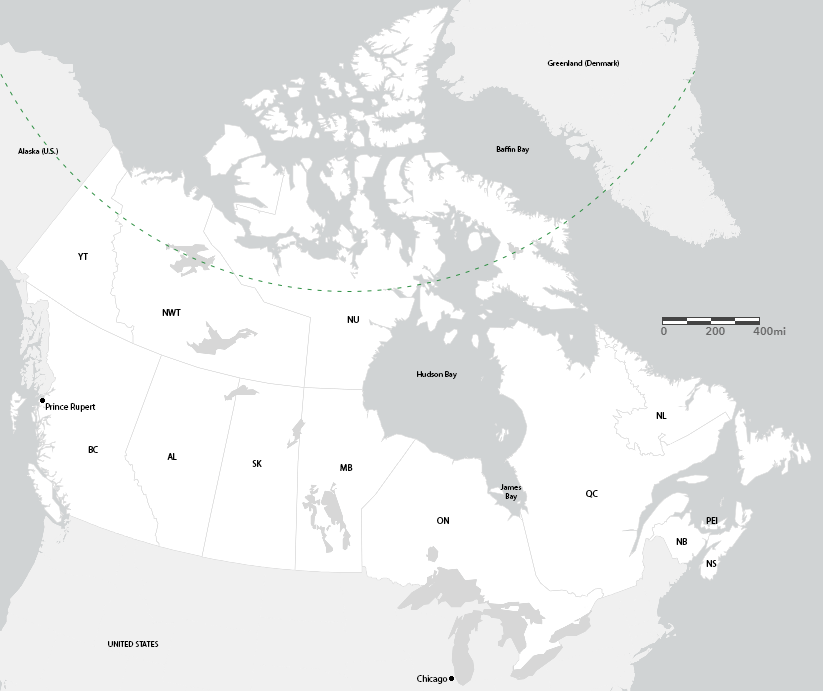
There's got to be somewhere closer than Prince Rupert from which Fraser and Turnbull can source the part they need to fix the conference room water closet. But what's going on with the lady at the door at the beginning of the scene? She's standing there smiling with a form in her hand, and Fraser, the acting liaison officer, simply ignores her. The younger woman who leads her away looks like she might be her daughter; was their business with the consulate concluded so it's okay that Fraser acknowledged them not at all? (The younger woman says "Come on" very patiently as she takes the older woman away. If these women weren't supposed to be in the scene, wouldn't they have reshot it? Therefore, they have to have been in there deliberately. But why?)
Scene 5
Huey and Dewey knock on the consulate door. Fraser answers it but does not invite them in.
FRASER: Ah.
HUEY: Okay, Fraser, don't give me a hard time. I have a warrant for his arrest.
FRASER: I'm afraid that Ray is already under arrest.
HUEY: By who?
FRASER: By whom.
DEWEY: By whom?
FRASER: By me.
HUEY: Fraser, you're a Mountie. You can't arrest anybody unless you're in Canada.
FRASER: I am in Canada.
HUEY: No, no. See, this is Chicago.
FRASER: Well, you would think so, wouldn't you, but you would be wrong.
DEWEY: Are we in the Twilight Zone?
FRASER: You see, under the terms of the Vienna Convention, nineteen-sixty-four, this consulate and the grounds upon which it sits is Canadian territory. [calls over his shoulder] Turnbull? [back to Huey and Dewey on the front step] So technically, you see, Ray is in Canada. Now, if you wish to arrest him, I'm afraid you will have to extradite him. [He holds out his hand and Turnbull slaps a set of forms into it like he's assisting at surgery.] These are the necessary forms — [He hands the forms to Dewey.] — to be completed in triplicate — [He holds out his hand and Turnbull hands him a pen.] — and filed with the American embassy in Ottawa. [He hands Dewey the pen.]
DEWEY: We are in the Twilight Zone.
HUEY: Fraser, you can't do this.
TURNBULL: Actually, he can. Regina versus Mombourquette, nineteen-sixty-seven. A confidence trickster was extradited to Alberta to face charges that he bilked pensioners in a phony mattress scheme. Also, in nineteen-eighty-four, Regina versus Horowitz, a man with a very large —
FRASER: Thank you, Turnbull.
TURNBULL: Sir.
FRASER: Gentlemen.
DEWEY: Can we use your bathroom?
FRASER: Oh, certainly, certainly — [remembers] — ah, no. Impossible.
He shuts the door in their faces.
Here's Uncle Wiki on the Vienna Convention of 1964. I can find no evidence that the Canadian court cases Turnbull mentions are real, and in any event, they wouldn't be on point, would they?, because those are matters of people being extradited to Canada, where this is a situation where they want to extradite Kowalski from Canada. All the same, I will revise my opinion of Fraser's arrest of Kowalski; did he know he was doing that for the purpose of keeping him safe?
Scene 6
Kowalski is still hanging around in the consulate. The women from scene 3 are taking seats in another room with another person.
KOWALSKI: Hey, they really gotta extradite me?
FRASER: That's right.
KOWALSKI: Wow. Go figure. [He follows Fraser down the hall.] Where are you going?
FRASER: To the scene of the crime.
KOWALSKI: A good plan. You do that, I'll get my files.
FRASER: Well, I'm sure the police have already picked up your files, Ray.
KOWALSKI: Yeah, yeah, they've gotten my files, but they wouldn't have gotten my files-files. I keep my secret stuff in a hollowed-out book. Let's get into it.
FRASER: [hand right in his face] Oh, no, you don't seem to understand, Ray. You can't leave the consulate.
KOWALSKI: Why?
FRASER: Detectives Huey and Dewey are undoubtedly stationed outside waiting to arrest you the moment you step from this building. As long as you remain here, you're safe. Diefenbaker, let's go.
Diefenbaker barks and comes running down the stairs. Turnbull appears halfway down the hall with a tea tray.
TURNBULL: Tea, Mr. Vecchio?
KOWALSKI: Safe?
FRASER: Welcome to Canada, Ray. [He biffs off.]
TURNBULL: Since you're a newcomer to our nation, I figured an orientation might be of some help as well as some good fun. Are you familiar with the sport known as curling?
KOWALSKI: No.
Okay so the folks in the background are there to show that the consulate does do ordinary non-Fraser-related business. I dig it! Here's a question, though: Didn't Turnbull meet Ray Vecchio at least twice? In other words, isn't Kowalski's undercover operation extremely known to practically everyone in Chicago? Sigh.
Scene 7
Fraser and Diefenbaker are in the alley where Kowalski met Volpe.
FRASER: Stay here. [Diefenbaker does stay. Fraser walks around and looks at the chalk outline of Volpe and the crime scene tape; he looks at a chipped concrete step and a circled bullet hole in the wall. Diefenbaker barks and points to something with his snout.] Good boy. [Fraser heads back to look where Diefenbaker is pointing. Diefenbaker barks again and goes behind some junk into a sort of hiding place.] What have you found? [Fraser runs his thumb along a surface and then tastes it. Diefenbaker grumbles.] Yeah. Gunpowder. The gunman fired from here after waiting for his victims to arrive. And he was a heavy smoker. [He picks up a cigarette butt and tastes it.] Some soft of salve. What do you think?
He extends the cigarette butt to Diefenbaker, who sniffs it and licks Fraser's fingers.
Doesn't Fraser's hand smell like some sort of salve (made from the mucous membrane of a pregnant it's not important)?
Scene 8
In the squad room, someone is cleaning out Kowalski's desk. They leave a copy of Canadian Impressionism in the bottom of his bottom drawer.
SOMEONE: This all of Vecchio's stuff?
WELSH: Yeah, and I want a receipt for all of it.
SOMEONE: Don't worry about it.
WELSH: I always worry when Internal Affairs starts messing with my detectives.
SOMEONE: If I need anything else, I'll call you. Oh, and I'll need a copy of any phone messages he gets. Every message.
WELSH: Hey, hey, I don't have enough people here to take messages for the people who work here. You want Vecchio's messages? You work Dispatch.
Once the IA guy is gone, Francesca goes to Kowalski's desk and gets the Canadian Impressionism book out, then heads for the supply closet. It's dark in there.
FRANCESCA: Fraser?
FRASER: I'm right here.
FRANCESCA: You smell great.
FRASER: That would be the neatsfoot oil.
FRANCESCA: You wear neatsfoot oil?
FRASER: On my Sam Browne. [There is an extremely awkward pause.] My belt.
FRANCESCA: Oh.
The supply closet door opens; the IA guy who just raided Kowalski's desk is there with a uniformed cop.
FRASER: Ah. [reads the guy's badge] Sergeant Kilrea. Just the man I was looking for.
SOMEONE (KILREA): You're looking for me in a closet?
FRASER: Well, no, I'm in the closet for an altogether different reason.
FRANCESCA: I wish.
KILREA: Who the hell are you?
FRASER: Constable Benton Fraser, RCMP, and I certainly don't mean to step on any jurisdictional toes, but Ray Vecchio did not shoot Mr. Volpe.
KILREA: Maybe he did, maybe he didn't. Who cares?
FRASER: I do.
KILREA: Listen to me. Ray Vecchio is a smartass. He brings the heat down on all decent cops. If Cahill wants Vecchio, I'm going to give him Vecchio. And you're going to give me that book. [He takes Canadian Impressionism out of Fraser's hand and walks away. Francesca shuts herself and Fraser back into the closet.]
FRASER: Oh dear.
I mean I assume Cahill and Kilrea don't know that "Vecchio" is Kowalski, right? Because IA is apparently in the dark on this matter for reasons that don't
need exploring at this juncturemake an awful lot of sense. And but so is it the real Vecchio who's a smartass who brings the heat down on decent cops, or Kowalski? (I suppose they could both be smartasses?)Canadian Impressionism by Paul Duval is a real book, and why Kowalski has it in his desk drawer (I mean, apart from the obvious, that is, as a place to hide his secret files) is a mystery. Another mystery: What did he do with the pages he hollowed out of it?
Neatsfoot oil is a rendered oil from the shins but not the hooves of cattle, remaining liquid at room temperature for reasons having to do with science so it is more useful as a leather conditioner than tallow, I guess. I can't imagine it would actually smell that good, but I'm not Francesca with a particular hangup on Fraser, so what do I know. On the other hand, maybe Fraser is trying to put her off: Remember the time on Cheers when Norm hosts his company Christmas party at the bar and asks Diane to make a particular effort to entertain his boss, who turns out to be incredibly gross and assaulty? Before he actually crosses the line, when he's just coming onto her way too hard, he says "You smell great. What is that?" and she says "Thank you! Dandruff shampoo."
Scene 9
At the consulate, Turnbull is babysitting Kowalski in the conference room and watching curling. Kowalski is throwing spitballs at the back of Turnbull's neck.
PLAY-BY-PLAY ANNOUNCER: The Canadian team has one in the four-foot and is going to play the guard. [A curler comes out of the hack to deliver a stone with a blue handle; a sweeper is sliding alongside.]
KOWALSKI: Anything that moves that slowly is not a sport.
TURNBULL: [muttering, incredulous] Not a sport. [The sweeper begins sweeping in front of the stone.]
PLAY-BY-PLAY ANNOUNCER: If you recall, back in the ninety-five bonspiel . . .
KOWALSKI: [making sweeping motions] This is not a sport. It's housework.
PLAY-BY-PLAY ANNOUNCER: . . . similar situation . . .
TURNBULL: It is a calling.
PLAY-BY-PLAY ANNOUNCER: They couldn't pull it off then, but I . . .
KOWALSKI: It may be a pastime, it may even be a hobby, but it is definitely not a sport.
Turnbull takes a deep breath. On the TV, a rock hits another rock and people cheer. Turnbull stands up.
PLAY-BY-PLAY ANNOUNCER: All right, so they have shot rock, but . . .
TURNBULL: Do you want to fight?
KOWALSKI: Over curling?
TURNBULL: Yes. What if I made fun of baseball?
PLAY-BY-PLAY ANNOUNCER: They're going to set up the rock just outside the twelve-foot —
KOWALSKI: All right.
Kowalski and Turnbull both put their dukes up. The TV shows the same shot of the same sweeper sliding alongside the same rock. Fraser returns.
FRASER: Afternoon, gentlemen.
PLAY-BY-PLAY ANNOUNCER: — so they can use it later on.
CURLER: Whoa.
KOWALSKI: Hey, you're empty-handed.
FRASER: But I am not empty-trousered.
Fraser takes off his tunic, shrugs out of his suspenders, and undoes his fly. Turnbull turns respectfully away, back toward the television. Fraser pulls files out of the flares of each of his trouser legs and hands them to Kowalski.
PLAY-BY-PLAY ANNOUNCER: . . . the tap back. That means he's going a bit too strong. He's actually taking weight off the rock. That shot went a little further than they wanted and knocked their own stone in the eight-foot out of position.
CURLER: Right off! Right off! That's okay. We're okay!
KOWALSKI: Yes.
PLAY-BY-PLAY ANNOUNCER: . . . Here comes Canada's last rock. They need to score at least one point here to give them the chance at a tenth end . . .
KOWALSKI: Yes!
Kowalski takes the files back to the conference table. On the TV screen, another blue stone is being delivered. Turnbull is very excited.
TURNBULL: Sir? Sir!
CURLER: All right! All right!
PLAY-BY-PLAY ANNOUNCER: Looks like they're going to do it —
FRASER AND TURNBULL: [making sweeping motions] SWEEEEEP!
CURLER: Come on!
On the screen, where yellow has been lying two, the blue stone hits the top counter and rests in the four-foot circle.
PLAY-BY-PLAY ANNOUNCER: Nice shot!
TURNBULL: Oh, I love this game!
Okay, yes, yes, Fraser walks into a room and doesn't even close the door or wait for Turnbull to be elsewhere before he takes his pants off for Ray Kowalski, yes, that's a thing that happened. Let's talk about the curling.
It doesn't look like that great of a shot.
The curling has already been a little bit of a mystery, because at the beginning of the scene, the announcer said "the Canadian team" had one in the four-foot and they were going to play a guard, and then we saw the team on the TV throw a blue stone. So Canada must be blue, okay. And we don't know who their opponent is. (A bonspiel is a curling tournament. The more popular curling gets, the more accessible on TV to more randoms, the more national and international championships use words like "playdown" [= playoff, basically] or even more broadly understood terms like, well, "tournament" or "championship;" and I have a sense that there are people who don't use "bonspiel" to refer to more formal round-robin competitions but only to events with cascading brackets. But I think that's a nicety that not everyone observes, and even the world championship is technically a bonspiel.)
Anyway, a guard takes about 25 seconds to come to rest (let's say more like 22 or 23 in the 90s; ice has been getting keener and keener in the past generation). And yet the next thing we hear from the TV, about 16 seconds later, just before Turnbull and Kowalski agree to throw down, is a hit and some cheering. So blue totally missed that guard, but I guess whatever they hit was okay to hit?
Then what's happening when Fraser first arrives must, necessarily, be a yellow shot, but the TV is apparently showing a replay of the blue one. We only get a glimpse of the rock, but it's definitely the same sweeper with the same shoes and the same broom. (Incidentally, why only one sweeper? In a televised game, playing with only three—one in the house, one to throw, and one to sweep—would be pretty surprising.) And then the commentary is talking about something going a bit too far; that must be a yellow stone they're talking about, but whoever it is shouting feels like the shot ends up okay, so that's good for them —
— but it sounds like the same person shouting for the sweep on the next stone, which is definitely blue but probably shouldn't have been swept at all, because we're almost ready to talk about the shot we do see, which is this: blue, with the hammer, throwing an in-turn up the center line. (I'll come back to that terminology in a moment.)
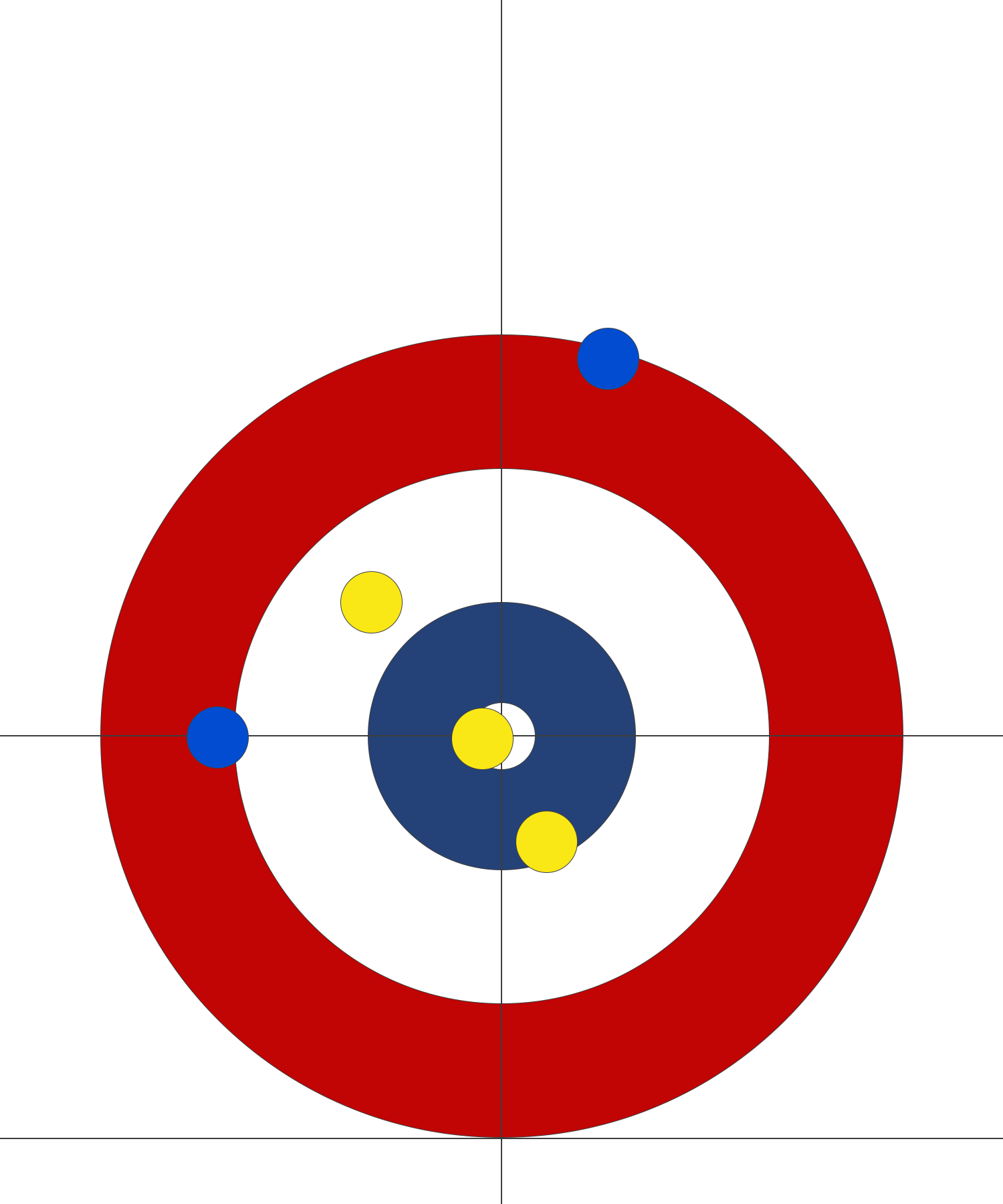
Here's the house as that blue rock arrives while Fraser and Turnbull are yelling.
And blue is about to throw their last stone of the end, in which they need at least one point to give them a chance at a 10th end. A game on television is normally 10 ends (especially in the 1990s), so if Canada needs to score to give them a chance at that end—that is, to be sure they're not mathematically or at least practically eliminated; you're mathematically eliminated if you're behind by more than eight points before the last end begins, because there are only eight points available in each end—that means they're behind, and probably badly, because if they were tied or even down just one they'd be happy to give yellow one point in the ninth and have the last rock advantage in the final end, when they should be able to get at least two points. In fact they should be able to get more than one here; assuming there are no other guards further out than we can see (there is about the same amount again of white playing space not visible off the top of the picture), they should be able to hit both of those yellow rocks out and get three. So how did we get here?
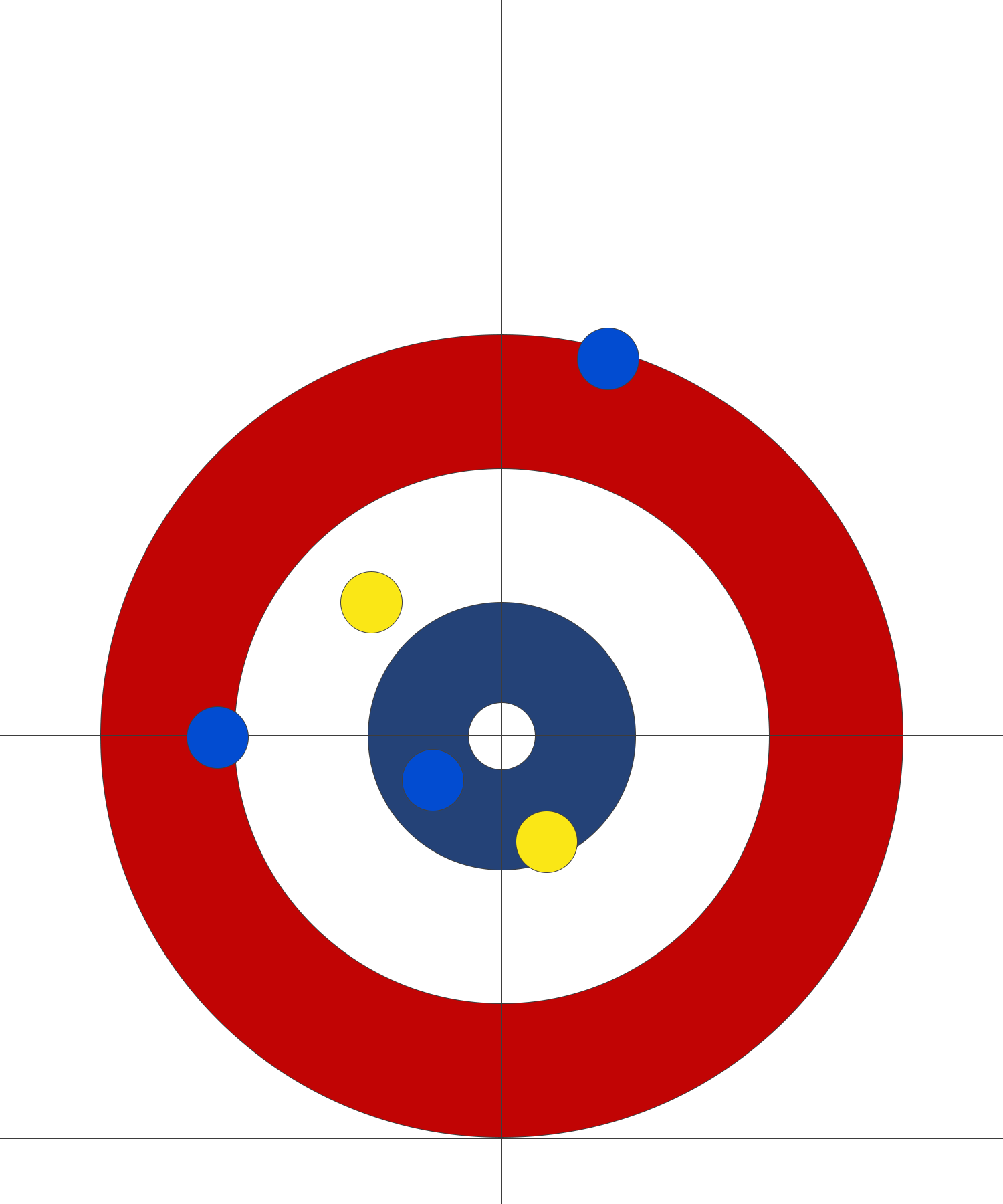
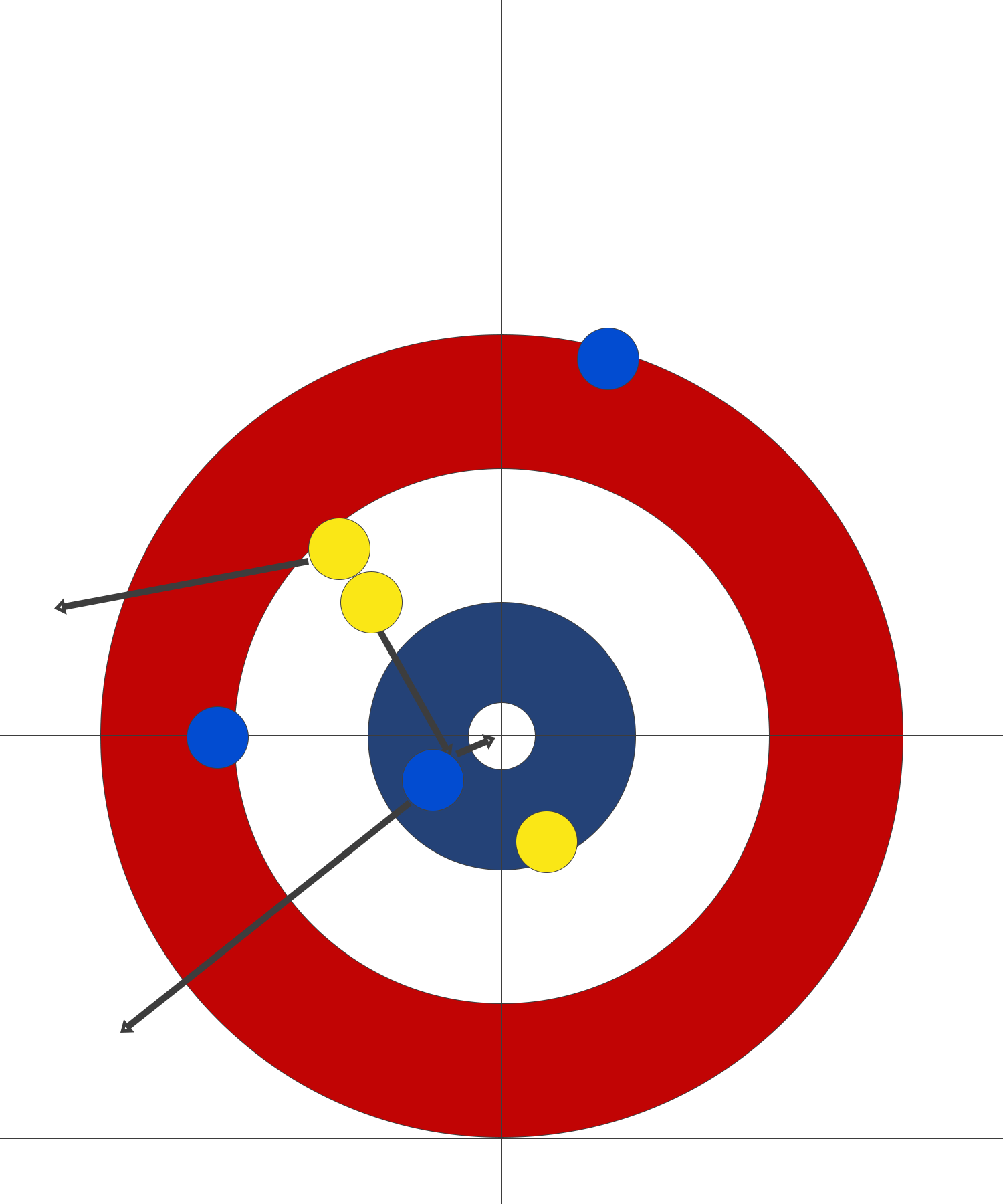
Let's work backwards again. The commentator said yellow—well, he said they were going to set up a rock outside the 12-foot and use it later on, which doesn't make sense if blue's next rock is the last rock of the end, because that means this is yellow's last rock of the end; that is, there is no later on unless by "later on" he means they need a yellow stone outside the 12-foot to be in blue's way. Anyway, though, he said that rock—their last of the end—went a little too far and knocked their own stone in the eight-foot out of position. But the last thing before that, blue had one in the four foot and was playing a guard. That means there used to be one blue stone in that blue ring, and they were trying to put another blue one out front somewhere so yellow couldn't (or at least couldn't easily) get at it. Given all these facts, I think what must have happened in this game was this:
Blue had a stone in the four-foot (left) and were going to play the guard (center) but wrecked on the yellow guard and rolled into the house (right).
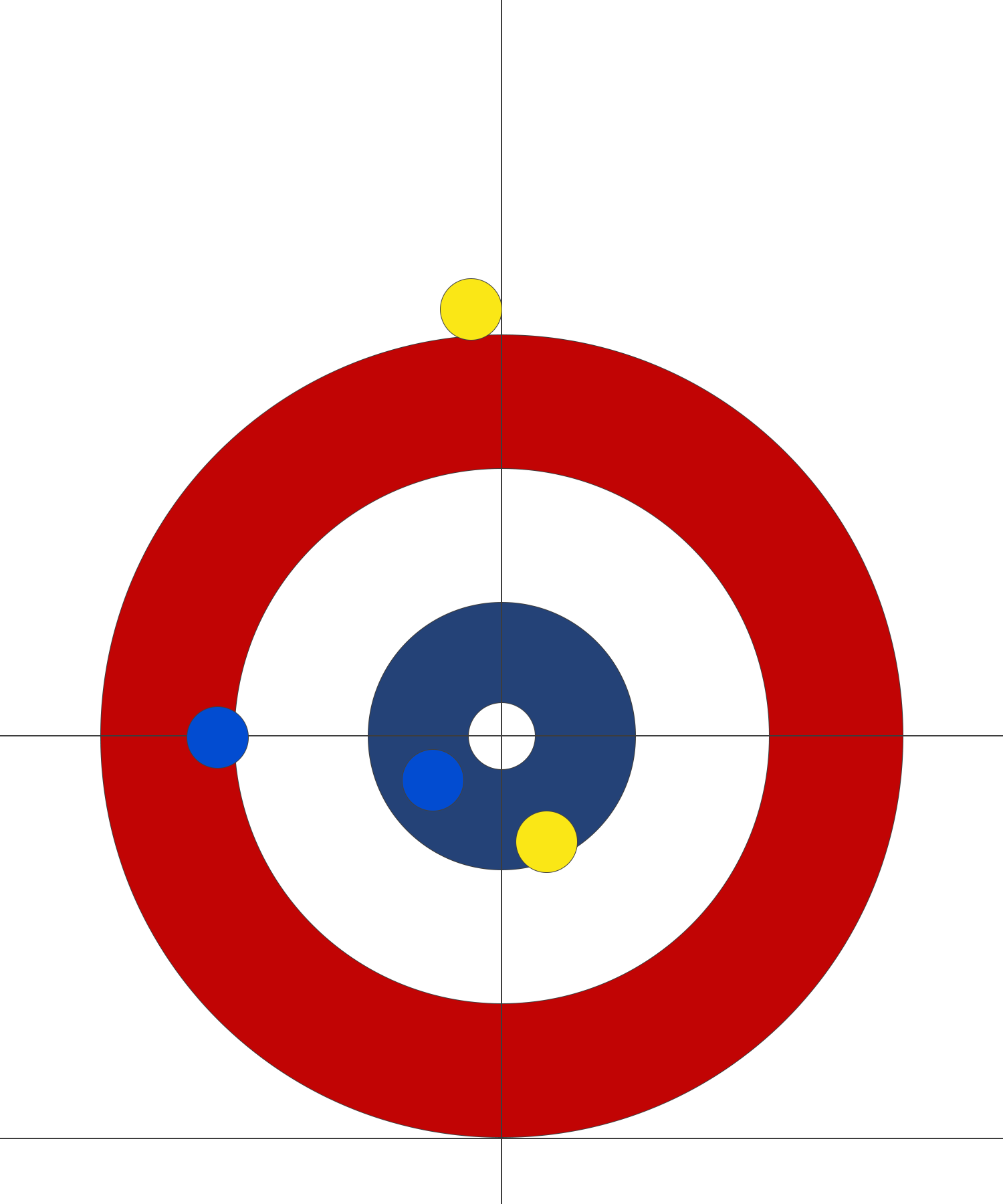
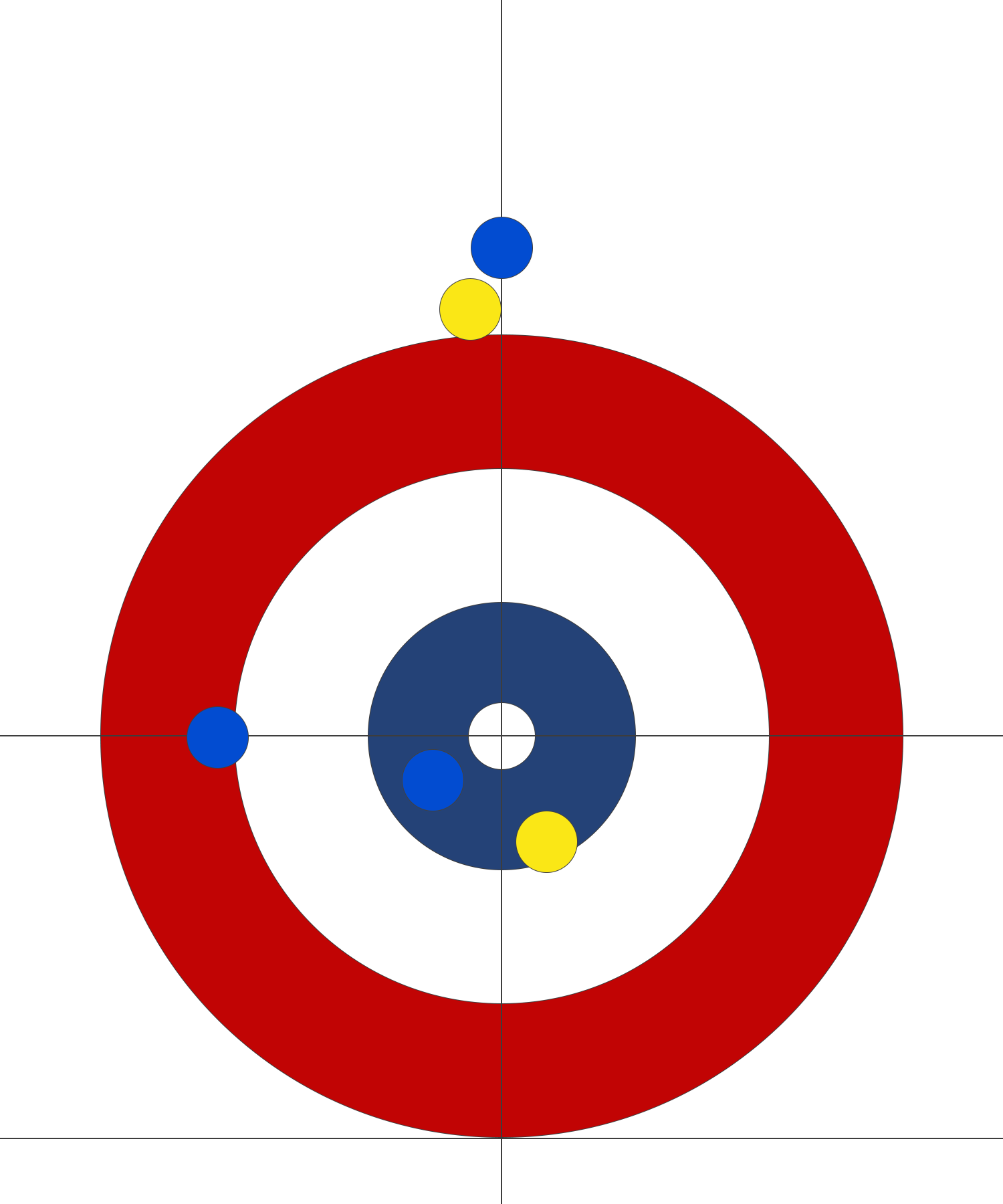
Although it's not impossible that by "going to play the guard" the commentator meant they were going to play the yellow guard, that is, try to chip the yellow guard and roll on, which is what they did; that's a slightly better outcome for a team that has the hammer (the last rock of the end), as blue apparently does, and it makes more sense that people would cheer this outcome if this is what they intended rather than if they meant to do the guard as shown in the middle image. Also, going for a guard and getting a chip and roll-in would be a pretty big miss, at this level.
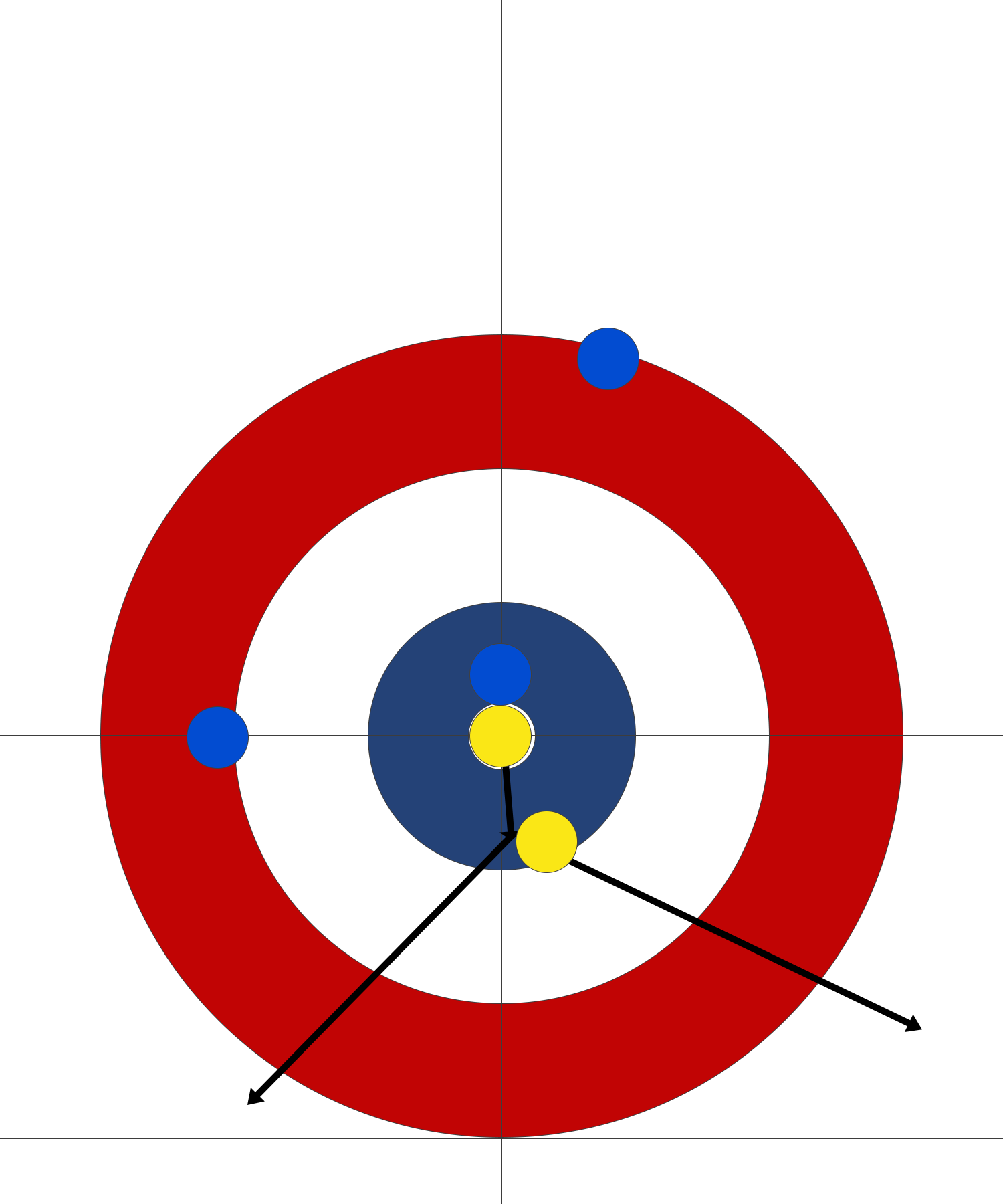
This is where the commentator says "So they have shot rock, but"—and we don't hear the rest of what he says, but it's a fair point, because what I would say is but they're pretty vulnerable, that is, yellow could relatively easily hit that blue counter out (left) and made blue take their last shot against three instead of against two (right).
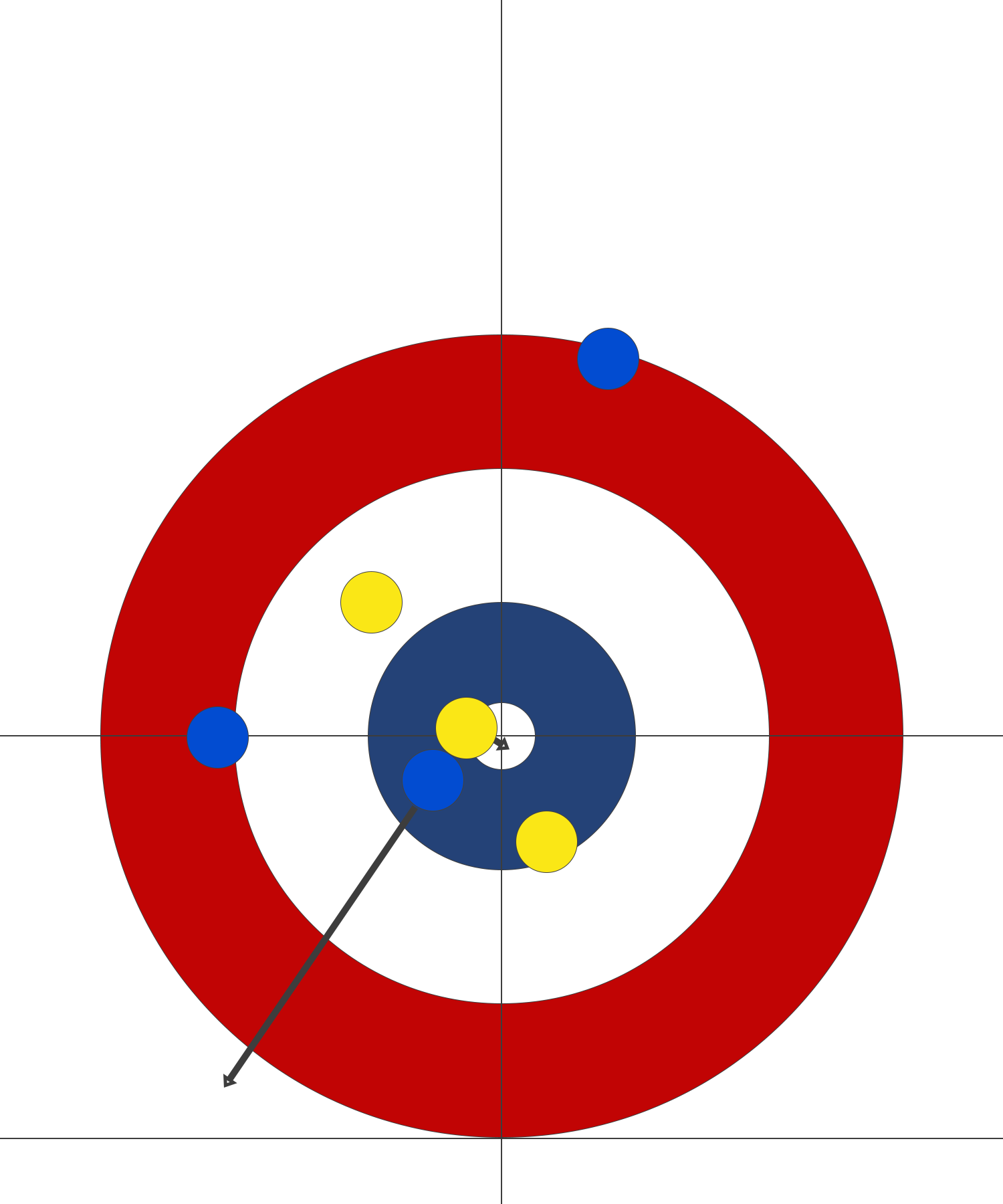
Instead of which, yellow, with their last shot of the end, were intending to put a rock outside the 12-foot and use it later on, which I guess means they were going for something like this (left) intending to hold blue to a single point? But alas they threw disastrously too much weight ("deeper than they wanted") and "knocked their own stone in the 8-foot out of position," which given what the house looks like when they're done can only mean they drove their stone from the eight-foot onto the blue one in the four-foot, it flopped onto the button, and they lost the shooter (right).
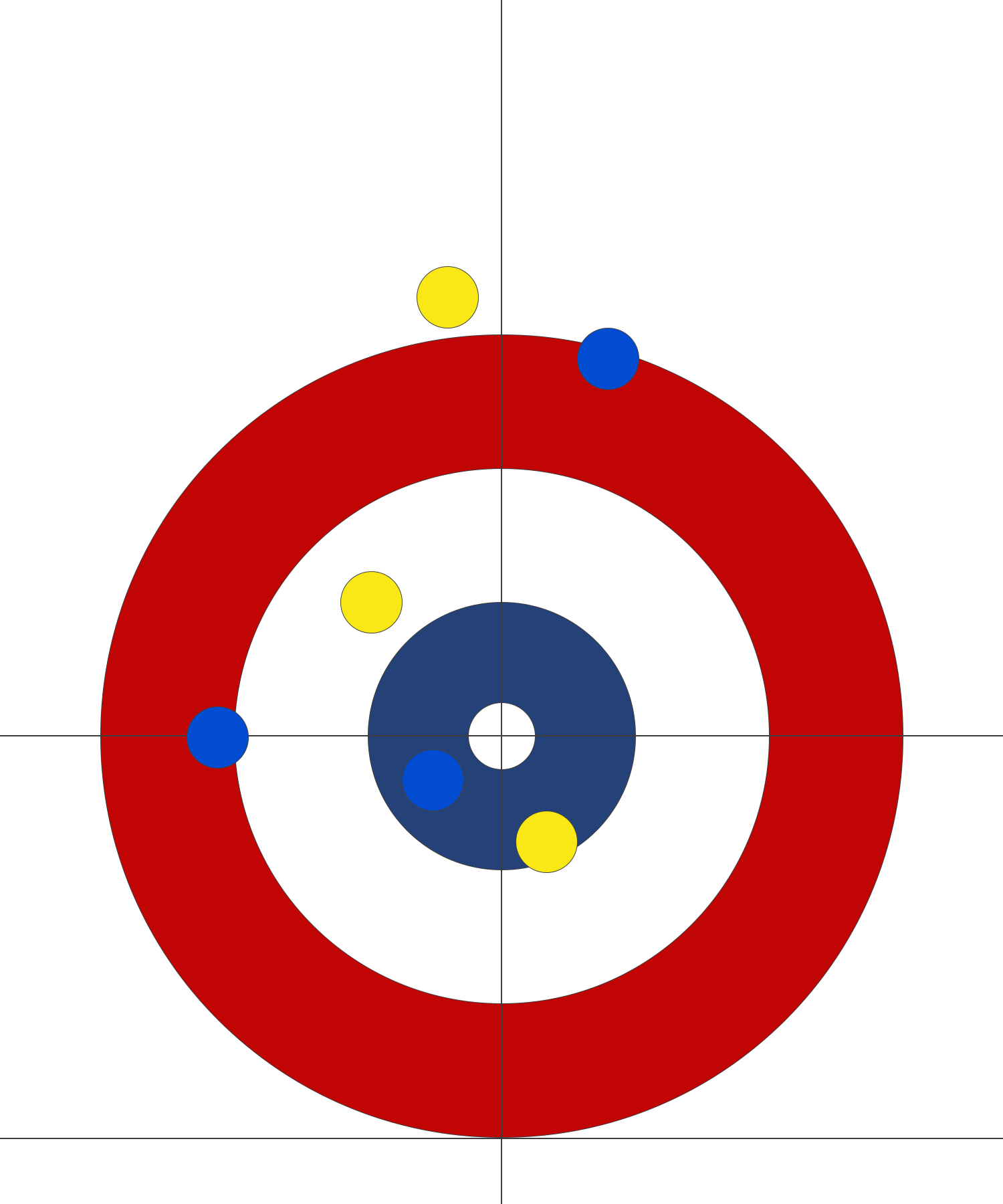
Their skip said "We're okay," but he had to know perfectly well he'd left blue a double for three.
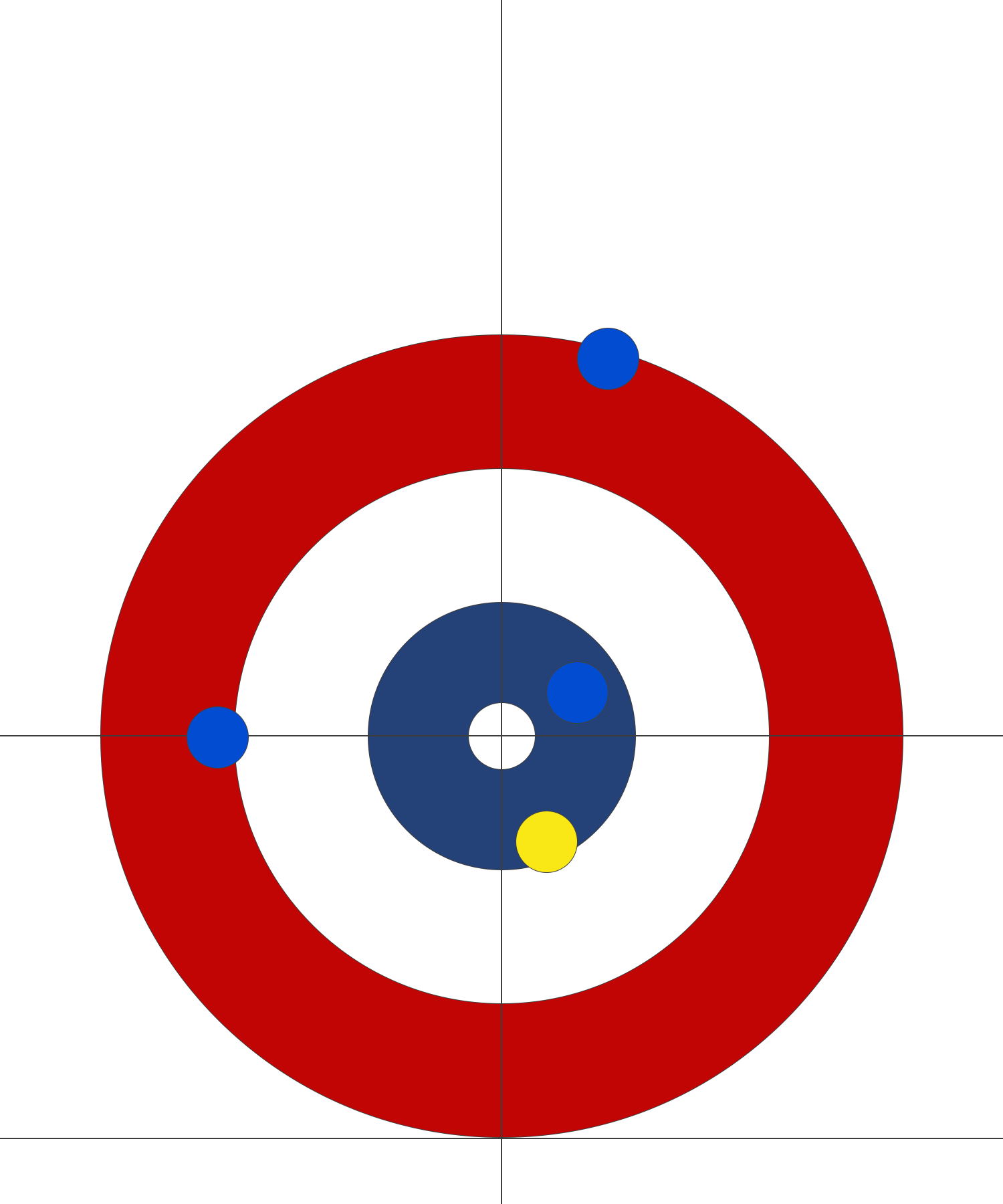
Which is where we came in. To remind: This is the house the blue skip was looking at when he got in the hack to throw his last stone.
What he should have done is throw a rock relatively hard along or just to the outside of the center line (the left side of the center line, on the diagram; his right side, because he's coming toward us) with a counterclockwise spin on it—we can see that he's right-handed, which makes the counterclockwise spin his out-turn—so it would come fairly straight up the center line and just begin to curve toward the center line and punch the yellow stone on the button right on its nose so both yellows go out and he gets three points.
But instead he throws an in-turn (clockwise) more or less exactly on but regrettably a hair inside the center line (that is, to its right on the diagram), which I suppose is another way to get to the nose of that top yellow rock, but it doesn't get there, does it? It hangs on the center line—in fact the sweeper keeps it on the center line, where if he'd laid off it might have curled a bit—and hits the yellow one off-center, missing the back yellow completely and coming dangerously close to rolling away far enough that he gives up a steal of one.
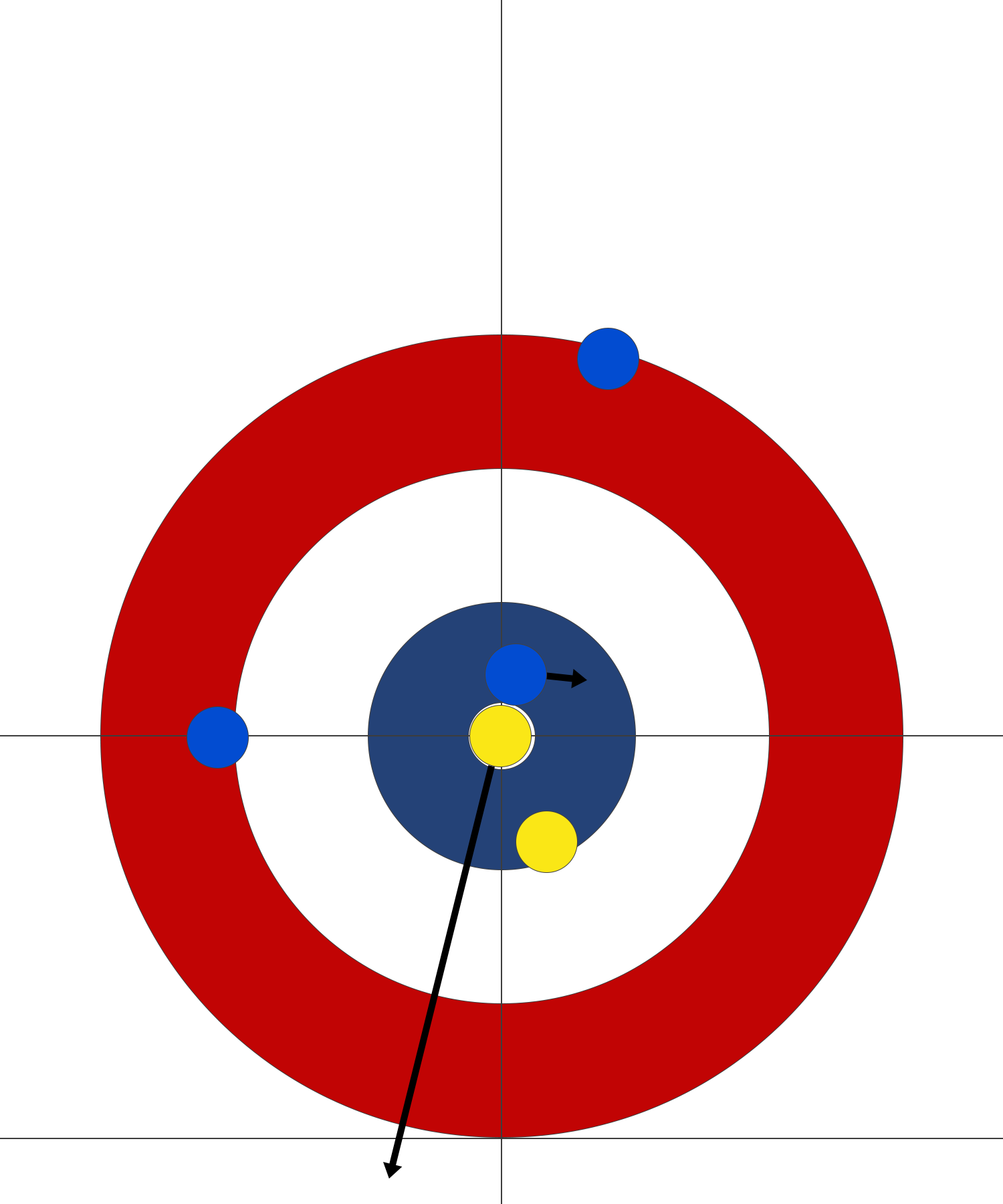
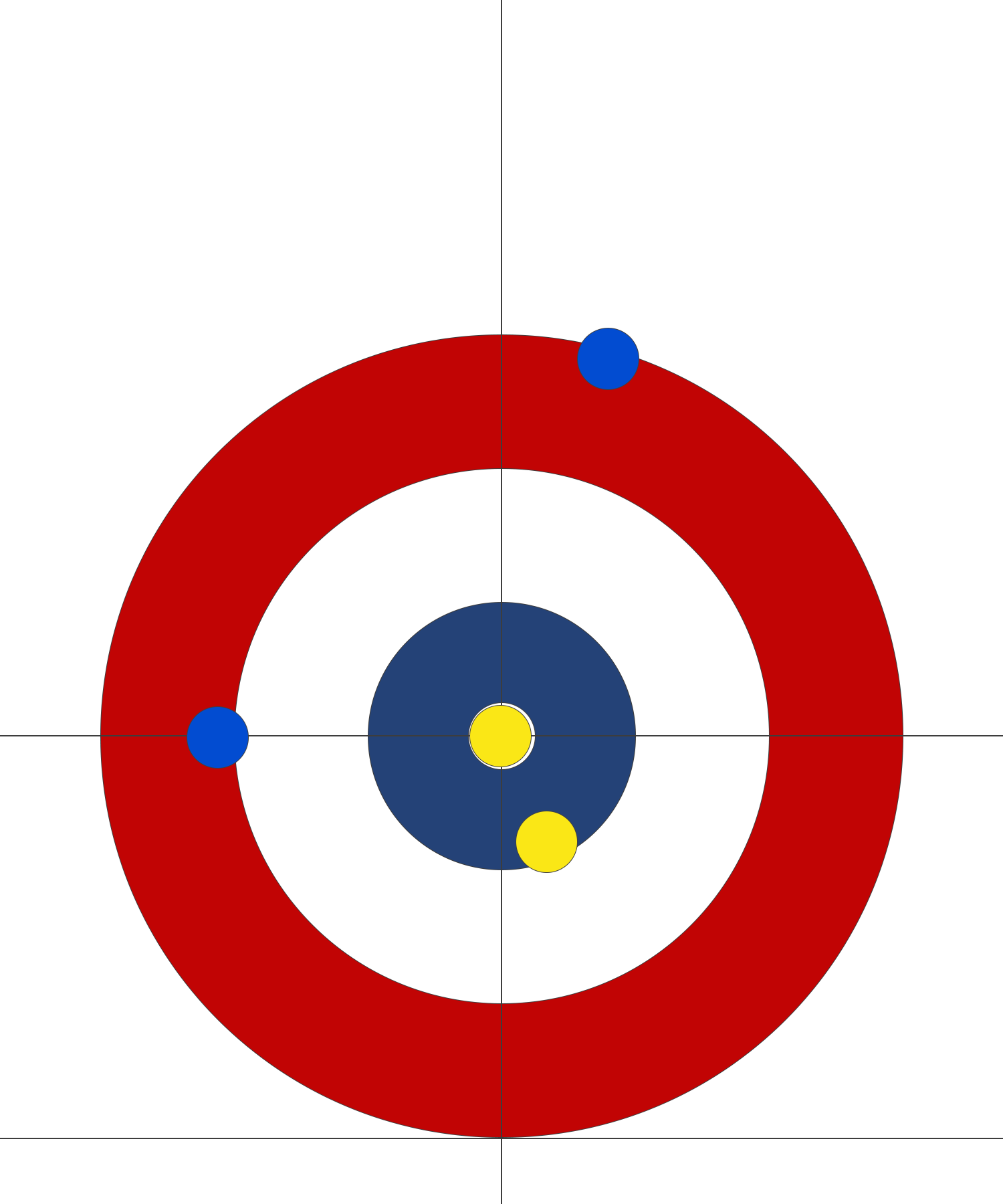
Now, the commentator said blue needed "at least one point" for something to happen, so maybe they're happy as long as they got any points at all and the skip knew something about the ice coming in from the outside of the center line or didn't feel good about his out-turn or what have you. But a single hit for just barely one when it could have been a double for three* isn't a "nice shot," no matter what the commentator says, and I'm disappointed in everyone involved in shooting this scene for not picking a better example of curling to have Turnbull introducing Kowalski to the game.
*Like I said, it's possible there are more guards further out front. So aaall of this explication assumes that neither team had to thread any needles to get those rocks where they got them. If there was a port blue might not have got through, then yes, that might well have been a very nice shot.
Anyway, curling is totally a sport, because despite what looks like the slow pace (which, as Turnbull said, hi, baseball?), the athleticism is very real, and the scoring is completely objective, and what more do you want in a sporting event? Kowalski can shove it.
Scene 10
Kowalski is looking at the files Fraser brought him. He brandishes an 8x10 photograph.
KOWALSKI: That — Eddie Herndorf. Old-style gangster. Guy's ruthless. Once he cut the muscles out of a guy's leg with a sword 'cause he cut him off in traffic. [He lays down another picture.] That — Gus Fillion, Eddie's main competitor. Sees himself as a Renaissance sort of guy. These two used to duke it out, but they've been getting along lately. Getting along until — [He puts down another picture.] — Andreas Volpe. Glue-huffing psychopath. Local kid, big ambitions.
FRASER: So it's your theory, if I may recap, that Volpe challenged their authority and was killed as a result? [The doorbell rings.]
KOWALSKI: Yeah. See, that's why we're policemen, Fraser. We get to figure these kind of things out.
FRASER: Right you are, Ray. Right you are. I think it's time that I paid Mr. Fillion a visit.
KOWALSKI: Look, no offense, Fraser, but these are Chicago hard guys. I mean, you can be as polite as you want, but they can have you hanging from a meathook in thirteen seconds.
FRASER: Well, I'm not without my resources, Ray.
TURNBULL: [appearing at the door] Sir? Your presence.
FRASER: Ah.
KOWALSKI: "Your presence?" What are you, like, a king or something?
FRASER: To Turnbull? Yes. [He follows Turnbull out to the lobby.] Ah, Lieutenant Welsh. Nice to see you. Welcome to Canada, sir.
WELSH: Fraser, this is Assistant State's Attorney Cahill.
FRASER: It's an honor, sir. I've seen your posters all over town.
CAHILL: Constable, I'll come straight to the point. I'd like you to surrender Detective Vecchio to me.
FRASER: Well, I'm afraid I can't do that, sir. The extradition treaty between our two countries is very specific —
CAHILL: We want to question Vecchio in connection with a more than particularly vicious homicide. I've suspected for some time that organized crime has an informant somewhere inside the police department of this city.
WELSH: Well, sir, I don't think we have to bother Constable Fraser with that.
CAHILL: I want this man to understand what he's interfering with.
FRASER: I think I can put your mind to rest on that point, sir. Ray had nothing to do with this murder. And I can personally vouch for his integrity.
CAHILL: I'm supposed to take your word on that?
FRASER: Yes, sir. [Cahill chuckles.]
WELSH: You see, ah, sir, ah, Constable Fraser doesn't lie.
CAHILL: Oh, well, that's a, that's an admirable quality in times of peace, but we're in the middle of a war, a war against crime and corruption, and I demand your cooperation! The City of Chicago demands your cooperation!
FRASER: And you shall have it, sir, to the full extent of the law.
CAHILL: Are you mocking me? Are you mocking this city, this administration?
FRASER: Certainly not, sir. No. We greatly appreciate the generosity shown to us by the people of Chicago, and I assure you, should you ever find yourself in Nunavut, you will not be wanting for a meal.
CAHILL: [laughs in his face] Come here. Come here. [Fraser leans down to listen to him closely.] You know, this, this Marquess of Queensberry thing, and your grammar and all, it, it, it, it, it's very quaint. But, ah, I just want to remind you that we took Grenada, we beat the snot out of Haiti, we knocked Panama on its ass, and if needs be, we can take this little pisspot too! Have a nice evening.
Cahill and his associate storm out of the consulate. Welsh goes with them.
FRASER: Oh, dear.
The older woman with the form comes out and shows it to Fraser. He speaks to her for a moment and then her daughter comes and takes her back into the conference room.
It sounds like the family in the conference room are speaking a tonal language, of which I have no experience at all. Is Fraser speaking to this woman in Cantonese? That's the only tonal language we've heard him use before (albeit badly, according to my native speaker contacts).
Cahill is much shorter than Welsh (but who isn't) and Fraser, so his spittle-flecked fury and invocation of U.S. victories in Grenada, Haiti, and Panama are pretty funny in a Napoleon-complex sort of way, although the events themselves are not funny at all. The United States invaded Grenada in 1983, ostensibly to protect American medical students there from being caught up in skirmishes between military and civilian groups seeking control of that country but in fact (as all the world knew) to chuck out and replace a Soviet-backed government they didn't like. Later, the United States invaded Panama in 1989, ostensibly to protect Americans living there and combat drug trafficking and money laundering but in fact (as all the world knew) to depose a dictator they didn't like. At least when the United States invaded Haiti in 1994 the action was authorized ahead of time by the United Nations and was taken to reinstate a legitimately elected president who had been ousted in a 1991 military coup. None of these small, developing Caribbean and Central American countries needed much of a U.S. push to get "knocked on their ass," as Cahill put it, and his suggestion that Canada—a highly developed country with an advanced economy and a better record on democracy and human rights indices than the United States—is a "pisspot" is of course preposterous.
Meanwhile, his mention of "this Marquess of Queensberry thing" is a reference to the Queensberry Rules of boxing named after the 9th Marquess of Queensberry, otherwise known as the father of Lord Alfred Douglas, Oscar Wilde's Bosie (himself an antisemite and a rotter, but I digress); this is a verbal disagreement rather than an actual fight, so Queensberry Rules have nothing to do with it, but I guess it makes a little more sense than invoking Robert's Rules of Order or any guide to parliamentary procedure Fraser might be more likely to be following?
At the time of this episode, the area that is now Nunavut was still part of the Northwest Territories, but the referendum to divide NWT and create Nunavut had passed years earlier and the April 1, 1999 date of establishment of Nunavut was approaching.
Again: Does Cahill think it's Ray Vecchio who's a mole, or "Ray Vecchio"? That is, apparently he, the occasional actual criminal, and Internal Affairs are approximately the only people in the state of Illinois who are not in on it. But either way, Fraser's loyalty to his friend is . . . what is it? Touching? Admirable? I mean: Fraser can safely assume Ray Vecchio didn't kill Volpe, because as far as he knows Ray Vecchio is in Las Vegas pretending to be a genuine Mob boss, not here in Chicago pretending not to be mixed up with the Mob. He's also taking Kowalski's word for it that he didn't kill Volpe, although all Kowalski has said is that he doesn't know who killed Volpe and for all he knows it could have been him. On what basis is Fraser so confident that Ray Kowalski, about whom all he knows is that he's a thrice-cited detective with no qualms at all about lying through his teeth (because that's what undercover work is), is not an informant within the police department for organized crime? Hmm?
The camera angles in this episode are sort of interesting. There's been a lot of shooting up from floor level. I continue to suspect the DP was just trying to make his own fun.
Scene 11
Fraser heads back to his office, looks around to be sure no one is watching, and steps into his closet, where the wind is howling because he's in his father's cabin now.
BOB FRASER: Close the door, son. Anyone would think you were born in a barn.
FRASER: I was.
BOB FRASER: Oh. That's true enough.
FRASER: [closes the door and approaches his father with a sigh] You always told me that the most important thing a man can do is his duty, and —
BOB FRASER: Uh-huh?
FRASER: — I'm about to embark on a somewhat devious course of action and I'm not entirely sure where my duty actually lies.
BOB FRASER: Nineteen-sixty-one.
FRASER: All right.
BOB FRASER: I was ordered to help thirty-two Inuit families relocate five hundred miles further north on Ellesmere Island. We had some dispute with the Russians — anh, this was long before the Canada Cup. We wanted to demonstrate our sovereignty over the far north. Now, I'd been up to Ellesmere, and I knew that life up there would be hard, if not impossible. Said as much to my superiors, but they were adamant, and I had my orders.
FRASER: So what did you do?
BOB FRASER: [puffs a sigh] Only thing I could do. I went up to Ellesmere, and I marked out thirty-two plots of land. I threw up a flag, opened up a post office. Tom Goforth, a young man from one of the families, lived up there all alone for the first year, receiving all these relocation checks. He forwarded them back to the families, who used the money to hire a lawyer, who won their case against their relocation in court.
FRASER: So you created a fictitious town.
BOB FRASER: Ah, Ellesmere was listed in Maclean's that year as having the lowest crime rate in North America. Your heart is where your duty lies, son. Your head is just along to help with the driving.
FRASER: [heads back to the cabin/office door, but turns back] Oh, uh — Tom Goforth, what happened to him?
BOB FRASER: Tom? Tom, I believe, moved to Winnipeg and went to work in a record store, but that's not relevant to this situation.
FRASER: No.
Fraser heads back into his office.
Sigh. Ah, Bob. If only a fake town set up by a sympathetic Mountie and a court case funded by the relocation stipends were what had happened to the people subjected to High Arctic relocation.
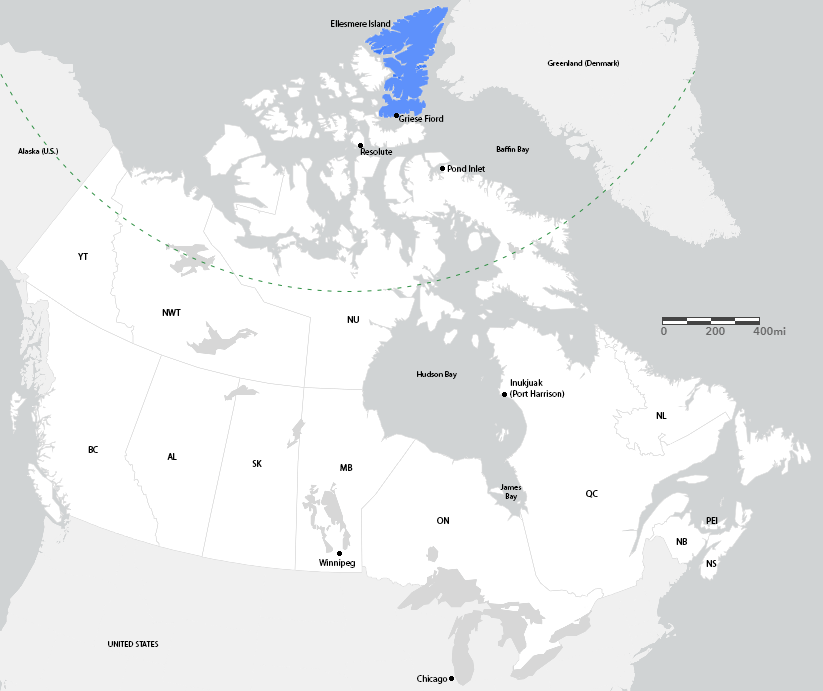
As the linked article says, in 1953 (which we have previously determined would have to be before Bob joined the RCMP), 92 people from seven or eight families in Inukjuak (then called Port Harrison), Quebec, and three families in Pond Inlet, NWT (now Nunavut), were relocated to Resolute and Griese Fiord—the latter of which is at the southern tip of Ellesmere Island—ostensibly because their current homes were no longer supporting their lifestyle but arguably because (as Bob suggests) the Canadians and the Soviets were up in territorial squabbles over uninhabited areas of the Arctic (which they still are, by the way, and the Canada Cup didn't solve much despite the USSR winning the second edition of that championship in 1981; it was only ever held five times in 15 years, of which Canada won the other four, before it was replaced by the World Cup of Hockey, which has been held even less regularly and often; at the time this episode was made it had been held exactly once and the United States had beaten Canada in the final, and the show curiously doesn't ever mention that) including the Northwest Passage, and having inhabitants there would strengthen the Canadian government's claims. The whole of Ellesmere Island is only 520 miles long, so the idea that eight years later Bob was instructed to relocate 32 families 500 miles further north is . . . well, that might have made a bad situation even worse?Canada established a Reconciliation Agreement and a trust fund to compensate relocated persons and their families in 1996, but its government didn't officially apologize for the High Arctic relocation until 2010. (NB: I am in no way suggesting that the United States has any stones to throw on the subject of (mis)treatment of Indigenous peoples.)
So let's review the Fraser Does Not Lie question, shall we? In "They Eat Horses, Don't They?" he promised Mrs. Gamez that nothing bad would happen, and then it did, which was not precisely a lie, because he wasn't the one who did the bad thing—but he shouldn't have promised such a thing if he didn't know it was going to be true. In "Pizzas and Promises," he was scandalized that Vecchio expected him to lie to people, but when he understood that it was the only way to solve the case, he did it (or tried; the lie didn't stay told for long). In "A Hawk and a Handsaw" he straight-up lied to Walter Sparks to get him to come in off the ledge; he apologized, but the fact remains. And in "Some Like It Red" he spent the whole episode lying to—well, to almost everyone, but it's Melissa who calls him on it, and he admits it but doesn't even apologize. (To say nothing of that time he was ready to chuck it all and turn to a life of crime, although the only person he actually lied to in that instance was himself.) So it's hard to say on what basis Vecchio (in "An Invitation to Romance" and "Vault"), Huey (in "Seeing Is Believing"), and Welsh insist that Fraser (or Mounties as a class, or Canadians in general) never, as a matter of policy, say anything that isn't true, especially when Fraser himself opened this episode by being slightly less than honest with Thatcher.
Scene 12
Huey and Dewey are sitting in a car outside the consulate. They watch Fraser and Diefenbaker leave the building.
DEWEY: Is that really a wolf?
HUEY: Could bring down a caribou.
DEWEY: Just the weak ones. It's known as calling the herd.
HUEY: Culling.
DEWEY: What?
HUEY: Culling the herd, not calling the herd.
DEWEY: Well, what did I say?
HUEY: You said — forget it.
Is it just me or is the show going out of its way to make Dewey unlikeable (or at least ridiculous)? I mean, it's a good thing Huey seems to get along with him, but.
Scene 13
Fraser and Diefenbaker walk into a bar.
FRASER: I'd like to speak to a Mr. Fillion, if I could.
BARTENDER: Hey, boss. [Fillion appears right away.]
FILLION: Is that a wolf? [Diefenbaker growls.]
FRASER: Half wolf, actually.
FILLION: Is that legit?
FRASER: Ah, yes. Yes. My name is Constable Benton Fraser, Royal Canadian Mounted Police. I first came to Chicago on the trail of the killers of my father, and for reasons that don't need exploring at this juncture, I've remained, attached as liaison with the Canadian consulate.
FILLION: [assesses Fraser for a moment and then decides he's for real] Come here. [leads him to a back wall and shows him a bunch of paintings and drawings; the bartender/lieutenant follows] I painted all these. I love dogs. Not candyass drop-kick dogs, you understand. I mean real dogs. [He points to a picture of a retriever of some kind.]
FRASER: A very deft touch. Amazingly lifelike.
FILLION: Anh, just something to do. Better than clowns. Hate clowns. Some experience with a clown — [He shudders.] — won't do them.
FRASER: It's understandable.
FILLION: So you're the one that's got, ah, Vecchio stashed away, huh?
FRASER: He is suspected of shooting a man named Andreas Volpe.
FILLION: So give him a medal.
FRASER: He's innocent of the charge.
FILLION: So you think I did it.
FRASER: I've formed no opinion, sir. I'm merely gathering information, proceeding more or less along the lines of a royal commission.
FILLION: [chuckles] I like you. You can talk. You know, most of the cops around here can't string a sentence together.
FRASER: The Academy stresses language skills as highly as it does hand-to-hand combat and snowmobile repair.
FILLION: [as the bartender/lieutenant takes a picture of Diefenbaker] I am going to paint you both.
FRASER: We would be honored. [Diefenbaker whimpers.]
FILLION: Listen. I had no reason to whack Volpe. Volpe was very valuable to me. He had good information. Information is power. But the word is that, ah, Herndorf was looking for some out-of-town talent.
FRASER: Was he successful?
FILLION: You be the judge. So. You, ah, like my work?
FRASER: Very much, yes. This one, I take it, would be an homage to Milton Glaser?
FILLION: That's right. Here, take one. Take two. [He gives Fraser a couple of framed drawings of dogs.] Here. I churn three, four of these out a day.
FRASER: I appreciate that. Thank you kindly.
Fraser nods politely to the bartender as he leaves.
Milton Glaser (1929–2020) was a graphic designer who created, among other things, a poster for Bob Dylan's 1974 Greatest Hits album that featured a silhouette of Dylan with multicolored hair. The picture Fraser asks about as an homage to Glaser is a profile line drawing of a human face with a silhouette of what looks to me like a Belgian sheepdog on its head. The other pictures are in a variety of other styles; I can't quite see the first one Fillion gives to Fraser, but the second looks like an Escher print. I like that Fillion sends Fraser away with samples of his wares; it reminds me of the Egg Man.
Are we going to talk about the word "candyass"? It was famously heard on the Watergate tapes when Nixon asked someone what his Secretary of the Treasury thought he'd been appointed for if not to harass people on the White House enemies list (like I said: remember when Nixon was the crookedest U.S. president ever?), and clearly the use of "candyass" in the Oval Office was a deliberate Nixon-referencing choice in The West Wing s1e3 "A Proportional Response":
BARTLET: It's been seventy-two hours, Leo. That's more than three days since they blew him out of the sky. And I'm tired of waiting, dammit! This is candyass! We are going to draw up a response scenario today, I'm going to give the order today, we're going to strike back today.
LEO: I wish you wouldn't say him, Mr. President.
BARTLET: What?
LEO: "Three days since they blew him out of the sky." Of course that's fine while it's just you and me, sir, but in there with Fitzwallace and the Chiefs, I hope you say it or the airplane and not him.
BARTLET: You think I'm taking this personally.But I don't think it's probably a particular Nixon thing here.
Scene 14
Huey and Dewey are still in the car outside the consulate. A pizza delivery car arrives.
DEWEY: Vecchio eats a lot of pizza. How does he stay so slim, you figure?
HUEY: Maybe he works out.
DEWEY: When?
HUEY: In secret.
DEWEY: When no one's looking, you mean?
HUEY: Maybe.
DEWEY: Sneaky guy.
In the consulate entryway, Kowalski examines the pizza.
KOWALSKI: There's no pineapple. Where's the pineapple?
PIZZA GUY: Tony, ah, don't put pineapple on 'em no more. Said it ain't right for the pizzas.
KOWALSKI: What is Tony, the Surgeon General all of a sudden? Get in there.
He sends the pizza guy into the conference room. Turnbull is in there watching TV.
NARRATOR: . . . disguised by their natural camouflage. Can you spot the woodchuck?
KOWALSKI: Can you get out? We need the room. [He disconnects the TV.]
TURNBULL: No. No, Ray. In Canada, when we wish someone to leave the room, we say, "Could you please leave the room."
KOWALSKI: Could you please leave the room before I punch you in the head?
TURNBULL: You see? You see how easy that is? [to the pizza guy, as he leaves the room] Hello. Welcome to Canada.
KOWALSKI: [beckons the pizza guy closer] All right, Sandor, I know you're plugged in. Talk to me. What are they saying? Who whacked Volpe?
PIZZA GUY (SANDOR): They're sayin' maybe you did, they're sayin' maybe Herndorf 'cause he's nuts, and they're sayin' maybe Fillion 'cause him and Volpe had a beef.
KOWALSKI: What kind of beef?
SANDOR: It's nothin' serious. Volpe tried to stick a bundle under Fillion's car.
KOWALSKI: So Fillion had him whacked.
SANDOR: Well, if it wasn't you, and it wasn't Herndorf?
KOWALSKI: All right, listen, you get back out there, put the word out on the street. Mountie wants to see Herndorf.
SANDOR: Herndorf? Ain't nobody wants to see Herndorf, right?
KOWALSKI: Did you just question my judgment?
SANDOR: I did.
KOWALSKI: And what do I have to do?
SANDOR: You have to hit me, Ray. [He takes his hat off.]
KOWALSKI: [swats him upside the head] Correct.
SANDOR: Thank you.
KOWALSKI: You're welcome. Now get back out there. [The pizza guy goes. Kowalski goes past the family still filling in their forms and looks out the window, where he sees Huey and Dewey staking the place out.] Damn.
Kowalski goes to where Turnbull is now watching TV in Thatcher's office.
PLAY-BY-PLAY ANNOUNCER: Denmark's lying three . . .
TURNBULL: Canada and Denmark are going to extra ends.
PLAY-BY-PLAY ANNOUNCER: . . . they can see a quarter rock . . .
KOWALSKI: [blocking Turnbull's view of the screen] Look, I gotta use the can.
TURNBULL: It's broken.
PLAY-BY-PLAY ANNOUNCER: . . . I don't see how he can make that . . .
KOWALSKI: You're right, so I'll go across the street.
TURNBULL: You can't. The police are outside.
PLAY-BY-PLAY ANNOUNCER: . . . take out all these rocks . . .
KOWALSKI: Right. That's why I need your uniform.
TURNBULL: Out of the question.
KOWALSKI: Okay. I'll whiz in the sink. [He starts to leave the office.]
TURNBULL: No! [stands up and starts unbuttoning his tunic]
CURLER: Hurry! Hard! Come on, come on! [Something happens on the TV that disappoints Turnbull. The curling audience cheers and whistles.]
PLAY-BY-PLAY ANNOUNCER: Unbelievable! Ladies and gentlemen, if this sport were to last a thousand years, I don't think you'll ever see a shot like that again!
Turnbull leaves the office. Thatcher's phone rings; Kowalski answers it.
KOWALSKI: Yeah?
THATCHER: [on a massage table] Who's this?
KOWALSKI: Uh, it's em— it's not an embassy — hey, what's the name of this place again?
THATCHER: It's a consulate, and this is Inspector Thatcher. Who is this?
KOWALSKI: Ray.
THATCHER: [groans] Oh!
KOWALSKI: Ray.
THATCHER: [The massage therapist is digging at her back.] Mmm!
KOWALSKI: Detective Raymond Vecchi—
THATCHER: I know your name, Detective. Is Constable Fraser there?
KOWALSKI: Ah, no can do, he's, ah, out hanging with gangsters.
THATCHER: I leave for a matter of hours and the whole operation falls apart. Is Constable Turnbull there?
KOWALSKI: Uh, yeah, hang on. [covers the receiver, shouts] Turnbull! Ice Queen! Phone! [reflects that maybe he shouldn't have said "Ice Queen" and turns back to the receiver again, lowering his voice all smoky] Ray.
THATCHER: Mmmhmm!
KOWALSKI: I got the touch.
Turnbull comes back through the lobby in his underwear (undershirt, white shorts, socks held up with garters), carrying his uniform, and salutes to the form-filling-in family on his way to give Kowalski his uniform in Thatcher's office.
If Denmark is lying three and Canada does something that (a) is impressive but (b) Turnbull doesn't like to (c) force the game to extra ends, I'm . . . sort of not sure what it was Turnbull would have preferred? I also don't know why Thatcher is calling her office from her vacation at all, never mind in the middle of a massage. No wonder she's got so much tension, am I right?
I have no issues with Kowalski wanting pineapple on his pizza. I do wonder about the dress socks and garters under those jodhpurs and knee boots. I also wonder why neither Turnbull nor Fraser, who lives in the building, has a spare uniform on a hanger that Kowalski could borrow, as Vecchio did that time he disguised himself as a Mountie, rather than requiring Turnbull to donate his. Budget cuts, I suppose.
Nevertheless, I refuse to believe that WC off the conference room is the only facility in the consulate. Thatcher's office probably has at least its own powder room, and if they've got a regal suite they keep ready for the Queen, you can't tell me there's not a full bath up there.
Scene 15
Huey and Dewey are still in the car.
DEWEY: Abmaster.
HUEY: Maybe. [Kowalski comes out of the consulate in Turnbull's uniform, but he keeps his head down and they can't see it's him behind the brim of the hat.] Dancercize.
DEWEY: Dancercize?
HUEY: Treadmill.
DEWEY: Free weights.
HUEY: Aerobics.
DEWEY: Step machine.
HUEY: Stationary bike.
Meanwhile, Diefenbaker is waiting patiently while Fraser helps an old lady across the street. A man in a wheelchair calls to him.
GUY IN WHEELCHAIR: Excuse me, young man? [A blue panel van comes speeding up, and the guy in the wheelchair pulls a shotgun from under his lap blanket.] Get in or I shoot the dog!
Diefenbaker barks, but Fraser is pulled into the van, which speeds away. Diefenbaker chases it.
Huey and Dewey are speculating about Kowalski's exercise regimen (they do not consider more obvious options like, I don't know, an inherently speedy metabolism or a heroin habit). They are doing this rather than (a) pay attention—so they don't see him leave the consulate and walk right past them—or (b) prevent actual crime, such as Fraser being kidnapped at gunpoint in broad daylight. Well done indeed.
Scene 16
A couple of guys drag Kowalski, whose hands are cuffed behind him, across a garage and toss him onto a chair next to where Fraser is already being held.
FRASER: Evening, Ray.
KOWALSKI: Hello, Fraser.
FRASER: [nodding to the uniform] It's not a bad fit, all in all.
KOWALSKI: Arms are a bit long.
FRASER: Well, you can always have them altered.
KOWALSKI: I know a good tailor.
BOSS BAD GUY: [looming over them, eating a sandwich] If I were you, if I had this heat on me? I'd be in some deep hole right now. Not out parading in a red suit.
KOWALSKI: I came to make you a deal, Eddie.
BOSS BAD GUY (HERNDORF): [laughs with his mouth full] Make me a deal? Whole town's out looking for who whacked Volpe. You, and you're going to make me a deal? Funny guy.
KOWALSKI: Come on, I didn't kill Volpe. I'm a cop.
HERNDORF: Oh yeah, I forgot. That would be illegal.
KOWALSKI: It was Fillion, we both know that. You help me, I'll nail him.
HERNDORF: Hey. You do your job. I'll do mine. [He nods to a knife-wielding henchman.]
KOWALSKI: Oh, so you're going to kill a cop now, Eddie, is that it? Do you know what happens when you kill a cop? [He starts scooting toward Herndorf with the chair he's tied to.] They hound you to your grave, Eddie. They'll hound you beyond your grave. [He tips over.]
FRASER: I don't think we have to worry, Ray. I don't think Mr. Herndorf intends to kill us. No, there are three — [listens for a moment] — no, make that four police cruisers traveling towards us on Michigan Avenue at approximately a hundred and twenty-two kilometers an hour. No, I believe that Mr. Herndorf intends to turn us over to the police.
HERNDORF: You got good ears, Red.
FRASER: Thank you.
HERNDORF: Oh, um, and Ray? Yeah, I really think you're going to enjoy prison. [to his guys] Let's go.
Herndorf and his thugs leave. Kowalski lies there. Fraser looks around for a solution.
KOWALSKI: I'm not going to jail. The food, the conversation, the sexual hijinks — I can't handle it.
FRASER: You may not have to, Ray. I think help is on its way.
KOWALSKI: Oh yeah? In what form?
FRASER: Diefenbaker. I think he followed me.
KOWALSKI: Yeah? Yeah? [calls to Diefenbaker] Come on. Come on! Dief!
FRASER: Ray.
KOWALSKI: Dief!
FRASER: Ray.
KOWALSKI: Dief!
FRASER: Ray!
KOWALSKI: What?
FRASER: It's pointless to yell. As you know, he's deaf. We'll just have to wait for him to find us.
KOWALSKI: [about two seconds later] I'm not that good at waiting.
FRASER: Just be patient.
KOWALSKI: I mean, I'm really not that good at waiting.
FRASER: Shh.
KOWALSKI: I was, I was three weeks premature. What does that tell you?
FRASER: Here he comes. [Diefenbaker barks and comes running.]
KOWALSKI: Hey, come on, boy. Come on, come on. [Diefenbaker comes straight to Kowalski and licks his face.] Hey, hey, I think he likes me.
FRASER: He likes the pizza. [He speaks briefly to Diefenbaker.]
KOWALSKI: Huh?
FRASER: [nods to direct Diefenbaker across the garage] It's Inuktitut. It's a slightly less complex language, easier for him to read.
KOWALSKI: What does it mean?
FRASER: It means, "fetch the knife from the hood of that car and apply it to the ties that bind us." Come on.
KOWALSKI: Come on.
Diefenbaker brings the knife and places it in Fraser's bound hands. Fraser cuts the ropes and gets himself free, then kneels down to free Kowalski.
FRASER: [While he's cutting Kowalski's bonds, speaks extensively in Inuktitut to Diefenbaker.]
KOWALSKI: Meaning?
FRASER: "Hide."
The sirens are approaching as Fraser gets the last rope cut. He and Kowalski and Diefenbaker scatter for their hiding places. The garage door opens and the police come rushing in, guns drawn.
POLICE: All right, guys, inside, let's go! Come on, over here!
KILREA: Every inch! Somebody find a light! Let's go! [He walks right past where Diefenbaker is under a tool rack.] Two guys in red suits, people, how hard can it be?
The cops keep looking behind and under things. Fraser and Kowalski are clinging to the ceiling joists.
FRASER: You all right?
KOWALSKI: I'm good.
POLICE: No, check those stairs! Okay, come on over here. Let's go, guys, come on!
FRASER: You sure?
POLICE: Heads up, heads up.
KOWALSKI: [clinging, speaking with difficulty] Pants are itchy.
FRASER: Yeah. Yeah.
POLICE: Come on, the stairwell, look in the stairwell.
FRASER: You know, Ray, I once spent thirteen hours hanging like this underneath a suspension bridge with a mountain cat swiping at me from above. She tore my lanyard, ripped my epaulette — oh. [He laughs at the memory.]
KOWALSKI: [hanging on as tight as he can] And what happened?
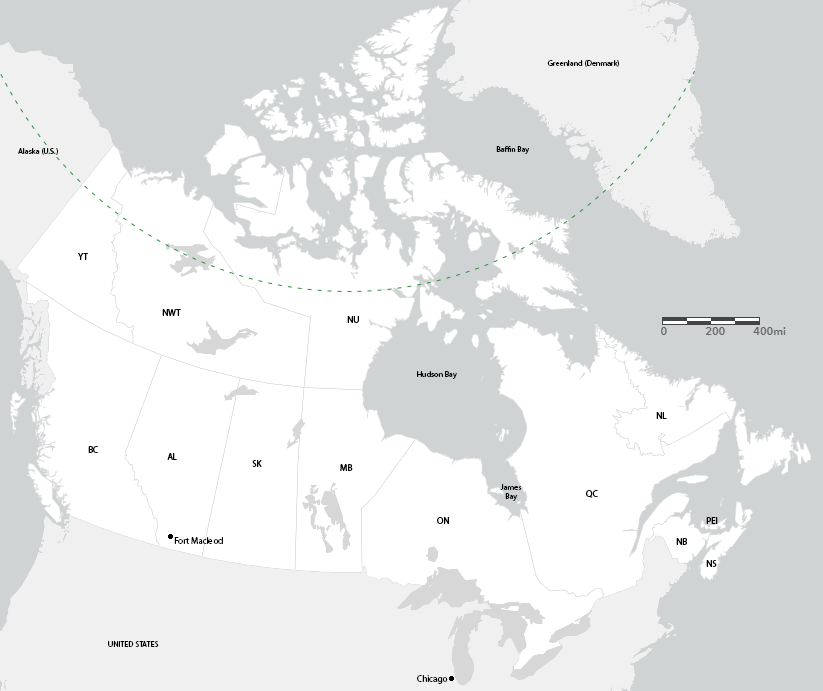
FRASER: Oh, well, fortunately, the nuns at Fort Macleod? They practice invisible mending. Shh, shh, shh.
OFFICER: This place is clean.
KILREA: All right, let's get out of here.
The police bugger off.
FRASER: I knew you could do it!
KOWALSKI: [squeaks] Thank you.
Kowalski lets go and drops into the backseat of a car.
Of course Kowalski wasn't asking what happened to Fraser's torn epaulette, was he. So we'll never know (a) how Fraser ended up under that bridge or (b) how he got away. Also, the police cars approaching at 122 kph are traveling at a little less than 76 mph. And maybe the upward camera angles were to get us ready for this hanging-from-the-ceiling moment. Do they do that? Foreshadowing with camera choices?Nowthen. More than 20 years ago, when I was in grad school, I took a course on linguistic typology in which I did some investigating of Inuktitut (investigating of work other people had already done, that is; I've never done any field work documenting languages no matter how many speakers they have). I no longer have any access to or even record of whatever books I was using at that time, but I did make a stab at actually translating what Fraser says to Diefenbaker.
Apparently there were original shooting scripts available online back then, which appears to be where I compared what I heard against what someone had written in by hand, "misspellings and all"—no idea why it would have been written in by hand if it was in the original script? maybe it was an annotation? so I have no idea how reliable that script/site/handwriting was at the time—but whatever site it was, presumably realduesouth.com, it's long gone. [Though still available at the Wayback Machine; why didn't I think of that?] So we'll go with what I hear as a very preliminary starting point, add that lost script as a useful input, and take my best efforts at translation with whatever book I was using then (I concluded: "Clearly this demonstrates the need for better Inuktitut-English dictionaries," which we sort of have now, the internet having proliferated since then despite also having suffered so much link rot) and the various websites I can find now (Inuktitut Lexicon Atlas; the Uqailaut Project; Inuktut Tusaalanga), and here we are:
FRASER: He likes the pizza. [to Diefenbaker] Savik. Akłunaaq.
KOWALSKI: Huh?
FRASER: [nods to direct Diefenbaker across the garage] It's Inuktitut. It's a slightly less complex language, easier for him to read.
KOWALSKI: What does it mean?
FRASER: It means, "fetch the knife from the hood of that car and apply it to the ties that bind us." Come on.
KOWALSKI: Come on.Diefenbaker brings the knife and places it in Fraser's bound hands. Fraser cuts the ropes and gets himself free, then kneels down to free Kowalski.
FRASER: [to Diefenbaker, while he's cutting Kowalski's bonds] Tuavinaluk uvani aqgutik nukatalik uukillu kisiani tikijjutituvik ijiqsimavik tavvanit qanuiqu naagit.
KOWALSKI: Meaning?
FRASER: "Hide."So okay. In the first place, I heard "Savik. Aklunat." and the long-lost script site had "Savik. Altuneat." There is no "altuneat" in any Inuktitut dictionary, and I definitely hear the hard sound (I have /k/, they have /t/) before the L sound rather than after it, and my way is closer to a word that does appear in those dictionaries, so I'm ready to call it and say the words are ᓴᕕᒃ savik 'knife' and ᐊᒃᖢᓈᖅ akłunaaq 'rope'. So Fraser's 18-word English translation isn't wrong, exactly, but it's amusing to suggest that he's conveyed all the same information in two words of Inuktitut that it took him a whole sentence of English to communicate.
The second line is harder, of course, because there's so much more of it. When I first tried to transcribe it, I apparently heard "uavinaluq ulaniakutit nukataililuqtilu kisiau vikiu tikuvit iksimavit tiavannit kannuiku mapit." The long-lost script site had "tuaviinnaaluk ullaniaqquht nuqqattailiutiiu kisiani tikiutiguut ijiksimavittavanunit qanuqunatit." I had some moderately interesting observations at the time about (a) how carefully actors pronounce things in languages they don't actually speak, (b) how accurately others of us hear things in languages we don't actually speak, and (c) how as a native speaker of English I really want words to max out at about three or four syllables (though that ties back in with item -a-, because I believe Paul Gross, also a native speaker of English, may have put some word-boundary-sounding pauses in places they may not have belonged.) In 2002, I believed the following:
'The first word has to do with a hurry or a rush; the -aaluk suffix means something I'm not familiar with. =->edited to add: am so. i knew it looked familiar. it's a reinforcer.
'The second word has me stumped -- but if I'm right and the script-transcriber is wrong (i.e., if it ends in -utit instead of -uht, which is a reasonable way a person might misread someone else's handwriting and which makes sense since there's no 'h' in Inuktitut), then it's a second-person singular intransitive verb. (Makes sense. Fraser's talking to Dief.)
'The root of the third word is mysterious to me as well, but the -taili- in the middle there means "avoid" and it's possible the -uti is reciprocal -- so whatever nuqqat- means, whoever it refers to doesn't want to do it to each other. :-)
'The fourth word, kisiani, means "only."
'The fifth word is another one I can't find; more precisely, I can find it but I can't find a translation of it. However, the ending -iguut marks the verb as first person plural intransitive: by this point Fraser's talking about himself and Ray. (I just don't know what he's saying, exactly.)
'The beginning of the sixth word, ijiksimavit, means "you are hidden." I'd guess the rest has to do with mood and/or aspect in some way.
'qanuq means "how." The rest of the word looks like a verbal affix and some other verbal paraphernelia; possibly "how you are" or "how you're doing it." Yielding:
'Hurry! You verb pronoun avoid verb each other (?) only we verb you hide ? how you do it.'All these years later, with different resources, I believe slightly differently:
- tuavi is the root meaning "hurry" and -aluk is an intensifier, so the first word is ᑐᐊᕕᓇᓗᒃ tuavinaluk 'big hurry'—I don't know where the 'n' in the middle comes from, because that's evidently not how Inuktitut does epenthesis—but there's no imperative anywhere on it, so it's not Fraser telling Diefenbaker to hurry and my 20-years-ago exclamation point doesn't belong.
- I think the second word may be a phrase—ᐅᕙᓂ uvani 'here' followed by ᐊᖅ aq 'arrive' + ᒍᑎᒃ gutik 'if/when 3PL'—but maybe it agglutinates all up into one word, ᐅᕙᓂᐊᖅᒍᑎᒃ uvaniaqgutik 'when they get here'.
- Digging into this bit took me most of my day off, and my confidence level is only about 70%, but I think what we're looking at is ᓄᑲᖅ nukaq 'younger sibling of a man' + ᑕᓕᒃ talik POSS followed by ᐆᒃ uuk 'try' + ᐃᓗ illu 'also' for a total of ᓄᑲᖅᑕᓕᒃ nukatalik 'my little brother' + ᐆᑭᓪᓗ uukillu 'try too' (or maybe 'keep trying'). There is no imperative on the verb, so I don't think Fraser is instructing Diefenbaker to try anything—and I'm not sure whom he's referring to as his little brother, but whether it's Diefenbaker or Kowalski, I'm pretty charmed by it. ❤️
- There is no dispute that the next word is ᑭᓯᐊᓂ kisiani 'only'. It's good for some things not to change. 😄
- The next bit took most of the rest of my day off. Ultimately I think we have ᑎᑭᑦ tikit 'arrive' + ᐅᑎᑦ utit '(two particles, -uti- and -t-, both of which mean doing something for or with someone else)' + ᐅ u 'be' + ᕕᒃ vik 'place where' resulting in ᑎᑭᔾᔪᑎᑐᕕᒃ tikijjutituvik 'go somewhere for (or with) me'. (Still no insight into whether he is speaking to Diefenbaker or about Kowalski here.)
- I feel better about the next bit: ᐃᔨᖅ ijiq 'hide' + ᓯ si (antipassive particle) + ᒪ ma 'be in a state of' + our old friend ᕕᒃ vik 'place where' = ᐃᔨᖅᓯᒪᕕᒃ ijiqsimavik 'hiding place'.
- Fraser's really filling the time while he cuts Kowalski free, is what's happening. I think the next bit is ᑕᕝᕙᓂᑦ tavvanit 'from here' (plus the with/for particle).
- I think the second bit from the end is ᖃᓄ qanu 'how' + ᐃᖅ iq 'no longer' + ᐅ u 'be' = ᖃᓄᐃᖁ qanuiqu 'what is no longer'.
- And the last bit may be ᓈ naa 'finish' + ᒋᑦ git IMP or it may be ᓇᑎᖅ natiq 'floor'. It still sounds to me like ᒪᐱᑦ mapit (or, for all I know, ᒫᐱᑦ maapit), but I can't find any word like that anywhere; -pit is a 2nd-person question particle attaching to consonant-final (except q) verb stems, so Fraser could be asking Diefenbaker, "Do you ?"—but I like the idea that it's ᓈᒋᑦ naagit 'make it so'. 😄
IN ANY EVENT, in contrast with the two words of Inuktitut/18 words of English, this is between nine and 11 words of Inuktitut/one word of English, because Fraser says that whole lot means "hide." Which is what it boils down to, of course, but taken all together it apparently means something like "They'll be here soon, buddy, so we'll all just find hiding places to begin with." Also, hasn't Diefenbaker been reading not just Fraser's spoken English (a skill he picked up on his own) but also written words for many years now? Why switch to another language at a time like this?
There are apparently some variations among Inuktitut dialects in terms of voiced, unvoiced, and fricative consonants, and maaaybe between q and k (especially in transliteration), but not between q and t, so the differences between what it might sound like Paul Gross says and what I think the words might be will have to be ascribed to something else. Fortunately the difficulty of distinguishing stop consonants when you can't see the articulator is fairly well documented. (I can't find it right now, but there is definitely a video where the speaker repeatedly says something like "tick" but the subtitle says "kick" and it isn't long before it really sounds like that's what they're saying.)

Scene 17
It is nighttime at the consulate. The doorbell rings, and Fraser answers it in his shirtsleeves.
FRASER: Ah, Lieutenant Welsh, nice to see you.
WELSH: Nice to see you, Fraser. [expectant pause] You going to let me stand out here all night?
FRASER: Oh, I'm sorry. Come on in, please.
WELSH: We gotta talk.
FRASER: Well, let's use my office, then. [Welsh heads for Thatcher's office.] Oh, sir, sorry, it's, ah, this way.
WELSH: It's this guy Cahill — [He is heading for a conference room.]
FRASER: Ah, sir — it's a little further back. It's, ah, just through here. [He shows Welsh right back to the depths of the building.]
WELSH: Excuse me.
Kowalski emerges from a doorway halfway along the hall after they've gone by. He is barefoot but back in his own clothes.
FRASER: Ray, would you care to join us?
Scene 18
Kowalski is back in Fraser's office with the gang. Diefenbaker grumbles.
FRASER: Lieutenant Welsh was just informing me that Assistant State's Attorney Cahill has filed a special request with our Department of External Affairs to expedite your extradition.
KOWALSKI: Uh-huh? Uh, come again?
WELSH: It means that at nine a.m. tomorrow morning, they're going to come in and yank your ass out of here. [to Fraser] You spend all day here?
FRASER: I go out for lunch.
KOWALSKI: Look, Lieutenant, I am telling you, I had nothing to do with that murder.
WELSH: I believe you.
KOWALSKI: You do?
WELSH: We know there's a rat in Major Crime. He must have been leaking to Volpe, because no matter what we threw at Volpe, he was able to walk. [to Fraser] There must be twenty rooms in this house. Why'd you pick this one?
FRASER: The others are much less intimate.
KOWALSKI: It's Kilrea. You check his arrest stats. He's dirty, I'm telling you. Um, Herndorf turns me in, who does he call? His little buddy Kilrea.
FRASER: Was Kilrea on the firing range the morning you qualified?
KOWALSKI: I don't know.
WELSH: That'd be easy enough to check out.
FRASER: And what about the officer on the scene of the shooting? Tibbet, has anyone spoken to her?
WELSH: IA told us to butt out.
KOWALSKI: That is one sick puppy. She needs a valium the size of a cheeseburger.
Fraser's office looks smaller every time we see it, like the trash compactor on the Death Star.
Scene 19
In a boxing ring at a gym, a bell rings. The uniform who shot at Kowalski is talking to Fraser while she's sparring. She mainly has her left hand forward.
UNIFORM (TIBBET): I am sick and tired of people telling me that I am uptight. I'm not uptight. I'm alert. There is a difference between being uptight and alert.
FRASER: I couldn't agree with you more.
TIBBET: Do you think society wants laid-back cops? I don't think so. We're in a war out there, and I'm on the front line. Hey! No street shoes in the gym.
FRASER: I anticipated as much. That's why I've taken precautions. [He swings a foot up onto the ropes; he's got one of those shower-cap bunny slippers over the sole of his boot.] Now, I'm curious. Didn't Detective Vecchio identify himself as a police officer?
TIBBET: Anyone can say that. You drop your guard for a second, they drop you.
FRASER: Officer Tibbet, I am quite sure Detective Vecchio did not shoot Mr. Volpe. Now, it would help my investigation enormously if you could tell me exactly what you saw.
TIBBET: I knew something was going to go down in that alley.
FRASER: Instinct?
TIBBET: No. Phone call. Yeah, I was on edge, but I wasn't as much on edge as I was the last time.
FRASER: The last time?
TIBBET: Yeah, when I shot the kid. [Fraser rolls his eyes but says nothing.] I was exonerated, you know. Big deal. I know what they say. "She's a woman. A woman can't take the pressure of the job." Well, that's a load of crap! I'd be just as ready to snap if I were a man!
FRASER: I'm sure you would.
TIBBET: What, you don't believe me?
FRASER: Oh, no, I'm, I'm sure you're quite capable of snapping regardless of your sex. [He sponges water over Tibbet's sparring partner.] Now, this telephone call you say that you received. Do you know who it was from? [He whispers in the sparring partner's ear.]
TIBBET: Nah, he didn't say. But I knew I recognized the voice. A guy. I met him a couple of times. Worked for Damon Cahill.
Fraser pats Tibbet's sparring partner on the back and sends him out into the ring again. She decks him with a right hook to the face. The bell rings.
FRASER: Ah, you're a switch hitter. [to her sparring partner] My mistake.
Tibbet's gym has a confederate flag on the wall, and the scene doesn't get better from there. We have a loose cannon who has already shot a kid and is now back out on the street (welcome to Chicago), and who got a tipoff from someone who works for Cahill that the Volpe-Vecchio meet was going to take place. The only positive thing I can say about her is that she was set up, too.
Scene 20
Outside the consulate, Huey and Dewey are still trying to stake out Kowalski. The pizza delivery car rolls up again.
DEWEY: Another pizza.
HUEY: Definitely working out. Maybe in the pool.
DEWEY: Mm-hmm.
HUEY: Thirty laps a day at least.
DEWEY: Could be aerobics.
HUEY: I'm starving. [He calls to Sandor, showing his badge.] Hey, buddy! Come here.
Are Huey and Dewey simply naming all the kinds of exercise they can think of?
Scene 21
Sandor is in Thatcher's office. Kowalski is on the phone but yelling at Sandor. Fraser is eating pizza and looking at documents.
KOWALSKI: Look, I'm not paying for their pizza. That's thievery. And there's no pineapple.
SANDOR: Hey, no one tells Tony how to make pizza, all right? He left Russia to be free.
FRASER: I think it's quite tasty.
KOWALSKI: Yeah, like your favorite toppings aren't blubber and lichen.
FRASER: Kilrea was on the range yesterday, but this is interesting. He wasn't supposed to be there. He'd qualified the day before.
KOWALSKI: [whose phone call has finally connected] Yeah, thank you. [hangs up] JP Tibbet, ah, shot a kid last year when she was working for the organized crime task force.
SANDOR: I was having a drink the other night with this guy, definitely OC, a big talker, real big mouth, right? He's talking about how Fillion had brought him in on this big job. Now here's the kicker. He had this real stinky painting with him. Said Fillion had gave it to him. It was like a rottweiler playing poker with his friends or something.
FRASER: That's Fillion.
KOWALSKI: Fillion. Herndorf. Cahill. Kilrea. Heh, got the makings of a bonspiel. [He hangs his head.]
FRASER: What's wrong?
KOWALSKI: I just made a curling reference. I'm going to go lie down. [He leaves the room. Sandor clears his throat.]
FRASER: Oh. Payment.
SANDOR: That'd be nice. In U.S. bills, if you please. [Diefenbaker barks in the hallway.]
FRASER: Excuse me. I'll be right back.
In the hall, Diefenbaker is barking and barking at Kowalski.
KOWALSKI: Come on. Stupid dog, stupid dog, stupid — get out of the way! Come on! [Diefenbaker snarls.]
FRASER: Ray, where are you going?
Kowalski was heading for Fraser's office and the back of the building; Diefenbaker is guarding the way and not letting him pass. Kowalski leans against the wall. Diefenbaker lays his head on his paws but doesn't move.
KOWALSKI: Hey, I can't wait around for Cahill and his goons to show up and arrest me. I gotta do something.
FRASER: Do what, Ray? And where? Everyone in this city on both sides of the law is looking for you.
KOWALSKI: Well, yeah, that may be, but I gotta do something.
FRASER: Yes, you do. You have to trust me.
KOWALSKI: Trust you, Fraser? [Fraser nods.] I don't even know if I trust me. You know, I don't think I whacked Volpe. But I can't remember details. That might have been my finger on the trigger.
FRASER: [shakes his head] You didn't shoot that man.
KOWALSKI: How do you know? How do you know? How can you be so sure?
FRASER: Because I know you. You're my partner. And you're my friend.
KOWALSKI: Was that hard to say?
FRASER: Not in the least.
KOWALSKI: You gonna call your dog off?
FRASER: I'm afraid I can't do that. Come on. Let's go watch some curling.
He heads back to the conference room. Diefenbaker whines and herds Kowalski along to follow him.
(OC = organized crime.) The way Kowalski is so down on himself he doesn't see why anybody would think well of him. 💔
Scene 22
In the morning, Huey and Dewey hop out of their car as additional siren-wailing patrol cars arrive at the consulate. There is also a media presence. A sedan drives up and disgorges Cahill, who meets Kilrea on the sidewalk.
CAHILL: You got the papers?
KILREA: Oh, yeah.
CAHILL: All right, men, follow me.
He leads a posse up the consulate steps.
REPORTERS: Care to comment? Sir? Sir? Sir?
BYRON: [to her cameraman] Make sure you keep him in the frame.
CAHILL: [stops on the stairs, puts on chapstick] Okay, let's do it.
BYRON: This is Shelley Byron reporting live from the steps of the Canadian consulate.
She turns and puts her microphone in Cahill's face. Inside, in Thatcher's office, Fraser and Kowalski are watching the broadcast live on television.
CAHILL: As you know, ah, as state prosecutor I have been concerned for some years about the level of corruption in our city and particularly within our police force. So keep your lenses clean and watch this.
He is about to pound on the door, but Fraser opens it before he can hit it.
FRASER: Ah, good morning.
CAHILL: I have a signed order here for the extradition of Raymond Vecchio.
FRASER: Yes, certainly. Won't you please come in. [He opens the double doors.]
TURNBULL: Excuse me, sir. [wands him with a metal detector]
CAHILL: What?
TURNBULL: You're fine. [wands Kilrea; the metal detector beeps]
FRASER: I'm terribly sorry, sir, but firearms are not permitted on the premises.
KILREA: What the hell is he talking about?
FRASER: We have very strict gun laws here in Canada. Now, I don't make the rules, I simply enforce them. [playing to the news cameras] But I took an oath very similar to the one you gentlemen took, I should imagine. Ah, without the references to the Queen, of course.
Cahill nods. A moment later, Fraser is standing and Turnbull sitting at the desk, checking in everyone's weapons and giving them little cloakroom tickets.
TURNBULL: Ooh, sir. A two-tone Beretta, model ninety-two, nine-millimeter, eleven rounds in the magazine, sporting a muzzle velocity of two thousand feet per second. Very nice.
FRASER: Very nice indeed.
TURNBULL: [to the person whose Beretta that was] Thank you. Enjoy the show.
FRASER: Thank you kindly.
Thatcher rolls up in a chauffer-driven limousine. She has no idea why the news crews are outside her door. A uniformed officer tries to stop her.
OFFICER: I'm sorry, ma'am, you can't go in there.
THATCHER: That's my building.
OFFICER: Uh, ma'am —
THATCHER: None of these cars are properly parked.
OFFICER: [following her] Ma'am? Ma'am?
She takes her sunglasses off, showing a raccoon-eyed sunburn.
So Cahill is about to do something extremely public and Fraser is lying in wait. This ought to be good. Meanwhile, how long has Thatcher been gone? Only a day, right? Or has it been two days? A whole weekend? (She took two pretty big suitcases with her in scene 1. It's surprising to me that she's back so soon.)
Meanwhile, the reporter's name is Shelley Byron, and it's like the writers' room isn't even trying anymore.
Scene 23
Fraser and Turnbull are doing a whole presentation in Thatcher's office in front of a picture of a Canadian flag being whipped in the wind. The camera is handheld, possibly as if we were watching one of the news broadcasts.
FRASER: Andreas Volpe was a man who made a lot of enemies. One of those enemies killed him. The question is, which one? I've brought you all together here to help answer that question. Was it Eddie Herndorf, a ruthless competitor, a man whose role he was trying to usurp?
HERNDORF: I don't have to listen to this. [tries to storm out, but Kowalski stops him]
FRASER: Perhaps it was Mr. Fillion. Mr. Fillion claims that he was receiving information from Mr. Volpe. Perhaps that information was costing too much.
FILLION: You're a smart guy, Mountie. Doesn't pay to get too smart. [He puts a framed pencil drawing of a beagle puppy on Thatcher's bookshelf and waves the cameras away.]
FRASER: Ah, well, maybe that was Mr. Volpe's problem. Maybe he was too smart. He certainly had information. But where was he getting it from? Maybe it was from his contact in the Justice Department. Someone who was offering him the protection of his office in exchange for information relating to criminal activity.
CAHILL: [laughing] Are you suggesting I was leaking to Volpe?
FRASER: I don't recall mentioning your name, Mr. Cahill.
CAHILL: Well, I don't see anyone else in here fitting that description.
FRASER: Or maybe it was a cop. A man who had made a deal with the devil but had decided that Mr. Volpe was a liability and not an asset. [Kilrea glares at him.] Fortunately, we don't need to speculate any more. The killer was not alone in that alley. There was a witness to the murder. A witness too afraid to come forward — [Herndorf and Fillion are skeptical. The reporters are all taking notes.] — but who has placed a sworn affidavit in this envelope, which was delivered to me. [Turnbull hands Fraser an envelope.]
CAHILL: That is evidence in an ongoing criminal investigation! Give it to me right now or I'll have you arrested for obstruction of justice!
FRASER: Certainly. Let me open it first.
CAHILL: [grabs it from him and gestures to the news cameras] This is evidence! I have a —
FRASER: It is, in point of fact, a blank piece of paper. But one that has proved quite revealing.
OFFICER: [in the hallway, still trying to stop Thatcher] Excuse me, Miss —
THATCHER: Get your hands off of me!
Thatcher comes into her office and sees it full of a media circus. Cahill drops Fraser's envelope, pulls a gun out of an ankle holster, and grabs Thatcher.
FRASER: What are you going to do? There are millions of people watching.
CAHILL: It didn't hurt O.J. Try to follow me, I'll kill her. [He drags Thatcher out of the office and hustles her down the stairs toward his car.]
THATCHER: Didn't I meet you at the Chilean consulate party?
FRASER: [following] Cahill! [Cahill turns around, his gun to Thatcher's neck] I'm going to count to three. [He glances at Thatcher.] One.
CAHILL: Wait a minute. I've got the gun here.
FRASER: [makes eye contact with Thatcher again] Two.
CAHILL: What have you got?
THATCHER: Me!
Thatcher elbows Cahill in the ribs, grabs his gun hand, and throws him over her shoulder onto the sidewalk.
FRASER: First off, sir, may I just say that your time at the spa has done wonders for your muscle tone and your reflexes. The sunburn, on the other hand — if I could recommend —
They head back up into the consulate as uniformed officers come running to take custody of Cahill.
Fraser's been reading a fair amount of Agatha Christie, apparently, and getting his Poirot on, but I don't feel like Cahill's hollering "that's evidence!" is the admission of guilt that Fraser and, crucially, Cahill seem to think it is. Is anyone else puzzled by Cahill's sudden need to flee the media attention he brought to this situation in the first place?
Also, I'm still stumped on the Kowalski of it all. If Fillion and, especially, Herndorf have met Kowalski before, as they seem to have done, why are they just going with it when everyone's talking about Ray Vecchio? I mean to say, this is the converse (or obverse) of the problem Fraser was having at the beginning of this season, where he was expecting Ray Vecchio and got Ray Kowalski and couldn't understand why everyone was calling the latter by the former's name. I don't know about Cahill and Kilrea, and apparently Sandor the pizza guy is cool, but I feel like Fillion and Herndorf know Kowalski and would be surprised to hear everyone pretending he was someone else.
I think the fact that millions of people were watching did hurt O.J., contrary to Cahill's claim. In case our younger viewers missed the reference, in 1994, retired football man O.J. Simpson was charged with the murders of his ex-wife and her friend and agreed to turn himself in but instead led the police on a long and extremely widely televised low-speed car chase before he was finally arrested. He was eventually acquitted in criminal court, which is probably what Cahill means when he says the publicity "didn't hurt" him, but found responsible for the deaths in the later civil trial.
Scene 24
Turnbull is trying to return everyone's checked weapons.
TURNBULL: Gentlemen, if we could do this in an orderly — no, no, no, don't — the ticket has to match the — sir, that is not your — the ticket has to match —
He gives up, defeated.
Except for the sock garters, Turnbull doesn't seem to be off the hinge at all in this episode, just overwhelmed.
Scene 25
Fraser and Kowalski and Thatcher are conferring on the sidewalk outside the consulate.
THATCHER: Fraser, I'll expect your report to be on my desk by oh-nine-hundred hours, and if your explanation isn't satisfactory, you can expect to be transferred to Baffin Island.
FRASER: Understood, sir.
THATCHER: [nodding to Kowalski as she leaves them] Detective.
KOWALSKI: [stops her and leans in] Call me . . . Ray.
Because she is not on the massage table, she doesn't groan. In fact she looks at him like he's nuts and goes back inside.
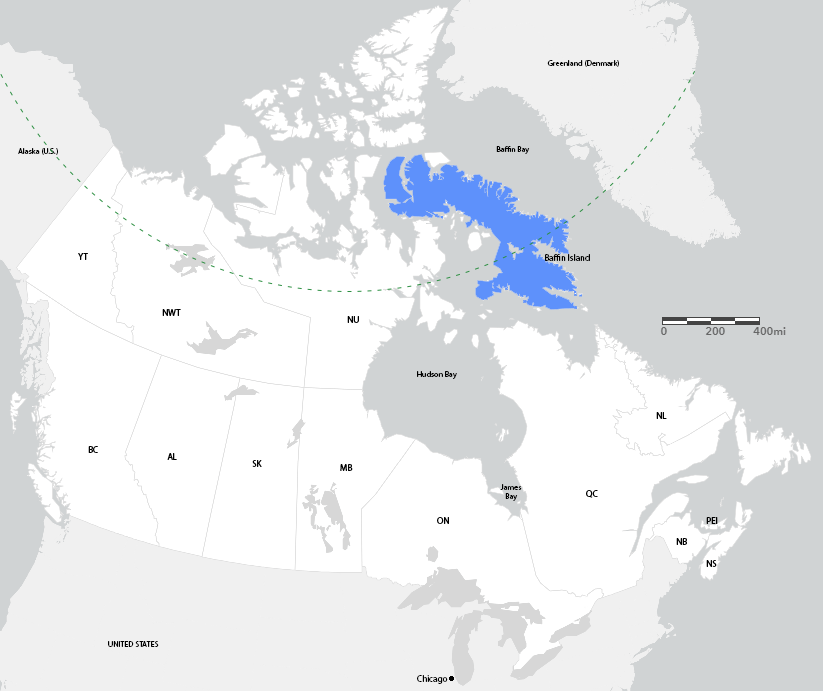
You'd think Fraser would be thrilled to be transferred to Baffin Island, except that apparently he still doesn't want to leave Chicago at this time? Interesting.
Scene 26
Fraser heads into his closet / his father's cabin. The wind is whistling and the chimes are chiming, but Bob Fraser is not there. An Indigenous man is sitting in a rocking chair by the fire.
FRASER: [looking around] Excuse me. Um . . . you are . . . ?
INDIGENOUS MAN: Joe.
FRASER: And you would be . . . ?
INDIGENOUS MAN (JOE): Dead.
FRASER: And my father is . . . ?
JOE: Fishing.
FRASER: I see. Well, could you just, uh — well, tell him I stopped by. Oh, and, ah, could you tell him it, uh —
JOE: It worked?
FRASER: Yes. Thank you kindly.
Fraser heads back to the consulate. Joe stays in Bob's rocking chair.
I'm also interested in Joe, hanging out in Bob's cabin. Like I get it, I can recognize that the Bob-as-Fraser's-own-subconscious thing they were pretty careful about in the first two seasons is going by the wayside and we're getting a lot more mystical with Bob from here out? But I liked Bob as Fraser's subconscious, dammit, and I want to keep digging in to what it means about Fraser's subconscious that there is a dude he has never met before warming up by Bob's fire while Bob isn't even home. Is Joe in some way connected to Bob's fictitious town up at the northern end of Ellesmere, that is, Bob helped him out in a similar way to how Fraser helped out Kowalski in this episode? Is he some kind of ghost subconscious stepdad? What's going on here?
Cumulative body count: 30
Red uniform: The whole time, plus bonus Kowalski in the red uniform as well