
![[personal profile]](https://www.dreamwidth.org/img/silk/identity/user.png)


return to due South: season 4 episode 11 (or season 3 episode 24) "Hunting Season"
Hunting Season
air date March 11, 1999
Scene 1
A couple of horses are hitched outside a log building apparently called the Musk Ox, according to the sign surrounded by blinking lights above its door. It is nighttime. Caption: The Northwest Territories. A person in a hooded parka steps up to the window of the Musk Ox, where a neon sign reads "BEER" (except the first E and half of the second E are not lit up:  ) and looks inside before going in. A jangly piano is playing, which is the only thing that doesn't stop when Parka walks in. Guys are sitting at tables drinking and smoking; a couple of guys in neckties are at the bar, along with the bartender. On the bar is a taxidermied fox. People step out of the way and watch as Parka goes through to a second room. Couple of guys, one young and one balding with a beard, are playing cards. They are exasperated to see Parka.
BALDING WITH A BEARD: You've been dogging us for months. We've told you all we know.
YOUNGER: You're insane, you know that?
BALDING WITH A BEARD: We already said all we got to say.
YOUNGER: Now get the hell out of here. We want to drink in peace.
BALDING WITH A BEARD: Yeah.
Parka steps toward the table.
YOUNGER: You haven't got any friends here. Clear out.
Younger stands up. Parka immediately grabs his arm and twists it around behind him, dropping him. Balding with a Beard gets up, and Parka shoves him into a couple of other people. Younger gets up off the floor, and Parka punches him in the face. Balding with a Beard is coming back; Parka throws him onto the table, which collapses. The two guys get up and are thinking about regrouping. The bartender, behind Parka, racks a shotgun.
PARKA: [in a woman's voice] You think you could? Think you could shoot a woman? [She pulls down her hood and indeed appears to be a woman with a blonde ponytail.]
BARTENDER: I've done worse.
PARKA: You might hesitate.
BARTENDER: Possible.
PARKA: [pulls out a revolver] That might be something to consider.
BARTENDER: Uh — I never cared too much for those boys anyway. [He lowers his shotgun and goes back to the bar.]
PATRON: That's just like him.
PARKA: [to the two guys] And it seems like you don't have many friends here either. [turns her gun to them] You're going to tell me what happened.
YOUNGER: You wouldn't shoot us.
PARKA: Wouldn't I?
BALDING WITH A BEARD: She would. You know she would. We don't know nothin'. We didn't see nothin'!
PARKA: Give it up, Eddie.
BALDING WITH A BEARD (EDDIE): Swear to God, I swear to God, we weren't there! What, what we said to the Mounties? That, that, that, that was what the Torrellis told us to say. [She cocks her gun.] Oh, please, don't — [He whimpers but then looks closer at the cylinder of the revolver.] Hey, that's not loaded.
PARKA: [looks at it for a moment] I was afraid of what might happen if it was. [She suddenly aims it back at them and pulls the trigger with a click.]
EDDIE: No! Oh, please, Mommy, no! Gah!
PARKA: Thank you very kindly for your help, boys.
She stalks out of the bar. Everyone watches her go. An old man leans across his table to speak to his buddy.
OLD MAN: Like to see more of that.
Does he mean he wants to see more of her specifically or more of people taking those two guys down a peg?
Scene 2
It is daytime. A small plane lands. Parka steps right into its path, then runs toward it. She is carrying a rucksack with a rolled-up Hudson Bay blanket hanging out of it.
PILOT: I got nothing of value on board here.
PARKA: Relax, Jake, I just want a ride.
PILOT (JAKE): Yeah, where to?
PARKA: Across the border.
JAKE: Why's that?
PARKA: I don't want to answer a lot of questions, I just want to go. Will you take me?
JAKE: Maggie, I, I got a quarter-ton of head cheese piled up in the hold here, I gotta — [She pulls her coat open so he can see the gun tucked into her waistband.] — but, of course, you know what they say about head cheese. [She throws her rucksack into the plane and climbs aboard.] It's real durable. [She takes her seat. He starts picking up speed to take off.] You, ah — you never been away from home, have you? [She shakes her head.] So why now?
PARKA (MAGGIE): I'm going hunting.
JAKE: Hunting?
The plane takes off.
Head cheese probably is pretty durable; it's a terrine made from veal or pork face preserved in aspic, and I don't see why it wouldn't keep in an uninsulated light airplane in the far north in March, where the daily average high is not higher than 10°F (-12°C), much colder than an ordinary refrigerator. (Why on earth Jake is transporting 500 lbs. of the stuff is a separate question.)
Scene 3
At the consulate, Fraser is standing on the newel post at the bottom of the staircase with a light bulb in his mouth, hanging onto the chandelier. He hears the door open and leans down to see who it is. Maggie, in red serge now rather than her parka, comes in and nods politely up at him.
MAGGIE: Hi.
FRASER: Mmf. Mmmf mmff mff — mmf — [He loses his balance. She gasps but can't help him not fall to the floor. He rolls up to his feet and pops the light bulb out of his mouth.] Hi. Uh — [He clears his throat.] — I'm a constable. [He shakes her hand.] Uh, well, obviously you are also a constable. My name is, uh — my constable name is Constable Benton Fraser.
MAGGIE: I'm, ah, Constable Maggie Mackenzie, from Inuvik.
FRASER: Ah, Mackenzie. The name is familiar.
MAGGIE: Ah, well, your — your father and my mother were friends. I certainly know your name. You're infamous in the North.
FRASER: Oh — yes, well. Um, so what is it that brings you to Chicago, business or pleasure?
MAGGIE: Neither. I'm on the trail of two men, and I thought you could help me.
FRASER: Ah.
"My constable name" is cute. I'd have preferred it if the restatement of "constable" had been slightly different; I think "My constable, uh, my constable name is Benton Fraser" would have been funnier. (I mean but I'd always prefer it if he didn't say "My name is Constable Benton Fraser," because it's not. His name is Benton Fraser, and his rank or title is Constable. "I am Constable Benton Fraser," yes; "My name is Constable Benton Fraser," no. Ah well.) I don't know why he's not on a stepladder to change that light bulb, but whatever, I guess the Canadian consulate is not subject to OSHA regulations?
Also, you know, the name Mackenzie should indeed be familiar to a dude who grew up in Inuvik on account of Inuvik is on the delta of the mighty Mackenzie River, which rises at the western end of the Great Slave Lake and flows more than a thousand miles north to the Arctic Ocean, draining most of the Northwest Territories (almost all, now; about half when what is now Nunavut was still NWT), more than half of Alberta, and fair slices of northern Saskatchewan and BC. To say nothing of the fact that there is a town of Mackenzie a hundred-odd miles north of the northern bend of the Fraser River in British Columbia. My point is that these are not uncommon names.

(When I was looking for the course of the Mackenzie I learned that there is a community on its banks named Little Chicago, about which all the internet seems to know is that it's there. I put it on the map for you for free.)
Credits roll.
Paul Gross
Callum Keith Rennie
Beau Starr
Camilla Scott
Tony Craig | Tom Melissis
Ramona Milano
and Gordon Pinsent as Fraser Sr.
(plus Draco the dog)
Dean McDermott, Matt Heney, Vince Bruni, and Jessica Steen as Maggie
Scene 4
Fraser is at his desk. Maggie hands him a photograph.
MAGGIE: These two men are killers. The Torrelli brothers. [The picture is of three men: one bald, one ginger, and one with dark hair and a sharp chin.] I heard they were in Chicago and, ah, had some time off. Thought I'd come down and try to find them. [She sits down across the desk from him.]
FRASER: Somewhat unusual, isn't it? Pursuing something like this on your own?
MAGGIE: The — the third man. The victim — [She points to the man in the middle in the picture, the ginger one. Her voice is wavering just a bit.] — was a hunting guide. He's, ah — he was — one of the most decent, gentle men I've ever known. Sometimes a crime is just so bad you can't let it go. You ever feel that way?
FRASER: Ah. Frequently. It's just that if these two men are murder suspects, it may be more prudent to pursue this through official channels.
MAGGIE: Officially, they had an alibi. But I know if I find them, I can prove they did it.
FRASER: I — I see. Uh, you see, in my position, I, um.
MAGGIE: [after a pregnant pause] I understand. I understand. You have no reason to get involved. [She stands up to go.] Everything I've heard about you — thought you might be able to help. Thank you kindly anyway, Constable. [She shakes his hand.]
BOB FRASER: Don't let her go, son.
FRASER: [jumping up from his chair, muttering at Bob] It's none of your business.
MAGGIE: I guess I feel it is.
FRASER: Oh, no, no. I didn't mean you.
BOB FRASER: She looks just like her mother. [His voice is echoing a bit.] God, it takes me back. I feel like a kid again. Well — fifty.
MAGGIE: [shouldering her pack] Is there someone else here?
FRASER: In this room, you mean? No. No.
MAGGIE: I thought I heard someone.
FRASER: No. It's just —
BOB FRASER: Wonderful woman, Ellen. Many's the night I sheltered in her cabin.
FRASER: Ah —
BOB FRASER: Long after your mother was gone, son.
FRASER: — I have a friend. Here — have your bag. [Maggie slowly hands over her bag.] I have a friend in the Chicago Police Department. He — well, he may be able to help.
Those would be the official channels, because you're not just a Mountie, you're the deputy liaison officer. Why is the fact that Fraser has a friend in the Chicago PD presented like some sort of brainstorm?
It's odd that Maggie can vaguely hear Bob, right? The only ones other than Fraser who've ever been able to see him have been Gerrard and Frobisher, although a few minutes before Gerrard saw him Bob was able to make his voice audible to the bad guys when the situation called for it. But this doesn't seem to be something he's doing on purpose. Hmm. 🤔
(I guess Fraser probably said "Here, let me have your bag.")
Scene 5
Maggie and Fraser and Diefenbaker are at the police station with Kowalski.
KOWALSKI: Sure, I mean, anything, I mean, anything at all. I mean, Fraser, we have always been here to cooperate with the Mounties, is that not right?
FRASER: Yes, Ray, we've always had a very good working relationship. [Diefenbaker grumbles.]
KOWALSKI: Yeah, well, that is the thing, relationship. I mean, you gotta know the person you're working with. [He hurries around to walk next to Maggie.] I mean, like, you know, go out for dinner and drinks — I mean, later, naturally, after we, ah, find the stuff you need.
MAGGIE: Right. [Diefenbaker yips.]
KOWALSKI: Fraser, what's with the wolf?
FRASER: I think he feels unnaturally protective of Constable Mackenzie.
KOWALSKI: He's not the only one. Have you got a picture of these guys?
MAGGIE: Yes. [She pulls it out of her hat.] Right here.
KOWALSKI: You know the funny thing? I have never met a Mountie girl before.
FRASER: [getting between them] What about Inspector Thatcher?
KOWALSKI: What about her? Oh, yeah. Um.
They have reached Francesca's desk, where Francesca is filing her nails. Kowalski reaches for her keyboard.
FRANCESCA: Hey, hey! Mitts off the hardware!
KOWALSKI: Uh, Francesca, meet Constable Mackenzie.
MAGGIE: [shaking her hand] Hi.
FRANCESCA: Hi.
KOWALSKI: She's trying to get some info on a couple of guys.
MAGGIE: Mike and Mark Torrelli. They're brothers.
FRANCESCA: Uh, are you and Frase friends from up north and everything?
MAGGIE: We just met today.
FRANCESCA: Oh, really? 'Cause you look closer than that. [She clears her throat.] Um. How long you been a Mountie?
MAGGIE: Five years.
FRANCESCA: Oh. I'm on the waiting list for the Academy.
MAGGIE: Congratulations.
FRANCESCA: Thanks. Yeah, the uniforms are nice because, you know — they're black, and that's always slimming and elegant. [Fraser and Maggie and Kowalski are standing there wondering when Francesca is going to, you know, do the research they've asked her to do.] Whereas your uniforms are — [She does jazz hands and a "waaah" face.] — kind of make a statement, you know?
MAGGIE: Yeah, they're an attention getter, all right.
FRANCESCA: Yeah.
MAGGIE: Whether you want them to be or not, they're —
FRANCESCA: Kind of like when you're having a bad hair day.
MAGGIE: Or trying to sneak past a cougar who's standing between you and some drinking water. [She and Fraser chuckle.]
FRANCESCA: Yeah, yeah. Yeah, I hate that.
KOWALSKI: Wow, I just came out of my coma. Ah, can you, ah, do a little work, Francesca? [He turns to Maggie.] So, ah, you think you're going to be transferred down here to the windy city of Chicago with some —
MAGGIE: No. No, I wouldn't last a week in the city. In fact, I'm finding it kind of hard to breathe right here, right now.
FRANCESCA: Well, that's probably because you don't have enough air. Why don't you guys give her some air? [She waves her hands to get Fraser and Kowalski to back off from crowding Maggie.] Some air!
FRASER: Oh. [He and Kowalski bugger off. Maggie goes to look over Francesca's shoulder.]
FRANCESCA: Hmm. Real couple of cretins here. Done time for assault, armed robbery. Five years ago you would have found Mark in Joliet and Mike in Sing Sing, but there's nothing current.
MAGGIE: What about an address?
FRANCESCA: Well, according to this, they live in Green Bay.
MAGGIE: Green Bay? Damn.
KOWALSKI: I, I've got an idea that might be good and, and, interesting. Um, why don't you look up known associates in Chicago?
FRANCESCA: Yes, that is good, Ray, and it's already done. Tommy Ellis was a cellmate of Mark's, and he's living in a rooming house in Sherman.
KOWALSKI: Okay, let's go rattle his chain.
FRASER: Well, uh, Ray, there's no, no reason for you to trouble yourself.
KOWALSKI: Fraser, it's no trouble. In fact, it's my duty.
FRASER: Yes, yes, but, uh — well, this is unofficial, and I'm sure you have other cases —
FRANCESCA: No! No. Uh, he's, he's got nothing. He's, he's free.
KOWALSKI: Uh, my thoughts exactly.
FRASER: Right. Well, uh, shall we? [He stands aside to let Maggie leave the squad room first.]
FRANCESCA: [to Francesca as she goes] Thank you kindly.
It doesn't take Fraser long to go from "my friend at the Chicago Police Department might be able to help" to "back off, friend at the Chicago Police Department." But seriously, what did he think was going to happen when he put a pretty blonde woman in front of Ray Kowalski?
What's actually a little surprising is how interested in her Fraser seems to be himself, his preference having generally* run to brunettes before now (with, if you're leaning that way, just the one obvious exception. Not, of course, that hair color is the only relevant factor; Fraser, at least, isn't that shallow (though Kowalski, so far, may be), and the women he's bothered to notice and be interested in have almost all had background or interests or both that he shared. Your main control-group examples are Miss Cabot, who was all equestrian and countrified (though in a rich-girl way), but blonde, and whom he was not interested in at all; and Francesca, who is a brunette, but with whom he has very little in common except proximity to the police department, and whom he has never been especially interested in. (I feel like it's highly unlikely that he did sleep with her, but if he did, it was probably because it was easier than not?) So your outliers are Elaine, a brunette with whom he has much more in common than Francesca but whom he is also not interested in, and Katherine Burns, a blonde with whom he has nothing at all in common but for whom he leaves his post to join at the party and waltz on the patio. (I assume whatever relationship they had went nowhere.)
*I admit Mackenzie King is an edge case; she was a brunette the first time we met her and a blonde the second, but he was maybe more into her the second time than the first. And for sure she was more interested in Fraser than he was in her. But except for Victoria and Janet, about whom is that not true? Meh, leave her off this list if you want. My point holds even without her.
Anyway, it hasn't taken Fraser long to get hung up on Maggie Mackenzie, but she's from Inuvik, 1999 population just a little more than 3,000. Say a little less than a quarter of those 3,000 people are under 20 and almost 60% are over 35, that leaves maaaybe 20% between 20 and 35, which is 600 people. What are the odds Fraser meets one of the (statistically speaking) not quite 300 women in his age group of interest from his home town in Chicago? Taken that way, it's not a huge shock that he's drawn to her.
Francesca, for some reason, still thinks she has a shot at Fraser and is conflicted between solidarity with Maggie (she hasn't spoken to another woman on our screens since she asked Mama Lalla about the curse on the station, which is one of a very few times she's spoken to other women at all, only about half of which have passed the Bechdel test) and wanting to shove her at Kowalski so Fraser will be unoccupied and free to return his attention to herself, which he's not going to do.
Scene 6
Fraser opens the door for Maggie but doesn't get out of the way, and Kowalski is also trying to stay with her, with the result that all three of them squeeze awkwardly through the doorway at the same time.
KOWALSKI: So, uh, Yukon Territories, so what do you do up there at night to keep warm?
FRASER: You know, Ray, it's the Northwest Territory or the Yukon. I kind of thought you might have had that straightened around in your brain by now.
I see now that the "correction" re: Yukon and NWT in "A Likely Story" was probably planted for the purpose of being able to call back to it here, but that doesn't make Fraser's correction accurate, and he should stop being a dick immediately.
BOB FRASER: That's it, son. She could be the best thing that ever happened to you. Don't let the Yank cut in.
FRASER: Do you mind?
KOWALSKI: Mind? Look, Fraser, I'm kind of a big picture kind of guy, okay?
Maggie goes to talk to a homeless woman scavenging in the dumpster. Diefenbaker goes with her.
FRASER: Well, that is the big picture, Ray.
BOB FRASER: You could do worse. The two of you could get some land, put up a cabin. Nothing like four walls to make a man feel trapped. Or — happy and content.
KOWALSKI: What's she doing talking to old Rosie? That some sort of Canadian thing?
FRASER: Well, I'm sure she's not doing any harm.
ROSIE: [protesting gratefully] No —
MAGGIE: Know what? I'm going to come back later, I'm going to show you how it's done.
ROSIE: Gee, thanks —
MAGGIE: Okay.
ROSIE: — thanks a lot. [Maggie comes back to join the guys.]
KOWALSKI: You didn't give her any money, did you?
MAGGIE: No.
KOWALSKI: That's good. Look, I'm, I'm a charitable guy and all, it's just that — you know, Rosie, I mean, you give her stuff, and, ah, it just encourages her. [He opens the passenger door of his car.] And, ah, she just goes around, start asking people, and, ah — [Fraser has got in the back of the car. Kowalski shuts the door and leans against it.] — some of them get annoyed, and eventually ah, we'll have to ask her to leave. [Fraser leans forward to look through the window Kowalski is leaning on.]
MAGGIE: No, I, I just gave her advice. [Fraser tries to open the car door. It bumps into Kowalski.]
KOWALSKI: Advice? [Fraser opens the door into Kowalski two or three more times until Kowalski actually steps aside and allows it to open.]
FRASER: [fake smile] Sorry. [He sits back and pulls back the passenger seat.]
KOWALSKI: After you.
MAGGIE: Thank you.
KOWALSKI: Welcome.
Maggie gets in the car; Kowalski shuts the door for her.
I was going to skip over the gross way Fraser and Kowalski are behaving toward Maggie and toward each other and just point out that Maggie has one star on her sleeve (she did say five years, and it appears she wasn't rounding up) and a marksmanship qualification for pistol but not rifle. But I'm also going to note that Bob, that is, Fraser's subconscious, isn't really sure what he wants, is he? Get some land, build a house, feel trapped? Innnteresting.
Scene 7
The GTO parks outside a building, and our heroes come into a hallway, in the order named: Diefenbaker, Kowalski, Maggie, Fraser. Kowalski knocks on the door of apartment 4, to which is taped a small page headed "A House Blessing" and a large NO SMOKING sign.
KOWALSKI: Tommy Ellis?
ELLIS: [answering the door] Yeah.
KOWALSKI: [badge] Chicago PD.
ELLIS: [sees Fraser and Maggie and scoffs] What's that, the police band?
FRASER: Ah, no, sir. My name is Constable Benton Fraser, Royal Canadian Mounted Police. I first came to Chicago on the trail of the killers of my father. And this is —
MAGGIE: I heard that. I've never known if it was true.
FRASER: Well — I'm afraid it is, yes.
MAGGIE: Did you catch them?
FRASER: I, I did, yes.
MAGGIE: I have to tell you how much I admire that kind of determination.
FRASER: Well, thank you. Thank you kindly.
ELLIS: Are you working for, like, uh, World's Weirdest Videos? [looks around for a hidden camera]
KOWALSKI: No. They're, ah, Canadian.
ELLIS: Oh.
KOWALSKI: Look, I got a couple of questions I want to ask you. [He shows Ellis Maggie's picture.] You know those guys?
ELLIS: Yeah, I, ah, I did some time with Marky. [He taps the picture.]
KOWALSKI: What for?
ELLIS: Driving.
FRASER: Traffic violations?
ELLIS: Yeah, speeding. Away from a bank job. [He chuckles. Kowalski does, too; Fraser looks at him, shocked.] Wrong place, wrong time. Who's the other guy?
MAGGIE: The man they killed. [She and Fraser are unamused.]
ELLIS: Wouldn't know about that. I haven't seen them since I got out.
MAGGIE: I see. [She hands Fraser her hat, comes over to Ellis, and reaches for his hand. He snatches it away.]
ELLIS: Look, you have no right to touch me.
FRASER: I'm sure Constable Mackenzie means no harm, Mr. Ellis. Just relax.
Ellis tries to relax, but he doesn't like it. Maggie reaches up and feels for the pulse point on his neck.
KOWALSKI: Scared, Tommy?
ELLIS: Hell, no. It's just that —
MAGGIE: You said you hadn't seen them?
ELLIS: That's right. Not in years. [Maggie looks at him for a moment. He pulls away from her.] Look, you know this isn't normal. None of you are normal. You want to take my pulse again, get a warrant. [He slams the door in their faces.]
KOWALSKI: I'm normal.
FRASER: In a pig's eye.
MAGGIE: He's lying.
KOWALSKI: No, I'm not.
FRASER: Very probably.
MAGGIE: Most certainly. I'm ninety-nine-point-four percent accurate.
KOWALSKI: Accurate?
MAGGIE: I know when someone is lying.
KOWALSKI: Well, what would that, ah —
FRASER: It's not surprising, Ray. I imagine you monitor pulse, galvanic skin response, respiratory rate, much like a polygraph?
Polygraph is useless at determining truthfulness, but never mind.
MAGGIE: Better. Look at the eyes.
FRASER: Ah.
MAGGIE: So much to be learned from the eyes. [They are all leaving the building.]
KOWALSKI: Hey, hey, hey, the, hey, eyes, eyes, I, I, you don't know —
MAGGIE: My mother taught me how to spot a liar.
KOWALSKI: Oh.
MAGGIE: The best question is, what are we going to do about it?
KOWALSKI: Well, seeing this is off the record, we won't be able to get a warrant, but, ah, I might be able to pull a file in the morning and see if I can squeeze him on, on something. [There is a full-length mirror at the bottom of the stairs; he does finger guns in it.] So, ah — [Fraser has left the building; Kowalski hurries to block the doorway and talk to Maggie before they both follow him.] — are you hungry?
MAGGIE: Ah — I'm actually tired.
KOWALSKI: Oh, okay, well, I'll give you a ride back to your hotel.
MAGGIE: Don't have a place yet.
KOWALSKI: Oh, hey, I got a lot of room in my place.
FRASER: [pushes Kowalski out of the way as he comes back in] Actually, Ray, I think she'd probably be more comfortable at the consulate.
KOWALSKI: Who'd want to stay at the consulate, Fraser?
FRASER: Well, I do.
KOWALSKI: I mean besides you.
MAGGIE: That, that's fine. That's fine. And thank you very much for your offer.
FRASER: Shall we? [Maggie goes out first, Fraser behind her. Behind him, Kowalski cocks his fist.] Stop that.
Kowalski:Maggie::Francesca:Fraser. (Oh, wait, didn't I read somewhere that they don't do analogies on the SAT anymore? How much younger than myself does a reader have to be for that notation to be meaningless? Ugh, I am feeling older every minute.) His failure to realize that his openings are being left lying on the floor is making me extremely uncomfortable.
Scene 8
Fraser is pulling blankets down from the top shelf of his office closet.
FRASER: I'll, ah, sleep out in the hallway. You can take the cot.
MAGGIE: Oh, no, no, I'll take the hallway.
FRASER: No, I insist.
MAGGIE: I don't want to put you out of your bed. I prefer the floor. You know, back home I like to sleep out whenever I get the chance. So that's — [She takes the blanket from him.] — thanks.
BOB FRASER: Stubborn. Likes sleeping on the ground. Just like her mother.
MAGGIE: I'm sorry?
FRASER: Sorry?
MAGGIE: I — did you say something?
FRASER: I did? Oh, I did. Ah, up with the sun. Up with the sun, I said.
MAGGIE: Up with the sun. Up with the sun. Always.
FRASER: Right. Good night.
MAGGIE: Night. [She closes the door behind her.]
BOB FRASER: Good hearing, too. She's got everything. [Diefenbaker scrabbles at the door and barks.]
FRASER: Oh, don't be ridiculous. You'd keep her up all night with your snoring.
Diefenbaker barks and whines.
Scene 9
Maggie is lying on the floor in the hallway, fidgeting with a pair of rings she has on a chain and brooding. She gets up. Next we see her she's out walking, dressed in mufti. She comes up to an apartment building and looks around; before she goes in, she moves her gun from the back of her waistband to the front and wraps her jacket up around it. As she goes inside, two men pull up and watch her and then look at each other. The driver has dark hair and a sharp chin; the passenger is bald.
Are these the Torrelli brothers?
Scene 10
In the morning, Fraser is getting dressed, straightening his lanyard with great care. Diefenbaker grumbles.
FRASER: Oh. Thank you. [He licks a finger and smooths his left eyebrow.] Right. [He and Diefenbaker head out into the hall.] Maggie? Constable Mackenzie? [Diefenbaker grumbles again.] Where? [He feels the back of his head.] Oh, it is sticking up. Good God. [He sits at the reception desk, pours some water in a glass, wets his fingers, and starts fussing with his hair.]
MAGGIE: [coming in from the back premesis] Constable Fraser?
FRASER: Ah, good morning, Constable McKenzie.
MAGGIE: Morning.
FRASER: I'm just, uh — I have, um, a head. I mean, I, I have — my hair is — well, I mean, I slept on my head. Well, not on my head, because — [He sighs heavily.] You know, in the words of Joe Obodiak, a hat can cover a multitude of sins.
MAGGIE: Joe Obodiak. From Eagle Creek.
FRASER: Why, yes. You — you knew him?
MAGGIE: Well, yeah, my mother used to tan a moose hide for him every winter.
I feel like any minute now the words "You betcha" are going to come out of this woman's mouth.
FRASER: Ah. Terrific sense of fashion, for a blacksmith, old Joe.
MAGGIE: Yeah.
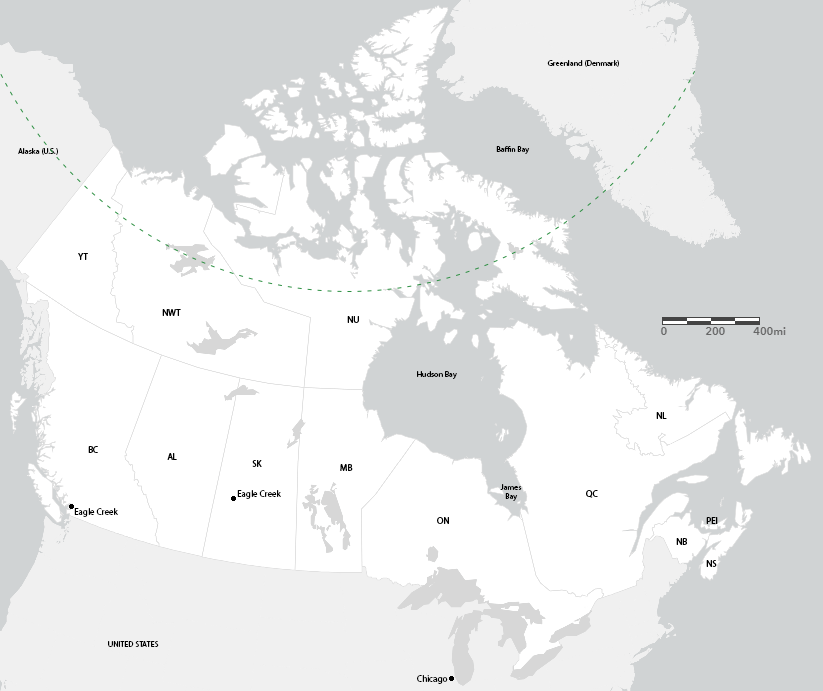
When last we heard of Joe Obodiak, he was a janitor in Eagle River. Now he was apparently a blacksmith in Eagle Creek. Although Mackenzie and Fraser are not unusual names, I feel like Obodiak kind of is, so maybe get your show bible together, writers' room? Although the name does get me a fair few hits when I google it—generally in Saskatchewan, which, as luck would have it, is also where there is a rural municipality named Eagle Creek. (There's also an Eagle Creek in BC, in the suburbs of Vancouver, but I'm not sure someone living there would need a moose hide tanned for him every year. Of course I'm also not sure how someone in Eagle Creek, SK, would be in regular communication with someone in Inuvik, but one thing the writers of this show have been consistent about is the northwestern folks moving around a lot over there, so who knows, maybe the Mackenzies came south . . . to Saskatchewan . . . for the winter?)
FRASER: I see that you're, ah — well, you're out of uniform.
MAGGIE: Uh, I, I didn't think it was appropriate, under the circumstances.
FRASER: Ah. True enough, true enough. Well, perhaps, ah, would you like to go out for, um, for breakfast?
MAGGIE: Well, I usually like to have pemmican.
FRASER: Oh, I wish. I wish. And you know, you would think that in a city of seven million souls, that one of them would have had the presence of mind to desiccate a little meat. But no.
MAGGIE: [producing a small leather bag] I happen to have some.
FRASER: [looking at her with a "now, don't tease me" face] Pemmican?
MAGGIE: Mm-hmm. [offers him some] Dried it myself last year. [Diefenbaker jumps up and whines.] Oh, you'd like some, too. [She giggles.] Here you go.
FRASER: [chewing] Oh. [in raptures] Nothing tastes like that. [They head back to his office to put the blankets away.]
MAGGIE: You must miss home, eh?
FRASER: Oh, very much. You? Oh, well, of course, you —
MAGGIE: — just came from there.
FRASER: — just came from home.
MAGGIE: Yeah. [They reach Fraser's office.] I'm sorry, Constable. This must be a real inconvenience for you.
FRASER: No, no, not in the least. Not an inconvenience at all. [He puts the blankets in the closet.] And, you know, you don't have to call me Constable, Constable, you can just call me, ah, Benton. Or Fraser. Ah, that's my name. Well, Benton is my name.
BOB FRASER: [follows Ben Fraser out of the closet, to Maggie's surprise] You'll never get anywhere like that, son. I know it's not easy, but try to relax and be yourself. In fact, try and relax and be someone else.
MAGGIE: Were you — were you just in the closet?
Fraser and Bob are stymied.
BOB FRASER: [quietly] She talking to me?
FRASER: [out of the side of his mouth] She seems to be talking to you.
All three of them look at one another for a minute.
BOB FRASER: You can see me?
MAGGIE: [does a kind of "Well, I mean, can't you see me?" gesture] Yes, of course.
FRASER: Holy moly.
BOB FRASER: Great Scott.
MAGGIE: My God! You look just like Bob Fraser. He looks like your — I mean, I only saw you a couple times, but, but I've heard about you forever. But I guess you, you're older, eh?
BOB FRASER: Old and dead. It doesn't do a lot for you.
MAGGIE: [begins to realize things are weirder than she thought] You're dead?
BOB FRASER: Not entirely alive.
FRASER: Oh, he's quite dead.
BOB FRASER: It's damned odd that she can see me.
FRASER: Very odd. Very odd.
MAGGIE: [after a pause] Have you seen my mum?
BOB FRASER: No. I, I was hoping to run into her. Never have.
MAGGIE: [remembers her manners] Pemmican?
BOB FRASER: Oh. No. [pats his belly]
FRASER: You know, if I could suggest that we, ah, step into your office, Dad. Right this way.
Fraser opens the closet door. Maggie looks at him and then looks at Bob and then goes ahead in. Bob follows her. Fraser beckons Diefenbaker, who also goes in. Fraser goes last and closes the door.
SOMEONE FROM INSIDE BOB'S OFFICE: Constable Fraser! Yoo-hoo!
I ADORE Maggie asking if Bob has seen her mother. I loved that about her the first time I saw this episode mumbleteen years ago and I love it even more now, years after losing my own dad. That little moment between her and Bob is just gorgeous: the way she's kind of quickly processed that she's speaking to a ghost and decided to roll with it, and the first thing, the first thing she does is ask about her mother; and the kind of combination tone he puts on the word "No"—he's both delighted and confused to be talking to someone other than Ben and (but) sorry he doesn't have a different answer for her. Brilliant, brilliant. Nice work, Steen; beautiful work, Pinsent. ❤️
Scene 11
Thatcher and Turnbull are coming downstairs from the second floor of the consulate.
THATCHER: Tea, Turnbull. Tea. At four. Sir Ellsworth Smythe is arriving from London. England. This afternoon.
TURNBULL: Wow. A knight, right here in the consulate. How many for tea, sir? Will he be alone, or will he accompanied by his squire?
THATCHER: Get a grip, Turnbull. Elton John's a knight, for God's sakes. It's not what it used to be.
TURNBULL: Just the same, sir, I'll wax the round table.
Thatcher goes into her office; Turnbull goes into a room on the opposite side of the hallway.
Scene 12
Maggie and Diefenbaker and Fraser and Bob are in Bob's cabin (in Fraser's closet) swapping stories.
MAGGIE: And then she sees the grizzly. She reaches down, grabs me by the hood of the parka, throws me up in the tree. I'm three. I'm hanging to this rotten old branch with one hand. She's down on the ground, right — right eye to eye with mama bear. It must've had some kind of understanding, because an hour or so later, she just let us be.
FRASER: Yeah?
MAGGIE: Not a minute too soon. I couldn't have hung on one more second.
Bob chuckles. In fact they all laugh, which is audible from the hallway. Turnbull and Thatcher meet in the middle and are puzzled by the sounds.
FRASER: — like the time you turned up naked at the Inuvik social —
Thatcher starts back toward Fraser's office. Turnbull blocks her way.
TURNBULL: Ah, perhaps Constable Fraser is playing a book on tape and doesn't want to be disturbed.
THATCHER: Constable Fraser was born disturbed, Turnbull. Now, get out of my way.
She hurries back to Fraser's office. Turnbull follows her. When she gets there, of course it's empty, but she can hear voices anyway.
FRASER: — so he ran buck naked straight into the middle of the Inuvik municipal social and water pillar, and there he chased —
Thatcher and Turnbull press their ears to the closet door. Inside, Fraser has finished telling his story.
FRASER: Just talking about it makes a fellow homesick.
BOB FRASER: [smiling] Yeah. Breaks your heart.
There's a knock at the cabin, that is, the closet, door. Diefenbaker howls.
FRASER: [getting up to answer it] Oh, dear.
BOB FRASER: Duty calls, son.
Maggie gets up, too. When Thatcher and Turnbull open the door, of course they see Fraser and Maggie just standing in the closet.
THATCHER: [with a frozen smile] Constable Fraser.
FRASER: Inspector Thatcher. Sorry.
THATCHER: For?
FRASER: I'm not sure. This is Constable Mackenzie. Inspector Thatcher and Constable Turnbull.
MAGGIE: [shaking their hands] Pleased to meet you. Hi.
TURNBULL: Hi.
THATCHER: Are you here officially?
TURNBULL: Or unofficially? [Thatcher elbows him in the ribs.] Oof.
FRASER: Constable Mackenzie is here on the trail of some suspects, sir.
THATCHER: In your closet?
FRASER: At the moment, yes.
THATCHER: Why wasn't I informed?
MAGGIE: It's, um, a personal matter, ma'am. Constable Fraser's just helping me out.
THATCHER: Personal. I see. I trust this won't interfere with your duties?
FRASER: Oh, no, sir.
THATCHER: Good.
MAGGIE: [breaks a long awkward pause by falling back on snacks] Pemmican?
THATCHER: [Turnbull is about to try some but stops when Thatcher says] I couldn't possibly.
Thatcher turns to go, but Turnbull is right behind her. They do the get-out-of-the-way dance for a moment before Turnbull stands aside; Thatcher does an exasperated sigh and leaves. Turnbull gives Fraser and Maggie a smile and a wave before following her.
MAGGIE: I see why you like her.
FRASER: Oh, Inspector Thatcher and I have a purely, um, uh — we should, we should get back on the case.
MAGGIE: Good idea. I have a lead.
FRASER: Oh, good. You do?
MAGGIE: Yes.
FRASER: Well, we should, we should follow that lead —
He gestures for her to leave the closet but then tries to step out at the same time, so they both get stuck.
MAGGIE: Sorry.
FRASER: Go on —
MAGGIE: Excuse me.
I was going to say something about how the pemmican always looks like jerky, but I see I've already done that. The point stands. At least they've been consistent?
Scene 13
At the police station, the gang is all at Francesca's desk. Kowalski doesn't like how Maggie got her lead.
KOWALSKI: You did what?
MAGGIE: I went back and talked to Tommy Ellis. He gave me the name of a man the Torrellis work with.
KOWALSKI: And, and did you think this is wise?
MAGGIE: I think he was less intimidated with me alone.
KOWALSKI: Less intimidated, that's your point? I mean, what if he was so unintimidated he put a bullet in your head and dumped you in the lake? [Diefenbaker grumbles.]
MAGGIE: I can take care of myself.
KOWALSKI: Yeah, sure, but —
FRANCESCA: Hey, here he is! Franco Zeffirelli, couple of convictions for bank robbery.
KOWALSKI: Bank robbery. Hey, all these guys are in the same club. Maybe the Torrellis are setting something up. Where do we find him?
Francesca punches up some more information.
Franco Zeffirelli was the director of the Romeo and Juliet you probably saw when your high school English teacher showed it on video (but the stars of which were abused in its filming), among other things. He seems to have been an antisemite and a hypocrite. Imagine our shock.
Scene 14
Outside, Maggie goes to check on Rosie, who has built a tipi and a fire pit.
KOWALSKI: Here we go again.
FRASER: Well, you know, Rosie does seem considerably more comfortable.
KOWALSKI: Yeah, but — okay, you're right. You got a thing for her?
FRASER: Who, for Rosie?
KOWALSKI: No.
FRASER: Oh, for Maggie. Well — it depends on what you mean by thing, Ray. [They go and lean against Kowalski's car.]
KOWALSKI: Hmm. Okay, well, to be honest with you, um, I, I, I got some feelings for her.
FRASER: Then we both have feelings.
KOWALSKI: I knew it! I knew it! A great girl comes along, one that I could really get close to, and you're after her like a mad, rabid Canadian dog.
FRASER: Ray, Maggie and I have a lot in common.
KOWALSKI: Yeah, you're both Canadian, and you're both kind of odd.
FRASER: Well, I do feel oddly comfortable with her.
KOWALSKI: Oddly comfortable. That's great. Love, Canadian style.
FRASER: You know, she might prefer you.
KOWALSKI: Oh, yeah, she's not going to go for the good-looking freak who speaks the same language, she's going to go for the Chicago flatfoot with the experimental hair. [Maggie waves goodbye to Rosie and comes back to join them.] Ah, more advice?
MAGGIE: Teaching her a little bit about trapping.
KOWALSKI: Trapping? What does she mean — forget about it.
FRASER: Shall we?
Scene 15
In Thatcher's office at the consulate, Turnbull—in his rubber gloves and flowered apron—is humming and shining the mirror over the fireplace. Thatcher paces for a moment, picks up the phone, puts it down again right away, paces some more, chews her fingernail, picks up the phone again, and puts it down again. Turnbull hurries over, spritzes the receiver, and scrubs at it with a soft cloth.
THATCHER: What are you doing, Turnbull?
TURNBULL: I assumed the phone was unclean, sir.
THATCHER: Unclean?
TURNBULL: Well, dirty, yes. I noticed your hesitation toward —
THATCHER: My hesitation was due to moral, not physical, concerns, Turnbull.
TURNBULL: [smirking a bit] Oh?
THATCHER: [confidentially] I was considering calling the Territories and checking Constable Mackenzie's credentials.
TURNBULL: On the surface, sir, it hardly seems a moral issue.
THATCHER: Yes, hardly. But the fact is — well, I, I felt —
TURNBULL: A certain resentment towards Constable Mackenzie?
THATCHER: That's — very perceptive of you, Turnbull.
TURNBULL: [aw-shucks] Thank you, sir.
THATCHER: So naturally, I don't want to feel as though I'm acting on any petty — [It begins thundering outside.]
TURNBULL: Emotions, sir?
THATCHER: — no! Of course not! Any petty — pettiness — or something.
TURNBULL: Ah. I understand, sir.
THATCHER: You do?
TURNBULL: No.
THATCHER: At any rate, you see my dilemma.
TURNBULL: Might I be so bold, sir? Don't make the call, sir. You'll feel better.
THATCHER: Is that your considered advice, Turnbull?
TURNBULL: Yes, ma'am, it is.
THATCHER: Thank you.
TURNBULL: Thank you, sir.
After a moment, Turnbull hands Thatcher the receiver and leaves the office. She begins dialing.
Apparently Turnbull's not the giant dope people (including Fraser and Thatcher) tend to think he is. I still can't work out the basis on which Thatcher's subordinates choose to call her "sir" vs. "ma'am."
Scene 16
Our heroes pull up at an abandoned building in the rain.
MAGGIE: He lives here?
KOWALSKI: That's what the computer says. [peeks in the window] Nobody home.
A guy approaches them, surprised that they're interested.
GUY: Hey. You want to rent it?
KOWALSKI: Ah, no — [He shows his badge.] — we just want to get inside.
GUY (LANDLORD): [looks at the three of them] Okay. [He opens the door and leads them in. The place is a wreck; the floor is warped and uneven and damaged. There's a dehumidifier in the middle of the empty room. Ceiling joists are exposed; electric wires are hanging loose.] Yeah, he left two weeks ago owing three months rent. Said he was going to open a store, but I never saw any sign of it. Lived upstairs. [Kowalski heads upstairs. Fraser is looking at a large cabinet of some kind, maybe where you'd put a checkout if this were a store. Maggie and Diefenbaker are looking at loose floorboards.] Flake like that, I should have known he didn't have the balls for retail. Good location, huh? Prime retail space. You know, you could — who am I trying to kid? Close the door behind you, willya?
FRASER: Thank you kindly.
KOWALSKI: [returning] There's nothing up there. What do you got? [Maggie and Fraser are both picking mud up off the floor and tasting it.] Ahh, I was hoping you wouldn't do stuff like that.
MAGGIE: Like what?
KOWALSKI: Uh, taste stuff.
MAGGIE: Well, it's the only way to know what you've got. [Diefenbaker grumbles; she greets him.] Hey.
KOWALSKI: What do you got?
FRASER: Mud.
MAGGIE: Right. Tracked in on the shoes of two different individuals.
KOWALSKI: Well that's great! All we gotta do is find some mud and we got our guys.
MAGGIE: It won't be that simple.
FRASER: Ah, no. There's not just mud, there's concrete mixed in with it.
Fraser and Maggie both nod and stand up. Kowalski's phone rings.
KOWALSKI: Yeah? When? Right away. [He hangs up.] We gotta go.
The four of them leave the building.
Kowalski did his weird nasal "well, that's great" thing again. I don't care for it.
Scene 17
Thatcher is face down on her office floor with her left hand behind her back, doing one-armed pushups with her right. She can get down but not up again; she falls right on the floor with a grunt. Her phone rings; she scrambles up and goes to answer it.
THATCHER: Inspector Thatcher.
CALLER: Thatcher, Mulligan here.
THATCHER: Ah, Inspector Mulligan, you're a hard man to reach.
CALLER (MULLIGAN): We were about fifty miles from a phone by dogsled.
THATCHER: Fifty miles by dog sled from a phone. Well — perhaps it wasn't so terribly urgent after all.
MULLIGAN: What?
THATCHER: At any rate, now that I have you on the line, I was wondering if I could ask you some questions about Constable Mackenzie. Yes — Maggie.
MULLIGAN: Really can't tell you much. She has been suspended.
THATCHER: She what?
MULLIGAN: Suspended.
Mulligan goes on explaining, but his words are not really comprehensible. Thatcher doesn't like what she's hearing, though.
[suspenseful chord] The plot thickens.
Scene 18
A patrol car whoops. Medical examiners are bringing a body out of a building on a gurney, past Welsh. A patrol officer waves some bystanders away.
OFFICER: What are you doing? Come on, there's nothing to see here. [Kowalski's car comes tearing around the corner and parks in the coroner's vehicle. The officer keeps redirecting the lookie-lous as our heroes get out of the car.] Other side of the sidewalk, please.
WELSH: You talk to this Tommy Ellis yesterday?
KOWALSKI: Yeah, what happened?
WELSH: He got himself shot last night.
KOWALSKI: Last night?
FRASER: Constable Mackenzie was here last night. [She isn't wild about his mentioning it. Welsh is interested. Kowalski's phone rings.]
KOWALSKI: Yeah. [He hands the phone to Fraser.] For you.
FRASER: Hello? Ah, Inspector. [Kowalski talks to Welsh and an ME while Fraser listens on the phone. Maggie watches all of this quietly.] I see. Thank you kindly. [He steps over to give Kowalski back his phone and speak to him and Welsh.] It would appear that Constable Mackenzie's status is something of a question mark.
All three of them turn around; Maggie and Diefenbaker have disappeared.
See, the thing for him to do would have been to go stand by Maggie and take her by the arm as soon as Thatcher said boo on the phone, rather than huddle up and whisper about her and give her a chance to abscond.
Scene 19
Thatcher is walking with Welsh at the police station; Fraser and Kowalski are behind them.
THATCHER: Where is she?
WELSH: We would like to know. She went to question the guy last night, he turns up dead today. And Constable Fraser's wolf is also missing.
THATCHER: You know, technically she's not a constable. She's been suspended.
KOWALSKI: Suspended?
THATCHER: Well, she's convinced the Torrelli brothers killed her husband.
FRASER: Her husband?
WELSH: Those guys killed her husband?
KOWALSKI: Hang on, hang on a second, she came to Chicago on the trail of the killers of her husband?
THATCHER: Exactly.
WELSH: You knew about this? [They all reach Welsh's office.]
FRASER: Well, sir, I —
THATCHER: Well, there's a lot she hasn't been telling us. She's been obsessed with these men, convinced they're the killers, in spite of the fact that they both have airtight alibis. Her behavior became erratic, and her superior officers felt she was becoming a danger to the community, so they suspended her.
WELSH: So we led a nutcase right to the guy she wanted to kill.
KOWALSKI: No, not exactly, sir.
FRASER: We were unable to locate the men she wanted to kill, sir, if indeed she wanted to kill them at all.
WELSH: So you're too incompetent to lead her to the guys she wanted to kill, so you lead her to some other guy, who she whacks, is that about it?
KOWALSKI: Well, I wouldn't put it like that, sir.
WELSH: How would you put it?
KOWALSKI: Well, sorta like that.
FRASER: We don't know that she killed him, sir.
WELSH: And we don't know she didn't. How could this happen, Constable?
FRASER: She seemed, ah — credible.
WELSH: You mean because of the uniform?
FRASER: And who she was.
THATCHER: In Constable Fraser's defense, she did put up a very convincing front.
WELSH: You never checked out her story?
FRASER: No, sir, I'm sorry.
THATCHER: As commanding officer, I will be taking disciplinary action.
KOWALSKI: Oh, I bet you will. [Thatcher glares at him.]
WELSH: Vecchio, you go find her, and find her quick, while you still have your shield.
KOWALSKI: Yes, sir.
Fraser is hanging his head, pretty ashamed of himself, and it's not easy to watch. Is he thinking about the time he told Kowalski he'd never made a procedural mistake? Is he thinking about the last time he believed in a woman he didn't really know, who turned out to have taken advantage of him, killed people, etc.? Because I am. It's actually pretty sympathetic of Thatcher to point out that Maggie was very convincing; like, it's not at all wrong of her and Welsh to be pretty mad right now, right?
Scene 20
Thatcher, Fraser, and Kowalski come out of Welsh's office.
THATCHER: I'm sorry, Fraser, but you have to learn. People can't be trusted.
FRASER: Yes, sir.
Thatcher continues on her way, but Francesca stops Fraser and Kowalski, waving a document in their faces.
FRANCESCA: Hey, I got something. About your case. [Fraser hangs his head and scratches his forehead.] Don't all thank me at once. [She holds the page up: It is a mug shot and fingerprint array.]
KOWALSKI: The victim.
FRASER: [takes it] The husband.
FRANCESCA: The husband? I don't know about that. His name's Casey Richmond. He's an associate of the Torrelli brothers. It's another bank robber!
KOWALSKI: A cop married to a bank robber. [He and Fraser push past Francesca and leave the squad room.]
FRANCESCA: You're welcome.
Thatcher is not wrong on the principle: Fraser's been lucky many, many times, but his naivete was bound to catch up with him at some point, wasn't it?
Scene 21
Fraser and Kowalski are leaving the station and heading for the car.
KOWALSKI: Why can I not read women? I mean, I, I try, but I always get it screwy. Um, and this one I liked.
FRASER: What, you don't like her now?
KOWALSKI: She lied.
FRASER: Well, possibly.
KOWALSKI: No possibly, Fraser. I mean, she, she, she played us like a couple of them sport fish that are easy — [He stops in the middle of his "reeling in" mime when he sees Rosie at her campsite in the corner of the parking lot.] — aw, Christ on a bike, you're not really going to eat those, are you? [She is spit-roasting rats over her fire.]
ROSIE: Best-looking meat I seen all year. I mean, you can get pretty good veggies from the dumpster back of Multi-Mart, but the meat, pah, you wouldn't want to know.
KOWALSKI: Yeah, but those are —
ROSIE: Tasty little buggers. [Fraser smiles and nods.] So easy to catch you wouldn't believe. Would you like to try it?
KOWALSKI: No, thanks. [They leave Rosie and head for the car.]
FRASER: You know, Ray, they're chock-a-block with protein. And actually, the neighborhood could benefit from a little rodent control.
KOWALSKI: You always got to look on the bright side of things, Fraser?
FRASER: Is that a defect?
KOWALSKI: No, but it's kinda dumb. [They get in the car.]
FRASER: Well, possibly.
KOWALSKI: So you're still going to try to protect her?
FRASER: Who, Rosie?
KOWALSKI: [annoyed that they're having exactly this conversation again] No. Maggie.
FRASER: Oh. Yes. Yes, now more than ever.
KOWALSKI: But you don't even know who she is.
FRASER: I intend to find out.
They pull out.
SEAT BELTS, fellas. Also: Nobody's checking for parasites in that urban bush meat. Rosie might be getting protein and culling the local rat population, but who knows what kind of public health emergency she's setting herself up to be the nexus of. Tsk.
Scene 22
Fraser and Turnbull have a variety of issues of the Franklin Valley Times spread out on a conference table.
FRASER: Her father's name was Matt Stern, a sometime geologist and prospector who was killed in a mine collapse in nineteen-sixty-nine. April.
TURNBULL: The man she married called himself Casey Mackenzie.
FRASER: Is there anything to link him to Casey Richmond?
TURNBULL: Nothing, sir.
FRASER: [frustrated] And she didn't know who he was.
TURNBULL: Her mother was a trapper.
FRASER: Mm-hmm. She raised Maggie alone in the bush.
TURNBULL: Her father?
FRASER: Well, when he was working, he stayed close to the mine. The rest of the time he was off prospecting.
TURNBULL: Hmm. Says here she gave birth to Maggie alone in her cabin.
FRASER: She was resourceful. [sees something interesting over Turnbull's shoulder] May I — may I have a look at that? [Turnbull hands him the issue he was reading. Fraser looks at it for a moment and hands it back.] Would you please tear that article out?
TURNBULL: Yes, sir. [He gets to work extremely meticulously tearing at the article Fraser wants.]
FRASER: Would you please tear that article out a little more quickly?
TURNBULL: Yes, sir. [He doubles his speed, but he's still doing teeny tiny tears.]
FRASER: Would you please remove your hands from the article? [Turnbull backs off and raises his hands. Fraser rips the article off the page in one go.] Thank you kindly.
TURNBULL: Pleasure, sir.
Fraser is already on his way out.
If the husband called himself Casey Mackenzie, then Mackenzie is Maggie's married name, so how is the fact that her mother and his father were friends contributing to his feeling that the name is familiar? (Except, as I said, that it's not an unusual name in the first place?)
His not-always-being-such-a-dope aside, I'm generally as happy to dunk on Turnbull as the next person; but I have to wonder two things.
- Fraser had the paper in his own hands; why on earth couldn't he tear the fucking article out himself in the first place rather than handing it back to Turnbull and asking him to do it?
- Why do they need to tear it out at all?
I have a very clear memory of watching Angels and Demons in 2009—the one in which Ewan McGregor burns his own chest with a branding iron, yes, that might have something to do with the clarity of my memory—and the biggest jump scare of all being when the female sidekick tells Tom Hanks they don't have time to copy something into their notes and tears a page out of a volume in the Vatican archives. I may have screamed out loud. My point is this: Even if they don't have a stepladder, do they not have such a thing in the Canadian consulate as a COPY MACHINE?
Scene 23
Fraser goes to his office, checks that the coast is clear, and heads into the closet. Maggie and Diefenbaker appear at the office window; Maggie slips her knife between window sashes and pushes at the lock. In the closet, that is, Bob's cabin, Fraser doesn't see Bob. Music cue: "Watching the Apples Grow" by Stan Rogers.
RECORD: ♫ Down on the farm, back among the family, away from Ontario, hear the ladies singing to the men, dancing it heel and toe and watching — ♫
FRASER: Dad?
He takes the needle off the record and goes to look out the cabin window. Out in his office, Maggie has got the window open and propped it up so she and Diefenbaker can climb through. She looks around to be sure the coast is clear. In the cabin, Fraser decides Bob is out. He comes out into the office to find Maggie gathering her things; she has her hat and her rucksack with the blanket roll stuck through it. He closes the closet door and looks at her.
MAGGIE: I didn't kill Tommy Ellis. I didn't have any reason to. I didn't kill him.
FRASER: Why did you leave the scene of the crime? Is it perhaps because you're under suspension? You know, your husband knew the Torrellis, and not just as a hunting guide or a fishing guide. He robbed banks with them.
MAGGIE: No, he didn't.
FRASER: Yes, he did.
MAGGIE: No, he didn't.
FRASER: Yes, he did. He knew them. They had motive. We can find out what actually happened.
MAGGIE: [upset, desperate] Casey didn't know them. He told me he didn't.
FRASER: He lied to you.
MAGGIE: He didn't know them! [She slaps his face. He takes it.]
FRASER: His real name is Casey Richmond. [Her face is crumpling.] In nineteen-eighty-seven, he and the Torrellis robbed the Kittering National Bank in Portland, Maine. Maggie, I'm trying to help you.
She sobs twice and leaves the office. He sighs and follows her. She runs from the consulate, passing Thatcher in the doorway. Diefenbaker barks and follows her. Fraser stops in the front hall.
THATCHER: Stop her, Constable!
Fraser just stands there.
Everybody's deeply involved with people they don't really know that well, it seems. (Why couldn't Thatcher stop Maggie herself? Come on, lady, are you a Mountie or aren't you?)
Scene 24
Fraser has been called on the carpet in Thatcher's office, with Turnbull and Diefenbaker as witnesses.
THATCHER: She's one of us, but she broke the law. [Fraser nods.] It was your duty to bring her in. You had her, and you let her get away.
FRASER: Yes, sir.
THATCHER: This would be an appropriate time to offer some sort of explanation, Constable.
FRASER: There's nothing I can say, sir. [Diefenbaker grumbles and barks.]
THATCHER: I'm sorry, Fraser, but you give me no other choice. [She has fetched a 12-inch hunting knife from a ceremonial stand on top of her filing cabinet. He nods and lifts his chin. She cuts his lanyard. Diefenbaker whines; Turnbull gasps and looks away, covering his mouth.] Take off that uniform. Clear off your desk. Bring me your files.
FRASER: Yes, sir. [He turns to go.]
THATCHER: Uh — you can continue to live here, if you like. Until you make some other kind of arrangements.
FRASER: Thank you, sir.
TURNBULL: Constable Fraser! [Fraser turns back again.] Chance d'Élysée, mon ami. [Subtitle: "A street in Paris my friend." (Don't worry, we'll come to this in a moment.) Turnbull does a thumbs up and puts on a brave face.]
FRASER: Thank — thank you, Turnbull.
Fraser leaves Thatcher's office. Thatcher goes to put her knife away. Turnbull's lip quivers.
Let's get Turnbull speaking French out of the way first, shall we? Yes yes the caption says "A street in Paris," so what he's supposed to have said is "Champs Élysées, mon ami," the Avenue des Champs Élysées being, yes, ho-hum, a street in Paris. Forsooth. It is the street in Paris, named for the Elysian Fields, the classical Greek heavenly afterlife. Normally the s at the end of "champs" would be silent, but because the next word begins with a vowel, in this name it is pronounced; but there's no "de" in the name anywhere, although Turnbull pronounced his second word very clearly as "d'Élysée," in which case he shouldn't have pronounced the s at all. Given that he also very clearly did pronounce the s, I've transcribed his utterance as "chance d'Élysée," which would mean "[the] luck (or fortune) of heaven." I'll absolutely grant that the subtitle is right there telling us that he was referring to the Champs Élysées, but if the show is going to spend all that time not re-recording dialogue until the actors by God pronounce things properly, I'm going to spend all this time reporting what they actually fucking said.
In either case, he probably doesn't mean "We'll always have Paris;" he probably means "This is not the end" or "Until we meet again" or something of that sort, and maybe he should have said "bonne courage" or "au revoir, not good-bye" or similar.
Thatcher defacing Fraser's uniform by snipping the lanyard is vaguely entertaining. Nobody really thought she was going to cut his throat when she came over to him with that giant knife and he uncovered his neck, but the idea that cutting a lanyard is the RCMP equivalent of handing in a shield is . . . no, okay, it's silly. Wouldn't it make more sense to slice the crown emblems off his epaulettes? And how would they demote Thatcher, if they needed to, who spends most of her time in business attire?
Scene 25
Back in his office, Fraser drops his Sam Browne and his ruined lanyard on his desk and takes off his tunic. He looks around and steps into his closet, where Bob is pacing, frustrated.
BOB FRASER: Suspended! That woman has been trying since day one to get you out of your uniform.
FRASER: Oh, so now you show up.
BOB FRASER: This is serious business, son. Serious business.
FRASER: Yes, it is. It is indeed. What do you think I should have done? Arrested her?
BOB FRASER: Not unheard of. You are an officer of the law. At least you were.
FRASER: [takes the torn-out article from his pocket] She was born May twelfth, nineteen-seventy.
BOB FRASER: Yes, she's a young woman, and a mighty attractive one at that. But that's no excuse for you not doing your duty. No excuse at all.
FRASER: Her father was killed April, nineteen-sixty-nine.
BOB FRASER: Now, son — son, you, you, you, you really disappoint me. When a man makes a mistake, there's nothing more important than owning up to it and pay the consequences. Here you are blithering on about dates or something.
FRASER: Her father died one year before she was born.
BOB FRASER: I'm not good at math.
FRASER: No, apparently not.
BOB FRASER: Well, what are you saying?
FRASER: I'm saying I think it's fairly clear that Matt Stern is not her father.
BOB FRASER: [blinks] Ellen always said he was.
FRASER: Oh? When? When you were warming yourself in her cabin?
BOB FRASER: Yeah.
FRASER: Yeah.
BOB FRASER: Great Scott.
FRASER: Great Scott.
BOB FRASER: You're not saying —
FRASER: I am. Maggie can see you.
BOB FRASER: Well, Buck Frobisher can see me! I'm not his father!
FRASER: Are you sure?
BOB FRASER: Well, I'm pretty sure. I — why didn't Ellen tell me?
FRASER: Would you have stayed?
BOB FRASER: Anh, she used to say she didn't want me to feel tied down.
FRASER: Well, obviously you didn't.
BOB FRASER: My God. My kid. [He sits down heavily.] I didn't get to know her.
FRASER: You didn't get to know me, either.
BOB FRASER: No, but at least I knew you existed. [Fraser concedes this.] You've got to find her, son.
FRASER: How?
BOB FRASER: She's a hunter. Find her prey, and you'll find her.
FRASER: Oh, that's great, Dad, thanks. Thanks. Once again, that really — [He punches the air.] — whoo, practical advice.
Fraser leaves the cabin. Bob sits and looks at the fire.
My guess is, Ellen Stern must have known what kind of dad Bob Fraser was and figured he'd make the same contribution to the upbringing of his child whether he knew about her or not. And Fraser knows this, too, which is why he reminds his subconscious father that he didn't take the time to get to know either of his children.
Scene 26
Fraser, in mufti, is back in the police station. He turns a corner and sees Kowalski.
KOWALSKI: Fraser.
FRASER: Ray.
KOWALSKI: In here.
The three of them—Kowalski, Fraser, and Diefenbaker—go into the gents' and shut themselves in a single stall.
KOWALSKI: Look, Fraser, I don't think this is the best place for you right now.
FRASER: I've been suspended, Ray.
KOWALSKI: I know, I know.
FRASER: And I am no longer allowed to liaise with you as an official representative of the Royal Canadian Mounted Police.
KOWALSKI: I know. 'Cause you've been suspended.
FRASER: Exactly my point, Ray.
The toilet in the next stall flushes. Welsh stands up and looks over the wall.
WELSH: What he's trying to say, Detective, is that technically, as a private citizen, he's free to come in here and liaise his head off.
FRASER: [He and Kowalski both pop up to speak over the wall to Welsh.] Ah, yes, sir. Technically.
WELSH: Good thinking.
FRASER: Thank you, sir.
Welsh leaves; thank God, we can hear him washing his hands and grabbing a paper towel before he leaves the restroom entirely. Fraser and Kowalski duck down to continue their conference.
KOWALSKI: You got something.
FRASER: Mud.
KOWALSKI: Again?
FRASER: Well, we know the two of them were walking in it, and we know it was mixed with concrete.
KOWALSKI: It was?
FRASER: Oh, yes. [They come out of the stall.] You see, concrete has a very distinctive taste.
KOWALSKI: Oh, yeah.
FRASER: And that suggests a construction site. [They emerge from the restroom.]
KOWALSKI: There's a lot of construction sites in Chicago, Fraser.
FRASER: Well, yes, Ray, but this one is probably located next to a bank.
KOWALSKI: [stops him; he gets it] Which they were staking out.
FRASER: [keeps walking] Right, and they got the mud on their shoes while they were checking out the bank.
KOWALSKI: [stops him; he gets it] So we've got to find a construction site that's near a bank.
FRASER: [keeps walking] Yes, one in which the concrete has only recently been poured.
KOWALSKI: [stops him; he gets it] Otherwise it wouldn't have been upon their shoes.
FRASER: [keeps walking] Yes, that's right.
KOWALSKI: [they have reached the squad room] Frannie, cement mixers. Find the construction sites that just poured cement in the last two days what is near a bank.
FRANCESCA: Right now?
KOWALSKI: Yeah.
Francesca shares her pretzels with Diefenbaker as she begins typing.
I have no earthly idea why that conversation had to happen in the men's room. None. Also, Francesca is back on her snacking, so one continues to be stumped about the relationship between the order in which the episodes were shot, the order in which they were aired, and the progress of Milano's pregnancy.
Scene 27
Fraser and Kowalski are in the car.
KOWALSKI: How's she going to find this place? I mean, we got computers and stuff. What has she got?
FRASER: She's got intelligence, imagination, all the same information we have. In addition, she's determined.
Maggie is walking determinedly through the streets of Chicago. Music cue: "Song for a Winter's Night" by Sarah McLachlan. She pulls her jacket around her against the cold.
The lamp is burning low upon my tabletop
The snow is softly falling
The air is still in the silence of my room
I hear your voice softly calling
If I could only have you near
To breathe a sigh or two
I would be happy just to hold the hands I love
On this winter night with you
And to be once again with you
The guys are driving to, presumably, the same destination she is walking to.
KOWALSKI: You guys really connected, didn't you?
FRASER: Yes, we did. In more ways than you think.
KOWALSKI: Well, look, you can spare me the details —
This feels to me like it rhymes just a bit with Return of the Jedi:
HAN: I'm sure Luke wasn't on that thing when it blew.
LEIA: He wasn't. I can feel it.
HAN: You love him, don't you.
LEIA: Well, yes.
HAN: All right. I understand. Fine. When he comes back, I won't get in the way.
LEIA: Oh — it's not like that at all. He's my brother.Except of course that what we've got here is Han and Luke talking about the connection between Luke and Leia (and Han not yet magnanimously offering to step aside). I think it's right for Fraser to leave it vague at this point, though, because "we're brother and sister, you and I" is the kind of news he ought to deliver to Maggie first, before he tells Kowalski.
Anyway, also, we only get the one verse of the song. The rest (which McLachlan in 1994 sings the same lyrics Gordon Lightfoot sang in 1967) goes:
The smoke is rising in the shadows overhead
My glass is almost empty
I read again between the lines upon each page
The words of love you sent me
If I could know within my heart
That you were lonely too
I would be happy just to hold the hands I love
On this winter's night with you
The fire is dying now, my lamp is growing dim
The shades of night are lifting
The morning light steals across my windowpane
Where webs of snow are drifting
If I could only have you near
To breathe a sigh or two
I would be happy just to hold the hands I love
On this winter's night with you
FRASER: Ray, over. [Kowalski pulls over. Two men get out of a car and look around furtively.] The Torrellis. [The Torrellis walk into Chicago Commerce Bank holding onto their coat pockets. They couldn't be more obvious if they were waving the guns in the air, but the two people waiting at the crosswalk and the two guys on the construction crew pay them no mind.] Let's go.
They get out of the car and head for the bank, playing it much cooler than the Torrellis did as they pass the getaway car. Once the wheelman feels like he's probably safe, Kowalski pulls his gun and runs to the driver's side window.
KOWALSKI: Hands on the wheel! Put your hands on the wheel!
The wheelman puts his hands on the wheel. Inside, the Torrellis get in line and look at each other. Bald Torrelli nods. Bearded Torrelli pulls a shotgun from under his coat and racks it.
BEARD: Everybody down on the ground!
People immediately start crying and hitting the floor. Bald Torrelli clunks the guy in front of him down with his gun.
BALD: Now! Everybody down! Nobody move!
Everybody gets down except, apparently, one customer.
BEARD: What are you, deaf, lady? I said down! [Maggie turns around, pointing a handgun at him.] You.
MAGGIE: You didn't really think that I'd give up, did you?
BALD: Shoot her.
BEARD: She's got a gun.
BALD: So do you.
MAGGIE: Do you think you could kill a woman?
BALD: Shoot her!
BEARD: I think I could kill you.
MAGGIE: Like you killed my husband.
BEARD: No, you killed him. [Fraser comes in; he is behind the Torrellis and they don't see him.] We were going to cut him in on a job, but he was going to turn us in. Because of you. Because he was married to a cop. You killed him.
Fraser sneaks up behind Bald Torrelli, grabs his gun, and elbows him in the face; the guy falls to the ground. Kowalski comes in, gun drawn.
KOWALSKI: Chicago PD! Drop the weapon.
While Bearded Torrelli is looking at Kowalski, Maggie kicks the gun out of his hand. He turns around to look at her; she cocks the hammer on her revolver.
FRASER: Perhaps you should lower your weapon also, Maggie.
MAGGIE: What do you think they'd get for what they did? Twenty-five to life? Parole in ten, maybe twelve?
BEARD: She's gonna shoot me.
FRASER: Maggie, don't do this. Don't throw your life away.
MAGGIE: Haven't you ever wanted justice?
FRASER: Many times.
MAGGIE: Did you ever care what happened to you?
FRASER: Not once.
MAGGIE: Then we're the same.
FRASER: Yes, we are the same. We're cut from the same cloth, you and I. I'm your brother.
Kowalski looks at him. Maggie looks at him.
MAGGIE: You're what?
BOB FRASER: [appearing in uniform on her other side] It's a shock, I know. And it's probably twenty-eight years too late to be dispensing advice. But you better let the law handle this.
MAGGIE: My brother — if he's my brother —
BEARD: Who are you talking to?
FRASER: It's none of your beeswax, nosy parker. [to Maggie] I don't want to have to visit you in prison.
MAGGIE: I just want him to say it.
BOB FRASER: Maggie.
MAGGIE: Say it!
BEARD: All right, all right, I pulled the trigger, I killed your husband.
FRASER: Now you don't have to shoot him.
MAGGIE: [pulling up her gun] I never intended to shoot him. I just wanted a confession.
BOB FRASER: That's encouraging.
MAGGIE: It's not even loaded. [She shows Chekov's Empty Revolver Cylinder.] Thank you kindly for your help. [Bob looks at her proudly as she steps away.]
KOWALSKI: Butt plate, on the ground. On the ground, down!
FRASER: [as Maggie comes over to him] That was, ah —
KOWALSKI: Fraser. [Fraser steps over to talk to him.] I know they do things a little differently up in Canada, but it's sorta frowned upon down here to, ah — you know, crush your sister's smokes.
FRASER: She's a nonsmoker, Ray.
Kowalski rolls his eyes in an extreme Fraser Has Missed The Point expression. Fraser heads back over to Maggie. He punches her on the arm. The pair of them look at Bob, who beams.
I am not a lawyer in the United States, much less in Canada, but based on my extremely amateur researches in the Criminal Code of Canada, the Torrellis' bank robbery gang may have constituted a criminal organization, and their murder of Casey Richmond-or-Mackenzie will have been caused by them for the benefit of or in association with that criminal organization (or while committing or attempting to commit an indictable offence for the benefit of or in association with the criminal organization), meaning that's first- rather than second-degree murder, for which the sentence in Canada —because who cares that we're in Chicago right now; the crime was done in Canada and they should be extradited forthwith—is indeed 25 years to life with parole in 12.5 years or 10 years, whichever is less (that is, 10 years). Maybe? I can't tell if they should be ineligible for parole until 25 years of the life sentence (if, I mean, that's what 25 to life means).
Scene 28
Maggie, back in uniform, leaves the police station with Kowalski.
KOWALSKI: So I guess you'll be back for the Torrelli trial. I'll see you then.
MAGGIE: Aren't forensics enough?
KOWALSKI: Ah, no, need motive. They overheard you talking to him and then he got whacked, so, uh —
MAGGIE: Right.
KOWALSKI: Besides, I owe you dinner.
MAGGIE: That's true, you do. I want to take them to Canada, try them there.
KOWALSKI: Ah, we got 'em first.
She smiles at him. Then she notices something.
MAGGIE: Hey, Rosie, where you going?
Rosie is hauling her campsite away on a travois; it looks like she's got a pillow, maybe a couple of cushions, some other fabrics that she rigs up to make walls, something with a handle—a knife or a cooking pot—and, oddly enough, a couple of potted plants.
ROSIE: Oh, heading east. Trapping's better by the lake. Hey, thanks!
MAGGIE: Any time.
Rosie goes past where Fraser, also back in uniform, is speaking to a cab driver.
FRASER: To the airport?
CABBIE: Sure.
FRASER: Thank you kindly. [He calls to Maggie.] Maggie?
KOWALSKI: You know, I think I stood a better chance before you were his sister. [She laughs. Fraser is coming toward them.] Fraser, stop. Turn around.
Fraser turns around obediently. Kowalski leans down and kisses Maggie sweetly on the cheek. Fraser turns back.
MAGGIE: Turn around again.
Fraser does turn around again. Kowalski and Maggie kiss lightly on the lips.
FRASER: You done?
MAGGIE: Bye. [Kowalski heads back toward the station house. Fraser watches him go as Maggie joins him walking to the taxi.] So, if I need help tarring the roof of my trailer, will you come?
FRASER: Yes.
MAGGIE: What if my generator breaks down in the middle of the night and I'm cold and lonely? Can I call you?
FRASER: Yes.
MAGGIE: What if I need advice on some unsolvable case or elusive criminal?
FRASER: Call me. And you know, if you need some advice, ah — say about a relationship, or things of a female nature?
MAGGIE: Really?
FRASER: [cracks his neck] Don't call me.
MAGGIE: [grins and hugs him] Benton Fraser, I look forward to having you as a brother.
FRASER: Likewise.
MAGGIE: Thank you. [She pets Diefenbaker.] And you. Goodbye, you. [Diefenbaker whimpers. Maggie stands back up.] Tell Dad I'll be looking out for him.
FRASER: I will. [She gets in the cab.] Be good.
MAGGIE: I'll try.
He closes the car door. The taxi drives away. Diefenbaker grumbles and barks.
FRASER: Yeah, I know. I have a family. [He watches the taxi go.]
BOB FRASER: I was a miserable father twice.
FRASER: Anh. You did what you could.
BOB FRASER: I never intended to stay away, son. It's just that — back home, everywhere I looked, I saw your mother.
FRASER: I know, Dad.
So Bob has finally admitted that he was a miserable father to Ben, and it is only at that point that Fraser is able to begin to forgive him. That sounds about right. Of course "everywhere I looked I saw your mother" is not an acceptable reason for—look, motherless children haunt their widowed fathers with memories of their (the fathers') dead wives. Family therapy was probably not available to Bob in the Northwest Territories in 1967, but the way out of that situation was through, wasn't it. Running away never solved anything; just, as I've said before, ask the Mysterious Man in Into the Woods:
They disappoint, they disappear,
They die but they don't.. . .
They disappoint in turn, I fear,
Forgive though they won't.. . .
Running away—let's do it.
Free from the ties that bind.
No more despair
Or burdens to bear
Out there in the yonder.
Running away—go to it.
Where did you have in mind?
Have to take care;
Unless there's a "where"
You'll only be wandering blind.
Just more questions;
Different kind.Where are we to go?
Where are we ever to go?Running away—we'll do it.
Why sit around resigned?
Trouble is, son,
The farther you run,
The more you feel undefined
By what you have left undone
And, more, what you've left behind.We disappoint, we leave a mess
We die, but we don't.Cumulative body count: 39
Red uniform: The whole episode except the period in which he's suspended.