
![[personal profile]](https://www.dreamwidth.org/img/silk/identity/user.png)


return to due South: season 3 episode 8 "Spy vs. Spy"
Spy vs. Spy
air date November 2, 1997
Scene 1
Fraser (in mufti) and Kowalski are walking down the street.
KOWALSKI: What time do you look at this apartment?
FRASER: Not till ten, so we have plenty of time for a game.
KOWALSKI: And you say that this guy is good, right?
FRASER: Oh, he's very good. A-ha! [He waves at a little old man approaching from the side to join them.]
LITTLE OLD MAN: Ah, Fraser! [Fraser hands him a paper bag.] Carrot bran?
FRASER: No, oat bran. It's Tuesday.
LITTLE OLD MAN: Oh, yeah, right.
FRASER: Always oat bran on Tuesday.
LITTLE OLD MAN: Right, right, yeah.
FRASER: This is my friend Ray. Ray, this is, ah —
LITTLE OLD MAN: H.
KOWALSKI: H. Like the letter H?
LITTLE OLD MAN (H): Correct. Beautiful day.
FRASER: Ahh.
KOWALSKI: H. Is that short for something?
H: [touching his forehead] Oh, ah, there's no fifteen-forty Belden Avenue. The street ends at, ah, fifteen hundred.
FRASER: [explaining to Kowalski] H receives calls from the plate he has in his head.
KOWALSKI: [going with it] Oh.
H: Yes, it, it was off the coast of Finland. Helsinki desk. Big dispute. Three Russian fishermen.
KOWALSKI: Oh, Helsinki desk, so you, what, work with the CIA or —
H: Yeah. Who do you work for?
FRASER: He's with the Chicago PD.
H: Oh.
H waves a hand dismissively.
Fraser is going to look at an apartment, hurrah! And stop living in his office! Also, he's out of uniform, which I am coming to appreciate more and more the less we see of any of the uniforms except the red one. I don't know who this old man H is, but apparently Fraser brings him bran muffins on the regular—from where? who knows?—and takes good care of him. Which is sweet. It's also sweet of Kowalski to get right on board with the messages-in-his-head thing and take an interest in H's life and history.
Scene 2
At the airport, a man in a suit but no tie is pipped out of a taxi. He is annoyed.
VOICE ON LOUDSPEAKER: Dr. Jeff Barker. Paging Dr. Jeff Barker. Please pick up the courtesy phone.
MAN WITH NO TIE: Taxi!
VOICE ON LOUDSPEAKER: Dr. Barker, you have a courtesy call. Anna Mulligan. Paging Anna Mulligan.
Another taxi drives up, and as the man is about to get in it, a woman gets in it with her two kids. The man is even more annoyed.
All these taxi-stealers are very rude and deserve whatever is coming to them.
Scene 3
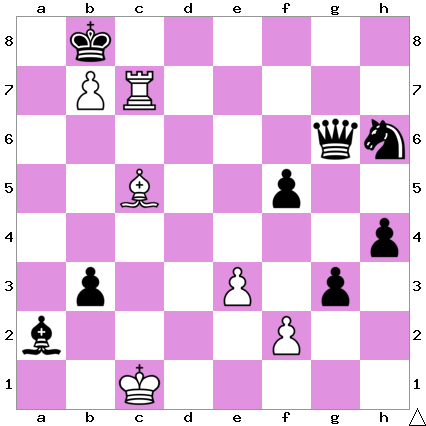
Kowalski and H are playing chess in the park. Kowalski, playing black, has captured both of H's knights, one rook, one bishop, and three of his pawns, though only four white pawns are visible on the board. H appears to have captured both of Kowalski's rooks and four of his pawns. Kowalski is thinking carefully about his next move.
KOWALSKI: Ah . . . um . . . um.
Finally he moves a knight and takes H's queen.
H: Oh, interesting stratagem. Double bluff and hide in plain view. Heh. Heh. I used that ruse in fifty-six to smuggle Santos out of Budapest before the tanks came rolling in.
KOWALSKI: Ah, what's he talking about?
SPECTATOR: He's a super-secret espionage spy guy, and nobody knows about it except you, me, and everyone else.
H: Will you stop mocking me? You get on my nerves. Just stop it! Stop it! Now, then, let me see, how about — [He moves a pawn.] — that? Checkmate.
KOWALSKI: No way.
FRASER: Yeah, I think he's got you, Ray.
KOWALSKI: Okay, another game. [He puts some cash on the table.] Double or nothing.
FRASER: Well, Ray, we really should get going.
H: Oh, yes. I hope you like the apartment. You'd be a great asset to this neighborhood.
FRASER: Oh, well, thank you kindly.
H: Now, ah, what's the time? [Fraser shows him his watch.] Oh! Oh, I'm late. Is there a, is there a back way out of here? Move out of the way, will you?
He pushes through the spectators to get away from the park.
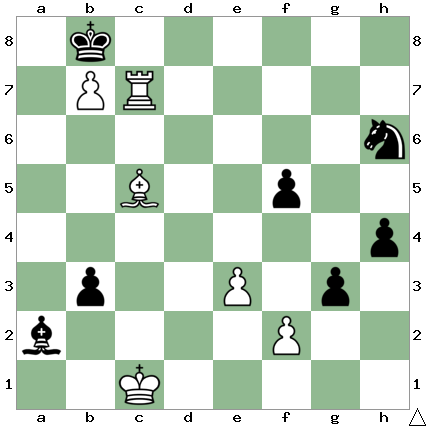
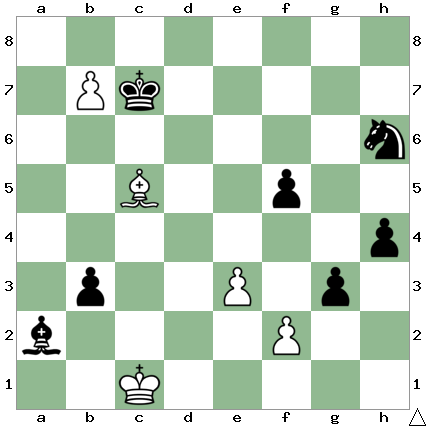
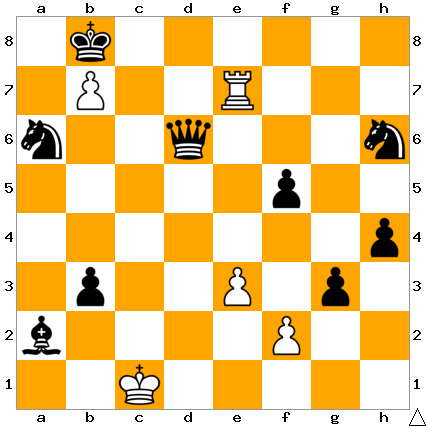
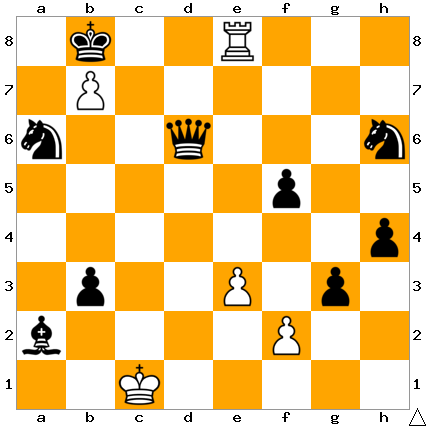
I am no kind of chess expert, but I do know each side normally starts with eight pawns. Maybe H gave Kowalski a pawn to compensate for playing black (as white always plays first)? Because there are definitely exactly seven white pawns visible in the shot: four on the board and three in Kowalski's garage. Anyway, here's the setup the first two times we see the chessboard:

No way to know how we got here, but after Kowalski considers for a moment and finally decides what move to make but before he makes that move, it looks like this: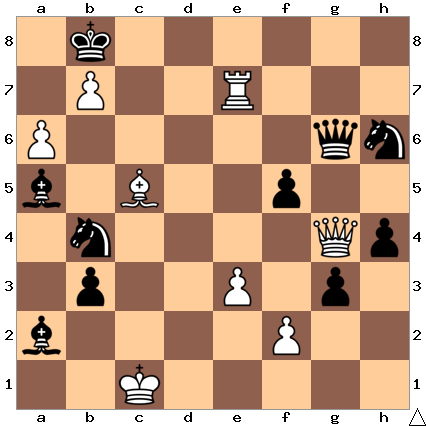
That is, the white king should apparently never have left the back row. Fair enough. Then here we are after Kowalski's move, NXg4:
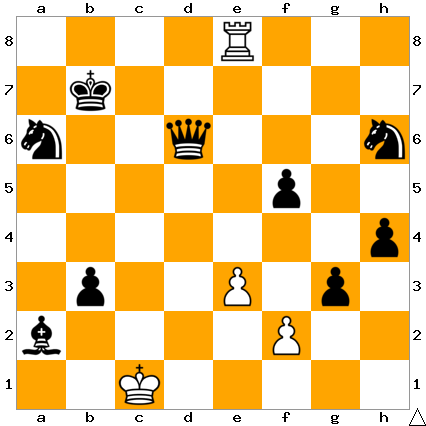
And here's H's checkmate, a7#:
It looks like Kowalski could have left the white queen alone and moved his other knight from b4 to a6 to take that white a-pawn before it could threaten his king (NXa6). But if he'd done that, the white queen would have just moved to f4 (Qf4+)—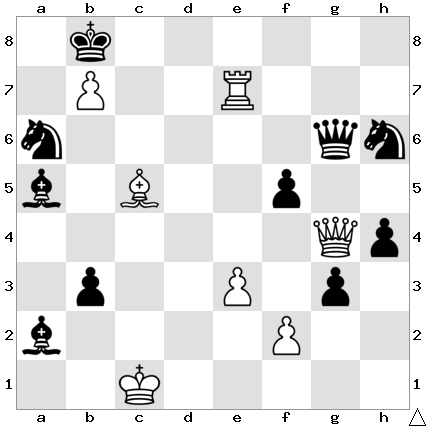
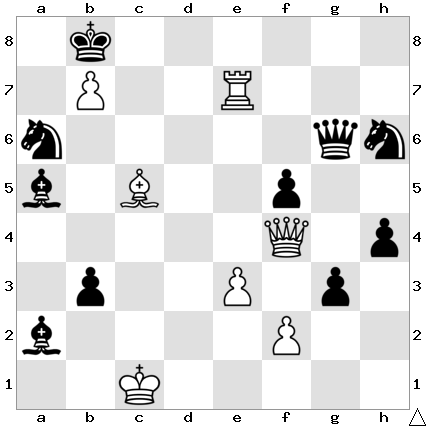
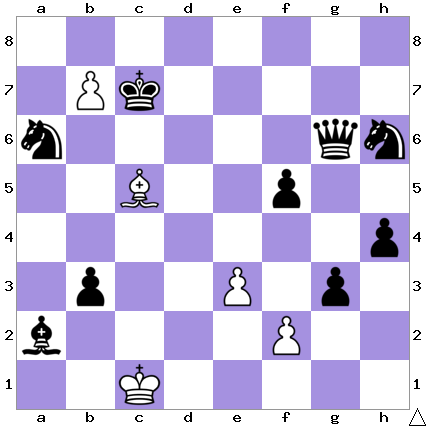
—and at first I had a whole thing here about how Kowalski could take H's queen with his g-pawn and keep his king safe for a little while longer, but no, that would involve that pawn moving backward, so with the white queen on f4 that's checkmate, isn't it. [eta later: No, wait, Kowalski has one or two more moves: He can sacrifice his bishop, Bc7: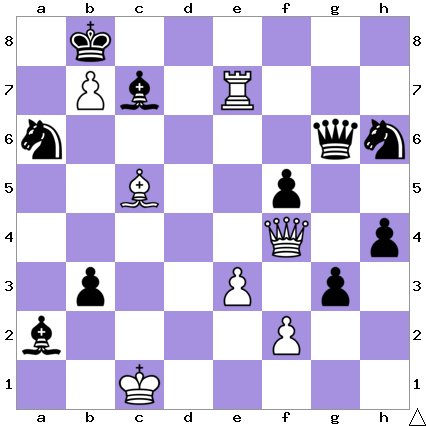
From there, H's choices appear to be (1) Rxc7 (take the bishop with the rook) or (2) Qxc7+ (take the bishop with the queen)—or

but if he does either of these, Kowalski is next going to avenge the bishop with his knight Nxc7 (take whichever of H's pieces is on c7 with the knight currently on a6).or

He's going to lose that knight to either the queen or the rook, whichever one didn't take the bishop—or
—but then his king will take whichever piece just took the knight and he'll be safe.(I think an exact alternative to the above would be sacrificing the knight and avenging it with the bishop; I think both defenses would work out the same. In either case, the white pawn will advance to b8 and be promoted to queen, but the king will take it back in the next move, and H will be down to two pawns and a bishop.)
Kowalski could also have blocked the check with his queen, Qd6, but then H would take the queen with his queen, Qxd6+, and now Kowalski could sacrifice the bishop, Bc7, but then H will take the bishop with his queen, Qxc7+, and Kowalski will take the queen with his knight, Nxc7, H will take the knight with his rook, Rxc7, Kowalski will take the rook with his king, Kxc7.

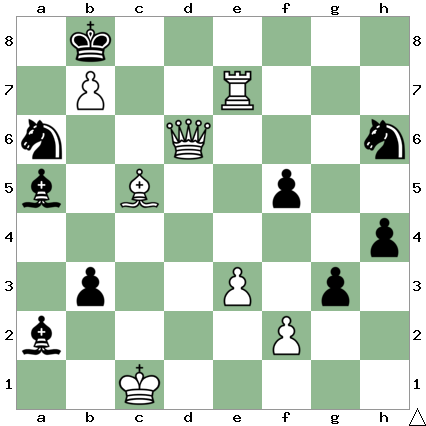
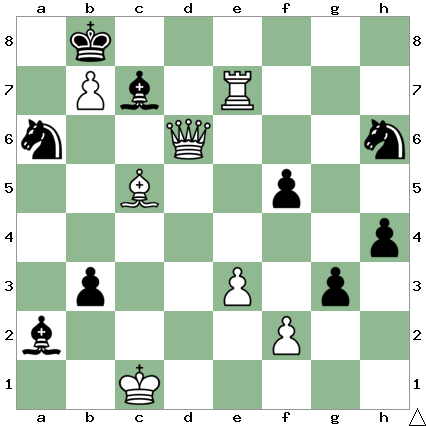
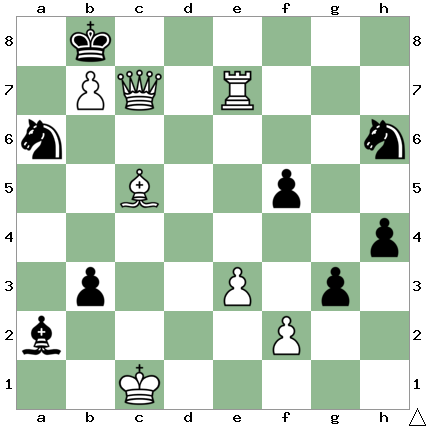

See above re: white pawn being promoted and immediately captured back by the king; and now H has two pawns and a bishop and Kowalski has four pawns, a bishop, and a knight, so Kowalski should be able to win, shouldn't he?In another alternative, though, suppose Kowalski does Bc7, sacrificing his bishop, and then H does Bd6—
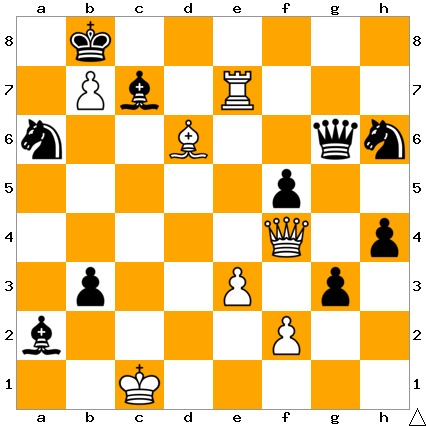
That's probably not that sound of a move, actually, because Kowalski would probably take the white bishop (Bxd6), at which point the only real move H has is to take the black bishop (Qxd6+), but now the white queen is under attack from the black queen (Qxd6), and then what can H do? He can move the rook to the top row (Re8+), but now the black king can safely take the pawn (Kxb7), and it won't be long before Kowalski takes that rook with either his queen or a knight, something the rook can't threaten, and H is down to his king and two pawns (Kowalski could have defended his king with his queen instead of that bishop all those alternatives ago, but H would have taken her, as we've seen in the blue-board diagrams, and then he'd have been stuck; the bishop is a better loss and c7 is a better square to lose it on.), and once that happens, I don't see how Kowalski, with four pawns and both knights and a bishop and his queen, can't checkmate H in not very many moves.

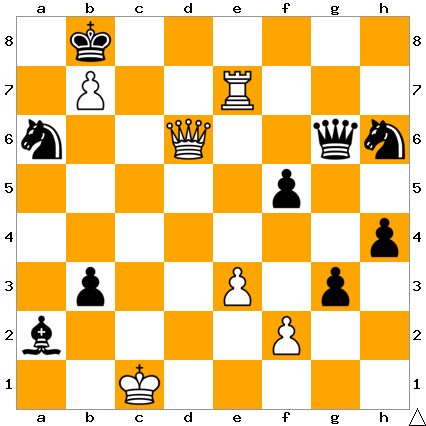
In short, Kowalski
is squeezed and has been since at least two moves agomay or may not have been able to win this game, but it looks like he sure didn't have to lose, if he'd just gone after that white pawn instead of the queen. The moral of the story, of course, being not to overlook the foot soldiers.]Anyway, I don't know who Santos is, but H is otherwise referring to the beginning of the Revolution of 1956 when the Hungarians rose up against the Soviets. (It didn't work.) It's clearer here than it was in scene 1 that the old man has a slight English accent, but he does, because Eric Christmas (1916–2000) was born in England and later moved to Canada. Is H supposed to be English? Hard to say.
Scene 4
Fraser and Kowalski are continuing on their way to Fraser's apartment interview.
KOWALSKI: I had him, Fraser. I was hustling. I gave him a couple of games, and then I was going to crank him for the big money. What do you want to bet he's on lithium the size of Pudding Pops? [He turns a corner.]
FRASER: Ah, Ray? It's this way. [He points across a street.]
KOWALSKI: No, no. It's this way.
FRASER: Well, Dief is very rarely wrong. [Diefenbaker starts to cross the street.]
KOWALSKI: Okay. This time when you're talking to the landlord, do not volunteer that he's a wolf, okay?
FRASER: [off Diefenbaker's glare] Well, you are a wolf. [Diefenbaker barks.] Yes, I know, but most people aren't as open-minded as you.
KOWALSKI: Don't talk to the dog in public, Fraser. It embarrasses me.
FRASER: Understood.
KOWALSKI: Okay.
They continue through the crosswalk. A taxi pulls up to the light; the driver is on the radio.
TAXI DRIVER: I'm telling you, there's no fifteen-forty Belden, Dispatch. The street just ends.
Okay so the 1540 Belden thing H mentioned in scene 1 was not just nonsense. Good note! Other than that: Why is Kowalski going with Fraser to look at apartments, do you think? I mean when Fraser first moved to Chicago, Vecchio came with him to look at 221 W Racine #3J, but now Fraser's been living in this town for several years and knows how to take care of himself, right? Though maybe not, if this is (as Kowalski implies) not the first apartment he's looked at on this particular search, and he disqualified himself by using the word "wolf" with reference to Diefenbaker.
H could be taking lithium for bipolar or major depressive disorder. Pudding Pops were popsicles made of frozen chocolate pudding, shilled by the loathsome Bill Cosby, and they were delicious. I miss them, but I also miss being a kid in the 1980s, which I still wouldn't be even if they brought pudding pops back now, so it's probably just as well that they don't.
Scene 5
H is hanging out in and around some public sculpture, reading notes he's taken in a little date book.
H: Thirty-two years. No contact. [He sees a man sitting on a bench.] Suspicious looking. What's he up to? [The Man On The Bench stands up, looks around, and comes away from the bench toward a public rubbish bin. He looks around and then slips his folded magazine under the top layer of trash in the bin. H is interested, but the Man On The Bench sees him looking, so he pretends to have noticed something somewhere else and looks away again.] Okay, okay. Stay calm. [The Man On The Bench walks away. H puts his notebook in his inside jacket pocket and hurries to look in the bin. He takes out the magazine and hides behind a cutout of a silhouette of a man with a briefcase.] Oh. Contact.
Inside the magazine is an envelope with a theatre ticket and some cash in it. H pockets the cash and then sees the Man With No Tie from scene 2, who apparently finally got a taxi, get out and look around—and see him. H starts to run, and the man starts to chase him.
H's date book appears to be open to the last week of March 1997 and reads as follows:
Monday, March 24: Empire St. — No Contact
Tuesday, March 25: Empire State Building — No Contact
Wednesday, March 26: Wrigley Field — No Contact
Thursday, March 27: Statue of Liberty — No Contact
Friday, March 28: Mt. Rushmore St. — No ContactThen he turns the page:
Monday, March 31: Carlsberg — No Contact
Tuesday, April 1: New Deal — No Contact
Wednesday, April 2: The Cape — No Contact
Thursday, April 3: Matanzas Tower — No Contact
Friday, April 4: St. Augustine — No Contact(I guess he doesn't monitor whatever he's monitoring on the weekends.) I'm less confident about both of the Wednesdays than I am about the rest, because they're blurry and at the bottom of the screen. It doesn't entirely make sense that he'd be checking in at Wrigley Field on a Wednesday when he was at the Empire State Building on Tuesday (and maybe also Monday, if that's what he means by "Empire St.") and the Statue of Liberty on Thursday, right? But after the Statue of Liberty things get fuzzier. The only Mt. Rushmore St. I could find is in Salem, Oregon; the googles assume "Carlsberg" refers to the brewing company, after which is named a neighborhood in Copenhagen. The New Deal was FDR's economic program to end the Great Depression. "The Cape" could be anything—Cape Cod, Cape Ann, Cape Canaveral, Cape Fear, Cape Hatteras, Cape Horn, Cape Town (or the Cape of Good Hope), Cape Breton Island, Cabo Verde.
I'm interested in the public sculpture, but I can't find where it is. I assume Toronto or Vancouver, but my googling hasn't got me anywhere on this one.
Scene 6
Fraser and Kowalski are still walking and talking.
FRASER: Maybe it's a combination of electromagnetism, cellular phones, radio waves — something's confused him.
KOWALSKI: Oh, yeah, that must be it.
FRASER: You know, Ray, it's sad. It's sad and pathetic to watch a grown man gloat over besting a dog.
KOWALSKI: You have your hobbies, I have mine.
FRASER: It's not a hobby, it's, it's —
H: [nearby] Help! Help!
FRASER: It's Albert.
They run and find the Man With No Tie holding H by his collar, up against a dumpster in an alley. Fraser tackles the man.
KOWALSKI: Chicago PD! [The man gets up and swings at him. Kowalski ducks and swings back, and the man goes down. Kowalski turns to Fraser.] You okay?
FRASER: Fine.
KOWALSKI: H! [H has run off.]
FRASER: Ray. [He picks up something Diefenbaker has been sniffing at.]
KOWALSKI: What's that?
FRASER: [It's the envelope H took out of the magazine. Fraser looks inside.] It's a theatre ticket.
KOWALSKI: So? [He turns to the Man With No Tie.] Pitter-patter, let's get at 'er. Come on. [The man just lies there.] Hey. Hey. Come on. Hey. [Kowalski pats his face. The guy does not move.] Hey!
Does it appear that Diefenbaker was in fact wrong about the route to the apartment Fraser is supposed to be looking at? Is that what we learn from the beginning of this scene, in which, by the way, Fraser and Kowalski are walking down the street very close together, indeed with their shoulders basically overlapping? . . . Only now Kowalski has killed a man with one punch, so I guess fun time's over.
Credits roll.
Paul Gross
Callum Keith Rennie
Beau Starr
Camilla Scott
Tony Craig | Tom Melissis
Ramona Milano
and Gordon Pinsent as Fraser Sr.
(plus Draco the dog)
Eric Christmas, Susan Douglas, Martha Burns, Jan Rubeš as Mort, and Maury Chaykin as Pike
Maury Chaykin (1949–2010) was, as I recall, a "hey it's that guy" actor who achieved some renown as Nero Wolfe. He was also the nephew of George Bloomfield, who directed a nontrivial number of episodes of this show (although not this one).
Scene 7
At the police station, Welsh is looking at a document and scolding Kowalski.
WELSH: The press is going to love this.
KOWALSKI: Look, I barely tapped him. I threw him a dead fish, sir.
WELSH: He dropped dead.
KOWALSKI: He heart attacked or something. He was assaulting or maybe robbing this old chess guy. We don't know, but somehow it involved these theatre tickets.
WELSH: You killed a guy for scalping? Look, the mayor does not like it when the Chicago PD goes around killing its citizens.
KOWALSKI: Look, he, he had no ID. He might not have even been a citizen.
WELSH: Oh, that's great, he's a foreigner, so it doesn't matter that we killed him. Chamber of Commerce is going to love that one. Great for tourism. Where's this old guy now?
KOWALSKI: Fraser's out looking for him.
WELSH: Dead body is downstairs?
KOWALSKI: Yeah.
WELSH: All right. I want to know who this guy is, and I want to know right now. When they ask me upstairs "Who is this guy we killed?", I want to be able to write a book about him.
KOWALSKI: Yes, sir.
WELSH: Now, when you kill a guy, this whole department has killed that guy. Do you understand?
KOWALSKI: Look, I barely tapped him.
WELSH: Do you understand?
KOWALSKI: I didn't even bruise my hammer.
WELSH: Do you understand?
KOWALSKI: Yes, sir.
Not that I don't appreciate the ways in which Welsh repeating "Do you understand?" until he gets an answer he likes is a lot like speaking to my kindergartener, but: Why is Kowalski not on paid suspension or in some way in more trouble than this or something? Is it because the Man With No Tie's mysterious death was not in an officer-involved shooting?
Scene 8
Fraser and Diefenbaker are walking down a dark hallway. Diefenbaker grumbles.
FRASER: This is it, boy? [Diefenbaker grumbles again.] Perhaps we can find a manager — [Diefenbaker jumps at the door, which swings open, and goes into the apartment.] — that's trespassing. [Fraser looks around.] Well, maybe just this, ah, once. [He closes the door behind himself and steps into the efficiency apartment to look around. A chessboard is on a small table, its game in the early stages. He looks at some books and papers on a desk.] Hmm. Count Leipnitz, Art of the Spy. [He puts the book down, goes to the bed, and smells the pillow. He runs his finger along the nightstand, moves something out of the way, and carefully opens the top drawer. He sets aside three medication bottles and turns the drawer over, finding a military-style medal tucked into the bottom support. He's puzzled, but he puts everything back carefully; while he's doing so, Diefenbaker grumbles, and Fraser moves over behind the door. Someone opens the door and comes into the apartment, leading with a handgun. Fraser grabs the person's wrist and takes the gun. It is an older woman, who gasps.] Oh, I'm terribly sorry.
OLDER WOMAN: Oh, my.
FRASER: Are you all right?
OLDER WOMAN: Who are you?
FRASER: My name is Constable Benton Fraser, RCMP. I — I first came to Chicago on the trail of the killers of my father, and for reasons that don't need exploring at this juncture, I've remained, attached as liaison with the Canadian consulate.
OLDER WOMAN: Are you the police?
FRASER: Well, yes, but I'm here strictly in an unofficial capacity. Well, I'm looking for Mr. Hanrahan.
OLDER WOMAN: Uh . . . uh, he moved out.
FRASER: Oh. When?
OLDER WOMAN: About an hour ago.
FRASER: Ah, I see. Do you by any chance know where he's gone?
OLDER WOMAN: [shakes her head] But if you find him, you tell him he owes me a week's rent.
FRASER: Oh, so you own the building.
OLDER WOMAN: I'm the manager.
FRASER: I see. Do you also live here?
OLDER WOMAN: Yes.
FRASER: I see. [He picks up his hat and leaves the apartment.]
OLDER WOMAN: [following him] Oh, my, my, my gun, please. That gun's my protection. Please give me back my gun.
FRASER: Do you have a permit for this weapon, ma'am?
OLDER WOMAN: Well, I never —
They've gone into the apartment office, where hand-lettered signs read "Office Hours 7AM–11PM" and "sorry no change!" There are a lot of little ceramic figurines in the window.
FRASER: You see, that could be a bit of a problem. [He knocks on a door in the office.] Mr. Hanrahan? It's Constable Fraser.
OLDER WOMAN: What are you doing? This is my apartment.
FRASER: I realize that, ma'am. [He knocks again.] Mr. Hanrahan, it is extremely important that I speak with you.
H (HANRAHAN): [opens the door] Oh. Well, come in.
FRASER: Thank you kindly.
HANRAHAN: How did you find me? [He shows Fraser in and they sit down. The woman starts preparing tea in the kitchen.]
FRASER: The single strand of hair that you used to monitor your bedside drawer was the same stylish tone that makes your hair so pleasing to the eye. Also, your pillowcase carried the floral scent that I notice you favor. And I see you are a reader of Count Leipnitz.
HANRAHAN: Oh yes, oh yes. "The man who is truly hidden —
FRASER: — is the man who hides beside himself."
HANRAHAN: Yes.
FRASER: And the man who attacked you today . . .
HANRAHAN: I don't remember that one.
FRASER: Oh, no, no, I'm, I'm actually talking about the man who attacked you today.
HANRAHAN: Oh, you're actually asking me about the man who attacked me today.
FRASER: Yes, actually today.
HANRAHAN: Yeah. Yeah. That is a matter of national security.
FRASER: I see. The man is dead.
HANRAHAN: I'll talk to you, but she has to leave the room.
OLDER WOMAN: Oh, Albert.
HANRAHAN: Now, Ruth, we've been through this many, many times. I'm sorry.
OLDER WOMAN (RUTH): All right.
HANRAHAN: [showing her out] I'm sorry. It's very private. It's for the best. [He closes the door behind her.] Constable, I'm a coward.
FRASER: You're not a coward, sir. I've seen your medal. From Korea. There were no cowards at the Chosin Reservoir.
HANRAHAN: That was years ago. I was, I was just a kid. But I've become — I've become afraid. I'm, I'm, I'm, I'm afraid of choice. I'm afraid of responsibility. I've been hiding from reality, and my excuse is I've been waiting for my country to call on me. Huh. Finally, they call — look. Look. There, there, there, there, there's, there's nothing left of me. I — nothing but talk, talk, and talk, and . . . and fear.
FRASER: Sir, excuse me. Are — are you telling me — [He clears his throat.] — that you're an intelligence operative in deep cover, living here in this rooming house, that you receive unwelcome taxi calls on a plate in your head, you play chess in a park, and that you're waiting for your government to activate you?
HANRAHAN: You've been very well briefed.
FRASER: [nods] Well, I wonder then if you could explain the significance of this. [He shows him the theatre ticket.]
RUTH: Albert? What's going on in there?
HANRAHAN: Ruth is so proud of me. It's going to break her heart when she knows the truth. [Ruth comes back in and stands by the door. Hanrahan gives Fraser the ticket back.] Now, you go in my place, okay? This is where you will meet your contact.
Fraser nods solemnly. Hanrahan winks.
This is a long scene in which it doesn't seem like an awful lot happens, huh? It seems that Count Leipnitz (which Fraser should pronounce with a long i, "LYPE-nits," instead of with a long e as he does, "LEEP-nits," as if it were spelled Liepnitz) and The Art of the Spy are fictitious; I can't find anything about them with either of those spellings nor without the t, even when I make an effort to stay away from Leibniz.
It's still not clear whether Albert Hanrahan is American or English; both the U.S. Army and U.S. Marines and the Royal Marines fought at the Battle of the Chosin Reservoir (1950), at which it is probably true there were no cowards (or none who returned); that was an important battle in the Korean War, though who won apparently depends on how you're counting? That is, the Chinese volunteers won in that they held Lake Changjin (the Korean, rather than the Japanese, name of the Chosin Reservoir) and sent the U.S. and allied forces back to South Korea, but the U.S. and allied forces won in that they hung in there and didn't get kicked out of the peninsula entirely. Put another way: To those fighting for a unified Korea, the battle was a failure, but if you consider that the U.S. was trying to help keep South Korea from being completely overtaken, technically they succeeded. Anyway, the "good guys" in that battle sustained almost 11,000 casualties including 78 Royal Marines, so Hanrahan could have got his medal from the Eisenhower administration or from the King.
Does he seem a little too old to have fought in Korea? He couldn't probably have been any older than 30 at the time, which would make him not yet 80 by 1997; the actor was 81 and looking older and frailer than I'd think of a man in his mid-70s, but a 75-year-old who's been through stuff will likely look older than a 75-year-old who hasn't (my father-in-law, for example, was in the navy during Vietnam but never got shipped over there, and he's about 76 now—that is, about five years younger than Eric Christmas was when he made this episode—and looks 10 or 15 years younger. People's levels of health vary, and a person who was in his mid-70s in the late 1990s may have "been older" with it than a person who is in his mid-70s in 2023—to take another example, I have a picture in which my great-grandmother, in her late 30s, looks about 20 years older than I believe I look now, in my mid-40s, because her life and my life had and have been so vastly different—but I will also conclude that having been through a rougher youth and looking this old in his mid-70s, Albert Hanrahan was more likely British than American (that is, had lived through WWII and post-war Britain and been a little worn down by it).
I don't think Fraser believes Hanrahan is actually an intelligence agent living in deep cover, etc., but he certainly believes Hanrahan himself believes it. The theatre ticket is a mystery, though; Fraser wouldn't be going in Hanrahan's place but in place of the Man With No Tie, wouldn't he? Because that's who Hanrahan stole the ticket from. 🤔
Fun fact: The old woman, Ruth, is played by Susan Douglas—Mrs. Rubeš.
Scene 9
Fraser and Kowalski are walking down the hall in the police station.
KOWALSKI: Are you completely nuts, Fraser?
FRASER: Not completely, no.
KOWALSKI: Come on, the guy is a mental patient. He picks up taxi calls via his head.
FRASER: Well, somebody attacked him.
KOWALSKI: Oh, geez, in that part of town? What a surprise.
WELSH: Vecchio, what's the word on that John Doe?
KOWALSKI: Uh, nothing, sir.
WELSH: You been downstairs?
KOWALSKI: To the cold meat party? Not yet, sir.
WELSH: Are you waiting for an engraved invitation?
KOWALSKI: I hate this part. I really hate this part.
FRASER: It's all part of life, Ray. [They head for the morgue.]
KOWALSKI: Look, don't tell me it's a part of life, Fraser. I know it's a part of life. It's the worst part.
FRASER: You know, eternity waits for us all, Ray, and in the knowledge that there's something larger than ourselves, I find a certain peace. [They can hear Mort singing.]
KOWALSKI: You lick anything, and I mean anything, I'm gone.
FRASER: Understood.
They go into the morgue.
Scene 10
Mort is singing "Libiamo, libiamo" and drinking champagne.
MORT: ♫ Libiamo, libiamo — ♫
FRASER: Hey.
MORT: — oh. Hi, boys.
KOWALSKI: Hey, it's freezing in here. Can't you turn it up a bit, the heat or something?
MORT: [chuckles] You wouldn't want me to.
FRASER: Have you determined the cause of death?
MORT: I was going to get to him after dinner.
FRASER: Ah. Well, do you mind if I, ah . . . ?
MORT: Be my guest.
FRASER: Thank you. [starts to pull back the drape over the body of the Man With No Tie]
MORT: You see, there's a special at Mendelssohn's. Chicken Tetrazzini, with peach Melba as dessert.
FRASER: Mmm.
KOWALSKI: [can't look] Clothes, where's his clothes?
MORT: In that plastic bag there.
FRASER: [sniffing the dead man's fingers] Mmm. I smell rough tobacco. Turkish, possibly a Russian blend. [Now he sniffs his face.] Liquid soap. The kind used in airline bathrooms.
MORT: Give me one hour, I'll tell you what he had for supper.
FRASER: Ah. Well, you know, I, I might be able to do that now. Well, you see, in the North, we don't often have access to postmortem equipment, so we've developed a very simple, nonintrusive technique.
MORT: So what do you do, you smell his breath?
FRASER: Yes, actually.
Fraser presses hard on the cadaver's upper abdomen, forcing air out of its lungs as it "sits up." Kowalski, looking over his shoulder, is appalled.
KOWALSKI: Aw, Fraser, that is the most disgusting thing I've ever glimpsed!
FRASER: [sniffing as he lays the body back down] Hmm, hmm-hmm, hmm.
MORT: Almonds.
FRASER: Yeah. Can we adjust this light? [Mort moves the pendant lamp as Fraser looks in the cadaver's mouth.] Huh.
MORT: That dental work. It looks like it was done by gardening tools.
FRASER: Heh. Ah, you see here? One cap on his third distal molar?
MORT AND FRASER: Cyanide.
KOWALSKI: [still with his back turned, raises his hand] Hey, hey, hey! Include me, here!
FRASER: I don't think you killed this man, Ray. When you hit him in the jaw, he bit down on a cyanide cap he had in his tooth and poisoned himself.
KOWALSKI: Good. Good. [He gestures to the guy's clothes.] This guy has no labels — who, who the hell is he?
FRASER: My guess is, judging by the amount of kasha he has between his teeth, that he arrived in the country today by plane, probably on a Polish or Russian airline. He smokes Russian cigarettes, he has a cyanide cap in his tooth — some people might conclude, as Mr. Hanrahan does, that he is a Russian spy.
KOWALSKI: Come on, the, the Russians can't afford food, let alone spies, Fraser.
FRASER: Well, people can starve, Ray, but a government can always afford spies. Well, I've got to get ready. I'll have to scrub up before I attend the theatre tonight, and I'll tell you something. I'm kind of looking forward to it. The last time I went to the theatre, it was the Great Bear Lake Opera Appreciation Society's presentation of The Shooting of Dan McGrew at the seventeenth annual Yellowknife Cultural Festival and Blanket Toss.
KOWALSKI: Come on, Fraser, you're not serious.
FRASER: I never joke about culture.
MORT: Oh! I have two tickets for Lucia di Lammermoor for Saturday night.
FRASER: Oh, I'd love to accompany you.
MORT: [delighted, starts to sing again] Oh! ♫ Che tu a Dio . . . ♫
FRASER: Goodbye, Ray. [He biffs off.]
KOWALSKI: Hey, hey, Fraser, who's going to ID the body? Fra—
MORT: You are. Here is the ink pad. And remember, you have to roll the pad around the top of his finger. It's not like printing a live man, huh?
KOWALSKI: I'm not doing it.
MORT: Well, I'm going for dinner. Chicken Tetrazzini, mmm. [He finishes his champagne and puts the glass down.]
KOWALSKI: I'm not doing it!
MORT: ♫ Che tu a Dio spiegasti l'ali, o bell'alma innamorata . . . ♫ [He leaves the morgue.]
KOWALSKI: Oh, this sucks.
Mort begins the scene singing "Libiamo ne' lieti calici" from La traviata, which we've heard before, and he's probably singing that because he's drinking; he finishes it singing "Tu che a Dio spiegasti l'ali" from, unsurprisingly, Lucia di Lammermoor, where Edgardo—having learned that Lucia has died—resolves to kill himself with her brother's dagger. He sings only the beginning of the aria (and reverses the first two words of it, but whatever); the text is "You who spread your wings to God, O beautiful beloved soul . . ."
Mort's dinner plans, in fact, are also opera-focused; chicken Tetrazzini is named for Luisa Tetrazzini and peach Melba for Dame Nellie Melba, both important sopranos (who both played Lucia di Lammermoor, incidentally). They were rivals in life, so it's nice to suggest they might complement each other so well at the dinner table. 😃
Fraser's theatre-going habits are, of course, nonsense. There does not appear to be in real life any such group as the Great Bear Lake Opera Appreciation Society, any such opera as The Shooting of Dan McGrew, or any such event as the Yellowknife Cultural Festival and Blanket Toss, though in the world of due South Fraser apparently saw that opera put on by that society at that event some time after the time he saw whatever it was the Yukon Light Opera was doing that one time.
Why would someone be toting a cyanide capsule in his teeth if he weren't a Film Or Television Russian Spy? Is there any other population that routinely uses those things?
Scene 11
At home in his office in the consulate, Fraser is shining the buckle on his dress uniform belt. He turns to Diefenbaker.
FRASER: Don't look at me like that. I only have the one ticket. Aside from which, what do you care? You're deaf.
Diefenbaker grumbles.
Is Fraser going to the symphony, then? Some production with no visual elements that a deaf spectator might appreciate?
Scene 12
At the theatre, the Man On The Bench from scene 5 and a woman with a Russian accent watch Fraser take his seat.
RUSSIAN WOMAN: Is that the buyer?
MAN ON THE BENCH: [also with a Russian accent] I don't know.
RUSSIAN WOMAN: Where is Karl?
MAN ON THE BENCH: I don't know.
RUSSIAN WOMAN: I will deal with this myself. Wait for me. [She takes the empty seat next to Fraser, and they both read their programs as the orchestra makes pre–tuning up noises.] The quality of the sound of music transports me like smoke. Do you have a light for my cigarette?
FRASER: I'm afraid this is a, a nonsmoking environment.
RUSSIAN WOMAN: The white raven waits for the right wave.
FRASER: I see.
RUSSIAN WOMAN: [impatient; tries again] The white raven waits for the right wave.
FRASER: Ohh. Um — [He clears his throat.] — Rusty Ruggles rode his wet reindeer through the red window.
RUSSIAN WOMAN: Are you playing games?
FRASER: I thought we were, yes.
RUSSIAN WOMAN: I don't like games.
FRASER: Oh.
The overture begins and the house lights go down. The audience is made up entirely of men in black tie with white shirt fronts and women in black dresses with scoop or deep V necks and pearls, so Fraser in his red tunic in the middle of the room (seriously, bang in the center of about row F in a house that looks like it's about 13 or 14 rows deep) is extremely visible. He's also picked out by a dim spotlight, but seriously.
RUSSIAN WOMAN: I'm here to do business. Arms business.
The audience applauds as the house lights go all the way to black.
Oh dear, Fraser seems to have stumbled into a genuine situation, doesn't he.
Per usual in this sort of film or television scenario, one wonders why these Russian people are speaking accented English rather than simply speaking Russian to each other. Margarita Gamez spoke to her children in English and I didn't know why; likewise Edgar and Rosanna Torres; but Agent Cortez and her colleagues spoke Spanish among themselves, which I thought was sensible. Likewise, Eric and his nephew David spoke Tsimshian in "Mask." So I don't have a good Watsonian explanation for nonnative English speaking characters' language choices, and I don't really have a good Doylist one, either, because while the Spanish-speaking characters may have been played by bilingual actors, the Tsimshian-speaking characters were not (at least Eric wasn't; Rodney A. Grant is a member of the Omaha tribe of Nebraska and may, for all I know, speak Omaha-Ponca, but he was almost fired from Dances With Wolves because he couldn't learn his lines in Lakota; Nathaniel Arcand, who played David, is Nēhilawē, a Plains Cree First Nation whose language is also unrelated to Tsimshian, though a cursory Google doesn't turn up as much detail on that actor's languages or language learning abilities), so the fact that I seriously doubt the actors playing the Russians are native or fluent or even capable speakers of Russian doesn't seem super relevant.
But here's the thing I actually find baffling: A woman Fraser has not met before is speaking to him, and he doesn't seem to be in any way uncomfortable about it. Am I right that that's weird? I mean I guess he wasn't uncomfortable with Mackenzie King or Julie Frobisher or Miss Cabot or Tammy Markles or Jackie the Dog Mom or Katherine Burns or Ida Aphrodite or Elaine or Francesca or Thatcher or any of a couple-few other women we've met (waitresses, club patrons, random women shopping for cars or wedding dresses or who knows what [generally gestures to the first two seasons of the show]) until they seemed to be interested in him socially, and he wasn't uncomfortable with Carol Morgan a.k.a. Morgan Thomas or Margarita Gamez or Christina Nichols (who was, after all, only 16) or Louise Webber or Suzanne Chapin or Dawn Charet or Jasmine the receptionist or Miss Madison or Jill Kennedy or Louise Saint Laurent or Rosanna Torres or Andie Whatshername (another teenager) or Shelley O'Neill or Irene Zuko or Agent Cortez or Sister Anne MacRae or Stella Kowalski or Mrs. Vecchio or Maria or any of the two or three other nuns, women attorneys, etc. we've met ([gestures again]) because they haven't been interested in him socially (or "socially"). (Is that all the women we've met in this whole show who weren't Constable Leann Brighton, Victoria Metcalf, or Janet Morse? I think it might be.) But he is flirting with this Russian lady; he comes right out and says so ("I thought we were [playing games], yes"), and she is decidedly not flirting back. They haven't even been introduced. Am I off base in wondering what the fuck? I mean, she wonders what the fuck, but she has particular in-universe expectations of what's going to happen at this opera (or whatever theatrical event it is) and her expectations are not being met; I have particular expectations of what's going to happen with Fraser and my expectations are not being met.
This is probably a fair time to mention that the Russian woman is played by Martha Burns, that is, Mrs. Gross, but that shouldn't be relevant; they're both professional actors, so their personal chemistry shouldn't get through. She's certainly playing "who the fuck is this guy" fine, so I don't think what I'm seeing from him is any type of warmth that he doesn't mean us to see; I think it's actually Fraser, I mean, rather than Paul Gross, behaving in a way that I don't understand.
Scene 12
The ballet (for it is Flora's Awakening, apparently) is in progress, and Fraser is talking to the Russian woman, which is an unforgivable sin in a live theatre, as he ought to know.
FRASER: You know, this is so exhilarating for me. You see, we very rarely had live music where I come from.
RUSSIAN WOMAN: Well?
FRASER: Well, because it's so remote. The cost of flying a symphony orchestra in by seaplane is — well, it's prohibitive. I mean, not to mention the dangers inherent of applying one's lips to brass instruments in subzero temperatures. As a matter of fact, there was a very amusing, somewhat painful incident at the sixty-seven centennial —
WOMAN BEHIND FRASER: Shh!
FRASER: Oh, I'm sorry.
I cannot understand why or how the Benton Fraser we know would be speaking out loud (a) to a woman who obviously doesn't want to listen to him (b) in a theatre during a performance. I'm so confused by this I can hardly focus on anything else. The '67 centennial he refers to is Canada's, of course. He'd have been about six years old at the time, so whatever amusing but somewhat painful incident he's about to tell the Russian woman about before the woman in the next row shushes him must be something he's heard about in stories, don't you think? Whatever: Maybe he breathed too much formaldehyde in the morgue or something and that's why he's talking during the ballet, because I say again and will keep saying, what the fuck.
Scene 13
At the station, Kowalski is walking and talking with Welsh.
WELSH: So the feds don't have his fingerprints on file. What's the problem?
KOWALSKI: But they don't say that. They're hiding something. If they didn't have the prints, they'd come out and say so, but they don't.
WELSH: No, no, no. It's government. They never just come out and say anything.
KOWALSKI: We had a seminar, Information Sharing in the Twenty-First Century. We, we had homework, scribblers, everything. Remember?
WELSH: Let it go. You want to get involved with the feds? It's always a disaster.
KOWALSKI: Hey, you're the one who wanted to know who the hell this guy was.
WELSH: Hey, I changed my mind.
KOWALSKI: Lieutenant, I killed the guy.
WELSH: Detective . . . look, the shooting team from Internal Affairs, they want you available to them, so don't leave the building.
KOWALSKI: But I didn't shoot anybody.
WELSH: Yeah, well, we don't have punching teams, so you're just going to have to make do.
Poor Kowalski is still torn up by the fact that the guy he hit with just one punch is now dead. One can imagine! Is he going to also maybe be directed to see a counselor? I'm spitballing based on other cop shows, you understand.
Scene 14
At the ballet, Fraser is still talking to the Russian woman, who can't stand it.
FRASER: And so, you see, when he lost his lips, he was forced to abandon the horn section, and he took up the triangle.
RUSSIAN WOMAN: Do you have any idea who I am?
FRASER: Actually, no, which is what —
WOMAN BEHIND FRASER: Shh!
FRASER: My apologies.
RUSSIAN WOMAN: Are you enjoying this kind of dangerous little game?
FRASER: That's an excellent question. First of all —
EVERYONE IN A TWO-SEAT RADIUS: Shh!
RUSSIAN WOMAN: Follow me.
FRASER: As you wish.
PRACTICALLY EVERYONE IN THE CENTER SECTION: Shh!
FRASER: Certainly.
Fraser and the Russian woman step out through a side door, where the Man On The Bench and another big guy immediately pull guns on him.
RUSSIAN WOMAN: Who do you work for?
FRASER: Technically, the Queen.
MAN ON THE BENCH: He works for the Colonels —
RUSSIAN WOMAN: [speaks Russian]
FRASER: Oh, you're Russian? I'm, I'm sorry, I — I mistook you for being English.
WOMAN BEHIND FRASER: [opens the side door to shush him] Shh!
FRASER: Oh, I'm, I'm terribly sorry. [to the Russians] Excuse me.
Fraser dashes back into the theatre and down a side aisle. The Russians are somehow in the corresponding aisle on the other side of the house. The music changes, and Fraser and the Man On The Bench do a couple of catch-me-chase-me back-and-forth hops up and down the aisle steps corresponding with the arpeggios on the harp—and then Fraser makes a break for it and runs down to the front of the house and up onto the stage. Audience members whisper and murmur, not understanding what's going on. He bumps into a dancer, who is surprised. Another dancer, who has just finished a pas de deux, drops the ballerina he was holding on the floor. The orchestra keeps playing. Fraser looks into the wings, but the big Russian dude is there with a gun, so he can't flee that way; the Man On The Bench is coming down the aisle, so he can't jump off the stage either. A ballerina, getting on with it, twirls around and jumps into Fraser's arms. He catches her. The Russians feel like they can't shoot him while he's performing, I guess? The audience applauds. Fraser sets the ballerina down and catches another one, lifting and presenting her as though he has the first idea what he's doing. He catches jumping ballerinas one after the other, making his way to the edge of the stage. The audience is delighted. Fraser jumps up onto a foam Pegasus backdrop thing. The Man On The Bench jumps up on the stage and tries to follow him. The dancers dance around, because the show must go on. Fraser pulls a knife out of his boot. The Man On The Bench is trapped inside a circle of girls doing fouettés, dodging legs. Fraser throws the knife and hits an offstage circuit labeled "horse fly," and the Pegasus rises up on wires and flies him offstage. The audience is thrilled. Fraser gives a little flourish as he leaves their view, and the audience does a mass standing ovation. Fraser climbs off the Pegasus onto a catwalk, from which he can see the Man On The Bench writhing on the floor as the corps de ballet close in around him and all finish with one foot on his chest.
Maybe you can get away with that kind of thing at the Yukon Cultural Festival and Blanket Toss, but I find this whole Fraser-onstage-and-the-ballet-refuses-to-be-interrupted thing so excruciating it's hard to discuss.
Can any Russian speaker help me out with the woman's line in Russian? I hear "sav karista ruk," which helps me not at all. Something about hands?[Thanks to AO3 userflownwrong, who reports that what the woman says in Russian is "Заткнись, дурак!" (zatknis', durak), which means "silence, fool!", and that her accent is horrifying. 😊] I'm stumped by Fraser's saying "Oh, I mistook you for being English," as well. There was something vaguely British-esque about her more-forward vowel in the word "smoke" in scene 11, but this woman is not speaking with an English accent or even any accent normally committed by a native speaker of any dialect of English. I mean, maybe Fraser can't tell because although he was raised by librarians and has read everything, he hasn't actually heard that many accents spoken out loud? Is that a valid explanation?
Meanwhile, of course no dancer who valued her safety would leap into the arms of a partner she didn't know (and know he knew how to catch her and how to hold her and how to put her down again).
But all that is nothing compared to the fact that the scene exists at all. I'm very uncomfortable right now. I want to move on and never think about this again.
Scene 15
Fraser runs out a stage door into an alley. He runs down the alley and almost collides with the big Russian dude from inside.
BIG RUSSIAN DUDE: [into walkie-talkie] He's in the alley!
Fraser turns and runs the other way. The big Russian dude fires a couple of shots after him. The Man On The Bench comes out and fires after him too. A car rolls up at the other end of the alley; its back door opens.
DRIVER: Get in.
Fraser gets into the car, which squeals away.
Scene 16
The car is careening madly through the streets, swerving around a lot of horn-honking traffic. The driver manages to avoid collisions, usually at the last possible moment, almost always although he is not watching where he's going. He is smoking a cigar.
DRIVER: My name's Pike. Cigar?
FRASER: No, thank you.
DRIVER (PIKE): Wise. [He throws his cigar out the window.] Well, you just landed yourself into one hell of a mess. At first, I thought that the Canadians weren't involved, but, ah, now I think you're RCMP.
FRASER: Well, I am.
PIKE: I know you say you are, but I think you are.
FRASER: I am, I said.
PIKE: You've got RCMP written all over your face. Who the hell would ever think you were undercover?
FRASER: Who are you?
PIKE: Here, hold this for a second, will you? [He hands Fraser an earpiece as Fraser slides back and forth across the back of the car.] We operate on a need-to-know basis. For security reasons we're not given a full total picture of our mandates and objectives.
FRASER: Well, ah, just to be clear, your organization is so secret that even you don't know what it is doing? [He gives the earpiece back.]
PIKE: [replacing the earpiece in his ear] That's right. That's absolutely right. That gentleman who your partner killed this morning, he was our conduit to the location of the weapons stockpiles. Now we're back to square one.
FRASER: Who are the Colonels?
PIKE: [panicking] Colonels? Colonels? What do you know about the Colonels?
FRASER: Well, nothing, I'm, I'm, I'm afraid.
PIKE: Well, when the Soviet Union split up, the KGB went freelance. They split up into two groups, the Mafya and the Colonels, both fighting for control of black market activity. We believe the Colonels have an agent deep in America, code name Nautilus.
FRASER: An odd designation. Does he lift weights?
PIKE: No, no, no one's ever seen him. He stays under for long periods of time. Nerves of steel. How much do the Canadians know?
FRASER: Well, that depends on the Canadian. Educational opportunities vary from region to region —
PIKE: Yeah, the old double blind maneuver. I used that in Reykjavik in eighty-one. Ever been to Reykjavik?
FRASER: Ah, no, no, I haven't.
PIKE: They have the most beautiful women in the world there. Their skin. It must be the cold air. [He careens around a corner; lights and sirens turn up behind him.] They've found us!
FRASER: No, I, I don't think so.
PIKE: We'll make a run for the Mexican border. Change passports. New IDs.
FRASER: Well, I'm afraid that I have responsibilities —
PIKE: Time's up. Watch your step. Adios.
Somehow from the driver's seat Pike flings Fraser out of the car, where he rolls over a boom box belonging to a guy who was standing at a bus stop minding his own business and ends up sitting on the bench.
GUY WHO WAS MINDING HIS OWN BUSINESS: Oh, man, my tunes!
FRASER: Good evening.
GUY WHO WAS MINDING HIS OWN BUSINESS: What the . . . ?
We're back in Bizarro World, apparently. Pike thinks Fraser was at this meet on purpose, and Fraser is almost willfully misunderstanding his question about how much "the Canadians" know, to say nothing of the fact that the undercover Russian agent is code named Nautilus and Fraser asks if he lifts weights—"Nautilus" is indeed the name of a brand of home fitness machines, but it's also a kind of cephalopod and also, and this is the crucial point, the name of Captain Nemo's submarine in Twenty Thousand Leagues Under the Sea and The Mysterious Island by Jules Verne, which I simply refuse to believe that Benton Grandson-of-Librarians Fraser has not read.
Put another way: Between talking at the theatre, thinking the Russian woman's accent was English, and failing to recognize a relatively obvious literary reference, I am beginning to doubt that this is the real Benton Fraser. Is there a chance he's been replaced by some sort of lifelike animatron? (I will now spend the next several weeks thinking about a scenario where Fraser is unavailable for some reason so the 27th precinct sends whichever Ray you prefer out with a Fraserbot to keep Chicago . . . if not safe, at least as safe as it was when the real Fraser was there. Of course it will be necessary to have the Fraserbot say "That'll put marzipan in your pie plate, Bingo!" . . . This episode is making me unwell. Someone please help me.)
Scene 17
Fraser is piling the shards of the boom box into the arms of the Guy Who Was Minding His Own Business.
FRASER: I'm terribly sorry about this, but a little bit of glue, I'm sure it'll be as good as new. [Kowalski rolls up in the car.] Ah, thanks for coming, Ray.
KOWALSKI: You mind telling me what the hell is going on, Fraser?
FRASER: [getting into the car] Have you ever seen The Magic Flute?
KOWALSKI: Oh, yeah, hundreds of times.
FRASER: Well, I'm sure you'll agree with me it's the most interesting evening in the theatre.
KOWALSKI: Oh, yeah.
They drive off. The Guy Who Was Just Minding His Own Business can't believe it. Then he loses his balance and drops the various pieces of his broken boom box, and he can't believe that either.
This poor guy with the boom box is a nice return to the way the show used to be, a little glimpse into the lives of people who are not charmed the way Benton Fraser is. Here's my question about our main characters: How did Fraser get in touch with Kowalski to ask him to come pick him up?
Scene 18
Fraser and Kowalski are back at the station.
KOWALSKI: I checked with the FBI file, but I couldn't find squat.
FRASER: Well, if the FBI files are closed to us, perhaps the RCMP will be more generous with their information sharing. You know, I hope Francesca doesn't mind me using her station.
KOWALSKI: Yeah, right. She'll never wash those keys again. It'll be like, ah, "Wayne Newton typed here" or something.
FRASER: [typing faster than ought to be possible] I'll just log on to the computer at the consulate and piggyback onto the mainframe database control in Ottawa.
KOWALSKI: [makes manic typing gestures] How'd you learn to do that?
FRASER: Well, early childhood piano training is an asset. Do you have his fingerprint card?
KOWALSKI: Ah — [looks around for it] — how can she work here? It's like a pigsty. [He moves a stocking out of the way.] Oh, here it is.
FRASER: Thank you kindly. [He puts the fingerprint card onto a flatbed scanner.] Consular access codes should override any restricting systems.
KOWALSKI: That's him.
FRASER: Karl Almazov. Former major in the KGB. Since the breakup of the Soviet Union, he's been working freelance for gun runners, drug dealers, the IRA, whoever has the price of his wage. He's suspected — oh, dear. [He grabs a manila envelope and tries to block Kowalski's view of the computer screen.]
KOWALSKI: What? What?
FRASER: It's top secret.
KOWALSKI: You're kidding me.
FRASER: No, I most certainly am not. What I'm doing right now could be considered grounds for treason. I'm afraid that you will have to close your eyes.
KOWALSKI: Oh, come on, Fraser.
FRASER: You will have to close —
KOWALSKI: Come on!
FRASER: You will have to close your eyes!
KOWALSKI: Oh, take a chill pill. [He stomps off toward his own desk.]
FRASER: Thank you.
KOWALSKI: Geez.
FRASER: [reading from the computer screen again as Kowalski sneaks back closer and closer] He is suspected of being involved in the sale of a large shipment of stolen Russian military equipment. This equipment is believed to have entered — no peeking!
KOWALSKI: Wasn't.
FRASER: You were.
KOWALSKI: Wasn't.
FRASER: Liar. — is believed to have entered the United States during some time between June twenty-third through August — stop it!
KOWALSKI: Stop what?
FRASER: You know very well what! [He turns back to the screen and mumbles instead of reading out loud.]
KOWALSKI: What are you mumbling about?
FRASER: I'm sorry. [He types a few things presumably to lock the screen and turns back to Kowalski.] Basically, Canadian Intelligence believes that there is a second armed group known only as the Colonels, and that they will attempt to intercept this shipment.
KOWALSKI: Wasn't that who the chick at the ballet thought you were, the Colonels?
FRASER: Exactly.
WELSH: [diving for Francesca's computer] How the hell did you get into the FBI files?
KOWALSKI: It's Canadian files.
FRASER: [trying to block him] RCMP files, sir.
WELSH: Canadians have computers now?
FRASER: Oh, strangely, yes. In addition to that, we also have our own news magazine, Maclean's, ah, as well as a special edition of Sports Illustrated, although that is something of a hot potato in the area of cultural protection — which, I might add, the Americans refuse to acknowledge even exists.
WELSH: That's terrific. You're to stay out of this, Detective, is that clear?
KOWALSKI: Yes, sir.
WELSH: All right. I'll clear you with the shooting team, but you're to have no further involvement in this. You do, you'll be teaching traffic directing in Zaire.
KOWALSKI: Yes, sir.
FRASER: Sir, Zaire has changed its name. It's now the Democratic Republic of the Congo.
WELSH: I don't care.
FRASER: Ah.
WELSH: Now, out, out. The two of you, get out.
KOWALSKI: Three bags full, sir. [Welsh goes into his office and slams the door.] What the hell does that mean?
FRASER: Well, it means there was a coup d'etat in the jungle —
KOWALSKI: Not that! I mean the computer.
FRASER: It means that Mr. Hanrahan is in great danger.
Sigh. I am very tired.
Okay. First of all, if Fraser wants to log in to the consulate computer system, why doesn't he just have Kowalski take him to the consulate? It's not like he isn't allowed in there. And it's late enough in the day that he might have the place to himself, as he does every night when he gets home because he's still living there, am I right? I'll overlook the fact that the shot of Fraser typing is obviously sped up and the audio dubbed in after, because I think we're supposed to be amused rather than impressed by his typing speed (she said, typing 100 wpm herself). Fine.
Not a syllable of this, of course, is how classified computer systems work, and I think we are supposed to buy that Fraser is logging in to this and piggybacking onto that and getting access to documents that really are classified. But I mean: Those computers are not connected to the same networks as unclassified computers. If he can get a classified document from Francesca's computer on her desk at the 27th precinct, it's because someone else uploaded it somewhere they weren't supposed to, which isn't his fault. Of course, if he found such a thing and knew or should have known what he was looking at the remedy wouldn't be to ask Ray Kowalski to close his eyes—what, for one thing, about everyone else in the room?—but to back out of the system and let someone know immediately, etc. etc. But if asking Kowalski to close his eyes or step away were sufficient to keep this "top secret document" away from him, why would it then be okay to read it out loud? And if mumbling it instead of reading it is a solution, why is it then okay to tell him what was in it? Treason, forsooth. (And "grounds for treason" is also nonsense, of course. Grounds for treason would be the circumstances that caused you to commit treason. Fraser means this could be considered treason, which would be grounds for whatever the consequences of treason might be.) If the penalty for mishandling classified information is similar in Canada and in the United States, Fraser is probably looking at a fine, loss of his security clearance—does he have a security clearance?—and maybe some jail time, depending on the sensitivity of the information he's sharing and the danger it may pose to (Canadian) national security. (Although keep in mind that Canada and the United States are very close allies, so an awful lot of stuff that's classified by one country is likely to be marked something like "except those guys are also allowed to know this".) In this case, here's what he pulls up on Francesca's monitor facing the room where everyone in the building can see it:
CLASSIFIED The Royal Canadian Mounted Police case file no. 7586947. Karl Almazov Former major in the K.G.B. Since the breakup of the former Soviet Union, has been working freelance for gun runners, drug dealers, the I.R.A., whoever has the price of his wage. He is suspected of being involved in the sale of a large shipment of stolen Russian military equipment. The shipment was tracked through sector G7 in U.S.A. airport ORD at 2:47 PM on June 2 Karl Almazov entered the U.S.A. through the same sector July 1st. A second party, a divergent political force is also present on American soil in small but growing numbers. Our intelligence reports lead us to believe that this group the Colonels will attempt to intercept the shipment. All information strictly confidential as per articles pursuant to the provincial criminal code in cooperation with the provincial justice department and its partners in crime prevention.
(It says "classified" right at the top, so he should have seen that before he got to the third sentence in his read-aloud, which is sloppy opsec and the real Benton Fraser would know better, I'm just saying.) I don't know if that's the kind of thing Canadian intelligence agencies would hear about happening in or to the United States and keep to themselves, but it doesn't seem that way? It's also not at all obvious to me how Fraser gets from here to "Mr. Hanrahan is in great danger," since Hanrahan didn't go to the ballet and would, it would seem, have nothing further to do with this business. Doesn't it? Although—okay, Karl Almazov is the Man With No Tie, and that's who the Russian woman and the Man On The Bench were expecting, so he was with them and would have handled the "arms deal" she was talking about if he hadn't crunched his cyanide capsule in the alley earlier. Nevertheless, he's the one whose ticket Hanrahan stole and gave to Fraser. He was also Pike's conduit to the location of the weapons stockpiles. Did he know that? I mean, was he working for Pike, or had he been compromised? Anyway, though, why would Hanrahan be in great danger? Why would any of them even know about him? Am I thinking this through correctly? (Please also see the Tumblr post "Your OPSEC is Bad and You Should Feel Bad" by
elumish and its repost beginning "I live in an army town" by
The Canadian cultural protectionism thing seems to be that because the United States is, population-wise, so much bigger than Canada (330 million of us, 38 million of them) and so nearby (Canada is freaking huge, but the overwhelming majority of Canadians live within 150 miles of the U.S. border), Canadian art and culture is at a very real risk of being subsumed by U.S. art and culture into a vast North American anglophone monolith, and they've taken a series of formal steps to prevent it. (This is among the reasons so many American cities are played by Toronto and Vancouver in films and television; it's not cheaper to work there because the U.S. dollar is so strong but because the Canadian government subsidizes arts and entertainment in a big way partly because it's a good thing for a government to do and partly because they're scared of Hollywood.) I'd think it would be more of an issue with broadcasting than with publishing, but apparently the U.S. magazine publishers didn't like it, hence the special editions of some magazines such as Sports Illustrated. I'm not sure what to make of Fraser's assertion that Americans refuse to acknowledge such cultural protection even exists. If they weren't, they wouldn't have had to get into it with the Canadian government over the issue of selling their publications up there.
The DRC was named Zaire from 1971 to 1997 under Mobutu Sese Seko, so it was not wrong of Fraser to refer to "Zaire 1974" last week; but it had only changed its name in May 1997, so I think Welsh can be excused for not being right on top of that here in November.
Scene 19
Kowalski, Fraser, and Diefenbaker are leading Hanrahan and Ruth to Kowalski's apartment.
HANRAHAN: Where are we going?
FRASER: To a place where you'll be safe.
RUTH: Are you sure this is necessary?
KOWALSKI: That's what I said.
FRASER: Quite necessary.
HANRAHAN: Oh, I need a rest.
KOWALSKI: I'm putting you straight to bed. Come on.
HANRAHAN: Okay.
RUTH: There. You'll be comfortable here.
Kowalski is uncomfortable.
FRASER: You have a problem?
KOWALSKI: I don't like old people sleeping in my bed. They smell funny, Fraser.
FRASER: Perhaps you smell funny.
RUTH: Are you two going to tell me what Albert is supposed to have done?
FRASER: [as Kowalski sniffs his own jacket] Well, there's a couple of things we need to do before we can be certain of anything. In the meantime, please don't answer the door to anyone, and don't answer the phone. If one of us is coming over, we'll call, let it ring once, then hang up and call right back. And I'll leave Diefenbaker here with you. [He turns to Diefenbaker.] You stay.
KOWALSKI: Fraser, the wolf can't stay here.
FRASER: Why not?
KOWALSKI: Because of the, um. Turtle.
FRASER: Diefenbaker has no interest in the turtle.
KOWALSKI: The turtle and the wolf are natural enemies, Fraser. Nnggh, they're fighting, and they —
FRASER: [nods, turns to Diefenbaker] Stay. [Diefenbaker barks. Fraser turns to Ruth.] Would you, ah, lock the door behind us?
RUTH: [shows them out] I'll look after your turtle.
I suppose it makes sense that Fraser would try to keep Hanrahan safe at Kowalski's place rather than camping on the floor at Turnbull's, but how does he always manage to pick exactly the worst safe house for any given person he's decided to help out? Why stash Victoria at Vecchio's instead of letting her go back to her hotel? (Okay, she totally faked that attack by Jolly in Fraser's apartment and she never had a room at any hotel, but Fraser didn't know that.) Why not bring Janet Morse and her kids to Kowalski's and Hanrahan and Ruth to the consulate instead of the other way around? (Or in fact why not bring all these people to actual hotels, which would make even more sense.)
Scene 20
Kowalski and Fraser are heading down the stairs in Kowalski's building.
FRASER: Ray, I wonder if you could drop me by the consulate. I'd like to see if I can find more information on the Colonels.
KOWALSKI: Don't you ever sleep?
FRASER: Well, of course I do, Ray. As a matter of fact, I just had a thirty-second nap coming down the stairs. It's very refreshing.
That seems like an unnecessary piss-take, especially from a guy who has been known to turn in for the night at 7:00 p.m.
Scene 21
The Man On The Bench is creeping around Hanrahan's place with a flashlight. Suddenly someone pops out of a closet and garrotes him. He drops the flashlight.
Scene 22
Kowalski is sleeping in the holding cell at the police station; a clanging sound wakes him up with a start.
FRANCESCA: Oh, look, you're an early riser. Well, seeing as you're up, a Miss Hanrahan's here to see you.
KOWALSKI: [pulling himself together] Hanrahan? [He heads into the squad room, which is full of the day shift, and gets himself a cup of coffee before heading over to his desk.] Miss Hanrahan? Detective Vecchio.
Miss Hanrahan is sitting at his desk. She is dressed in a yellow sweater set and has her hair pinned in quite a non-severe style, but she is definitely the Russian woman Fraser was flirting with at the ballet, so we know she is not really Miss Hanrahan.
RUSSIAN WOMAN ("MISS HANRAHAN"): [in a perfect Canadian accent] Oh. They said you found my father.
KOWALSKI: Who said?
"MISS HANRAHAN": The veterans' hospital at Waukegan. They called me last night.
KOWALSKI: We only put that inquiry on the computer yesterday. I mean, they don't waste any time.
"MISS HANRAHAN": I came as fast as I could. They said you found him. Four years, I'd almost given up hope. Where is he? Is he, is he all right?
KOWALSKI: Yeah. Um, can I see some ID?
"MISS HANRAHAN": Certainly. [She hands him her driver's license.]
KOWALSKI: Thanks. Um, I hate to have to ask this, but there are, um — your father ever work for the government?
"MISS HANRAHAN": No. He was an accountant. Till his breakdown. He was taking treatment at the vet, and then he disappeared. Detective, I really must see my father.
KOWALSKI: Yeah. Okay, um, I'll take you to him.
She can do a perfect Canadian accent, of course, because the actress herself is Canadian. I am not qualified to judge how good her Russian accent was. 😛 But why wouldn't she use this Canadian accent any time she's speaking English, even when she's not trying to fool anyone? Who speaks a nonnative language with more than one accent depending on the circumstances?
I still have no idea how they know who Hanrahan is. In the world of this arms deal at the ballet, he still seems to be some guy who found a ticket that was supposed to belong to their gun-running colleague and didn't use it, so why on earth would she be pretending to be his daughter?
Scene 23
Kowalski is driving "Miss Hanrahan" across town.
"MISS HANRAHAN": Do you often sleep at the station? [On "station," her accent slips.]
KOWALSKI: I, ah, live by my wits — ah, a calling that affords me at times, ah, no great measure of security. [His phone rings.] Vecchio.
FRANCESCA: Ray, I just heard back on that missing Hanrahan guy. He had a daughter.
KOWALSKI: Francesca, way to be all over that job. Guess who's in the car with me?
FRANCESCA: I don't know. That's a pretty good question, seeing as the daughter drowned two years ago.
"MISS HANRAHAN" (RUSSIAN WOMAN): [pulls a gun on Kowalski] Hang up the phone. Go on.
KOWALSKI: Okay.
RUSSIAN WOMAN: Take me to him.
KOWALSKI: [looks in his rearview, sees someone following him] No.
RUSSIAN WOMAN: Take me to him or I shoot.
KOWALSKI: [sees the car behind him turn left; steps on the gas] Go ahead. Go ahead, shoot, 'cause I don't care, lady. Go ahead, shoot! I don't care if you kill the both of us. I'm nuts. Come on, let's go!
RUSSIAN WOMAN: Slow down.
KOWALSKI: I'll kill both of us! Let's go!
RUSSIAN WOMAN: Slow down.
KOWALSKI: Yeah, okay.
The car that was behind Kowalski and turned left comes out of a side street and cuts him off. Kowalski t-bones it, rattling the Russian woman against the dashboard, and jumps out and runs for the open back door of the miraculously undamaged sedan.
PIKE: Get in.
Kowalski dives into the car and Pike pulls away with a screech of tires. The Russian woman hops out of the car and fires four shots after them, scaring the crap out of some passersby but not hitting anything.
I don't know how Kowalski knows that the car behind him is there to help. I think I prefer to think he intends to go down in a blaze of glory here.
Scene 24
In a car with some green-screen scenery happening out its windows, Pike is lighting a cigar with an extremely active Zippo. He turns to Kowalski in the back seat to introduce himself.
PIKE: Name's Pike.
KOWALSKI: Hey, hey, hat's on fire. [Which it is; Pike has ignited the brim of his fedora.]
PIKE: Huh?
KOWALSKI: Hat's on fire!
PIKE: Oh! Geez! Zowee! [He throws the burning hat out the window and puts on a new one that he has produced from nowhere.] That hat thing, that was a mistake. Don't get the wrong idea about me. I'm a serious man.
KOWALSKI: Yeah, right. Can I see some ID?
PIKE: Maybe you should show me some ID, Ray Kowalski! [swerves madly]
KOWALSKI: [clinging to the back of the front passenger seat] What are, what, what, what do you, what are you saying?
PIKE: [swerving again] Three years ago, the, ah, Bureau's ECO Division started tracking a Mob lieutenant in Vegas known as Armando "the Bookman" Langoustini. [swerving some more; Kowalski is flung back and forth across the back seat] Turns out, ah, Ray Vecchio is a dead ringer for Langoustini. So what do they do? They start grooming him. And then, what do you know? What do you know happens? Car crash. [swerves, laughing] Car crash, the Bookman's killed. Was it an accident? You be the judge. Anyway, this opens up a window of opportunity. So the feds slide in Ray Vecchio as the Bookman. But this is a fragile cover, so they need to, they need to cover the cover. [looks over his shoulder as he keeps driving] They need a new Ray Vecchio to slide in there at, at, ah, division 27, Chicago PD. They pick you. [turns around and swerves just in time not to drive into the back of a city bus]
KOWALSKI: How do you know all this?
PIKE: I know everything. I know everything. They, they, they tell me everything. I mean, I know everything. [swerving] You graduated from high school with a sixty-one percent average —
KOWALSKI: Sixty-two.
PIKE: That's a failing average where I come from. You're five foot ten and a half, you weigh a hundred and fifty-nine pounds, your vision is twenty-sixty, you got, uh, no, twenty-forty-five —
KOWALSKI: Astigmatism. I have astigmatism.
PIKE: You got a tattoo on your left shoulder of a Champion spark plug —
KOWALSKI: It's my right shoulder, right —
PIKE: Satellite photos have all been reversed.
KOWALSKI: What do you want?
PIKE: I do the talking. I do the talking, you draw the conclusions. Get it? Get out! Get out of the car!
KOWALSKI: But — [Pike flings him out of the back of the car as he goes around a corner; Kowalski ends up on a bench, sitting on a boom box, which collapses under him.] Uh . . . sorry. A little bit of glue and it'll be okay.
Both Kowalski and Fraser should know you can't repair a boom box with glue.
IMDb and Wikipedia make Rennie 5'11", but they also list Paul Gross at 6'0" and I'm not sure I buy even that height difference. It's hard to tell between the slouching and the boots with a sturdy heel and the never really standing still. (Wikipedia has Marciano at 6'0" and IMDb says 5'11¾", which is precious.) This whole scene is a bit of a mystery—we know a little more about Kowalski than we did before, but he doesn't know anything more about Pike, and neither do we.
Scene 25
Ruth comes into Kowalski's apartment. Diefenbaker grumbles.
HANRAHAN: I woke up and you were gone.
RUTH: Oh, I had to go out and get something for my headache.
HANRAHAN: Oh, I need a drink.
RUTH: Now, you know I don't have money for that sort of thing.
HANRAHAN: I can give you money. Look at that. [He hands her some cash.]
RUTH: Where did you get that?
HANRAHAN: I got it yesterday in the park.
RUTH: The park? Do you know what this means? Everyone's been looking for this. There, there must be a code or something.
HANRAHAN: Oh, yeah, a microdot. [He tries to look closer at it.]
RUTH: [peers at it through a magnifying glass] Oh, this is wonderful.
HANRAHAN: Shall we call the police?
RUTH: No! No. This is your chance to be a hero.
HANRAHAN: How?
RUTH: Well, you're going to get these men.
HANRAHAN: I can't do that.
RUTH: Yes, you can. And I'm going to be right with you, and nobody will ever laugh at you again. Oh, make me proud, Albert.
HANRAHAN: All right, Ruth. I will. Oh.
RUTH: Let's go. [She leads him to the door.] You wait for me downstairs, and I'll put the dog in the back.
HANRAHAN: Oh, Ruth, this is wonderful. [He kisses her.]
RUTH: Ah! And my car is in the alleyway.
HANRAHAN: All right. [He goes; she pats his back and closes the door behind him.]
RUTH: Now, let's see what we've got for you in the fridge.
Diefenbaker whines.
"Everybody" has been looking for a particular $50? How does she know? Who's "everybody"? Albert's going to get what men? I mean . . . one begins at this point to think Ruth might be Up To Something, doesn't one? (Why not take the dog with them, for example?)
Scene 26
Fraser and Kowalski are at Hanrahan's apartment. A crime scene unit is taking pictures of where the Man On The Bench is hanging—like, from hangers—in the closet. Kowalski has his back turned.
KOWALSKI: One ring, hang up, call again?
FRASER: That's correct. It's one of the men from the theatre.
KOWALSKI: You found him?
FRASER: Well, I came back. I wanted another look around the room.
KOWALSKI: What kind of person would strangle someone to death? [He looks at his phone.] Not answering.
They leave the crime scene unit to their work.
Kowalski, you are a homicide detective. You know exactly what kind of person would strangle someone to death. More important for our purposes is the extremely interesting fact that Fraser is wearing the brown uniform, I repeat, Fraser is wearing the brown uniform, which we have not seen since "The Edge".
Scene 27
Kowalski and Fraser go into Kowalski's apartment.
KOWALSKI: Ruth? Albert?
Kowalski goes to check the bedroom. Fraser picks up a teacup on the kitchen counter.
FRASER: It's still warm.
KOWALSKI: No one's here.
FRASER: [comes out of the kitchen] Diefenbaker.
He feels for Diefenbaker's pulse and sniffs at his food bowl.
Scene 28
Kowalski hops down his fire escape. He sees a car parked under a "no parking" sign and runs across a couple of garage roofs to get in front of it. He holds up his badge as it drives toward him.
KOWALSKI: Chicago PD!
The car keeps driving. Kowalski jumps out of the way and shoots out its back tires as it goes, but it disappears around the corner at the end of the alley. Fraser comes along carrying Diefenbaker.
FRASER: I think he's going to be all right. The drug knocked him out before he could finish all the meat. That probably saved his life.
KOWALSKI: What kind of person would poison a dog?
FRASER: A malfeasant.
KOWALSKI: A malfeasant?
FRASER: A bad person. We need a car.
Kowalski runs up to the next car he sees, waving his badge.
KOWALSKI: Chicago PD! We need the car.
Having commandeered the car, Kowalski is driving at approximately 1 mph while Fraser sniffs the road. Fraser stands up and points to the right.
FRASER: It's this way.
Fraser mispronounces "malfeasant" (he says "malfeaseant"), but never mind. Apparently Kowalski shot a hole in the car's gas tank as well.
Scene 29
At the dock, guys are moving crates around, supervised by the Russian woman, who has a larger gun.
RUSSIAN WOMAN: Get going! Move it! [a couple of guys on a ramp stumble] Whoa, watch it! Move it! Get going! Move it! Come on!
Ruth and Hanrahan sneak around and watch this scene progressing.
How did they know to go there?
Scene 30
Fraser is still sniffing the road to track the car.
FRASER: There's rubber marks here where the tire was flapping. These metal scrapes are from when he was riding on the rim. And this is a gasoline spill. [He tastes it.] It's low octane. There was dirt in the line.
KOWALSKI: [looking in the wing mirror] Fraser, you think I'm losing my hair?
FRASER: No, it's full-bodied and bushy, Ray. It's this way.
The cars behind Kowalski are very, very patient with how slowly he's creeping along. I appreciate the throwbacks to the last time Fraser tried to track a car as if it were a wild animal and to Fraser's partner fretting about losing his hair (although it's true that Kowalski does not appear to be thinning the way Vecchio was; but notice that Fraser doesn't actually even look before reassuring him).
Scene 31
Ruth and Hanrahan peek around the corner of a shipping container and see the Russian woman and the big Russian dude supervising more crate-loading at gunpoint.
Scene 32
Fraser is still tracking the car on foot. Kowalski is driving behind him at walking speed, bored.
FRASER: At the rate he's losing gas, he couldn't have gotten much farther than this.
KOWALSKI: Maybe he got gas.
FRASER: Oh, Ray, come on. You know it's impossible to find a gas station in downtown Chicago.
KOWALSKI: [turning his head] Hey. That's my car.
Wait, Ruth stole Kowalski's car? Maybe he means "my" in the RCMP sense, like "always get our man."
Scene 33
The Russian woman is still yelling at the dockworkers. Ruth and Hanrahan are still peeping.
RUSSIAN WOMAN: Move it! Come on! Get the lead out!
Fraser and Kowalski creep around the area between containers also. Fraser flips open his knife and pries open a crate labeled ХРУ́ПКИЙ (khrupkiy, "fragile"). About a frillion rubber ducks fall out, which Kowalski tries and fails to catch. The ducks had been concealing big guns.
FRASER: Russian weapons. Shh.
The Russian woman and the big Russian dude are still supervising the guys toting crates around. Fraser and Kowalski creep up and hide behind some pallets. Kowalski has his gun drawn and his glasses on.
RUSSIAN WOMAN: Come on, come on.
BIG RUSSIAN DUDE: Has Yuri returned yet?
RUSSIAN WOMAN: I have a feeling Yuri will not be returning.
BIG RUSSIAN DUDE: Nautilus?
RUSSIAN WOMAN: The Nautilus is a bogeyman used to frighten children. Are you a child?
BIG RUSSIAN DUDE: No.
Someone drops a crate right in front of them. The Russian woman yells at him.
HANRAHAN: [to Ruth] Stay back. Get back.
RUSSIAN WOMAN: [to workers] Now get back to work. [to Big Russian Dude] Whoever has the microdot also has the location. If we lose these guns, we lose everything.
HANRAHAN: [to Ruth] We have to get the police. We must trust someone. [He realizes she is not behind him.] Ruth? Ruth? Ruth!
BIG RUSSIAN DUDE: [to Russian woman] What if it is Nautilus?
RUSSIAN WOMAN: If he shows up here, he dies.
BIG RUSSIAN DUDE: [frustrated with dockworkers' pace] Come on.
Someone hits Hanrahan in the face with a gun. He cries out and falls to the ground. The Russian woman hears the noise and moves in that direction to investigate. He is concealed behind a stack of crates, so she doesn't see him, but she thinks she sees movement where Fraser and Kowalski are peering between a gap in the stack they're hiding behind. She fires. They duck. Dockworkers hit the dirt. Kowalski pops up and returns fire. The big Russian dude joins the Russian woman and fires in our heroes' direction some more. The Russian woman heads toward the place where Kowalski was firing from.
RUSSIAN WOMAN: Hold them!
The big Russian dude keeps firing. Kowalski is moving sideways to where Ruth is cradling Hanrahan's head in her lap, patting him. He startles Ruth when he bends down to check on Hanrahan.
RUTH: Ah! He — he wanted to be a hero.
KOWALSKI: Well, you just take care of him. Keep your head down.
RUTH: Oh.
KOWALSKI: Okay.
He pats her shoulder. The Russian woman comes running around a truck. Fraser is running along the top of it; he jumps down and tackles her to the ground. They both scramble to their feet, but before they can fight or he can arrest her or anything the big Russian dude fires again. They flee in opposite directions, she to cover behind pallets and he to the running board of the truck cab, using the driver's side door as a shield.
PIKE: [suddenly peeking out from behind another stack of crates] Oh. Finally.
RUSSIAN WOMAN: Finally what?
PIKE: It's over. I almost had you three years ago with the diamond merchant. And the nine thousand pairs of fake French blue jeans at Antwerp. [Fraser can't believe Pike is for real.]
RUSSIAN WOMAN: I've never been to Antwerp. [She pops up and fires a few shots at Pike with a handgun.]
PIKE: [fires back a bit] And again last year, at the boat show in, in Buenos Aires. Remember that? With that freight full of fake Dave Clark Five memorabilia?
RUSSIAN WOMAN: I hate the Dave Clark Five!
PIKE: Twenty years. For twenty years I've hunted you, Nautilus.
FRASER: Ah, excuse me.
PIKE: Yeah?
FRASER: I think twenty years ago she still would have been a child.
The big Russian dude comes around a corner, firing. Pike fires back and hits him in the chest.
RUSSIAN WOMAN: I was in eighth grade.
PIKE: You were in the eighth grade. Well that, the eighth grade, that would make you, what, twelve and a half, thirteen? Plus twenty is twenty . . . thr . . . thirty-two. No, that's a, that's a valid point. That's a valid — oh, so you're the one! [He turns to Fraser.] I knew it. I was right the first time, wasn't I? Don't, don't, don't, I don't want to know how old you were twenty years ago or what grade you were in 'cause it's too confusing to me. I'm not good at math, so —
FRASER: Well, actually, I was educated at home, and my exams, they were all flown in by bush plane.
KOWALSKI: [sneaks up behind the Russian woman] Drop it! Move!
He restrains her and leads her out from behind the crates. Fraser hops down from the truck and retrieves his hat.
FRASER: That was good work, Ray.
KOWALSKI: [shoving the Russian woman's gun in his waistband] Thank you.
PIKE: All right. Let me get this straight. You're not Nautilus, right? Okay, and she's not Nautilus, right? And I'm not —
KOWALSKI: Nautilus? Who's Nautilus?
A grey wig drops to the ground and Ruth, wearing a much more stylish but still grey hairstyle, points a semiautomatic rifle at them.
RUTH: Drop your guns, all of you.
PIKE: So —
FRASER: She's Nautilus.
RUTH: Damn right.
KOWALSKI: [dropping his guns] You never mentioned Nautilus.
FRASER: I realize that.
RUTH: Drop it. [Pike drops his gun.]
FRASER: She had your man Yuri killed.
RUSSIAN WOMAN: So she's real. Nautilus is real, ha ha!
RUTH: Very real.
KOWALSKI: Hello, am I the only one here who doesn't know who Nautilus is?
FRASER: Yes, it would appear so, Ray. [to Ruth] I had my suspicions when I first disarmed you. The way you laid your finger along the trigger guard. It was very professional.
KOWALSKI: Partners means sharing. You ever hear of that, Fraser? Partners —
FRASER: Yes, I understand that. Could we deal — could we deal with it later?
KOWALSKI: — sharing.
FRASER: When you strangled Yuri, you used your knitting for the garrote. I detected traces of lanolin from the wool around his throat.
RUTH: Very clever. But right now it's not doing you any good, is it?
PIKE: You're not going to get out of here.
RUTH: Who's going to stop me?
HANRAHAN: [appearing to Ruth's left] I am. [She can't aim her gun both at him and at the others.] You used me. You lied to me every step of the way.
RUTH: Oh, shut up. People lie. You lie. That's life.
HANRAHAN: No, no. Not about you. I had — I had real feelings about you.
RUTH: You know what? You're an old fool. And you're right, you're a coward. You hide behind ideas of love when the fact is you're afraid to take what you want.
HANRAHAN: No I'm not. No I'm not. I'm not afraid any longer.
RUTH: Don't make me shoot you.
HANRAHAN: You're going to have to.
Diefenbaker snarls and jumps at Ruth, tackling her. She drops her gun. Kowalski and Pike bend to retrieve theirs and Fraser hurries forward to step on Ruth's gun before she can get it back.
FRASER: [to Diefenbaker] Keep your eye on her. [He speaks over his shoulder as he picks up the gun and removes the clip.] It's interesting you should mention the Dave Clark Five, Mr. Pike, since it's not generally known that they were more than merely entertainers.
Fraser returns to where Kowalski is still restraining the Russian woman. Hanrahan rushes to Ruth. Pike is gone.
HANRAHAN: Are you all right?
RUTH: Yes, I'm fine. You've ruined everything, you old fool.
FRASER: Where'd he go?
Kowalski looks around and shrugs.
I don't know what Fraser is referring to when he says the Dave Clark Five were more than merely entertainers. I do know that "20 years ago," that is, 1977, was just before the period during which Clark himself refused to license any of the band's recordings for sale. I also know that I saw Time, the Musical by Dave Clark starring a recording of Sir Laurence Olivier's disembodied head in London in 1987. I remember almost nothing about it.
There's no reason for the accent on the У in ХРУ́ПКИЙ; Russian doesn't use the acute accent, though the word might be spelled that way in a textbook so a learner would know which syllable to stress. I do appreciate the return of the return of the rubber ducks. Love a running gag.
So looking back over the episode, yes, Ruth does have her finger laid next to the trigger guard when she first comes into Hanrahan's apartment in scene 8, and that grey hair has obviously been a wig this whole time, and she did sneak out "to get something for her headache" (that is, apparently to kill the Man On The Bench, whose name was apparently Yuri) while Hanrahan was napping at Kowalski's place. So by the law of conservation of characters we might could have guessed she was Nautilus. Which makes her . . . a Russian spy? An agent of the Colonels, I guess. And the Russian woman and her buddies are working (I guess) for the Mafya? Because they're scared of (or at least working against) Nautilus? Except "Nautilus is real?!" sounds like a kid discovering there really is a Santa Claus, as if the Russian woman is on the same side as Nautilus? This gun shipment is a mystery, also. Almazov was going to sell the guns to ~someone~ (we have no idea who?) and the Colonels were going to intercept it, and the Russian woman and her pals did intercept it, but they're not the Colonels, because they're going to kill Nautilus if Nautilus shows up? . . . Even without Pike, I'm stumped by the way the moving parts in this episode are supposed to have fit together before Hanrahan and Fraser started interfering. I guess I'm just impressed that the word "MacGuffin" has not appeared in this episode even once.
Scene 34
Back in the park by the chess tables, a small crowd is gathered around our heroes and Hanrahan.
KOWALSKI: For service to his city and his country well above and beyond the call of duty, I present this citation to Albert Hanrahan.
Kowalski hands Hanrahan a certificate and a trophy. Everyone applauds. The guy who called Hanrahan a super-secret espionage spy guy in scene 3 peers at the trophy.
SPECTATOR: It's blank. There's nothing written on it.
HANRAHAN: Of course it's blank, you fool. You think the CIA wants to broadcast its assets? The fact there's nothing written on it proves that it's genuine.
A car driven by a bearded Pike drives up.
SOMEONE: Wolf on the loose.
Fraser and Kowalski go over to the car. Diefenbaker trots away.
FRASER: Mr. Pike?
BEARDED PIKE: No, I work with Pike. The name's Ike. Nada went back to Mother Russia. Part of a prisoner exchange.
KOWALSKI: What about the Nautilus?
BEARDED PIKE (IKE): Escaped. We were transferring her back to federal. Took out three cops with one knitting needle. Pike wants you to have this.
Ike hands Fraser a note. In the background, Hanrahan is setting his certificate on fire.
FRASER: Thank you kindly. [reads] She's out there somewhere.
The note is singed around the edges. Ike drives off, his tires squealing.
PIKE (VO): If it takes the rest of my life, I'll find her. Till we meet again. Signed, Pike.
We can see what must be Ruth's feet, in her sensible shoes, with her knee-highs pushed down around her ankles, under her long dowdy skirt, walking along a crowded sidewalk.
The note actually says "She's out there somewhere and if it takes the rest of my life I will track her down," but never mind. Was the "Wolf on the loose" line timed wrong? That is, should Diefenbaker have run off before Pike-no-wait-Ike drove up?
Cumulative body count: 29
Red uniform: Dress version at the ballet, regular version at the end; one important brown uniform interlude