![[personal profile]](https://www.dreamwidth.org/img/silk/identity/user.png)
Okay, here we go! The project, it turns out, is annotated transcripts, and I'm going to do them spoiler-free, though I guess the medium being what it is we can have spoilers in the comments. But I think it's an interesting exercise to approach a thing you're totally familiar with as though it were brand-new. (I was three years old when The Empire Strikes Back was released, which means I've lived my entire life already knowing that Darth Vader was Luke Skywalker's father, and I've always been envious of people who got to feel that surprise and wonder if it was true. I know: It shows.)
DUE SOUTH - Pilot
air date: April 26, 1994
Paul Gross
David Marciano
Wendel Meldrum
Chuck Shamata
Joseph Ziegler
Page Fletcher
Ken Pogue
Kaye Ballard
and Gordon Pinsent as Fraser Sr.
(plus Frankie the dog)
( Scene 1 )
So what have we learned? Well, we're in Canada. The man who has been killed was a Mountie, and he believes his fellows will avenge him.
( Scene 2 )
What we've learned: This is a small, slightly old-fashioned office environment in a very cold place, and Fraser's co-workers think he's a weirdo because they don't appreciate dry understatement. (They also don't appreciate those eyelashes, but we do. I urge you to watch Fraser rather than either of the others when the telegram arrives. The makeup team on this show did some nice work, I'm just saying.)
Anyway, also, where are we? Two thousand miles to the Northwest of the already snowy place in the first scene. So where was that? For a start, fair enough: Canada's really big. But I'm looking at a map here, and starting from the absolute boundary between the north coast of Alaska and the north coast of the Yukon, two thousand miles southeast takes you—well, look for yourself.
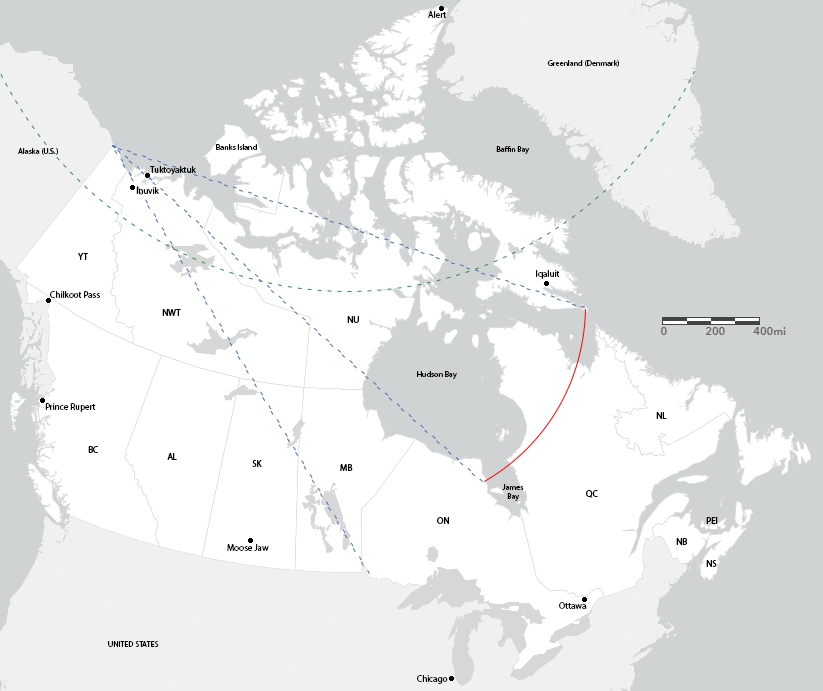
Those blue dotted lines are two thousand miles long by this map's scale. The one that lands in southern Ontario is the nearest to south your southeast trajectory can take you before you use up Canada. Somewhere along the red curve is more likely for the first scene—northeastern Ontario, that northwest quarter of Quebec, or the tiny islet off the eastern end of Baffin Island (the big one with Iqaluit on it), which is in Nunavut but in 1994 was still Northwest Territories. Anywhere west of that and if you go two thousand miles northwest you land in the Arctic Ocean. There's a bit of wiggle room where you could have the grey-hair get shot in northern Quebec or the north point of Newfoundland if Fraser and his dogsled and his coworkers' drinking water were on Banks Island up there north of Tuktoyaktuk. But if they were on the mainland, it seems to me the shooting took place somewhere along the red curve. (The green line is the Arctic Circle, more or less, so you can see that the southern bit of Baffin Island is indeed south of the northernmost point where the Yukon meets Alaska and we haven't in fact gone two thousand miles to the plain west. That parallel and the locations of the cities and towns and passes are as close as I could get them; I made this map in PhotoShop, not ArcGIS [which I don't have], so thanks for being cool. :-) )[update May 2024! I have been playing with the free online version of ArcGIS, and I am now in a position to add the following map:
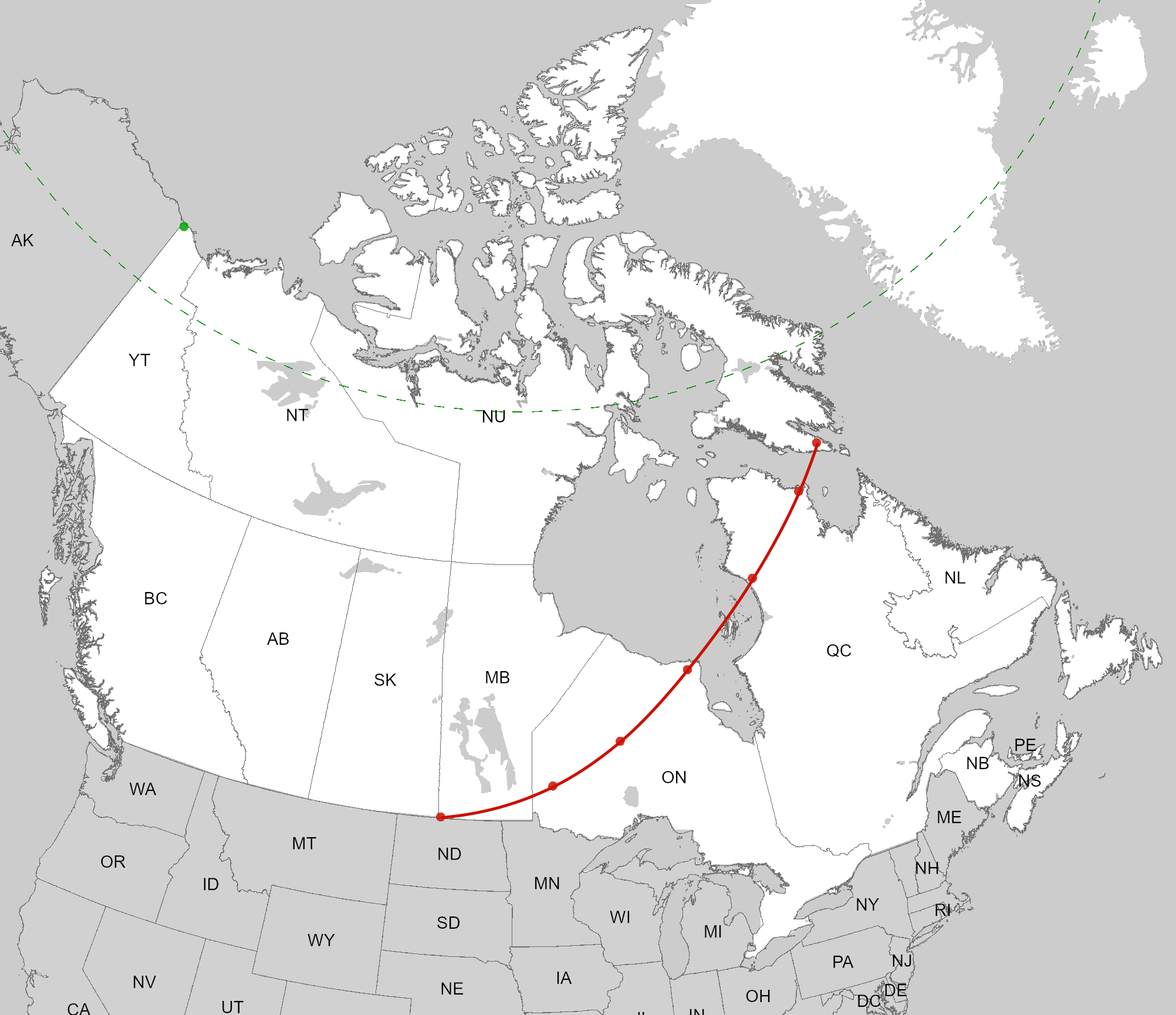
The green dotted line is very definitely the Arctic Circle. The green point is of course as far northwest as you can go in Canada, and the red points are a more accurate 2000-ish miles away from there (and the red curve connects them). It's a conic projection, see, so points the same distance away won't be on a strictly even arc on a flat image.]
( Scene 3 )
( Scene 4 )
What we've learned: We're back in the "southeast," wherever that is. The old man does some expository heavy lifting about what Fraser's dad was like.
But what time of year is it? Ten below zero in the first week of the hunting season? First week of what season? .30-06 is a serious bullet; Fraser's dad wasn't accidentally shot by someone going after ducks and geese. Cursory research suggests the big game seasons in Canada are as follows:
- Black bear: autumn and sometimes spring in the west; autumn only in Ontario
- Grizzly bear: a few weeks in May or June, west only
- Deer: August to late November depending on the province
- Moose: mid-September to mid-October
- Bison: February and March in the north
- Polar bear: late winter or early spring, in the far north, but only in Indigenous communities with occasional non-Indigenous guests
- Seal: November to May in Atlantic Canada
So it's possible we're far enough north, even though we're two thousand miles southeast of wherever Fraser was stationed, to be hunting bison, and it could be February; but it's more likely that it's August or September, which could still be 10 below (centigrade) if we're at the north end of the red arc in the map up there, not that far from Iqaluit, where Uncle Wiki tells me the mean temperatures in August and September are around or slightly below freezing. Especially if the old man was speaking with any hyperbole at all. Also, it's been light out this whole time, even two thousand miles to the northwest, so it's less likely to be February than August. Anyway, concluding it's August makes it a bigger deal when the older guy asks Fraser when was the last time he spoke to his father and Fraser thinks about it for a moment before answering "Christmas."
We still don't know a lot about Fraser, but he is kind of deceptively stoic. Looks at his father's body for a long time; nice teeth-clenching jaw-twitching performance here.
( Scene 5 )
( Scene 6 )
( Scene 7 )
What we've learned: Bless him, Fraser has a very different haircut in the outdoor scenes than he had in the interior shots fifteen seconds earlier. Also the audio on a lot of his lines is different from the audio on everyone else's in the exterior scenes in this episode, like he did some overdubbing much later and someone Did Not Match the Levels. Also also, he's pretty strong; an adult bull caribou averages 350 to 400 lbs, so it's not completely out of line that he'd be able to heft the thing on his shoulder as he does, but that's not unimpressive.
( Scene 8 )
So we are in the NWT rather than northern Quebec or Ontario. Itty bitty islet off Baffin it is, then, I guess. Fraser appears to be alone as his father's chief mourner; his mother nor any siblings are not present.
Bob Fraser, for that was his name, was a Mountie long enough that he was already a legend 22 years ago.
( Scene 9 )
What we've learned: More exposition from Four Chevrons, who makes it sound like normal conversation, so well done that actor.
Constable Ben Fraser is not younger than 31, assuming you can't join up until you're 18. Bob was a Mountie for well more than 22 years, which will therefore have been since Ben was a little kid. (As a matter of interest, the population of Moose Jaw, Saskatchewan, in 1994 was approximately 33,000.) Props note: The badge Fraser gives to Four Chevrons looks like he got it out of a cereal box.
( Scene 10 )
( Scene 11 )
What we've learned: Fraser is very sincere, possibly too polite for his own good, and pretty naive—not immune to being taken advantage of. He carries his cash in his hat. (Additional note: I'm certainly no expert, but the pemmican Fraser offers that young woman sure looks like jerky to me.)
( Scene 12 )
( Scene 13 )
( Scene 14 )
What we've learned: For a start, the people of Chicago are not bundled up against any type of cold, so it's not February, end of query. I mean we don't know how much time has passed between Fraser asking for the transfer and getting it, but probably not whole months, right? It doesn't look like people are sweltering in a midwest heat wave, so maybe it's like September by now rather than August, but Christmas was more like eight months ago than eight weeks ago.
Anyway. Detective Armani is a little slick, maybe even a little slimy, a particular kind of fake polite, and (just as Charlie, Four Chevrons, and Fraser himself predicted) not that invested in solving the Bob Fraser case, but he is appropriately chastened when Fraser turns out to be the dead Mountie's son. Fraser is a little impatient but continues to be unfailingly polite, which happens to be the correct most devastating way to make Armani feel like shit in this conversation; he's also quite a detective himself.
( Scene 15 )
What we've learned: We now know what the liaison officer does, so thanks for the expository job interview, Fraser's bumbling boss. Moffat and Brighton are both in civilian dress, although they are both RCMP officers the same as Fraser. Fraser himself continues to be so polite people can't tell he's digging at them.
( Scene 16 )
What we've learned: Brighton is big mad that she did underling scut work for four years and then didn't get the promotion she'd been in line for, and frankly: FAIR ENOUGH. Like I don't know if we're supposed to hate her because we're supposed to love Fraser, and it's true that he didn't mean to step on her, but look what happened: A good-looking white dude wanted a job for Reasons, and two or three other white dudes made sure he got it, and none of these white dudes even stopped to wonder if there were any other candidates (such as women or people of color or people who were already there practically doing the job already) who should be considered for that job. Fraser doesn't feel like he deserves Brighton's ire, and maybe he doesn't, but he also doesn't say anything like "Oh wow, I had no idea, let's talk to Moffat, because I don't need this job, I just need to be in Chicago while they're working on finding who shot my father, so for heaven's sake you take the office and I'll take the desk and the schedule and the dry cleaning and whatever else you were saying." Not a word of it. That my-your-the thing is one tiny moment of sensitivity, but it's not much, is it. Granted he's been on the force for 13 years and she may have been for as little as four years, so it's possible he outranks her, but this is a man who GAVE AWAY EVERY SINGLE TAXI HE SHOULD LEGITIMATELY HAVE BEEN THE ONE TO BOARD, and it doesn't even occur to him to step aside rather than take a job he knows perfectly well he doesn't deserve and literally only got because of the literal Old Boys Network, I'm going to go ahead and say it, I AM DISAPPOINTED IN CONSTABLE BEN FRASER TWENTY-FIVE MINUTES INTO THE PILOT EPISODE. CONSTABLE LEANN BRIGHTON WAS ROBBED. Ahem.
( Scene 17 )
( Scene 18 )
What we've learned: When he's not trying to entrap garment buyers, Armani dresses loud. But he isn't so bad; he straight-up acknowledges when he was wrong, and he turns around and goes to bat for Fraser without further grumbling. Fraser continues to be polite to an inconvenient fault (with the elevator this time just as he was with the taxis at the airport). Once is an accident, twice is a coincidence, but if he gets to the third time this is going to be a pattern, and I'm going to start thinking you know what, buddy, it's nice to be courteous and thoughtful of other people, but it's also okay to want things for yourself and even (gasp) to have them. Eight months without even speaking to your father, but apparently not estranged. Dude.
( Scene 19 )
( Scene 20 )
What we've learned: Armani pronounces Fraser's name with a zh rather than a z.
Isn't 32°S a direction rather than a location? I don't see how that's enough information to find Armani's car.
Prince Rupert is on the west coast of British Columbia, just south of the Alaskan panhandle. That's all I get when I Google "Prince Rupert Sound;" is Fraser referring to Chatham Sound, which is right there off the port of Prince Rupert, or to some other (possibly fictitious) body of water? Anyway, John Diefenbaker was prime minister of Canada from 1957–1963.
( Scene 21 )
What we've learned: Is the fabric in Diefenbaker's mouth supposed to be the shirt we previously saw being worn by the guy who agreed to watch the car for them?
( Scene 22 )
What we've learned: The disarming-the-crowd stuff was a bit silly, wasn't it, but the show played it absolutely straight.
Detective Armani's name is Ray Vecchio. How does Fraser know that? It's not totally out there to assume they introduced themselves properly at some point when we weren't looking, but up to now the show's been pretty careful about exposition, so having Fraser call him "Ray" without showing us when he learned that is a bit of a blip. Fraser continues to be naive and trusting—asking the guys to keep an eye on Ray's car because he's heard it's not a great neighborhood; assuming the people in the bar will cooperate with Ray's investigation because they have basic respect for the law, even though the whole reason they're there is that they suspect one of the patrons was hired to kill his father, which ipso facto demonstrates a lack of basic respect for the law, doesn't it. But weirdly everything falls into place for him.
Dudley Do-Right is a Mountie who appeared in a segment on Rocky and Bullwinkle in the early 60s.
( Scene 23 )
( Scene 24 )
What we've learned: Captain Walsh has a lava lamp on his desk and one of those tippy liquid frame things on top of the air conditioner in his window. Guy needs to be able to look at things to calm himself down. Nice pair of reaction shots between Fraser and Vecchio when they hear about each other's respective unsolved case loads.
( Scene 25 )
What we've learned: Okay, here I need to say that the first time I ever watched this pilot, I happened to have looked away right before this point and then I was utterly gobsmacked when "Superman's Song" started to play. (I'd know that cello solo anywhere.) So it's hard for me to be objective about the next couple of minutes, because I've loved that song since the early 90s, and comparing Benton Fraser to Clark Kent is never not going to get me right in the feels. But I'll try.
The business with putting Brighton in a cab could have been completely ridiculous, but it wasn't. It's clear to me just when she's lurking outside the office door that she's is feeling guilty about giving Fraser this envelope-licking drudge work, and that's an impressive bit of performance, isn't it?, if I can get that without her saying a word? Then before she gets in the car, "Your father was quite the man" is plainly a sort of apology, and the sad smile is an acceptance of it, and tipping the cabbie to walk her all the way to her door isn't silly, it's showing us that Fraser is not capable of not being a decent guy. (And then he does a little flip-twirl of his hat before he puts it back on, which, again, should have been ridiculous, but he's brought us along to a place where it works. It's been 40 minutes since "That's the last time he'll fish over the limit," and here we are.)
If you weren't in love with Benton Fraser (and I mean that in a TV-consumer way: Okay, I've known the whole time that this guy is the lead character, he's our hero, and now I'm there, I'm with you, I'm On His Side) before now, this scene should have done it. Look at the way he looks at Diefenbaker while Diefenbaker is licking the stamp. Listen to his voice when he tells the cabbie Constable Brighton is Canadian. And then play Brad Roberts singing "Sometimes I despair the world will never see another man like him" under it, and tell me you're not all in. If you're not in love with Benton Fraser after this scene you're probably not going to be a fan of this show, is all I'm saying.
The lyrics we don't hear are:
Hey, Bob, Supe had a straight job.
Even though he could have smashed through any bank in the United States.
He had the strength, but he would not.
Folks said his family were all dead.
Planet crumbled, but Superman, he forced himself to carry on,
Forget Krypton, and keep going.
Superman never made any money
Saving the world from Solomon Grundy,
And sometimes I despair the world will never see another man like him.
Tarzan was king of the jungle and lord over all the apes,
But he could hardly string together four words: "I Tarzan, you Jane."
Sometimes when Supe was stopping crimes,
I'll bet that he was tempted to just quit and turn his back on man,
Join Tarzan in the forest.
( Scene 26 )
What we've learned: Okay well. Ben was seven the last time Bob saw him, which was some time before 10jan69, so assuming that was some time in 1968, he'll have been born in 1961. How tall was Bob Fraser if a seven-year-old child isn't tall enough to reach his belt? My son is not quite five and a half and the top of his head is approximately level with my bra band. Anyway that makes Ben 32 or 33 now (that is, in 1994), which adds up with the ≥31 we worked out before. We get the sense that the long periods of separation (last seen him at Christmas, remember) had been a feature of this father-son relationship for Ben's whole life. Bob thinks of that as strength, and he thinks of himself as weaker, implying that he himself felt sorrow at leaving his son behind. He admires the criminal he tracked for thinking of his son rather than himself; he preserves the guy's reputation (and may damage his own) by lying to Gerrard about catching him.
What we've learned: Vecchio is clawing back his reputation in every scene, of course. Having promised to follow up exactly one lead, he's now doing everything he can to help Fraser solve the case, and here he reveals that he also knows what it is to be a son who has lost his father. (Also, Fraser has no other family, so if he had any other siblings, they and his mother are gone now.)
( Scene 27 )
What we've learned: Aha, she is also Ray's mother, so Maria and Francesca are his sisters, and I said we were coming at this thing as if we knew nothing, didn't I?
What we've learned: In addition to Ray's mother, two sisters, and brother-in-law, there are at least four children and two other senior citizens at the table. One or two of the kids could be Maria's, but at least two and maybe three of them look older than that (assuming she and her husband didn't have kids before they were married, which, given that her mother crosses herself when everyone starts really arguing, seems like a safe bet).
I believe Francesca is performatively praying to Mary when she speaks Italian here, and Mrs. Vecchio is gushing over how beautiful she finds the child (which reinforces the suggestion that it is her grandchild).
I never thought of polenta (Italian corn fritters, right?) as sort of like a yellow pemmican, but if you classify foods as similar based on being heaps of mush, then sure, I guess? Why not consider matzo balls and plum pudding part of this group as well. 😃
( Scene 28 )
What we've learned: Fraser is not above making people believe things that are not true. Probably he'd say the line is between simply allowing people to draw their own incorrect conclusions and actually encouraging them to commit crimes so you can arrest them. Much more trivially, he's wearing a brown leather blazer that looks great. Also, "I had one of your hunches, Ray. Felt good" is maybe the first time we see Fraser loosen up at all; and when Ray says "What, are you going to tell him to surrender or you'll eat something off the curb?" Fraser makes a "hm, there's an idea" face that is very funny.
( Scene 29 )
What we've learned: Fraser's stunt man does a beautiful swan dive.
Also, is Fraser becoming less and less concerned with police procedure, or is it just me? From "Isn't that entrapment?" to licking mud so he can mislead Drake's ex-wife to kicking in a door rather than waiting until they actually get an actual warrant in half an hour of television. (I assume that "Practically" means a warrant is coming, because Vecchio called in for backup and it's not that he's doing this all on his own without the boss types knowing about it.)
Also also, Alert is a weather station. It is the northernmost continually inhabited place in the world. I do not believe that civilian librarians would move there with their eight-year-old grandson, even for a six-month tour of duty. So either there's another place called Alert, Fraser is pulling Ray's leg, or his grandparents had some very unorthodox ideas about proper environments in which to raise children.
( Scene 30 )
What we've learned: After the lurking-outside-his-office and feeling-bad-that-she-gave-him-crappy-tasks and then the putting-her-in-the-taxi and now this, I feel like an effort has been made to show us some chemistry between Fraser and Brighton. An added Doylist detail is that Wendel Meldrum (1954–2021), the actress playing Brighton, has third billing in this thing, behind only Paul Gross and David Marciano as Fraser and Vecchio (and Gordon Pinsent with his and-as credit at the end), so it seems possible that they were teeing up some romantic tension here. And I don't not see it, but I can't tell if it's really there or if I see it because Paul Gross could generate chemistry with a ham sandwich.
( Scene 31 )
What we've learned: I'd say between the dive out the window in Chinatown and this car chase, Fraser's stunt man earned his money.
Fraser is horrified that Four Chevrons shot a man he'd already subdued. It is a good facial expression of what the FUCK is the matter with you and moving immediately on to reassessing everything he'd ever thought about this man.
( Scene 32 )
What we've learned: It was also Chekov's Government Hydroelectric Project! Ugh, the evidence shows that Bob Fraser was on the take, and Ben Fraser can't stand it.
( Scene 33 )
What we've learned: One, Bob Fraser had a sentimental streak; two, Paul Gross looks terrific (if that's the sort of thing you like) in a frayed cable-knit sweater by firelight.
( Scene 34 )
What we've learned: Luca Brazza sleeps with the fishes.
( Scene 35 )
What we've learned: At this point they can hang a hat right on every trope they care to and we won't mind, is that it?
What we've learned: Out here in the snow, Fraser is an action hero. Vecchio's not too bad in the outdoors himself. The dog who plays Diefenbaker is extremely professional. (I mean that sincerely. Look at that good boy lying there on his mark, whimpering on cue, and then moving his hind feet up to make it easier for the man to pick him up.)
Chuck Connors (1921–1992), by the way, was the lead in The Rifleman from 1958 to 1963.
( Scene 36 )
What we've learned: The only people who want Fraser are in Chicago because in Canada they're mad that he turned in one of their own? When he turned in one of their own for having murdered another one of their own? For having murdered Bob Fraser, whose name was being spoken with awe by new recruits as long as 22 years ago? Does Sad-Eyed Charlie mean to imply that people are taking Gerrard's side in all of this? Because that is some bullshit.
I'm so mad about that that it's hard to focus on what else we may have learned about where these various scenes are taking place. A bus goes by behind Fraser, but bells are ringing like it's a train or tram car. If I knew more about Ottawa's public transit I'd be in a better position to say for sure whether we're in Ottawa right now, but people are in shirtsleeves, so it's warmer than wherever they were when it was -10 in the first week of hunting season just a couple of weeks ago.
The dam is called the East Bay Power Plant. I assume the bay in question is the Hudson Bay, but there's not a wilderness area the size of Germany on Baffin Island, so maybe we've been in northern Quebec this whole time after all?
Of course there's nowhere in Canada from which you can go north and end up in Russia (unless you go so far north that you pass the pole and go south again).
Maybe, maybe, there's also something in how mad people are that the dam project might (I suppose) get shut down because of Fraser, and take all the jobs and economy and blah with it. That's also bullshit, but at least it makes a little more sense than people being mad at Fraser for blowing the whistle on Gerrard. Jesus Christ. Even if there is a thin blue line, I can't get behind a well, what can you do reaction in this case. If Gerrard had killed a civilian and Fraser had lit him up for it, I could see their fellow officers being mad at Fraser for that. That would also be wrong! But it would square with what I understand about police loyalties, especially on television. But Gerrard himself is a cop killer, so everyone who's mad at Fraser for turning in Gerrard can fuck off.
( Scene 37 )
( Scene 38 )
( Scene 39 )
What we've learned: That is, what do we now know about Fraser. He's unorthodox in his policing methods but wholeheartedly committed to doing the right thing. He's almost offensively polite. He's historically much more comfortable in the middle of nowhere than in a city. (He's also very easy on the eyes, if—as I said—you like that sort of thing.) He's sort of sweetly naive in his tendency to trust that people other than himself also want to do what's right, and a lot of people in his life disappoint him (or worse) on that matter. When it should work out for him, it doesn't; the people who taught him to be this way turn out not to want him when he is this way. But on the other hand, when it shouldn't work out for him, it does; he gets a whole bar full of people to disarm just by asking nicely, and the scammy airport guy does return his hundred bucks. Go figure.
Cumulative confirmed body count: 2
Red uniform: At the funeral, on guard duty, on investigation when coming directly from guard dutyAccurate map of all locations mentioned in this episode:
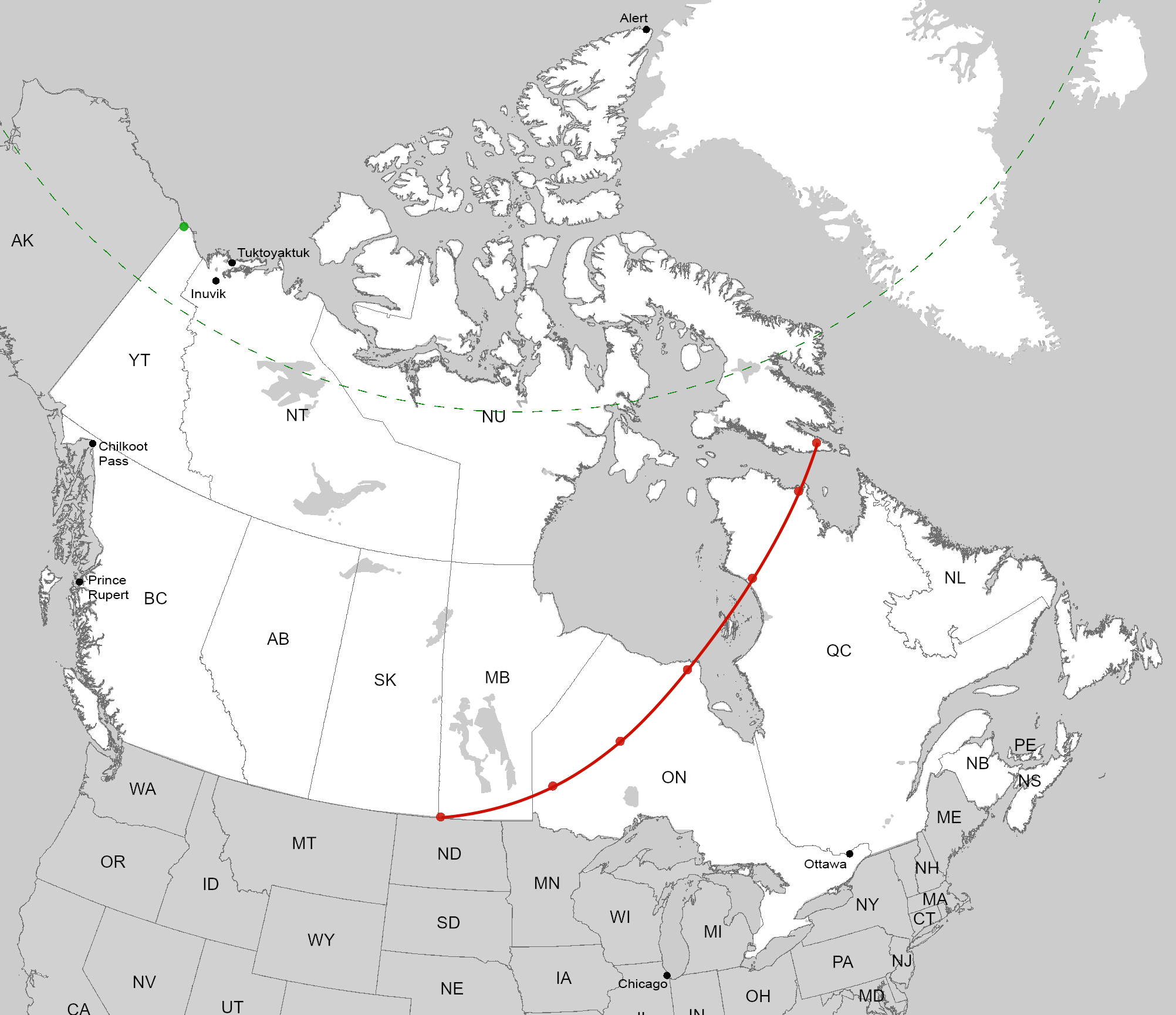
This is obviously the longest one of these, because of all the work a pilot episode has to do (and because it was a two-hour movie rather than just a single episode pilot). Tune in next time for the annotated transcript of season 1 episode 1 "Free Willie," which aired an unusual five months after the pilot.