![[personal profile]](https://www.dreamwidth.org/img/silk/identity/user.png)
Chinatown
air date October 27, 1994
( Scene 1 )
Sixty-seven words of dialogue and Vecchio has managed to be rude to people who live in the suburbs, people who operate Chinese restaurants in the suburbs, people who operate Chinese restaurants downtown, Fraser, and Diefenbaker. Nice work, buddy.
( Scene 2 )
I do not speak Cantonese; I can't make even a reasonable stab at transliterating what they are saying here. My sister-in-law and her mother supply the following:
FRASER: 第一, 第四, 和菜, 白飯, 豆豉醬
daih6 yat1, daih6 sei3, woh4 choi3, baahk6 faahn6, dauh6 sih6 jeung3
Number one, number four, special set menu, white rice, bean pasteRESTAURATEUR: 多谢哂, 多谢哂
do1 jeh6, jeh6
Thank you very muchThat's not as many syllables as either of them says, but I'm going to assume (a) Fraser's accent was so atrocious they couldn't work out what he was trying to say after the bean paste thing and (b) the restaurateur's "sai" was a sentence-ending particle. Anyway, I think the last thing Fraser says is 唔該, m4 goi1, which is a please/thank you hybrid as I understand it.
Meanwhile, Vecchio continues to cover himself in Orientalist glory. Internal organs? One in every tree? Oy vey.
( Scene 3 )
In-laws to the rescue:
YOUNG MAN: Ma, 我出去. 我担心佢地
Ma, ngoh5 cheut1 heui3, ngoh5 daam1 sam1 keuih5 deih6
Ma, I'm going out. I'm worried about them.MOTHER: 唔准去, 問過你爸爸先
mhhun4 jeun2 heui3, mahn6 gwo3 neih5 bah4ba1 sin1
You're not allowed to go out, ask your father first.YOUNG MAN: [Even my native-speaker source couldn't catch this, but I believe I can confirm he calls his father "Baba," which is about the extent of my knowledge of this language]
FATHER: (to mother) 由得佢去; (to kitchen guy) 你跟住佢出去
yauh4 dak1 keuih5 heui3; neih5 gan1 jyuh6 keuih5 cheut1 heui3
Let him go; you follow him outThey said the kitchen guy's line at the bottom of the stairs was unintelligible.
( Scene 4 )
Fraser's use of dialect to describe Cantonese and Mandarin is a little problematic. The varieties of language represented by written Chinese are generally not mutually intelligible. They are often called dialects, even by native speakers, possibly for political reasons—in my limited experience of diaspora native and heritage speakers, a Mandarin speaker is more likely (a) to use "Chinese" to mean "Mandarin" and (b) to refer to Cantonese, Taiwanese, etc. as "dialects" than a Cantonese speaker is to do either of those things; make of that what you will—but/so many linguists, including the ones who taught me, believe it is more correct to classify them as languages even though China is one country. (Insert the comment here often attributed to Max Weinreich: A shprakh iz a dyalekt mit an armey un flot—a language is a dialect with an army and a navy.)
But it is probably accurate to have Fraser use dialect, because he'll have learned from his grandparents in the 1960s, and they will have learned in China in or before the early 1940s; the revolution in question is probably the Chinese Communist Revolution, so "before the revolution" could have been any time from about 1920 to about 1945, depending how you count. We don't know if these grandparents were Bob Fraser's parents or Ben Fraser's mother's parents; we don't actually know anything at all about Ben's mother except that she was gone from Ben's life before Bob died. Bob was born around 1932, though, so whether Ben was raised by his paternal or maternal grandparents, let's figure they will have left China by around 1930. And before that they lived there long enough to learn Mandarin, Cantonese, Fuzhou, and Swatow well enough to teach it to their grandson in some sort of meaningful way more than 30 years later? Impressive.
( Scene 5 )
The dishes are apparently 四 (sei3) ho (didn't get the character for that), 炒飯 chaau2 faahn6, 豆豉醬 dauh6 sih6 jeung3: the fourth one, fried rice (noodles), bean paste. So evidently they had already put down "number one" and this sequence begins with "number four," which they are calling "fourth one"—and there are two more things after the bean paste that we don't know what they're talking about.
( Scene 6 )
Among the restaurant folk's dialogue is 我都話叫你 ngoh5 dou1 wah6 giu3 neih5 "I already told you . . ."
The "glass" gag is sort of amusing. I'm not sure why we needed Diefenbaker's new friend. And I'm with Vecchio: I don't know why Fraser had to jump out the window rather than run down the stairs.
Credits roll.
Paul Gross
David Marciano
Beau Starr
Daniel Kash
Tony Craig
Catherine Bruhier
(plus Lincoln the dog)
Lu Yu, Joel de la Fuente, Alex Carter, and Tsai Chin
That "and" credit is on account of Tsai Chin was a big deal—from being the first Chinese student ever to study at the Royal Academy of Dramatic Arts in the 1950s to starring in The Joy Luck Club in 1993.
( Scene 7 )
( Scene 8 )
Vecchio does a 180 and objects to Fraser telling a Chinese man about Chinese wisdom. Well observed, Vecchio.
( Scene 9 )
Aaand he immediately skids back the other way. I'm not sure there's any good way to end a sentence that begins "These people come from a culture that only . . .". (I'm not sure there's any good way to end a sentence that begins "These people . . .".) As it happens, I'm not sure "only responds to strength" is a cultural stereotype I've heard about China? But that's entirely beside the point.
However, "That's a cultural stereotype"/"Yeah, look who's talking" is very funny.
( Scene 10 )
( Scene 11 )
So in the grand tradition of TV local law enforcement, in come the feds and they're way worse than anyone you don't get along with in your own department. Definitely the best people to put undercover in Chinatown are likely to be named McClusky and O'Hara, right? Although there we go again with the cultural stereotypes. We assume McClusky and O'Hara are Irish guys or at least of Irish extraction and therefore probably pasty white, maybe with red hair and freckles, is that it? No chance either of them could have an Irish father and an Asian mother? Or be Asian guys adopted by Irish-American families? (I admit I am thinking here of Kal Penn's character on House, and the time he was talking to House or Thirteen or someone about his bio family. "I'm an Indian guy named Kutner. Ever wonder what happened to my parents?") Let's not leap to conclusions. . . . But it's not a great look for the feds.
Mr. Lee is pretty concerned that he doesn't know the feds for a guy who's only known Fraser for an hour and a half. Of course Fraser came in and spoke his language to him (with a terrible accent, but still), which probably helped a lot.
I'm not a lawyer, but I'm pretty sure kidnapping is a federal offense if you cross state lines. If they've taken David Lee to Gary, Indiana, fine, but there is in fact a crime of kidnapping in the Illinois statutes, and Agent Ford is full of crap.
Because Fraser brought it up, here are the Canadian time zones.
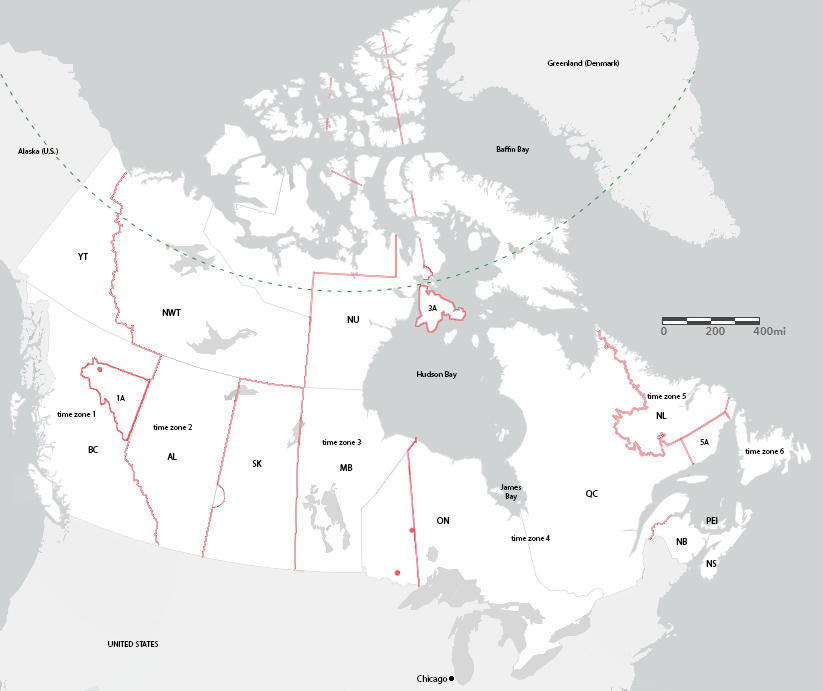
Zone 1, which includes the Yukon and British Columbia, is Pacific time (GMT-8). Zone 2, which includes the Northwest Territories, Alberta, and parts of Nunavut and Saskatchewan, is Mountain time (GMT-7). Zone 3, which includes parts of Nunavut, all of Manitoba, and a slice of Ontario, is Central time (GMT-6). Zone 4, which includes parts of Nunavut, most of Ontario, and most of Quebec, is Eastern time (GMT-5). Zone 5, which includes Newfoundland (but not most of Labrador), New Brunswick, Prince Edward Island, and Nova Scotia, is Atlantic time (GMT-4). Zone 6, which includes the Labrador peninsula and a slice of the mainland, is GMT-3.5. (I don't know these half-hour time zones, man.) Depending how you prefer to consider them, zone 1A either has year-round daylight saving or is in Mountain time but does not observe daylight saving; Saskatchewan, except for that little carve-out two-fifths of the way up on the left, either has year-round daylight saving or is in Central time but does not observe daylight saving; zone 3A and apparently two cities in western Ontario either have year-round daylight saving or are in Eastern time and do not observe daylight saving; and zone 5A either has year-round daylight saving or is in Atlantic time and does not observe daylight saving. . . . I don't know about you, but I make that 10 time zones, not six.It looks like the Assembly of First Nations is one of at least two organizations of Indigenous Canadians, the other being the Congress of Aboriginal Peoples, and the question of who is represented by which (or both or neither) is much more complicated than I'm going to attempt to address.
I am an editor, so I'm entirely qualified to tell you that Fraser should have said "our country comprises ten provinces" etc. or "our country is composed of ten provinces" etc. rather than "our country is comprised of". Tsk.
( Scene 12 )
Again with the internalized homophobia from Vecchio, but I think it is fair for Elaine to wonder what the two of them are doing in a literal closet. I think she probably should have knocked, though; it was clear she was opening the door to see what they were up to rather than because she actually needed any supplies. Meanwhile, Fraser being in a pissy snit with Diefenbaker is hilarious.
( Scene 13 )
Interestingly, it's usually Gardino who's the hothead and Huey who's a little calmer and more reasonable. I'm a little surprised that Gardino is the one who feels like working with the feds is crossing a line (although it is true he's nursing a grudge about his dictaphone). Bold of Huey to identify Vecchio as "a badly dressed Italian" right in Gardino's face, though, isn't it? As if Gardino were some sort of fashion plate himself?
( Scene 14 )
Locking the car door is a tiny detail that amuses the hell out of me for some reason.
( Scene 15 )
( Scene 16 )
Dale Evans was married to Roy Rogers (another classic TV reference from Vecchio), which is a surprising parallel to draw given Vecchio's wiggins about having spent time with Fraser in the supply closet and his refusal to exchange body heat to save their lives in the industrial freezer. I've never watched The Roy Rogers Show; did Roy solve crimes? Was Dale his sidekick?
( Scene 17 )
Oh, Elaine. Fraser has not been interested, which is all the information you need; it doesn't matter why! Whether he'd rather go out with another woman, a man, his dog, or no one at all, the important thing is that he does not want to go out with you. There's no sense being mad that you found him and Vecchio in the closet. Jealousy is never a good look. I'd also say your whole job appears to be to do the detectives' grunt work, so no, making them do it themselves Just Occasionally doesn't make a lot of sense; but (a) she's right that she does deserve to be appreciated, and (b) she does immediately get the white pages down and start doing what Vecchio asked even as she's snarking at him, so.
Huey and the feds seem to be looking at Gardino like he's an idiot because they think they called him, Gardino, a moron; but in fact they called both of them morons.
I don't think my car manual specifies its dimensions to quite the precise degree this one apparently does. Wheel base, sure; distance from tailpipe to left rear wheel, no.
Look how matter-of-factly Fraser acknowledges that he spent a lot of time alone as a child. He doesn't react as if it's a surprising question, but he also straightarms it right back at Vecchio; it's not important to him whether Vecchio was trying to tease him or what, because he absolutely did spend a lot of time alone as a child, and what of it?
( Scene 18 )
( Scene 19 )
Vecchio has previously gone off-piste with Fraser on cases nobody else wanted or that Welsh didn't want investigated at all. (Vecchio himself didn't actually want the Willie Lambert case.) I think this is the first time he's specifically asked Welsh to take a case away from someone else and give it to him.
( Scene 20 )
I am, as I have said, not a lawyer. Neither, I think, is Agent Ford, so he's not the one who decides whether Charlie Wong is indicted under RICO, but never mind. Based on my extremely inexpert understanding of the RICO Act, I thiiink the rest of what Ford says is not bullshit? Except that Charlie Wong is almost certainly right that if they had any evidence they wouldn't talk about it, they'd just do it.
I don't know what expertise with U.S. federal law prompts Fraser to claim "He can't do this" w/r/t Ford threatening Charlie Wong with Mr. Lee's testimony. I believe FBI agents are totally allowed to lie to witnesses and suspects whenever they damn please. So Ford can indeed do this. Of course if Fraser means "He will ruin everything if he does this," that's a ballgame of a different sort.
I'm pretty sure you don't need a writ of habeas corpus to get your client out of a police station if he's not under arrest. Again, not a lawyer! But I'm pretty sure that if you're not under arrest then you're not under arrest and you're free to go whenever you please. And that a writ of habeas corpus gets you out of prison if you've been imprisoned unjustly. Unlawful arrest and detention isn't covered, but in any event, Charlie Wong hasn't been arrested, so the habeas corpus thing is just silly.
( Scene 21 )
In-laws to the rescue:
CHARLIE WONG: 即刻睇下有無位
jik1 hak1 tai2 hah6 yauh5 mouh4 wai2
Immediately go and see if there are empty seatsThey weren't sure about this without the context—I only sent the tiny clip with the single line of dialogue—so I'm going to gloss that as "Make sure he doesn't have anything in his pockets."
That Charlie Wong, what an asshole.
( Scene 22 )
Well: If Fraser wasn't already on your side, telling him "I want my family back" is a good way to get him there, am I right? Mrs. Lee wanted her husband to give Charlie Wong what he wanted, a night or two ago. I guess her calculus changed when the police got involved, as his did.
I like that Fraser is starting to lose patience with Vecchio's squeamishness about his tasting things. In the pilot it was "I'm sorry, Ray," and in "Manhunt" it was licking the gum wrapper and ignoring Vecchio's discomfort, and here we are with Fraser telling him just don't look, then. Progress! And then absolutely deadpanning at him with "I am a professional." Love it.
( Scene 23 )
See, I feel like if Fraser were deadpanning this, he'd be looking at Ray when he said it. There's something different about the line delivery; I feel like he's sincere. Which means Bob Fraser did say "Keep your friends close but your enemies closer" (although look where that got him), and Ben Fraser has somehow never learned that that line wasn't his. But how can he not have heard of Sun Tzu, given (a) the world of information at his local library and the fact that his grandparents (b) were librarians and (c) taught him no fewer than four Chinese languages? I'm pretty tore up about this one.
( Scene 24 )
Why, oh, why did Vecchio not comb his car and debug it after scene 19?
( Scene 25 )
The thug speaking Cantonese, we don't have characters for, but he seems to be saying "wai Jimmy ah"—"Hey Jimmy, you there?" Which, if the inside guy's name is Jimmy, sure.
The music does a great job of setting the mood of the tribute-and-hurrying-to-save-David scene. I like that the neighbors go inside rather than watch Mr. Lee walk to Charlie Wong's; it's possible they are turning their backs on him because they feel he's letting them down, but I think it's more likely (and much more satisfying to contemplate) that they are doing him the honor of not watching him humiliate himself.
I love Vecchio's line "I'm not that good a cop." I'm not wild about Fraser saying "you got another thing coming;" I think it is almost a mortal lock that he would say "you've got another think coming," and they should have done ADR until they had a take where that's what he did say. Ah well.
The incompetence of the feds, of course, continues uninterrupted.
( Scene 26 )
I will never not cry when the parents and their children are reunited safely.
( Scene 27 )
Oh, Elaine.
Okay first of all: If this is "breaking out," how the hell clear is her skin when she's not breaking out? I ask you. Also, Elaine is supposed to be a Chicago local, but in this monologue her accent gives her away: rips your guts out and break(s) out are Canadian down to the ground. Sorry, Catherine Bruhier.
Anyway. It sounds like Elaine is maybe over her crush on Fraser and also over the feeling that the detectives don't appreciate her enough? Also, Diefenbaker may be over his snit at Fraser, because he doesn't really want to hear Elaine dissing him—just wants to eat her ice cream and then buzz off? (That may not be indicative of Diefenbaker's mood where Fraser is concerned, I admit.)
What Carpenters tunes do we think Elaine was humming at the supermarket? "(They Long to Be) Close to You" for sure. What else?
I'm fairly sure the title of the episode is simply on the nose and not meant to be a reference to the 1974 film Chinatown, in which there are shenanigans and murders regarding a dam project, which sounds more like the pilot than this episode, doesn't it?
Cumulative confirmed body count: 5
Red uniform: Out to dinner