![[personal profile]](https://www.dreamwidth.org/img/silk/identity/user.png)
Call of the Wild part 2
air date March 14, 1999
( Scene 1 )
( Scene 2 )
These scenes run together quite seamlessly, in fact, but the first one is all flashback and the second one is all new. At the same time, I know this is billed as a two-parter, but I question the need for a "previously on" when "previously" was the previous hour. All there's been is a commercial break. "Several minutes ago, on due South . . ." doesn't have the same ring to it, I guess.
Credits roll.
Paul Gross
Callum Keith Rennie
Beau Starr
Camilla Scott
Tony Craig | Tom Melissis
Ramona Milano
and Gordon Pinsent as Fraser Sr.
plus Draco the dog
Dean McDermott, Anne Marie Loder, David Marciano, Bo Svenson, Kenneth Welsh, and Leslie Nielsen as Buck Frobisher
McDermott and Loder (Turnbull and Stella) are sharing billing and Marciano (Vecchio) is behind them both. I will never understand.
( Scene 3 )
( Scene 4 )
Even if you're fluent in Morse code, you can't as a human person decipher binary computer code such as is transmitted by a hissing buzzing clanging modem unless you have some sort of decoder chip implanted in your head. Maybe not even then. I like that the show is finally allowing Fraser to just handwave the impossible things he does. No more slow your own heart rate, calculate the cubic feet of air in an ostensibly airtight room, clamp down your own saliva ducts, whatever—just don't worry how I know this, it's not important.
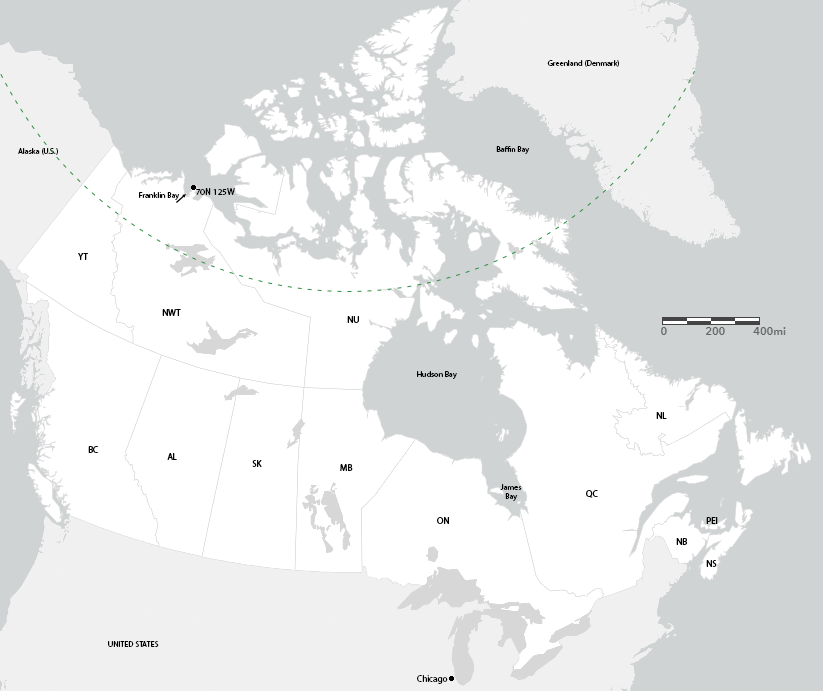
70°N 125°W is pretty dang close to Franklin Bay, depending how much of Amundsen Gulf is indeed Franklin Bay. My question is, how is that plane going to get there? It must have more than twice the range of the little plane Fraser and Vecchio crashed in in "North." Which—this looks like a bigger plane than that, and there are light aircraft whose range is over 1,000 and even potentially 2,000 miles, but even so, bro, I don't think this plane is starting from Chicago and getting to 70°N 125°W on a single tank of gas.
I can't think of a good reason for Fraser to have said "e'en" instead of "even."
( Scene 5 )
I don't believe Air Canada offers full-body massages, nor is it appropriate to expect that sort of service from the cabin crew of any airline, but ha ha, sexual availability of flight attendants, what a funny funny joke that isn't at all tiresome. Meanwhile, of course Thatcher will be an Air Canada partisan, but Stan Rogers died in a fire on an Air Canada flight, I'm just saying.
How has Turnbull never flown before? When he moved to Chicago, did he do it on a bus?
( Scene 6 )
Vecchio's sneering Armando persona is—well, it's not that Armando is cool, but it's good the way Vecchio can shake him off and put him back on again.
The code name is 17FOC76. Hmm.
( Scene 7 )
I'm imagining a bowling ball being sucked through forty yards of garden hose, and it's not going well for the hose. I think Fraser's analogy could use a little workshopping if he's trying to emphasize the danger to the bowling ball in this situation.
( Scene 8 )
For what feels like the first time all season, we can see Francesca below the shoulders and she's got a visible little tum. Impossible to say if that's a Milano who's about five months along or a Milano who's had the baby and is almost but not quite back in the shape she was before, but there you are.
( Scene 9 )
Fraser shoves the crate off the plane at 9:54 on the playback and Kowalski at 9:58; he jumps out himself at 10:03. This sort of plane appears to have an average speed of 175 mph (well, a cruising speed of 150 knots, and for this purpose I'm calling that close enough), which is about .05 miles per second, so in five seconds the plane will have gone about another quarter-mile.
The snow isn't bottomless, of course—there's land under it—and even if it's soft and powdery to a depth that's safe to land in after jumping out of a plane, how will the guys get out again? Conversely, if it's got a stopping depth shallow enough that they can reach the surface, how will they not break several bones (or rupture one or more internal organs, or both) when they hit it?
I wish they'd acknowledged the fact that they've done "we'll jump" / "like hell" before, but I'm glad that "Great Scott, turtles!" apparently works on everyone.
( Scene 10 )
Well, there is that. (It's not like he hasn't been back since he left, given that he had a vacation long enough for Vecchio to leave town and Kowalski to get in his place, but never mind.)
They both hit the snow at 10:10 on the playback, one after the other. So Kowalski was falling for about 12 seconds and Fraser for about seven. Accelerating at 32 feet per second per second, Kowalski has fallen about 2300 feet and Fraser only about 800, and they shouldn't land (a) at the same time nor (b) right next to each other (or, I guess, for them to land at the same time the plane can't have kept level but will have had to descend 1500 feet in eight seconds, which if Muldoon was flying and left the controls to come shoot at them I guess is not impossible?); I guess a quarter mile isn't that far, but the guys just aren't going to land side by side unless Fraser can somehow dive out of the plane in a directional way and catch up with Kowalski as he falls. Which, given that he can stay with Kowalski when they're both flying improvised fire extinguisher jetpacks, may be plausible? But come on.
Do note, though, that Kowalski is covered with snow and Fraser doesn't have a flake on him. Good to know that some things never change.
( Scene 11 )
( Scene 12 )
Fraser has put on mittens and a warmer coat and also, apparently, changed into the trousers that go with the brown or blue uniform rather than the jodhpurs that go with the red tunic. Also probably a sweater. Kowalski is wearing some bib snowpants and also evidently some more layers than he was wearing before they left the plane. When have they had time to do this? And wouldn't changing your clothes in the windswept outdoors be very cold indeed? Why is neither of them wearing a hat? WTF?
( Scene 12 )
How does Turnbull know how to drive a dogsled? If he's originally from the far north like Fraser, won't he have had to fly on a plane before, you know, ever, and probably a small one at that?
( Scene 13 )
Fraser gave Bob enough what for in "North" about the possibility of abandoning his partner; you'd think Bob (that is, Ben's subconscious) would have learned by now that it is Not Going To Happen (with the arguable addition of especially not this partner).
( Scene 14 )
Stella finds Ray Vecchio charming, which is a good thing, because why would she have given a shit that Ray Kowalski was not the real Ray Vecchio? She never thought of him as Ray Vecchio in the first place. (In fact, given that she's with the state's attorney's office, shouldn't she and Ray Vecchio have met before? When she said apparently Vecchio didn't read Guy Rankin his Miranda rights, did she just hear that from someone but never in her entire career clap eyes on the guy until now? I guess even all the time he was mixing it up with her colleague Louise St. Laurent they never managed to be in the same place at the same time.)
( Scene 15 )
There's nothing that high within a two-day walk (I mean, a difficult two-day backcountry hike) from Cape Parry, which is what's up at the north end of that peninsula we were talking about when Fraser said 70°N 125°W and Franklin Bay, because of course it's all river delta up there, but never mind.
( Scene 16 )
I'm pretty sure that's what Kowalski said, and I think he means he just shit his pants. Which, given the spill he just almost took, fair (although we don't know what, if anything, they've been eating).
( Scene 17 )
The ongoing Huey-and-Dewey-hate-each-other's-driving gag is fine, but Huey wouldn't feel that kind of whiplash if he'd wear his goddamn seatbelt.
( Scene 18 )
This was almost certainly not necessary in general, still less so given my conclusions about Thatcher's history of being sexually exploited, but I'm glad Frobisher stood in her defense rather than encouraging his boorish troops.
( Scene 19 )
At the beginning of this scene, the stars and the waning crescent moon (illuminated on the left because northern hemisphere) look very close. At that phase the moon doesn't appear until well after midnight, but it's strange that they'd have kept hiking through that many hours of darkness (in Whitehorse, YT, the sun sets at 8:00 p.m. in mid-March and rises again at about 8:15 a.m.). For a giggle, I asked timeanddate.com for moonrise times in the Yukon in March 1999, and as it turns out, third quarter is accurate! So that's fun. But it doesn't answer why the fellas weren't tucking in to sleep until three in the morning.
It's harrowing to hear Fraser admit to his own subconscious that he doesn't know whether Kowalski will survive. And even more so, of course, to hear Kowalski praying Our Father at this point.
( Scene 20 )
I mean, yes, an incapacitated Kowalski is going to be a lot of extra work for Fraser. But it's better than a dead Kowalski!
Fraser has no ice crystals on his beard stubble (of which he has none) nor his eyebrows. If it was possible for exactly one of them to sleep with his back to the wind, he should have arranged Kowalski on that side, so presumably this is his Teflon hand-laundry good luck surfacing again instead.
( Scene 21 )
( Scene 22 )
The show said Fraser and Kowalski's relationship is the same as Bob and Caroline's. They've said it twice now, along with pointing out that willingness to lay down your life for someone is true love. I don't know what else I could be meant to conclude here.
I'm sure what Kowalski means is that the pack is digging into his back in a way that's uncomfortable.
( Scene 23 )
( Scene 24 )
I'm just so glad Kowalski quoted White Heat (1949) rather than Titanic (1997) ("I'm the king of the world!") that I'll overlook the fact that right after James Cagney says "Made it, Ma! Top of the world!" he is engulfed in flames and dies.
What idiot would hear "mine field" and start running? I mean, running the other way, maybe. But running through a mine field is not the way to get through a mine field safely, am I right? I feel like even I know that. (I'm going to leave behind both "I just climbed my first mountain" and the fact that the fellas are jammed in that tight spot hip to hip. I feel like those things balance each other out.)
I mean, but listen, if either of them had fallen in there by himself, he'd have fallen much further and probably died, definitely been unrescuable. Only because they were together could they get stuck that relatively short way down as they did.
( Scene 25 )
( Scene 26 )
When Kowalski was facing death, he sang "S.O.S." by ABBA. Was that the time Marcus Ellery robbed the bank and he (at age 13) peed his pants, or another time facing death?
Where are those happy days? They seem so hard to find
I try to reach for you, but you have closed your mind
Whatever happened to our love? I wish I understood
It used to be so nice, it used to be so good[REFRAIN] So when you're near me,
Darling, can't you hear me? S.O.S.!
The love you gave me,
Nothing else can save me. S.O.S.!
When you're gone, how can I even try to go on?
When you're gone, though I try, how can I carry on?You seemed so far away, though you were standing near
You made me feel alive, but something died, I fear
I really tried to make it up, I wish I understood
What happened to our love? It used to be so good(refrain)
Maybe Fraser doesn't know that one, and that's why he suggests singing "Northwest Passage" in the face of death. For the romantic atmosphere. (The romantic atmosphere.)
Anyway, I think it's delightful that Delmar asks if they want help rather than just charging ahead and assuming. It seems like a knucklehead question from a guy who repeated the fourth grade at least once, but in fact "May I help you" is much more correct than "Let me help you," so well done!
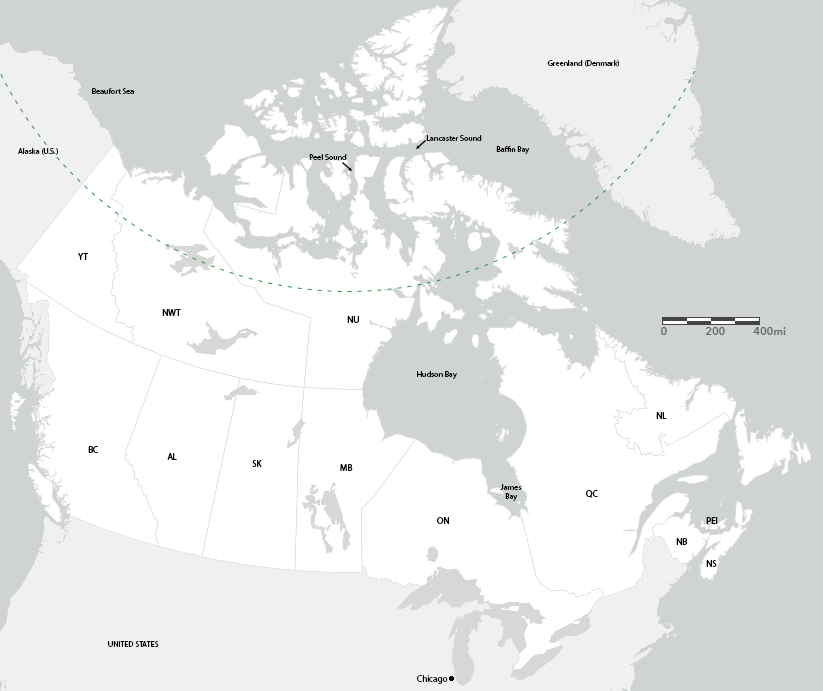
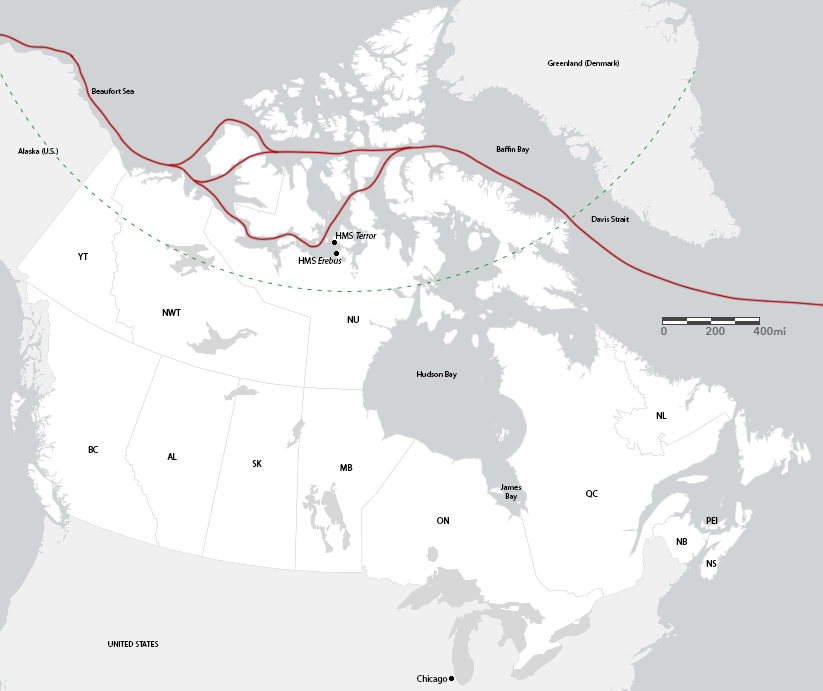
All right. Yes: In 1845, Captain Sir John Franklin did leave England in command of HMS Erebus and accompanied by HMS Terror to search for the Northwest Passage, which after late July of that year were never again seen by Europeans. (The Wikipedia article on the expedition says "In late July 1845 the whalers Prince of Wales (Captain Dannett) and Enterprise (Captain Robert Martin) encountered Terror and Erebus in Baffin Bay, where they were waiting for good conditions to cross to Lancaster Sound" and cites Richard Cyriax, Sir John Franklin's Last Arctic Expedition; a Chapter in the History of the Royal Navy (London: Methuen & Co., 1939), 66–68; I can't get Google Books to show me those pages, but I've got "The Erebus and Terror, when last seen at the end of July, 1845, were moored to an iceberg on the east side of Baffin Bay, opposite Lancaster Sound," so I'll take it. They seem not to have reached Peel Sound until the summer of 1846. But never mind: The gist of Fraser's comment is accurate, which is that the entire expedition was lost; all members were declared dead in 1854. By 1999, many had gone in search of Franklin and his lost ships, and noone (that is, no Europeans) had found more than a trace of them here and there. (Fear not: Of course we'll come back to this.)
( Scene 27 )
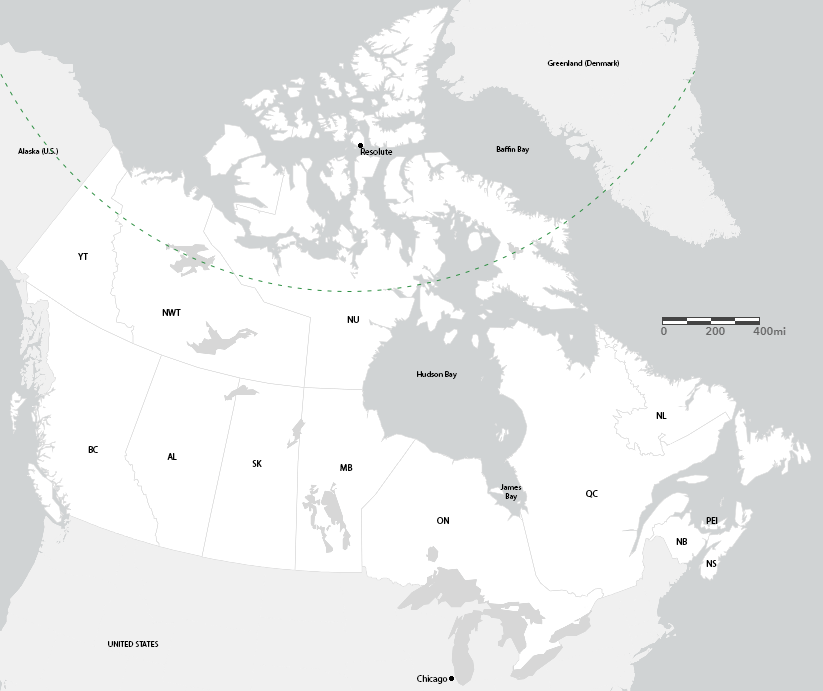
I don't know any of the places Delmar mentions, so I'm not going to do the map again. It sounds like he says "Trojan Valley," of which Google is unaware in Canada; there is a Diamond Head on the side of Mt. Garibaldi 50 or so miles north of Vancouver and a Mt. Sabine at about the same latitude on the eastern end of British Columbia, but those are thousands of miles from the northern areas where we've been led to understand Fraser and Kowalski jumped out of the plane on the way to Franklin Bay. There's also no King's Creek all the way up there. In short: The whole thing is a mystery, including the Argentine soccer team reference, because I think when Delmar says "an Argentine soccer team eating themselves" he is referring to the amateur Uruguayan rugby team that (with a couple of dozen others) crashed in the Andes in Argentina in 1972, which you may remember from the film Alive (1993).
( Scene 28 )
Fraser. Honestly. Not when you've just finished proposing to Kowalski, innit?
( Scene 29 )
Frobisher, of course, is attempting to echo the St. Crispin's Day speech from Henry V:
This day is call'd the feast of Crispian.
He that outlives this day, and comes safe home,
Will stand a tip-toe when this day is nam'd,
And rouse him at the name of Crispian.
He that shall live this day, and see old age,
Will yearly on the vigil feast his neighbours,
And say "To-morrow is Saint Crispian."
Then will he strip his sleeve and show his scars,
And say "These wounds I had on Crispin's day."
Old men forget; yet all shall be forgot,
But he'll remember, with advantages,
What feats he did that day. Then shall our names,
Familiar in his mouth as household words—
Harry the King, Bedford and Exeter,
Warwick and Talbot, Salisbury and Gloucester—
Be in their flowing cups freshly rememb'red.
This story shall the good man teach his son;
And Crispin Crispian shall ne'er go by,
From this day to the ending of the world,
But we in it shall be rememberèd—
We few, we happy few, we band of brothers;
For he to-day that sheds his blood with me
Shall be my brother; be he ne'er so vile,
This day shall gentle his condition;
And gentlemen in England now a-bed
Shall think themselves accurs'd they were not here,
And hold their manhoods cheap whiles any speaks
That fought with us upon Saint Crispin's day.St. Crispin's Day is October 25, which I suppose is one reason Frobisher couldn't just do the regular speech. 🙄 (This episode didn't air on March 11, which is a bummer.)
( Scene 30 )
( Scene 31 )
I've got a deus ex machina for Sgt. Buck Frobisher? Sign here, please. [h/t Cleolinda Jones]
I mean, last time we had a season-ending two-parter, we had Sea Mounties, right? So why not Air Mounties this time. Pity this is the series finale so we'll never get Fire Mounties, innit.
When Fraser says "a Delta-class Russian nuclear submarine" all I can hear is Leo McGarry speaking to President Bartlet in The West Wing season 3 episode 6 "Gone Quiet" (2001):
LEO: This is one of those things we've talked about that sounds worse than it is because of your inexperience with the military.
BARTLET: What is it?
LEO: Okay. The USS Portland is a Seawolf-class, or "big," nuclear submarine.
BARTLET: Yeah.
LEO: It has a crew of a hundred and thirty-seven. It is loaded down with highly classified intelligence-gathering equipment. And it is in the waters off North Korea.
BARLET: Right.
LEO: We don't have it right now.
BARTLET: What does "we don't have it" mean?
LEO: Well, as you know, with our ships, our boats, and our submarines, we keep in pretty close touch with radar, sonar, satellites, radio, encrypted messages — and we don't have the Portland now.
BARTLET: We don't have it?
LEO: We do not.
BARTLET: And they're in North Korea?
LEO: Yes. Last we heard. So we're going to set up meetings in the next few hours. Plus, if anything happens, I don't like people knowing you were running for election while the boat was out there.
BARTLET: Nah, I think I'll go ahead and cancel that trip, Leo. If only to stick around and see how this sounds worse than it really is.
LEO: I'll stick around, too.
BARTLET: I think you will.
( Scene 32 )
When Vecchio said "Wish me luck" and Fraser said "You don't need it," the next major thing that happened was that Fraser found out Muldoon had killed his mother and Vecchio got shot. Kowalski can't know that, but still, this feels like a dangerous callback, doesn't it?
Okay, stipulated: It's a little weird to have a guy's wife play his character's mother. Nevertheless, it's a walk-on part that who would bother auditioning for? and I can see having her come in and do it more or less as a favor to the show, don't have to spend any time getting to know each other or building any kind of rapport, put her in the cold-weather gear and get the shot in 20 minutes and move on with the considerable expense of the rest of the episode. On a practical level I get it.
And the moment she creates is lovely. (It's all her, as well; he has his back to the camera and Pinsent isn't even in the frame.) I appreciate that Caroline's focus is on Bob, whom she must have been waiting for, right?, because whatever borderland/afterlife situation she found herself in, he was somewhere else, not joining her, obviously not for the first 25 years she was there, but even since he died himself, which, not unreasonable of her to expect he'd turn up, right? But as soon as Fraser calls to her, she looks at him, and look how her face changes! Because the last time she saw him, he was only six, and now here he is, a man grown, and she thought she'd never see that but here she is: What a gift. Maybe the fact that I have a six-year-old has softened me unusually. But that smile is gorgeous.
Anyway, then she turns back to Bob, as she must, because it's time for them to go. Nothing, indeed, is permanent. Poor Fraser, losing each of his parents twice, am I right?
And/but/so okay: This Bob is evidently not Fraser's subconscious, unless what's happening here in the mine shaft is Fraser having some kind of break(through). Maybe that's why Bob is (a) visible to Muldoon, (b) able to actually shoot the gun and punch him, and (c) looking so peaky and grey and then actually disappears. Last Three Minutes Of The Series hypothesis: Since "The Gift of the Wheelman," what we see as Bob has been Fraser's subconscious; but the Bob who is visible to other people (in "Bird in the Hand" and "All the Queen's Horses") is in fact Bob Fraser's ghost. I'll have to think more about what that means with respect to "Hunting Season," but I'm down with the idea that there are two Bobs.
( Scene 33 )
Last part first: You should not, repeat, should not say Stanley. How dare you.
Saddam Hussein was, at the time this episode aired, still very much in control of Iraq and the subject of considerable western sanctions and U.S. and UK missile strikes. I can't find the exact picture they've spliced Thatcher into because he was captured in 2003 and executed in 2006, so well done Ice Queen, I guess?
If Francesca "loved her babies as though they were her own," then the details of their conceptions are irrelevant, right? (Though "as though they were her own" is a shitty thing to say about an adoptive parent.) Another wasted opportunity to have had the character be pregnant at the same time as the actress, if you ask me. Which I know nobody did.
I don't have anything in particular about Turnbull's or Welsh's ever-after storylines, but let me ask this about Huey and Dewey: I don't understand how their club—a fixed address—would have played the marginal houses for any length of time, short or long. If they bought and established the One-Liner, wouldn't their place be one of the marginal houses? Also, wasn't Huey going to buy a drum machine that he could program to do the rim shot for him? What's he doing sitting behind a set?
Anyway. So Fraser and Kowalski are off to find the hand of Franklin. In 1999, of course they couldn't know—or more accurately, they certainly could have known, but nobody did, because white people had spent more than 150 years not listening to the Inuit—that the wrecks of the Erebus and the Terror would be found (by white people; the Indigenous people knew they were there) in 2014 and 2016, respectively. It's disappointing to think that Fraser, of all people, would go searching for Franklin in Nunavut and not ask the local Inuit for help, so I'll choose to believe that he did ask, and that maybe he and Kowalski were part of the greater world discovery 15 years later. Why not. Headcanon accepted.
Cumulative body count: 44
Red uniform: Only until they jump out of the plane and land in the snow; oddly, once he's in Canada, he doesn't wear it again
Previous | Index of annotated transcripts
And that's the ball game. Thanks for reading along with me, hope you've enjoyed the commentary, stand by for the whole megillah to appear at AO3 as soon as I can finish recoding the links.