![[personal profile]](https://www.dreamwidth.org/img/silk/identity/user.png)
Asylum
air date November 16, 1997
( Scene 1 )
There's a fair amount to unpack in this scene, isn't there? Fraser and Kowalski apparently have plans that they don't want Thatcher to know about (before Kowalski has to cancel), and Fraser is practically lying to her face so she won't find out? Kowalski does an ooh-hey-are-we-flirting-now reaction to Volpe putting his hands somewhere interesting, which is itself not uninteresting from the guy who asked Fraser if he found him attractive and said he'd try anything sexually? Fraser is where Kowalski runs when he needs help?
Fraser should say "comprising" or "consisting of," not "comprising of," but it won't be long before I have to give up on that one, I expect. Sigh.
Kowalski's hair is not at all spiky today, and fun fact, "volpe" is Latin for "fox." (Bro!)
I can't really hear the lyrics to "Boring Days" and I can't find them online. Anyone got a source?
Credits roll.
Paul Gross
Callum Keith Rennie
Beau Starr
Camilla Scott
Tony Craig | Tom Melissis
Ramona Milano
and Gordon Pinsent as Fraser Sr.
(plus Draco the dog)
Dean McDermott, Wayne Robson, John Evans, Kurt Reis
( Scene 2 )
I know Fraser said it wasn't important what pregnant creature's mucous membrane he used to make the salve, but I'm still simultaneously interested and revolted. I mean in the interest of research, I'm interested, but I'm actually fine not knowing and not thinking about it any further.
I'll give Fraser partial credit for not having been happy about having to arrest Kowalski (and Kowalski full credit for not arguing or trying to get away). What he does, though, is read Kowalski his Miranda rights, which are rights he has in the United States; Canadian arrest procedure is slightly different, and I'm surprised Fraser isn't reading Kowalski those rights instead.
( Scene 3 )
So this Cahill is a smarmy sonofabitch, huh? Looks like Welsh hit it on the head. But here's what I don't get: Do the police work for the state's attorney (which is what Illinois calls the district attorney)? I don't think so. He's not the boss of them. So theoretically he can fuck off. (Also, "Is that the way you normally conduct the affairs in this station?" is absolutely a question and not at all a statement, so he can fuck off twice.)
( Scene 4 )
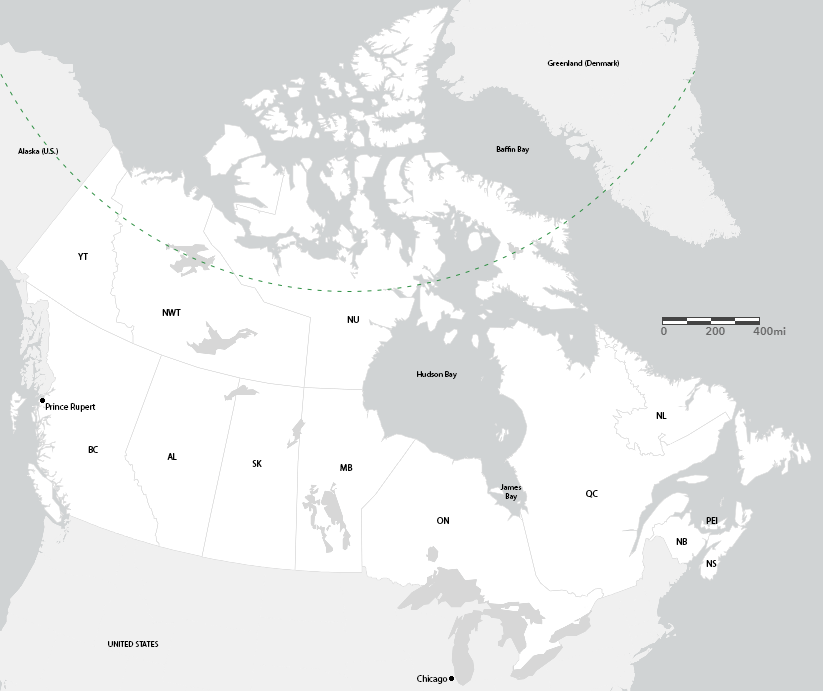
There's got to be somewhere closer than Prince Rupert from which Fraser and Turnbull can source the part they need to fix the conference room water closet. But what's going on with the lady at the door at the beginning of the scene? She's standing there smiling with a form in her hand, and Fraser, the acting liaison officer, simply ignores her. The younger woman who leads her away looks like she might be her daughter; was their business with the consulate concluded so it's okay that Fraser acknowledged them not at all? (The younger woman says "Come on" very patiently as she takes the older woman away. If these women weren't supposed to be in the scene, wouldn't they have reshot it? Therefore, they have to have been in there deliberately. But why?)
( Scene 5 )
Here's Uncle Wiki on the Vienna Convention of 1964. I can find no evidence that the Canadian court cases Turnbull mentions are real, and in any event, they wouldn't be on point, would they?, because those are matters of people being extradited to Canada, where this is a situation where they want to extradite Kowalski from Canada. All the same, I will revise my opinion of Fraser's arrest of Kowalski; did he know he was doing that for the purpose of keeping him safe?
( Scene 6 )
Okay so the folks in the background are there to show that the consulate does do ordinary non-Fraser-related business. I dig it! Here's a question, though: Didn't Turnbull meet Ray Vecchio at least twice? In other words, isn't Kowalski's undercover operation extremely known to practically everyone in Chicago? Sigh.
( Scene 7 )
Doesn't Fraser's hand smell like some sort of salve (made from the mucous membrane of a pregnant it's not important)?
( Scene 8 )
I mean I assume Cahill and Kilrea don't know that "Vecchio" is Kowalski, right? Because IA is apparently in the dark on this matter for reasons that don't
need exploring at this juncturemake an awful lot of sense. And but so is it the real Vecchio who's a smartass who brings the heat down on decent cops, or Kowalski? (I suppose they could both be smartasses?)Canadian Impressionism by Paul Duval is a real book, and why Kowalski has it in his desk drawer (I mean, apart from the obvious, that is, as a place to hide his secret files) is a mystery. Another mystery: What did he do with the pages he hollowed out of it?
Neatsfoot oil is a rendered oil from the shins but not the hooves of cattle, remaining liquid at room temperature for reasons having to do with science so it is more useful as a leather conditioner than tallow, I guess. I can't imagine it would actually smell that good, but I'm not Francesca with a particular hangup on Fraser, so what do I know. On the other hand, maybe Fraser is trying to put her off: Remember the time on Cheers when Norm hosts his company Christmas party at the bar and asks Diane to make a particular effort to entertain his boss, who turns out to be incredibly gross and assaulty? Before he actually crosses the line, when he's just coming onto her way too hard, he says "You smell great. What is that?" and she says "Thank you! Dandruff shampoo."
( Scene 9 )
Okay, yes, yes, Fraser walks into a room and doesn't even close the door or wait for Turnbull to be elsewhere before he takes his pants off for Ray Kowalski, yes, that's a thing that happened. Let's talk about the curling.
It doesn't look like that great of a shot.
The curling has already been a little bit of a mystery, because at the beginning of the scene, the announcer said "the Canadian team" had one in the four-foot and they were going to play a guard, and then we saw the team on the TV throw a blue stone. So Canada must be blue, okay. And we don't know who their opponent is. (A bonspiel is a curling tournament. The more popular curling gets, the more accessible on TV to more randoms, the more national and international championships use words like "playdown" [= playoff, basically] or even more broadly understood terms like, well, "tournament" or "championship;" and I have a sense that there are people who don't use "bonspiel" to refer to more formal round-robin competitions but only to events with cascading brackets. But I think that's a nicety that not everyone observes, and even the world championship is technically a bonspiel.)
Anyway, a guard takes about 25 seconds to come to rest (let's say more like 22 or 23 in the 90s; ice has been getting keener and keener in the past generation). And yet the next thing we hear from the TV, about 16 seconds later, just before Turnbull and Kowalski agree to throw down, is a hit and some cheering. So blue totally missed that guard, but I guess whatever they hit was okay to hit?
Then what's happening when Fraser first arrives must, necessarily, be a yellow shot, but the TV is apparently showing a replay of the blue one. We only get a glimpse of the rock, but it's definitely the same sweeper with the same shoes and the same broom. (Incidentally, why only one sweeper? In a televised game, playing with only three—one in the house, one to throw, and one to sweep—would be pretty surprising.) And then the commentary is talking about something going a bit too far; that must be a yellow stone they're talking about, but whoever it is shouting feels like the shot ends up okay, so that's good for them —
— but it sounds like the same person shouting for the sweep on the next stone, which is definitely blue but probably shouldn't have been swept at all, because we're almost ready to talk about the shot we do see, which is this: blue, with the hammer, throwing an in-turn up the center line. (I'll come back to that terminology in a moment.)
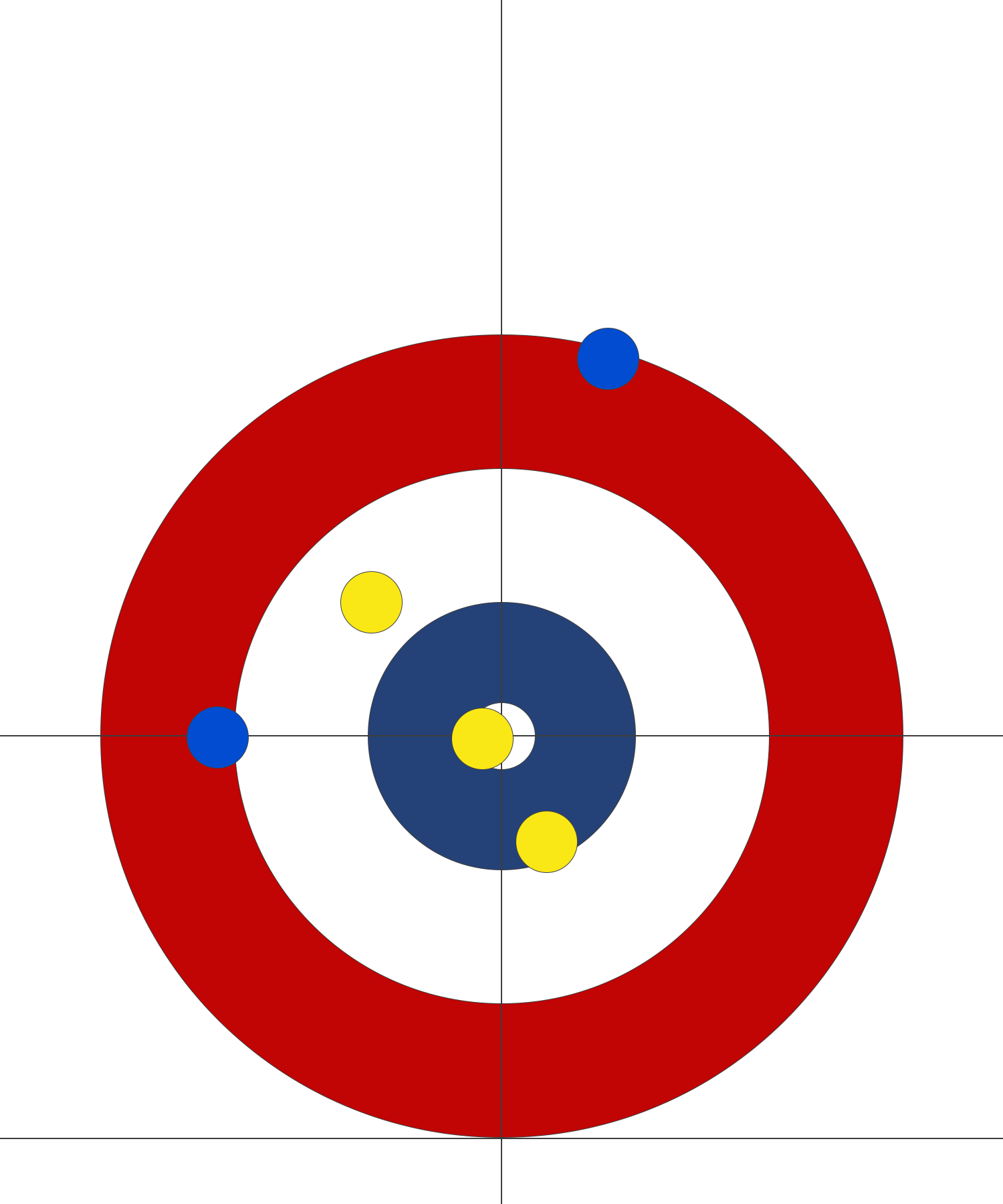
Here's the house as that blue rock arrives while Fraser and Turnbull are yelling.
And blue is about to throw their last stone of the end, in which they need at least one point to give them a chance at a 10th end. A game on television is normally 10 ends (especially in the 1990s), so if Canada needs to score to give them a chance at that end—that is, to be sure they're not mathematically or at least practically eliminated; you're mathematically eliminated if you're behind by more than eight points before the last end begins, because there are only eight points available in each end—that means they're behind, and probably badly, because if they were tied or even down just one they'd be happy to give yellow one point in the ninth and have the last rock advantage in the final end, when they should be able to get at least two points. In fact they should be able to get more than one here; assuming there are no other guards further out than we can see (there is about the same amount again of white playing space not visible off the top of the picture), they should be able to hit both of those yellow rocks out and get three. So how did we get here?
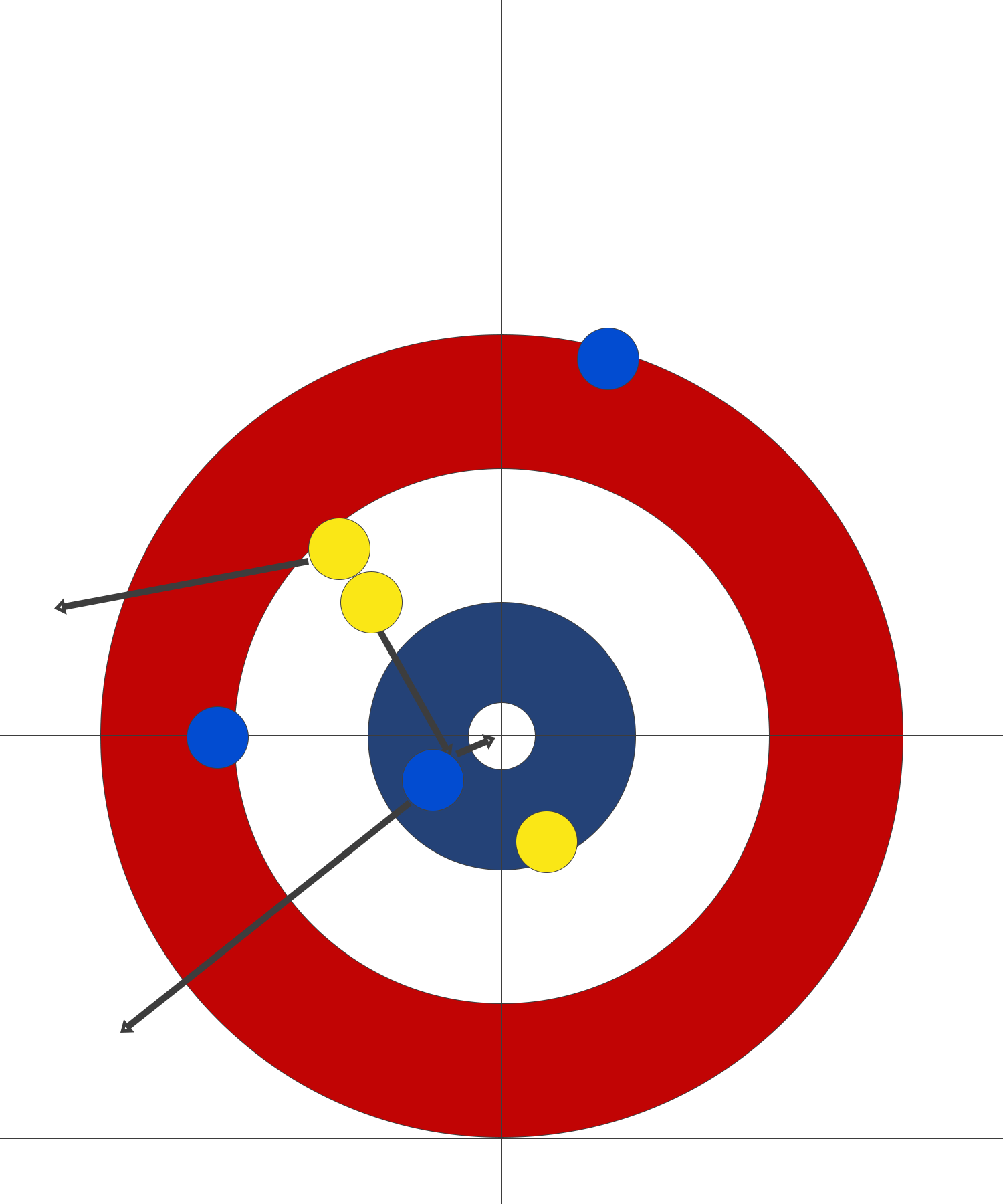
Let's work backwards again. The commentator said yellow—well, he said they were going to set up a rock outside the 12-foot and use it later on, which doesn't make sense if blue's next rock is the last rock of the end, because that means this is yellow's last rock of the end; that is, there is no later on unless by "later on" he means they need a yellow stone outside the 12-foot to be in blue's way. Anyway, though, he said that rock—their last of the end—went a little too far and knocked their own stone in the eight-foot out of position. But the last thing before that, blue had one in the four foot and was playing a guard. That means there used to be one blue stone in that blue ring, and they were trying to put another blue one out front somewhere so yellow couldn't (or at least couldn't easily) get at it. Given all these facts, I think what must have happened in this game was this:
Blue had a stone in the four-foot (left) and were going to play the guard (center) but wrecked on the yellow guard and rolled into the house (right).
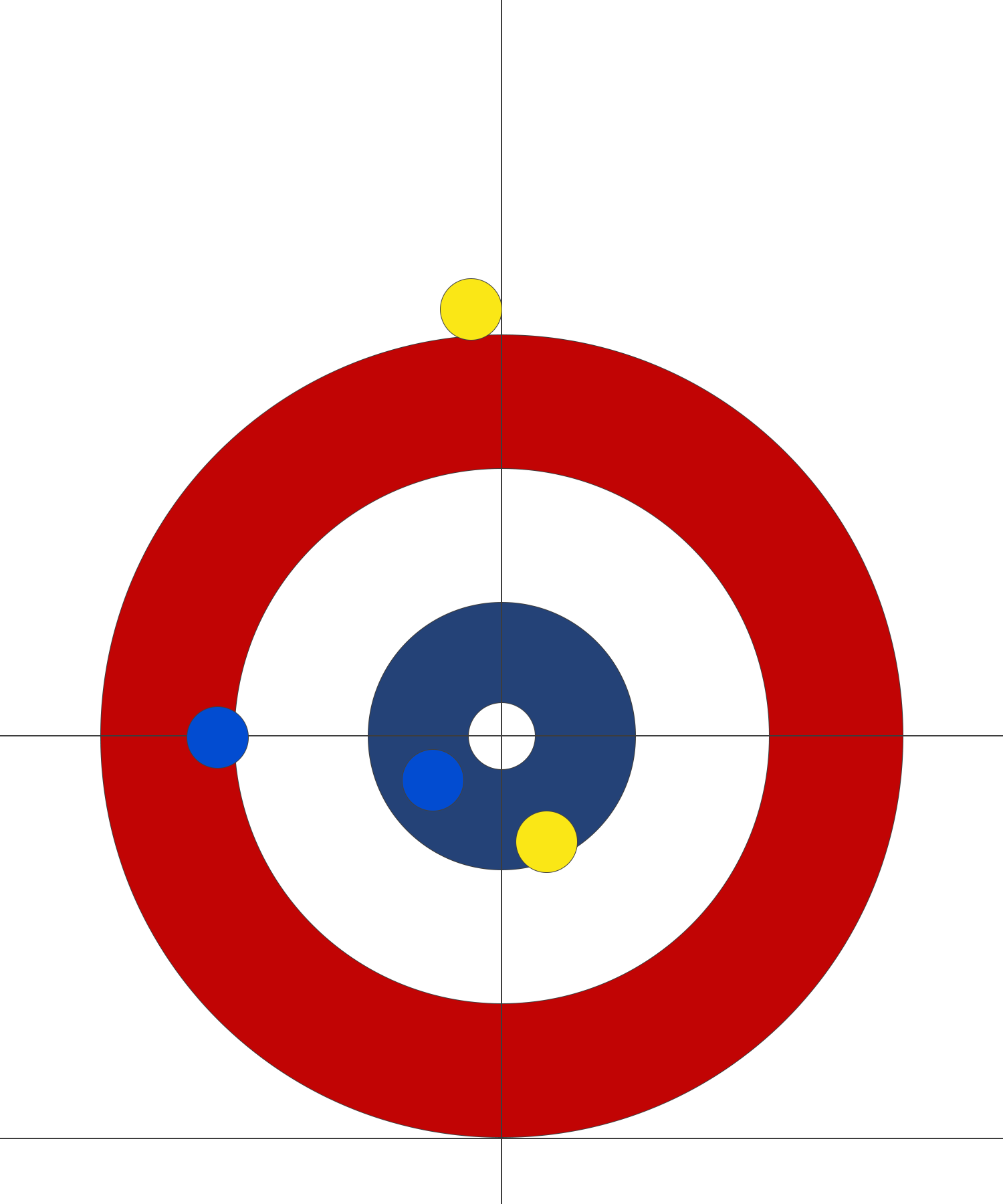
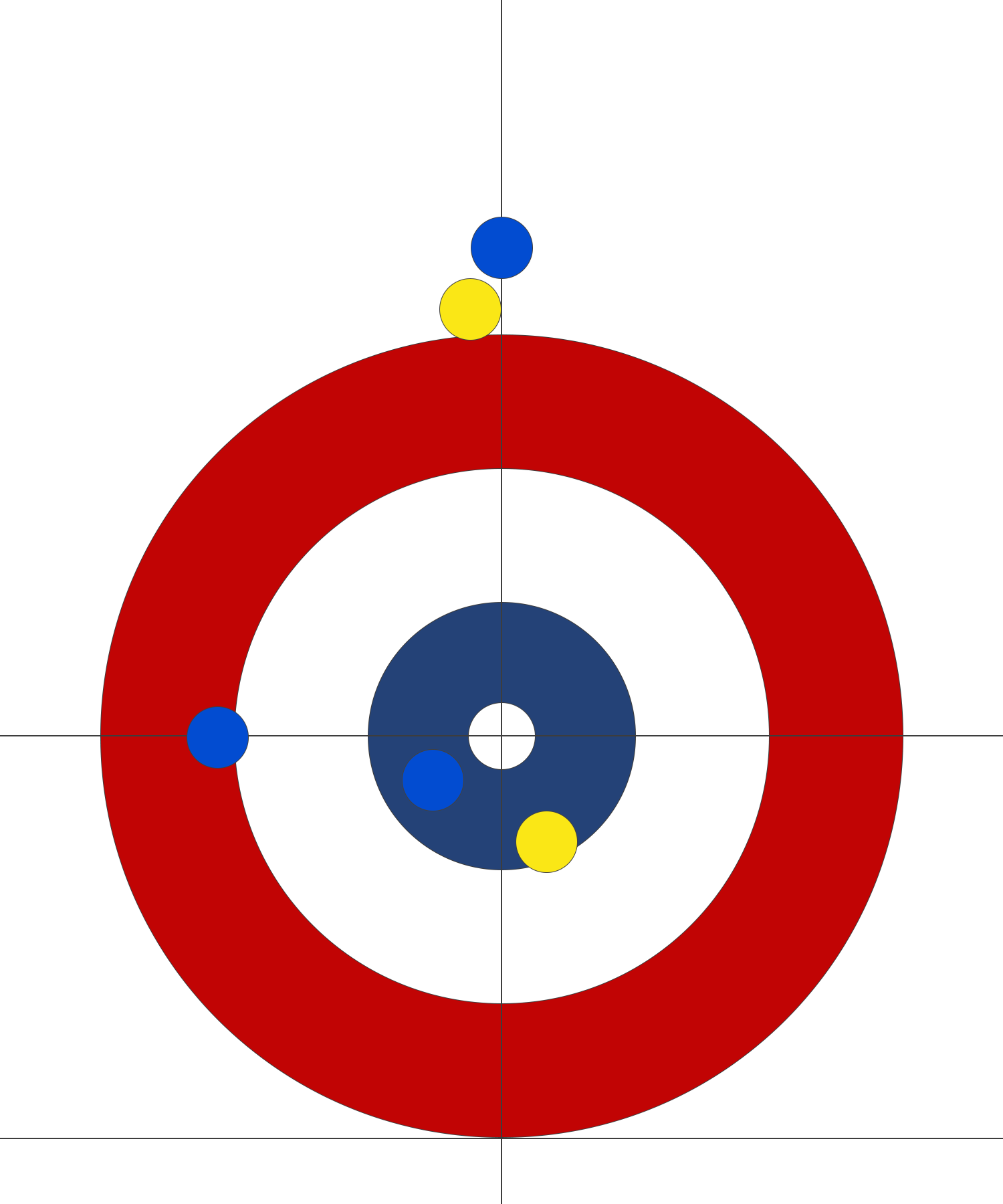
Although it's not impossible that by "going to play the guard" the commentator meant they were going to play the yellow guard, that is, try to chip the yellow guard and roll on, which is what they did; that's a slightly better outcome for a team that has the hammer (the last rock of the end), as blue apparently does, and it makes more sense that people would cheer this outcome if this is what they intended rather than if they meant to do the guard as shown in the middle image. Also, going for a guard and getting a chip and roll-in would be a pretty big miss, at this level.
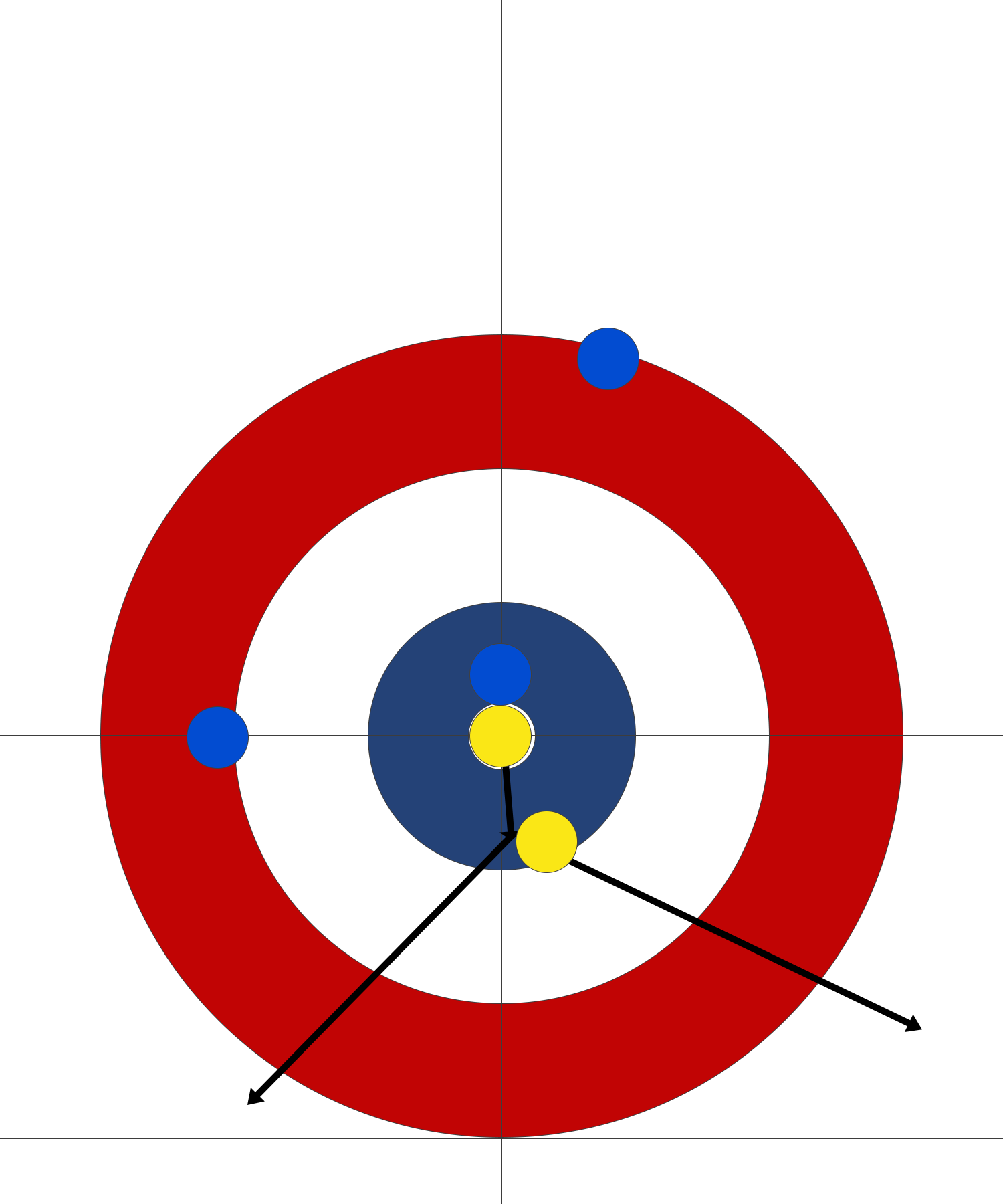
This is where the commentator says "So they have shot rock, but"—and we don't hear the rest of what he says, but it's a fair point, because what I would say is but they're pretty vulnerable, that is, yellow could relatively easily hit that blue counter out (left) and made blue take their last shot against three instead of against two (right).
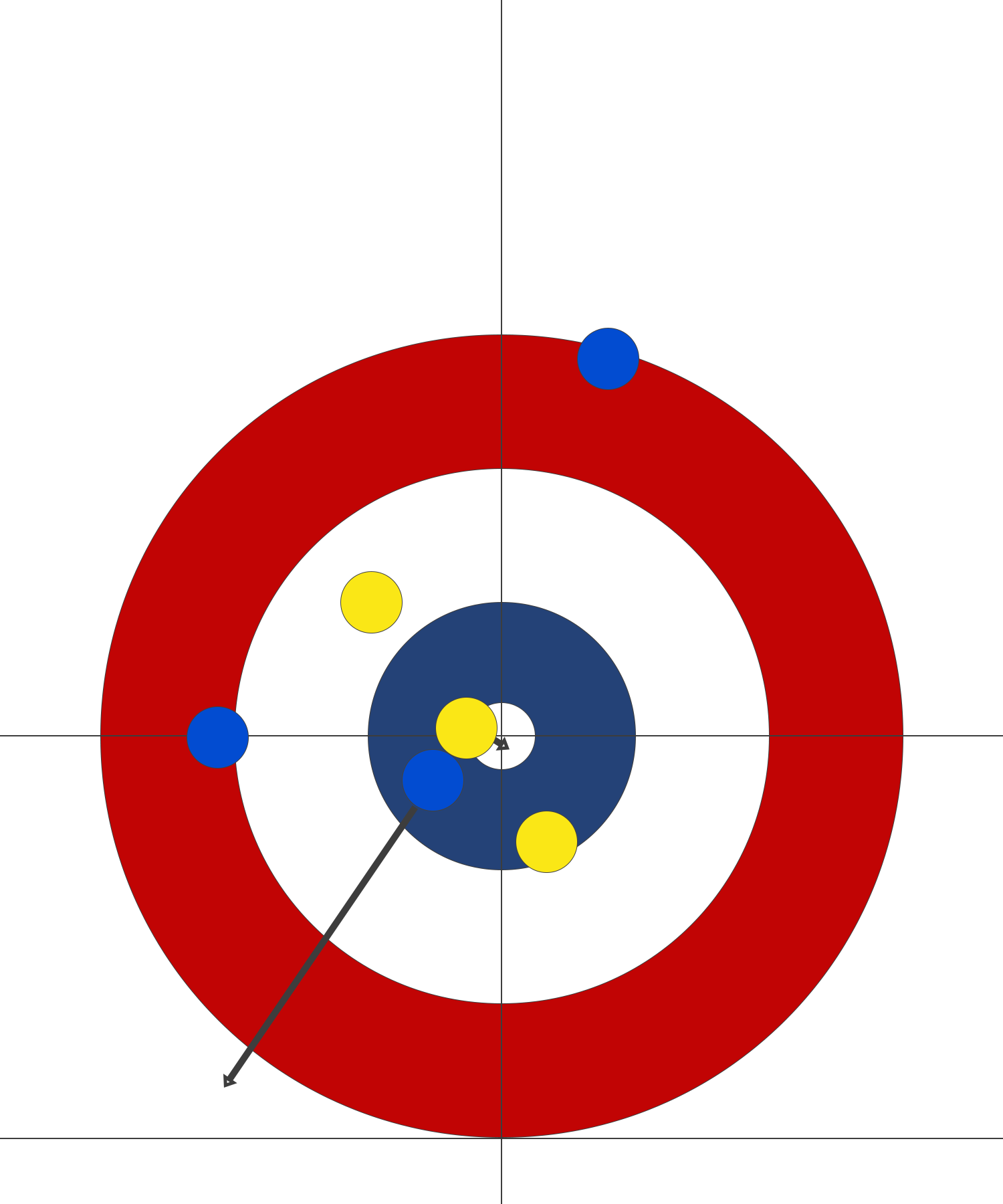
Instead of which, yellow, with their last shot of the end, were intending to put a rock outside the 12-foot and use it later on, which I guess means they were going for something like this (left) intending to hold blue to a single point? But alas they threw disastrously too much weight ("deeper than they wanted") and "knocked their own stone in the 8-foot out of position," which given what the house looks like when they're done can only mean they drove their stone from the eight-foot onto the blue one in the four-foot, it flopped onto the button, and they lost the shooter (right).
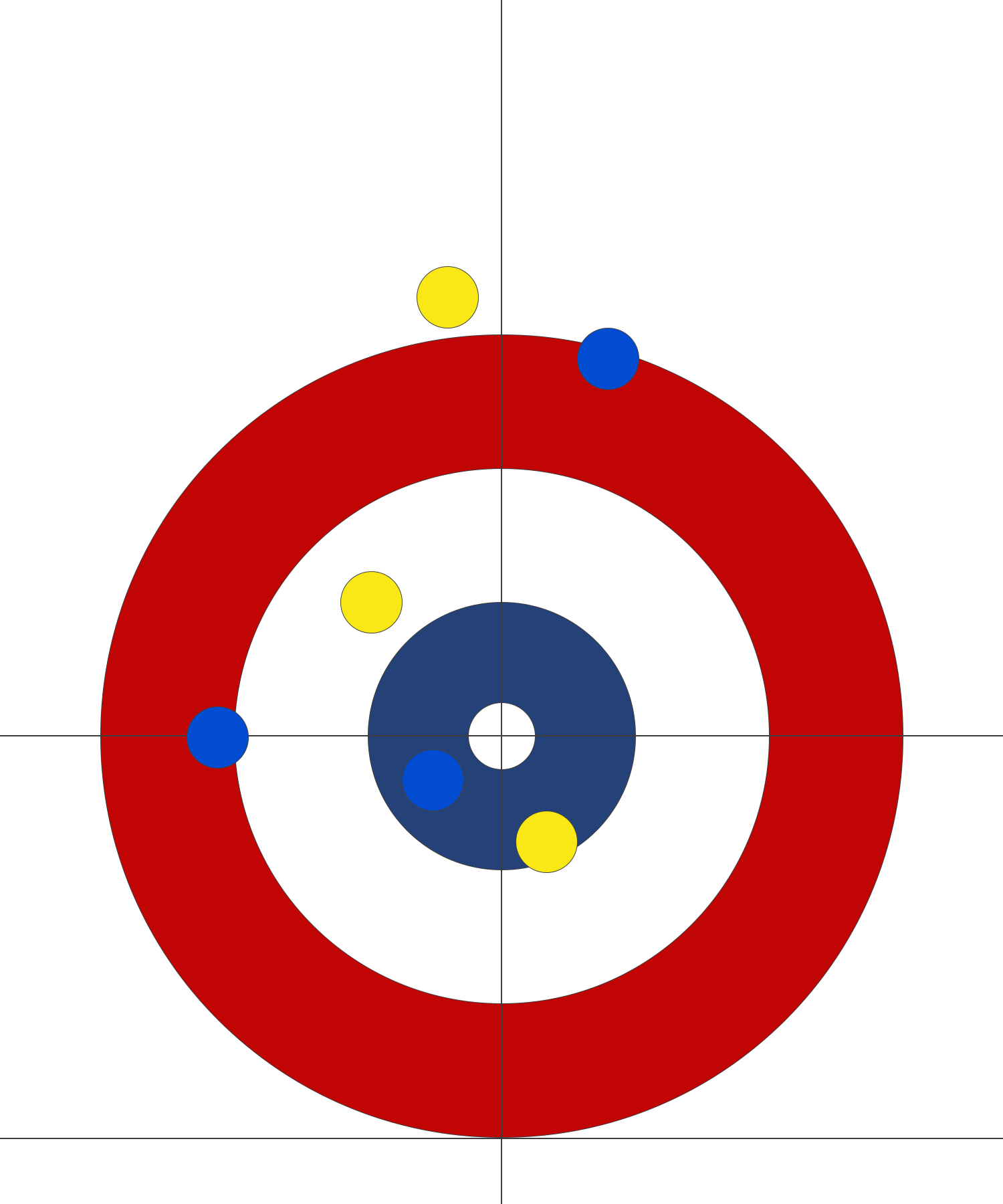
Their skip said "We're okay," but he had to know perfectly well he'd left blue a double for three.
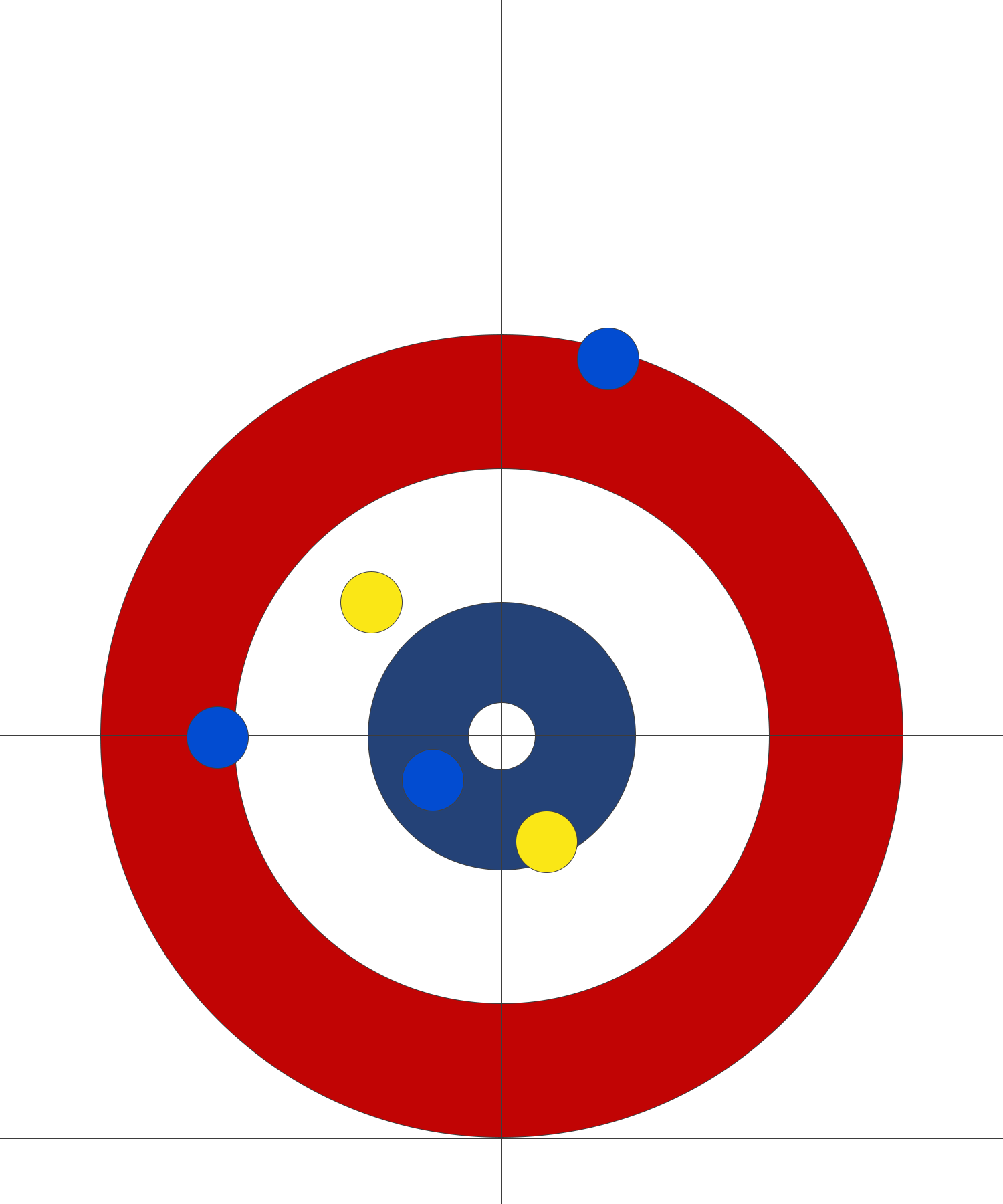
Which is where we came in. To remind: This is the house the blue skip was looking at when he got in the hack to throw his last stone.
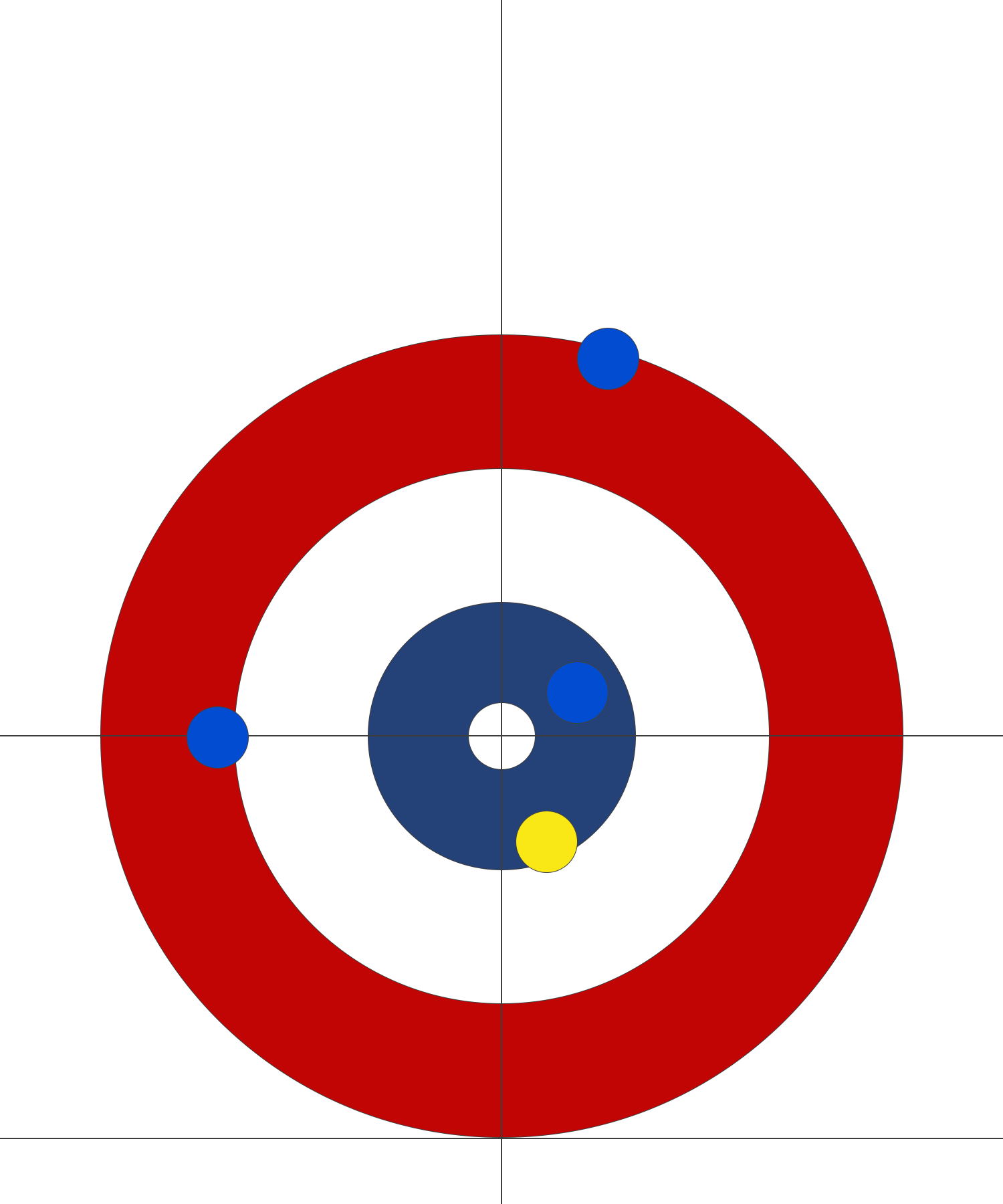
What he should have done is throw a rock relatively hard along or just to the outside of the center line (the left side of the center line, on the diagram; his right side, because he's coming toward us) with a counterclockwise spin on it—we can see that he's right-handed, which makes the counterclockwise spin his out-turn—so it would come fairly straight up the center line and just begin to curve toward the center line and punch the yellow stone on the button right on its nose so both yellows go out and he gets three points.
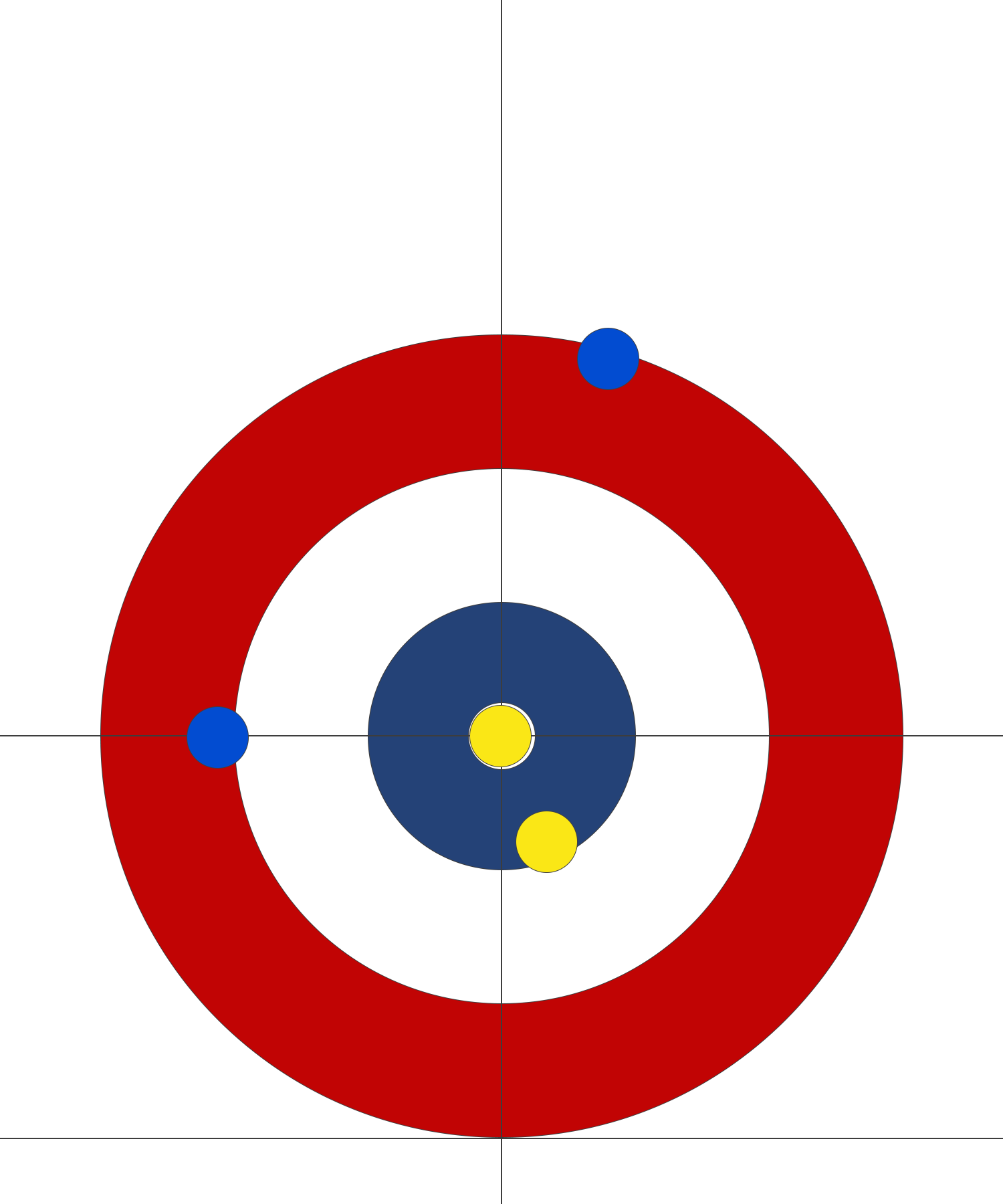
But instead he throws an in-turn (clockwise) more or less exactly on but regrettably a hair inside the center line (that is, to its right on the diagram), which I suppose is another way to get to the nose of that top yellow rock, but it doesn't get there, does it? It hangs on the center line—in fact the sweeper keeps it on the center line, where if he'd laid off it might have curled a bit—and hits the yellow one off-center, missing the back yellow completely and coming dangerously close to rolling away far enough that he gives up a steal of one.
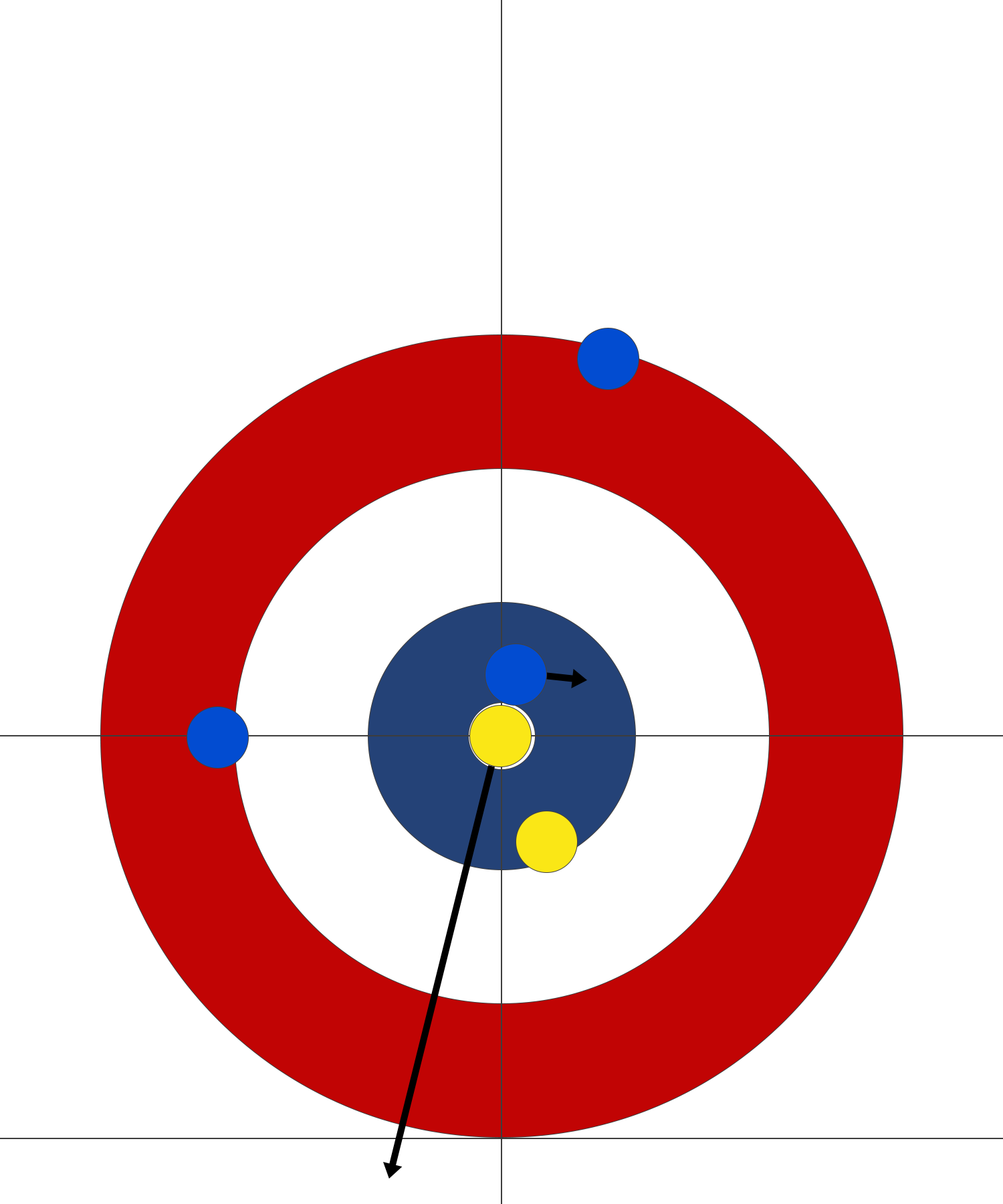
Now, the commentator said blue needed "at least one point" for something to happen, so maybe they're happy as long as they got any points at all and the skip knew something about the ice coming in from the outside of the center line or didn't feel good about his out-turn or what have you. But a single hit for just barely one when it could have been a double for three* isn't a "nice shot," no matter what the commentator says, and I'm disappointed in everyone involved in shooting this scene for not picking a better example of curling to have Turnbull introducing Kowalski to the game.
*Like I said, it's possible there are more guards further out front. So aaall of this explication assumes that neither team had to thread any needles to get those rocks where they got them. If there was a port blue might not have got through, then yes, that might well have been a very nice shot.
Anyway, curling is totally a sport, because despite what looks like the slow pace (which, as Turnbull said, hi, baseball?), the athleticism is very real, and the scoring is completely objective, and what more do you want in a sporting event? Kowalski can shove it.
( Scene 10 )
It sounds like the family in the conference room are speaking a tonal language, of which I have no experience at all. Is Fraser speaking to this woman in Cantonese? That's the only tonal language we've heard him use before (albeit badly, according to my native speaker contacts).
Cahill is much shorter than Welsh (but who isn't) and Fraser, so his spittle-flecked fury and invocation of U.S. victories in Grenada, Haiti, and Panama are pretty funny in a Napoleon-complex sort of way, although the events themselves are not funny at all. The United States invaded Grenada in 1983, ostensibly to protect American medical students there from being caught up in skirmishes between military and civilian groups seeking control of that country but in fact (as all the world knew) to chuck out and replace a Soviet-backed government they didn't like. Later, the United States invaded Panama in 1989, ostensibly to protect Americans living there and combat drug trafficking and money laundering but in fact (as all the world knew) to depose a dictator they didn't like. At least when the United States invaded Haiti in 1994 the action was authorized ahead of time by the United Nations and was taken to reinstate a legitimately elected president who had been ousted in a 1991 military coup. None of these small, developing Caribbean and Central American countries needed much of a U.S. push to get "knocked on their ass," as Cahill put it, and his suggestion that Canada—a highly developed country with an advanced economy and a better record on democracy and human rights indices than the United States—is a "pisspot" is of course preposterous.
Meanwhile, his mention of "this Marquess of Queensberry thing" is a reference to the Queensberry Rules of boxing named after the 9th Marquess of Queensberry, otherwise known as the father of Lord Alfred Douglas, Oscar Wilde's Bosie (himself an antisemite and a rotter, but I digress); this is a verbal disagreement rather than an actual fight, so Queensberry Rules have nothing to do with it, but I guess it makes a little more sense than invoking Robert's Rules of Order or any guide to parliamentary procedure Fraser might be more likely to be following?
At the time of this episode, the area that is now Nunavut was still part of the Northwest Territories, but the referendum to divide NWT and create Nunavut had passed years earlier and the April 1, 1999 date of establishment of Nunavut was approaching.
Again: Does Cahill think it's Ray Vecchio who's a mole, or "Ray Vecchio"? That is, apparently he, the occasional actual criminal, and Internal Affairs are approximately the only people in the state of Illinois who are not in on it. But either way, Fraser's loyalty to his friend is . . . what is it? Touching? Admirable? I mean: Fraser can safely assume Ray Vecchio didn't kill Volpe, because as far as he knows Ray Vecchio is in Las Vegas pretending to be a genuine Mob boss, not here in Chicago pretending not to be mixed up with the Mob. He's also taking Kowalski's word for it that he didn't kill Volpe, although all Kowalski has said is that he doesn't know who killed Volpe and for all he knows it could have been him. On what basis is Fraser so confident that Ray Kowalski, about whom all he knows is that he's a thrice-cited detective with no qualms at all about lying through his teeth (because that's what undercover work is), is not an informant within the police department for organized crime? Hmm?
The camera angles in this episode are sort of interesting. There's been a lot of shooting up from floor level. I continue to suspect the DP was just trying to make his own fun.
( Scene 11 )
Sigh. Ah, Bob. If only a fake town set up by a sympathetic Mountie and a court case funded by the relocation stipends were what had happened to the people subjected to High Arctic relocation.
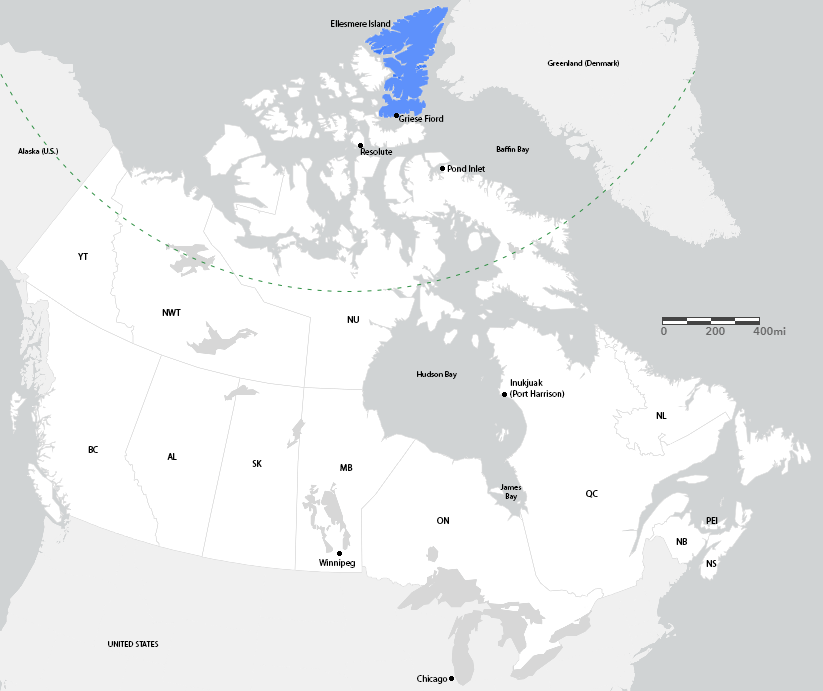
As the linked article says, in 1953 (which we have previously determined would have to be before Bob joined the RCMP), 92 people from seven or eight families in Inukjuak (then called Port Harrison), Quebec, and three families in Pond Inlet, NWT (now Nunavut), were relocated to Resolute and Griese Fiord—the latter of which is at the southern tip of Ellesmere Island—ostensibly because their current homes were no longer supporting their lifestyle but arguably because (as Bob suggests) the Canadians and the Soviets were up in territorial squabbles over uninhabited areas of the Arctic (which they still are, by the way, and the Canada Cup didn't solve much despite the USSR winning the second edition of that championship in 1981; it was only ever held five times in 15 years, of which Canada won the other four, before it was replaced by the World Cup of Hockey, which has been held even less regularly and often; at the time this episode was made it had been held exactly once and the United States had beaten Canada in the final, and the show curiously doesn't ever mention that) including the Northwest Passage, and having inhabitants there would strengthen the Canadian government's claims. The whole of Ellesmere Island is only 520 miles long, so the idea that eight years later Bob was instructed to relocate 32 families 500 miles further north is . . . well, that might have made a bad situation even worse?Canada established a Reconciliation Agreement and a trust fund to compensate relocated persons and their families in 1996, but its government didn't officially apologize for the High Arctic relocation until 2010. (NB: I am in no way suggesting that the United States has any stones to throw on the subject of (mis)treatment of Indigenous peoples.)
So let's review the Fraser Does Not Lie question, shall we? In "They Eat Horses, Don't They?" he promised Mrs. Gamez that nothing bad would happen, and then it did, which was not precisely a lie, because he wasn't the one who did the bad thing—but he shouldn't have promised such a thing if he didn't know it was going to be true. In "Pizzas and Promises," he was scandalized that Vecchio expected him to lie to people, but when he understood that it was the only way to solve the case, he did it (or tried; the lie didn't stay told for long). In "A Hawk and a Handsaw" he straight-up lied to Walter Sparks to get him to come in off the ledge; he apologized, but the fact remains. And in "Some Like It Red" he spent the whole episode lying to—well, to almost everyone, but it's Melissa who calls him on it, and he admits it but doesn't even apologize. (To say nothing of that time he was ready to chuck it all and turn to a life of crime, although the only person he actually lied to in that instance was himself.) So it's hard to say on what basis Vecchio (in "An Invitation to Romance" and "Vault"), Huey (in "Seeing Is Believing"), and Welsh insist that Fraser (or Mounties as a class, or Canadians in general) never, as a matter of policy, say anything that isn't true, especially when Fraser himself opened this episode by being slightly less than honest with Thatcher.
( Scene 12 )
Is it just me or is the show going out of its way to make Dewey unlikeable (or at least ridiculous)? I mean, it's a good thing Huey seems to get along with him, but.
( Scene 13 )
Milton Glaser (1929–2020) was a graphic designer who created, among other things, a poster for Bob Dylan's 1974 Greatest Hits album that featured a silhouette of Dylan with multicolored hair. The picture Fraser asks about as an homage to Glaser is a profile line drawing of a human face with a silhouette of what looks to me like a Belgian sheepdog on its head. The other pictures are in a variety of other styles; I can't quite see the first one Fillion gives to Fraser, but the second looks like an Escher print. I like that Fillion sends Fraser away with samples of his wares; it reminds me of the Egg Man.
Are we going to talk about the word "candyass"? It was famously heard on the Watergate tapes when Nixon asked someone what his Secretary of the Treasury thought he'd been appointed for if not to harass people on the White House enemies list (like I said: remember when Nixon was the crookedest U.S. president ever?), and clearly the use of "candyass" in the Oval Office was a deliberate Nixon-referencing choice in The West Wing s1e3 "A Proportional Response":
BARTLET: It's been seventy-two hours, Leo. That's more than three days since they blew him out of the sky. And I'm tired of waiting, dammit! This is candyass! We are going to draw up a response scenario today, I'm going to give the order today, we're going to strike back today.
LEO: I wish you wouldn't say him, Mr. President.
BARTLET: What?
LEO: "Three days since they blew him out of the sky." Of course that's fine while it's just you and me, sir, but in there with Fitzwallace and the Chiefs, I hope you say it or the airplane and not him.
BARTLET: You think I'm taking this personally.But I don't think it's probably a particular Nixon thing here.
( Scene 14 )
If Denmark is lying three and Canada does something that (a) is impressive but (b) Turnbull doesn't like to (c) force the game to extra ends, I'm . . . sort of not sure what it was Turnbull would have preferred? I also don't know why Thatcher is calling her office from her vacation at all, never mind in the middle of a massage. No wonder she's got so much tension, am I right?
I have no issues with Kowalski wanting pineapple on his pizza. I do wonder about the dress socks and garters under those jodhpurs and knee boots. I also wonder why neither Turnbull nor Fraser, who lives in the building, has a spare uniform on a hanger that Kowalski could borrow, as Vecchio did that time he disguised himself as a Mountie, rather than requiring Turnbull to donate his. Budget cuts, I suppose.
Nevertheless, I refuse to believe that WC off the conference room is the only facility in the consulate. Thatcher's office probably has at least its own powder room, and if they've got a regal suite they keep ready for the Queen, you can't tell me there's not a full bath up there.
( Scene 15 )
Huey and Dewey are speculating about Kowalski's exercise regimen (they do not consider more obvious options like, I don't know, an inherently speedy metabolism or a heroin habit). They are doing this rather than (a) pay attention—so they don't see him leave the consulate and walk right past them—or (b) prevent actual crime, such as Fraser being kidnapped at gunpoint in broad daylight. Well done indeed.
( Scene 16 )
Of course Kowalski wasn't asking what happened to Fraser's torn epaulette, was he. So we'll never know (a) how Fraser ended up under that bridge or (b) how he got away. Also, the police cars approaching at 122 kph are traveling at a little less than 76 mph. And maybe the upward camera angles were to get us ready for this hanging-from-the-ceiling moment. Do they do that? Foreshadowing with camera choices?Nowthen. More than 20 years ago, when I was in grad school, I took a course on linguistic typology in which I did some investigating of Inuktitut (investigating of work other people had already done, that is; I've never done any field work documenting languages no matter how many speakers they have). I no longer have any access to or even record of whatever books I was using at that time, but I did make a stab at actually translating what Fraser says to Diefenbaker.
Apparently there were original shooting scripts available online back then, which appears to be where I compared what I heard against what someone had written in by hand, "misspellings and all"—no idea why it would have been written in by hand if it was in the original script? maybe it was an annotation? so I have no idea how reliable that script/site/handwriting was at the time—but whatever site it was, presumably realduesouth.com, it's long gone. [Though still available at the Wayback Machine; why didn't I think of that?] So we'll go with what I hear as a very preliminary starting point, add that lost script as a useful input, and take my best efforts at translation with whatever book I was using then (I concluded: "Clearly this demonstrates the need for better Inuktitut-English dictionaries," which we sort of have now, the internet having proliferated since then despite also having suffered so much link rot) and the various websites I can find now (Inuktitut Lexicon Atlas; the Uqailaut Project; Inuktut Tusaalanga), and here we are:
FRASER: He likes the pizza. [to Diefenbaker] Savik. Akłunaaq.
KOWALSKI: Huh?
FRASER: [nods to direct Diefenbaker across the garage] It's Inuktitut. It's a slightly less complex language, easier for him to read.
KOWALSKI: What does it mean?
FRASER: It means, "fetch the knife from the hood of that car and apply it to the ties that bind us." Come on.
KOWALSKI: Come on.Diefenbaker brings the knife and places it in Fraser's bound hands. Fraser cuts the ropes and gets himself free, then kneels down to free Kowalski.
FRASER: [to Diefenbaker, while he's cutting Kowalski's bonds] Tuavinaluk uvani aqgutik nukatalik uukillu kisiani tikijjutituvik ijiqsimavik tavvanit qanuiqu naagit.
KOWALSKI: Meaning?
FRASER: "Hide."So okay. In the first place, I heard "Savik. Aklunat." and the long-lost script site had "Savik. Altuneat." There is no "altuneat" in any Inuktitut dictionary, and I definitely hear the hard sound (I have /k/, they have /t/) before the L sound rather than after it, and my way is closer to a word that does appear in those dictionaries, so I'm ready to call it and say the words are ᓴᕕᒃ savik 'knife' and ᐊᒃᖢᓈᖅ akłunaaq 'rope'. So Fraser's 18-word English translation isn't wrong, exactly, but it's amusing to suggest that he's conveyed all the same information in two words of Inuktitut that it took him a whole sentence of English to communicate.
The second line is harder, of course, because there's so much more of it. When I first tried to transcribe it, I apparently heard "uavinaluq ulaniakutit nukataililuqtilu kisiau vikiu tikuvit iksimavit tiavannit kannuiku mapit." The long-lost script site had "tuaviinnaaluk ullaniaqquht nuqqattailiutiiu kisiani tikiutiguut ijiksimavittavanunit qanuqunatit." I had some moderately interesting observations at the time about (a) how carefully actors pronounce things in languages they don't actually speak, (b) how accurately others of us hear things in languages we don't actually speak, and (c) how as a native speaker of English I really want words to max out at about three or four syllables (though that ties back in with item -a-, because I believe Paul Gross, also a native speaker of English, may have put some word-boundary-sounding pauses in places they may not have belonged.) In 2002, I believed the following:
'The first word has to do with a hurry or a rush; the -aaluk suffix means something I'm not familiar with. =->edited to add: am so. i knew it looked familiar. it's a reinforcer.
'The second word has me stumped -- but if I'm right and the script-transcriber is wrong (i.e., if it ends in -utit instead of -uht, which is a reasonable way a person might misread someone else's handwriting and which makes sense since there's no 'h' in Inuktitut), then it's a second-person singular intransitive verb. (Makes sense. Fraser's talking to Dief.)
'The root of the third word is mysterious to me as well, but the -taili- in the middle there means "avoid" and it's possible the -uti is reciprocal -- so whatever nuqqat- means, whoever it refers to doesn't want to do it to each other. :-)
'The fourth word, kisiani, means "only."
'The fifth word is another one I can't find; more precisely, I can find it but I can't find a translation of it. However, the ending -iguut marks the verb as first person plural intransitive: by this point Fraser's talking about himself and Ray. (I just don't know what he's saying, exactly.)
'The beginning of the sixth word, ijiksimavit, means "you are hidden." I'd guess the rest has to do with mood and/or aspect in some way.
'qanuq means "how." The rest of the word looks like a verbal affix and some other verbal paraphernelia; possibly "how you are" or "how you're doing it." Yielding:
'Hurry! You verb pronoun avoid verb each other (?) only we verb you hide ? how you do it.'All these years later, with different resources, I believe slightly differently:
- tuavi is the root meaning "hurry" and -aluk is an intensifier, so the first word is ᑐᐊᕕᓇᓗᒃ tuavinaluk 'big hurry'—I don't know where the 'n' in the middle comes from, because that's evidently not how Inuktitut does epenthesis—but there's no imperative anywhere on it, so it's not Fraser telling Diefenbaker to hurry and my 20-years-ago exclamation point doesn't belong.
- I think the second word may be a phrase—ᐅᕙᓂ uvani 'here' followed by ᐊᖅ aq 'arrive' + ᒍᑎᒃ gutik 'if/when 3PL'—but maybe it agglutinates all up into one word, ᐅᕙᓂᐊᖅᒍᑎᒃ uvaniaqgutik 'when they get here'.
- Digging into this bit took me most of my day off, and my confidence level is only about 70%, but I think what we're looking at is ᓄᑲᖅ nukaq 'younger sibling of a man' + ᑕᓕᒃ talik POSS followed by ᐆᒃ uuk 'try' + ᐃᓗ illu 'also' for a total of ᓄᑲᖅᑕᓕᒃ nukatalik 'my little brother' + ᐆᑭᓪᓗ uukillu 'try too' (or maybe 'keep trying'). There is no imperative on the verb, so I don't think Fraser is instructing Diefenbaker to try anything—and I'm not sure whom he's referring to as his little brother, but whether it's Diefenbaker or Kowalski, I'm pretty charmed by it. ❤️
- There is no dispute that the next word is ᑭᓯᐊᓂ kisiani 'only'. It's good for some things not to change. 😄
- The next bit took most of the rest of my day off. Ultimately I think we have ᑎᑭᑦ tikit 'arrive' + ᐅᑎᑦ utit '(two particles, -uti- and -t-, both of which mean doing something for or with someone else)' + ᐅ u 'be' + ᕕᒃ vik 'place where' resulting in ᑎᑭᔾᔪᑎᑐᕕᒃ tikijjutituvik 'go somewhere for (or with) me'. (Still no insight into whether he is speaking to Diefenbaker or about Kowalski here.)
- I feel better about the next bit: ᐃᔨᖅ ijiq 'hide' + ᓯ si (antipassive particle) + ᒪ ma 'be in a state of' + our old friend ᕕᒃ vik 'place where' = ᐃᔨᖅᓯᒪᕕᒃ ijiqsimavik 'hiding place'.
- Fraser's really filling the time while he cuts Kowalski free, is what's happening. I think the next bit is ᑕᕝᕙᓂᑦ tavvanit 'from here' (plus the with/for particle).
- I think the second bit from the end is ᖃᓄ qanu 'how' + ᐃᖅ iq 'no longer' + ᐅ u 'be' = ᖃᓄᐃᖁ qanuiqu 'what is no longer'.
- And the last bit may be ᓈ naa 'finish' + ᒋᑦ git IMP or it may be ᓇᑎᖅ natiq 'floor'. It still sounds to me like ᒪᐱᑦ mapit (or, for all I know, ᒫᐱᑦ maapit), but I can't find any word like that anywhere; -pit is a 2nd-person question particle attaching to consonant-final (except q) verb stems, so Fraser could be asking Diefenbaker, "Do you ?"—but I like the idea that it's ᓈᒋᑦ naagit 'make it so'. 😄
IN ANY EVENT, in contrast with the two words of Inuktitut/18 words of English, this is between nine and 11 words of Inuktitut/one word of English, because Fraser says that whole lot means "hide." Which is what it boils down to, of course, but taken all together it apparently means something like "They'll be here soon, buddy, so we'll all just find hiding places to begin with." Also, hasn't Diefenbaker been reading not just Fraser's spoken English (a skill he picked up on his own) but also written words for many years now? Why switch to another language at a time like this?
There are apparently some variations among Inuktitut dialects in terms of voiced, unvoiced, and fricative consonants, and maaaybe between q and k (especially in transliteration), but not between q and t, so the differences between what it might sound like Paul Gross says and what I think the words might be will have to be ascribed to something else. Fortunately the difficulty of distinguishing stop consonants when you can't see the articulator is fairly well documented. (I can't find it right now, but there is definitely a video where the speaker repeatedly says something like "tick" but the subtitle says "kick" and it isn't long before it really sounds like that's what they're saying.)

( Scene 17 )
( Scene 18 )
Fraser's office looks smaller every time we see it, like the trash compactor on the Death Star.
( Scene 19 )
Tibbet's gym has a confederate flag on the wall, and the scene doesn't get better from there. We have a loose cannon who has already shot a kid and is now back out on the street (welcome to Chicago), and who got a tipoff from someone who works for Cahill that the Volpe-Vecchio meet was going to take place. The only positive thing I can say about her is that she was set up, too.
( Scene 20 )
Are Huey and Dewey simply naming all the kinds of exercise they can think of?
( Scene 21 )
(OC = organized crime.) The way Kowalski is so down on himself he doesn't see why anybody would think well of him. 💔
( Scene 22 )
So Cahill is about to do something extremely public and Fraser is lying in wait. This ought to be good. Meanwhile, how long has Thatcher been gone? Only a day, right? Or has it been two days? A whole weekend? (She took two pretty big suitcases with her in scene 1. It's surprising to me that she's back so soon.)
Meanwhile, the reporter's name is Shelley Byron, and it's like the writers' room isn't even trying anymore.
( Scene 23 )
Fraser's been reading a fair amount of Agatha Christie, apparently, and getting his Poirot on, but I don't feel like Cahill's hollering "that's evidence!" is the admission of guilt that Fraser and, crucially, Cahill seem to think it is. Is anyone else puzzled by Cahill's sudden need to flee the media attention he brought to this situation in the first place?
Also, I'm still stumped on the Kowalski of it all. If Fillion and, especially, Herndorf have met Kowalski before, as they seem to have done, why are they just going with it when everyone's talking about Ray Vecchio? I mean to say, this is the converse (or obverse) of the problem Fraser was having at the beginning of this season, where he was expecting Ray Vecchio and got Ray Kowalski and couldn't understand why everyone was calling the latter by the former's name. I don't know about Cahill and Kilrea, and apparently Sandor the pizza guy is cool, but I feel like Fillion and Herndorf know Kowalski and would be surprised to hear everyone pretending he was someone else.
I think the fact that millions of people were watching did hurt O.J., contrary to Cahill's claim. In case our younger viewers missed the reference, in 1994, retired football man O.J. Simpson was charged with the murders of his ex-wife and her friend and agreed to turn himself in but instead led the police on a long and extremely widely televised low-speed car chase before he was finally arrested. He was eventually acquitted in criminal court, which is probably what Cahill means when he says the publicity "didn't hurt" him, but found responsible for the deaths in the later civil trial.
( Scene 24 )
Except for the sock garters, Turnbull doesn't seem to be off the hinge at all in this episode, just overwhelmed.
( Scene 25 )
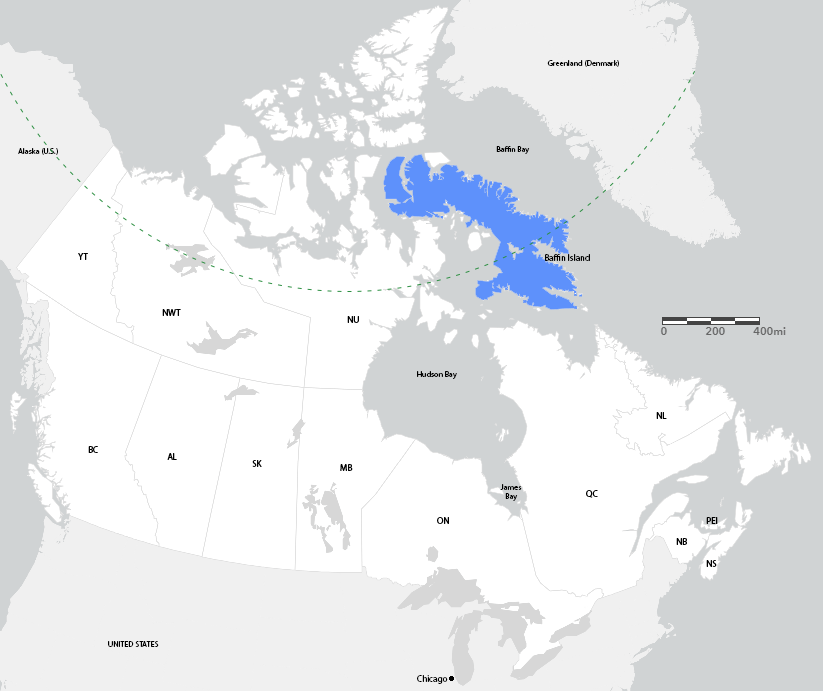
You'd think Fraser would be thrilled to be transferred to Baffin Island, except that apparently he still doesn't want to leave Chicago at this time? Interesting.
( Scene 26 )
I'm also interested in Joe, hanging out in Bob's cabin. Like I get it, I can recognize that the Bob-as-Fraser's-own-subconscious thing they were pretty careful about in the first two seasons is going by the wayside and we're getting a lot more mystical with Bob from here out? But I liked Bob as Fraser's subconscious, dammit, and I want to keep digging in to what it means about Fraser's subconscious that there is a dude he has never met before warming up by Bob's fire while Bob isn't even home. Is Joe in some way connected to Bob's fictitious town up at the northern end of Ellesmere, that is, Bob helped him out in a similar way to how Fraser helped out Kowalski in this episode? Is he some kind of ghost subconscious stepdad? What's going on here?
Cumulative body count: 30
Red uniform: The whole time, plus bonus Kowalski in the red uniform as well